The Paradox of Love – Joan and John

This is my second post in a series about the paradox of love. It is a little different in that it’s about a man I’ve met, and a couple in love. I’ve included two of his poems.

Let’s answer this question: What is the best hoped-for outcome of any relationship?

Even Grimm’s Fairy Tales don’t finish with the “and they lived happily ever after” fantasy. The best we can hope for is, until death do us part. Barring the end of the movie The Notebook, murder-suicide pacts, or certain accidents; someone gets left. And we are often made miserable by our loss, about being left without someone we love, or about how that happened.

I don’t know John Gorow well. We attend the same writer’s group. John’s an old timer in the group; I’m new. He agreed to allow me to publish the story he related to me, and the poems he wrote. It is a remarkable and inspirational story. His poems are wonderful.

Joan and John Gorow met in 1969, when both were recovering from divorce. Prior to their marriage in 1972, Joan told John that she had been diagnosed with Multiple Sclerosis (MS). According to John, Joan’s health setbacks did not begin for about 28 years. Since 2000, her MS was a problem. Then came breast cancer. While treatment led to a full recovery, a Parkinson’s diagnosis soon followed, in addition to her worsening MS.

For approximately 15 years, John was Joan’s constant companion and full-time caregiver. As Joan’s health continued to deteriorate, the burden on John increased. In response to that challenge, John wrote the following beautiful, heart-wrenching poem.

***
CAREGIVER
by John Gorow

Time moves on
Inconvenient impairments become life altering
Legs don’t do what she wants
Hands have difficulty holding things

Normal chores are no longer normal
Cooking becomes dangerous
Washing dishes is impossible
Clothes can’t be carried to the washer while using a walker
The vacuum can’t be pushed
Self-worth begins to fade.

The one who has been cared for must now give care
She has cooked for me
It is my turn to cook for her
She washed our clothes
I will do the washing
She kept our home clean
I will try my best

It is assumed we all can dress ourselves
That is no longer true
Showering on her own can’t be done
No more going to the bathroom by herself

Memory slips – confusion arrives
What day is it?
Where are we?
I need patience
We talk, and then we laugh – I cry on the inside

Kids tell me to get help
I finally do – one day a week
Who is it harder on – her or me?
I get some freedom – she does not.

Caregiving is tough
Better than the alternative
I want her as she was
It will not happen
But then again, I do have her

(October 17, 2013)

***

Seven months ago, on October 22, 2016, John no longer had Joan with him. Since then, John has suffered and struggled with his pain. He wrote the following poem to directly address grief in response to the prompt: what brought you to your knees? In the fifth stanza, he directly addresses the paradox of love, vis-à-vis his grief.

***

GRIEF
by John Gorow

Who are you, grief?
Why do you pester me?
You have dropped me to my knees.

I knew I would have to deal with you,
But is it forever?
You keep lingering in my life.

I think you may be gone,
Then you grab me once again.
My laughs turn into tears.

Others have told me about you,
But you don’t behave the same with all.
I can’t determine when you will rise again.

What a paradox.
I have tried to hate you,
But without love you wouldn’t be here.

I know we will take the rest of my journey together,
So I must accept you.
That acceptance will be slow.

You should know
I will no longer dread the tears you bring me,
You will need to accept that.

You can stay with me,
But I will slowly rise from my knees.
I will move forward, but not forget.

(May 18, 2017)

***

I want to close this post with the same line John ended his email to me. It’s a beautiful one-line poem of five words.

“I miss her very much.”

***

As we look both ways and mind the gaps,
let’s not forget that some of us are suffering.
Let us love and support each other, and at all times, let us cherish those we love –
paradox or not.

 

From Pleasure, Pain

This is the first in a series of blog posts about what I see as the paradox of love. This essay is my answer to the prompt, what has brought you to your knees? I’m not sure where I’ll go with this. Maybe you can help. Ask me questions, or prompt me in some direction. Please keep in mind, this is merely my take. Feel free to provide yours.

Nothing begins, nothing ends,
that is not paid for with moan;
for we are born in other’s pain,
and perish in our own.
~ Francis Thompson

Twenty years ago, I started using the phrase it’s all about how we feel. Normally, I’d caveat such a mantra by claiming it only applied to people without mental health issues. In this case, I think the words apply universally. How do you feel?

Love is the highest standard we have for caring about others. In literature, movies, music, religion, and in our daily lives; our obsession with love is obvious. It’s poorly defined, extensively written about, and grammatically misused; but love is everywhere in the English language. We want to love and to be loved. It’s our ultimate pleasure. How sweet love is.

I embrace love, but I fear pain. Pain can take over my body. Excruciating physical pain has brought me to my knees. It’s absurd that such pain may be helpful as it travels my nervous system from its source to my brain. Pain is abnormal. Even though we all experience pain, it’s not supposed to be there unless something is wrong. Pain is a symptom more useful to doctors than to me.

As bad as physical pain is, emotional pain is more devastating. In extreme cases, mental grief often leads to thoughts of suicide. In physical pain I might say, I want to die; but, I never intended that. I only wanted the pain to stop. On the other hand, people in emotional agony can be dangerous.

Our vulnerability to emotional pain is greatest when we love someone. When we love another person, we grant that person more power over us than any god or demon. Still, we choose to love. Not just willingly, but aggressively with passion and desire. Why? It’s like we can’t live without it. If anyone does live without love, we consider that sad and dysfunctional.

Love has brought me to my knees in two ways. First, the wondrous and joyful pleasure of experiencing love has led me to my knees with happiness. Be it romantic love, love of parents, love of children, grandchildren, or friends; the wonderful state of love takes away the dark and gives light.

Second, love has dropped me in pain, in fear, in a depressingly dark, hateful passion. Love betrayed leaves behind lifelong scars too deep to ever completely heal. The end of a romance, the betrayal of a friendship, the dismissal of a parent we love, the suffering or death of a child; each of these may, and perhaps should, put me on my knees. Such pain and agony from the dark side of love makes me question the value of life.

There may be recovery or even pleasure at the end of the tunnel. Time may mend love betrayed. Still, our human nature forces us to look back into that dark tunnel, into that abyss of pain and suffering. We remember. Do we dare to ever again risk pain by making ourselves vulnerable? Do we face the agony of finding ourselves desperately miserable because we loved?

Why do we do it? Would you, could you, live without love?

That’s a paradox of love. We know the risks, the vulnerability, and the potential to suffer. And yet, we still seek out love and take the risk. How do you feel now?

Even when we look both ways and mind each gap, we will experience pain in life.

“The truth is, everyone is going to hurt you.
You just got to find the ones worth suffering for.”
― Bob Marley (20 years after his death, which means he never said it. True, nonetheless.)

The youtube poem below is worth hearing/reading, and I think the Love Hurts song by Nazareth is worth a listen.


V – Vexfest: Different Stereotype (NaPoWriMo #26)

I sort of got the idea for this from another A to Z blogger, Sandra of What Sandra Thinks, specifically her Bitchfest 2017, where she adds “special touches of sarcasm, darkness and foul language.” Since I find her humor refreshing, I decided to take a similar, but more serious, path.

Vexations create a state of being annoyed or frustrated. I confess that during my life I’ve been guilty of many of the things I find vexing. My greatest frustration may be my own human condition. We have many words devoted to being pissed off. I am not the only one.

***

Vexatious Me
by Bill Reynolds

With all the natural evil that be,
I am most troubled by
The moral evils that I see
Placed peeps on peeps. I’m vexed and…

Affronted by unfair stereotyping,
Aggravated by sense of entitlement,
Angered by any amount of animal abuse.
Annoyed by the foolishness of youth,
Bugged by too much welfare abuse,
Bent out of shape by all the bullies,
Disgruntled by job discriminations.
Displeased with wasting time, including mine.
Embittered by lost love.

Enraged by abuse toward women.
Exasperated by flawed governance.

Frustrated by incompetence, especially mine,
Furious over child abuse, anywhere, any time.

Indignant over unjust justice.
Infuriated by big black lies, also
Irked by little white ones.

Irritated by misunderstandings and
Miffed by gossip for fun and pleasure.
Offended by those too sensitive,
Outraged by starving children.
Peeved by human weaknesses, yet
Piqued by those better than I.
Pissed off when treated unfairly, and

Riled by my own pride.

Worried that nothing will change.

***

I failed to mention other drivers (texters, Beemer drivers, and Mercedes too), the wealthy, other people’s kids and dogs, and the folks who work at the driving license places in virtually every state. Also, virtually anyone who disagrees with me about nearly anything at all. And then there are people who are more vexatious than I.

Relax and go with the flow. We’re only human,
but let’s look both ways to enjoy the view.
Mind the gaps my friends, lest you get too twisted.


T – Tercet: In Real Time (NoPoWriMo #24)

The tercet is a poetic stanza of three lines with a rhyme. While there is no specific rhyme scheme necessary and some even venture into free verse, I prefer to not to dig in unplowed turf. However, I did play with this and came up with rhyming lines one and two in each stanza, and using mid and end line rhymes in line three: aab2, bbc2, etc.

***

In Real Time
By Bill Reynolds

Not to be seen, heard, or specifically smelt.
We know it’s there, cuz experiences felt,
No gods can stop it, no power to quit.

Some sew it wisely, while others just wait.
The outcome’s the same, we share the same fate.
Fight back as we may; that is only delay.

Wind we can feel, the rain we may taste.
But the passage of time, we have little to waste.
Let’s consider the past; make choices that last.

Perpetually running, it passes in silence;
Everything changes, nothing is timeless.
Reality speaks loudly, but time passes proudly.

***

Thinking of time, be looking both ways.
While minding the gaps, watch only today’s.

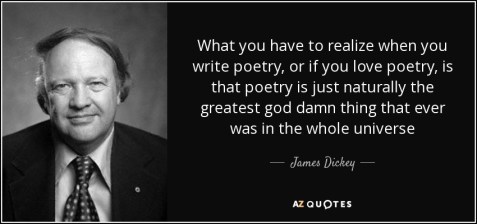
P – Poetry: The Greatest God Damn Thing (NaPoWriMo #19)

What do I believe?

The title of this quatrain poem is taken from a New York Quarterly, ‘Craft Interview’ with James Dickey, as quoted in the Introduction to The Art of Poetry Writing by William Packard. I’m new to poetry writing, but I have always loved it. Thus, I concur with Mr. Dickey’s assessment.

***

The Greatest God Damn Thing
by Bill Reynolds

Beating hearts bring words as rhythm flows,
the brick and mortar for posing forms.
They come to me in words of prose.
I wrangle with words to bring the storms.

I feel the beat as I tap my feet,
I catch the bop and I keep the time.
My world finds rhythm to keep the beat.
I seek my Po-voice and find the rhyme.

Mind and spirt bring forth my emotions.
Poetic verse grows as I now can hear it.
Out of me come plans and potions.
The poem I’ve written is part of my spirit.

The pleasure I found in hearing the sound.
My voice is here and my voice is there,
My emotions can show a feeling we share,
My poem’s my gift to everyone around.

**

Read, write, and love poetry silently and in several voices
as you look both ways on the highway of life.
See and hear all the rhythm and rhyme.
But, mind the silence of the gaps.

***

I agree — Naturally

Poem: Ordinary Bagatelle

This poem is to appreciate the beauty of simple, ordinary, normal things. A bagatelle is a small thing, something of little importance, a trifle. A demoiselle is a young lady. Vapid means lacking liveliness.

Beautiful Simplicity

Fear not. The simple’s no beast. 

Appreciate the trifle, the tad and the bit.
The fortuneless, the ordinary, the nothings of wit.
Care about the underdogs, the lonely and poor.
Acknowledge the average as part of the tour.

Perk up, dear sweet passé bagatelle,
Deserted and lonely, a crumb of demoiselle,
Desiccated prune mocked as less worthy,
by those who unkindly, do not prefer thee.

Yes, you are shallow and vapid to some.
As a threat to no others, are you liken to none?
Our joy is in knowing the small we still see.
No danger to us, as you let the world be.

Let the worldly and wise have their just due,
Yet forging the lesser means forgetting them too.
The great and the small are part of it all.
So, sing a wee tribute, give the trifle a call.

There’s enough for each at this glorious feast.

Simply look both ways and mind the gaps.

Battling Bastards III (Ben Steele)

Reading or writing about events like Bataan, we often focus on man’s inhumanity to man – that dark side of our nature, which we often shun until memoir time. Throughout known history, our capacity for cruelty is well-documented. Genocide (killing to eliminate a group, race, ethnicity, religion, or language) is too common. While respecting victims of atrocities, I want to focus on survival, with one survivor in mind.

Ben enjoying it.

When survivors tell their story, they become windows to history, guiding and motivating our chant of never again. From their dark stories, we learn to prevent future atrocities. On the bright side, survival stories are inspirational. What others endure, survive, and subsequently achieve are symbolic of human resilience: that remarkable human physical and spiritual asset.

I discovered Benjamin Charles Steele long before I met him, as I was feeding my curiosity about Bataan by reading books. I only read five. “Only,” because so many books and articles have been written about the Death March, many by survivors or their families.


One of those books, Tears in the Darkness by Michael and Elizabeth Norman, focuses on Ben’s story. While the Normans included much more within the pages of their ten-year project, they trace Ben’s life experiences, particularly during the war years. I recommend it.


My signed copy

Born in 1917, Ben Steele grew up on his parent’s Montana ranch. The family lost the ranch during the Depression Years, when he was about 15. Ben continued to work as a ranch hand, which interrupted his education several times before he finally graduated from high school in 1939. The following year, Ben joined the Army Air Corps. Eighteen months later he was a prisoner of war (POW) in the Philippines.

Ben may have developed a passing interest in art when had delivered art supplies. But, he had little exposure, and no formal training. Ben received his formal art degrees after the war.

For much of his early POW time, Ben was ill (Beriberi, dysentery, pneumonia, blood poisoning, and malaria). He worried about adding mental illness to the list, as so many others had. So, he began to draw. Risking severe punishment or death to stay sane, Ben started a self-prescribed therapy to fight off life-threatening melancholy. He had seldom drawn anything during his life.

Feeling guilty about my unused art supplies.

Unknowingly, from his sick-bed in the wretched Bilibid Prison, he was launching a seventy-four-year, successful art and teaching career. This late high school graduate, Army enlistee, and future college professor, was barely hanging on to life. While starving and hardly existing in some of the bleakest living conditions imaginable, Ben used charcoal and sticks to do his first primitive drawings.

“I used to sit there day after day. I thought I’d lose my damn mind. I wanted something to do, so I started drawing with anything I could find to draw with. I’d draw on walls. People around me said, ‘Why don’t you draw the guys? You know, there are no photographs taken of this stuff.’ So, I started drawing stuff around the camp and sketches of people and portraits as close as I could. I wasn’t very skillful.” ~ Ben Steele

Eventually, Ben was moved to mainland Japan where he worked as slave labor in coal mines. The only two of his original drawings to survive the war were done there. The original drawings he did in the Philippines were in the possession of a fellow prisoner, catholic priest, and army chaplain, named Father Duffy. When the ship Duffy was on sank, the drawings ended up at the bottom of the Pacific Ocean. A few years later, as he recovered in a Spokane, Washington, hospital, Ben reproduced his lost drawings from memory (part of his therapy).

When the US dropped an atomic bomb on Hiroshima, Japan, Ben worked 75 miles south. He heard the blast. Soon the war ended. Ben and others were on the road home and toward recovery from the three-and-a-half-year ordeal. Ironically, some survivors eventually fell victim to mental and emotional problems resulting in suicide, death from substance abuse, or other such maladies. However, most survived, and I was fortunate enough to meet some of them.

Once a cowboy….always…

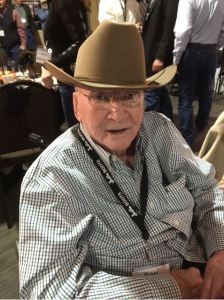
When Ben’s art was displayed in a building on White Sands Missile Range in 2011, I was there for my last Death March. By then I’d read Tears in the Darkness, and other books about Bataan. So, I knew Ben’s story.

When I went to see the art the day before the March, Ben was there. His daughter was escorting him in his wheel chair – he was 93. We shook hands. He signed my book about his art and we talked, mostly about his life as an artist.

I immediately knew I was talking to a Montana cowboy, who happened to have been a POW, college professor, well known artist, an American hero, and a witness to much about life’s realities.

At his core, this happy man who was pleased with life and was the same cowboy who joined the Army Air Corps 71 years earlier.

“Little things that probably bother a lot of people don’t bother me. I figure I’m probably living on a little borrowed time, and I’d better enjoy it!” ~ Ben Steele

Another WWII veteran I knew, Joe P., said virtually the same thing to me last year. Both men died in 2016, in their late 90s after living full and happy lives. Perhaps their life choices were reflected in the last three words I quoted from Ben, “…better enjoy it!”

Life has its ups and downs; reality in art, literature, history, and personal stories enable us to look both ways, to the dark, or to the light. Enjoy life, but mind the gaps.

The Summer of ’59

Facing the Dark Side

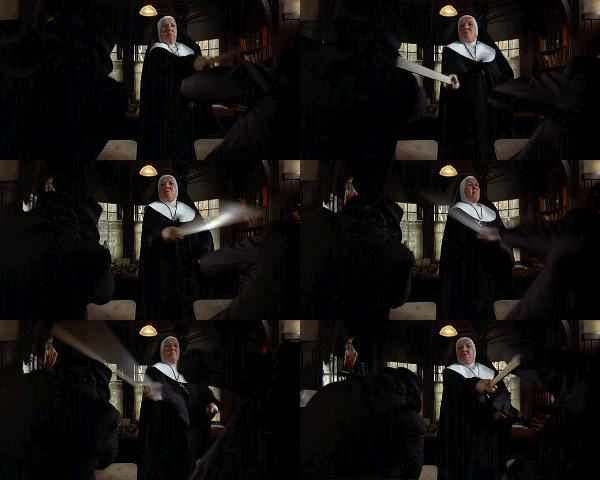
When I was in the sixth grade at my Catholic school, I dreaded being promoted to seventh grade. Sister Mary Scary taught seventh grade. That nasty creature who floated around Saint John’s wearing Rome’s version of a burqa, but used a white frame to emphasize a face that was perpetually angry, who posed as a Catholic nun but was really the Wicked Witch of the West. That daughter of Satan himself, would have complete control of my life from eight to three every weekday, plus an extra hour at church every Sunday and Holy Day of Obligation, when I would be forced to sit, kneel, or stand to watch men and boys dressed in feminine garb prance, kneel, sing, pray, and read in a dead language of which I understood nary ten words.

Saint John's Church and School
Saint John’s Church and School

Mom and Dad were delighted in June of 1958, when I handed them my report card with that depressing word emblazoned on the back cover: “Promoted!” To me, it said, “sentenced to nine months of suffering in Purgatory at the hands of evil.”

I worried all summer. My friend, Jimmy, who was a grade ahead of me reported the horrible carnage that he and others had endured at the hands of Lucifer’s daughter. Whatever the version of depression a 12-year-old boy could encounter, I’m sure I had it. Never, have I wanted a summer to pass more slowly.

My parents always supported authority over me. The nun, teacher, priest, cop, drunk adult, irate neighbor, or neighborhood tattle tale was always right. Ok, occasionally, they really were right. But from my point of view, my parents should have supported me – their son who they claimed to love. I could not discuss my fears about the nun with my parents.

My siblings had the “we survived, but you probably won’t” attitude and said as much. However, my older brother, Danny, did have some advice for me. “Be an altar boy. They like altar boys,” he said. That made sense to me. I would play their game to survive.

Survival

I worried enough about Sister Scary that I managed to get through seventh grade with minimal physical damage and mental distress. I passed academically, and I was home free. This time I was even more pleased than Mom and Dad that I was not held back. I had not shed one tear. I was doing well. My eighth-grade teacher was to be Sister Mary Wonderful, who was also the school Principal. Life was good again.

Toward the end of seventh grade, I was finally approached to join the exalted and glorious ranks of the chosen ones. I was asked if I wanted to be an Altar Boy. All my friends were becoming Altar Boys, and I wanted to be one, too. My brother, Danny, had been one, and it was what good Catholic boys did.

Altar Boys
Altar Boys

I accepted the offer from the Father O’Burts, logically assuming my parents would approve. I started learning the Latin prayers and talking to other boys about the process and the job. I was happy about it. My plan for eighth grade was to be one of the chosen. I even signed up for the school basketball team. I didn’t play well, but I was the tallest boy in my school. I began to look forward to my final year at Saint John’s.

Not So Fast

Then, as the skies darkened again, I had the familiar bad feeling. As September and the start of school approached, there was a shockingly frightful rumor. Sister Wonderful was being transferred, and Sister Mary Scary, the evil antagonist of my short life, was being promoted to school principal and would be moving up to teach eighth grade.

Oh, dear God, No! I was supposed to be done with her. But as every dependable source, including the church bulletin, soon validated, ‘twas da troot. The second coming of the Inquisition had been promoted to Principal of Saint John’s elementary school, and would teach 8th grade to my class. I knew that I could not survive another year. My only solace was knowing that, except for a few favored girls, the rest of my classmates were as upset as I was. The Altar Boy gig became critical.

Say What?

So then, still expecting them to be pleased with the news, I decided to tell my parents that I was to be an Altar Boy. I expected them to be proud, if not overjoyed.

I was happy when I walked into the kitchen and sat down for dinner. She was at the sink behind me. “Mom, guess what? Fadder O’Burts as’t me ta be an altar boy. And I’ma gunna do it, too.”

I turned to look at Mom, smiling and all full-of-myself, at first. Then, severe shock set in when she turned and said, “No yer not!”

Dad looked up and added, “Like Hell, y’are! Yeh kin get dat idea outa yer thick skull right now.”

Dazed, I needed something quick – a prayer, to get sick, perhaps a deadly disease, anything. Desperation was overcoming me.

I was unaware that when Danny had been an Altar Boy, it was not a good experience. The logical consequence, of course, was that I was not permitted to follow, and my parents did not give one inch. Nor did they tell me why I was being denied my only hope to survive nine more months of the Black-veiled Horror. Today, I am glad that I was not part of that Altar Boy thing, but at the time, it was the worst possible news.

Option Two

Quickly, I changed the subject. “Mom, Coughlin is 7th through 12th grade. Can I go there for 8th grade? I’ll be starting there fer 9th grade and high school the next year, anyway.”

She didn’t even look at me. “Now, Billy-boy. Why’d ya do dat? Jist graduate St. John’s then go to high school like your brother and sister did. After I see ya graduate Saint John’s, the Lord can take me. It’ll never happen again.”

“I will graduate from Coughlin High, Mom. And probably college too. So, the Lord can wait.”

With that, the food in Dad’s mouth came spewing out. He was choking and coughing and wheezing and trying not to die while laughing at my confidence. My wonderful summer was ending in embarrassment and darkness. I became angry and depressed again.

Blues Brothers
Blues Brothers

As It Happened

I was right. Eighth grade was worse than seventh for exactly the reasons that I had predicted. Even our basketball team suffered from the curse of the cruel Head Demon. Sister Mary Scary controlled every aspect of student lives – thus influencing their spiritual growth or decline. She and I were in constant struggle to have all of Hell on our side. That nun and I never had one good day. Eventually, we developed a healthy fear of each other as my size and strength worked to discourage many of her thoughts. Sister Scary promoted me to high school and out of Saint John’s. To this day, I’m certain that neither of us wished to deal with the other any longer than necessary. I was neither the first, nor that last, to be moved along to become someone else’s problem.

Age and experience change how we see our world.
Look both ways and mind the gaps.

Not the Same Kennedy

Do you mentor?
Do you mentor?

Few of us are born with an inaccurately low self-esteem, but the potential is there for disordered self-image. I may have inherited my mother’s negative opinion of personal abilities (hers and mine), but the passing of the flaw was socio-cultural, not biological. How I got that way is unimportant. What is important is that while humility may be a good thing, too often people miss much in life because they found their way to the “I’m not good enough, I can’t, I am too scared, or nobody loves me” quagmire.

Jack was my teenage friend, and the first to motivate my turnaround from I cannot, to I can. I’ve met others who helped me see my greater potential to achieve. They always came into my life at the right time. My post on synchronicity tackled the phenomenon. Some are still involved in my life, and some inspirational souls have recently landed in my patch of life.

When I first met Hilton M. Kennedy he was a Master Sergeant in the US Air Force, and he would soon be my boss and direct supervisor. The man I eventually called Ken, but many called Mac, had olive colored skin, lots of jet black hair, was several inches shorter than I, and smoked too many Salem cigarettes. I don’t know if Ken was a hyper-active child, but he was one for the most effervescent men I had met. Ten years my senior, Ken reeked enthusiasm. Other than being married, where we worked, and the Air Force, we had little in common, at first.

Ken’s personality included talking fast, a trait one seldom finds in a Louisiana native. I enjoyed our many chats where he made me believe that he was interested in me, and that I would have a successful future. Many of those discussions were accompanied by measured amounts of fine liquor. Living in Ankara, Turkey, ensured financial advantages for Americans in the late sixties. Of course, fine liquor required equally fine cigars.

Do what?
Do what?

I began to see good changes in myself. I was becoming more confident. My self-opinion and hopes began to unfold from whatever dark recess of my mind they were held captive. I attribute any success and goodness in my life to many people, some from my past and some in my life today, some from almost 50 years ago. Hilton Kennedy was the right guru at the right time in my life.

We became personal friends and our families got close as he kept tabs on my career following the end of my enlistment and his eventual retirement. We went to visit him, and he and his wife visited our home. Eventually, our relationship was more friendship and less his being my mentor and advisor. One of the last times I saw him, my wife and I were guests of he and his wife in Rome, New York. He played the harmonica and I thought all was well. But it was not to be.

To remember a friend

In the late eighties, I learned that my friend and mentor had been diagnosed with Huntington’s Disease, a dreadful genetic illness with no cure. The mental  and physical degradation was disastrous for someone who was such a fast-paced, high-stepper in life.

It was horrible. I didn’t know what to do, what to think, or how to feel. While I felt bad for him and his family, I regretted the worlds loss of one of the good ones. Fortunately, the regressive disease was stopped when Ken died of a heart attack at the age of 55. I faced the loss feeling that any suffering by Ken and his family was aborted.

Ken has been gone for over 25 years. I remember, and I’m grateful for that man being in my life and the difference he made in me simply by believing in me, showing his faith in me, and his eventual friendship.

Look both ways every day.
You may be the long remembered difference is someone’s life.
But, mind the gaps.

Who Ya Gunna Kill?

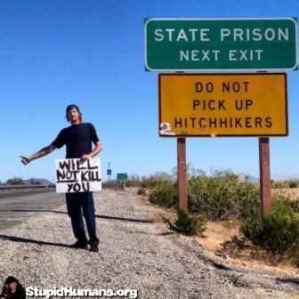
Intrigued? It's murder!
Intrigued? It’s murder!

Seriously? Would you? I spent a career in the military. Flying B-52s would have removed me from the carnage by five miles, but I never dropped bombs on people. Fly all day, spend a few minutes dropping whatever (normal or ‘conventional’ bombs, various kinds of nuclear bombs or missiles, or mines into water like harbors or ports), then home and to the club for a night of brews and pizza before going out again in a day or so. I just missed out on that fun (not) routine in Viet Nam.

I was trained to shoot three guns: two rifles and one pistol. But I never shot anyone either. I spent a career as a trained killer, but I’ve never killed. I don’t even hunt. And, at least for now, I don’t own a firearm. However, I have no doubt that I would kill. War is different. Self-defense is different. I am not a pacifist.

Per the United Nations Office on Drugs and Crime, the most dangerous regions in the world for murder and other violent crimes are Africa, Caribbean (toss in Brazil), and Central America. Canada comes in at 89th with about 516 murders, and the US at 92nd with 12,253 (both based on rate by population). Australia seems to have virtual love fest going on and is way down the list. But I want to look at this from a personal, more individualized perspective.

murder-3A few days ago, I wrote a tongue-in-cheek note on Facebook about how I did not whack some guy because my wife would kill me, had I dispatched the fool to his happy hunting ground. The fact remains, people kill people. I cannot imagine doing that except in self-defense or war. Neither of those would be considered murder, even in the biblical sense. Why do humans kill each other? Mental illness aside, why do we do it?
Here’s a little clip from J. D. Robb’s book, Glory in Death, p 138.

“Biblically speaking,” Nadine put in, “murder is the oldest crime.”

“You could say it has a long tradition. We may be able to filter out certain undesirable tendencies through genetics, chemical treatments, beta scans, we deter with penal colonies and the absence of freedom. But human nature remains human nature.”

Those basic motives for violence that science is unable to filter: love, hate, greed, envy, anger.”

“They separate us from the droids, don’t they?”

“And make us susceptible to joy, sorrow, and passion. That’s a debate for the scientists and the intellectuals. But which of those motives killed Cicely Towers and Yvonne Metcalf?”

Later they add thrill as basic human motive for violence.

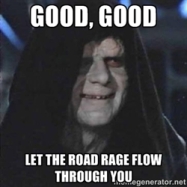
Can this be for real? Do people kill because it’s fun? Sorry, that can’t be considered normal. But those other emotions can account for a lot of murders. Love, hate, greed, envy, and anger are common human emotions. And yet, people kill strangers for cutting them off in traffic. We call it road rage, but it’s anger. Statistically, murders of women are often done by male mates, partners, or lovers. What’s up with that?

The countries in the high murder-rate areas that I mentioned have significant drug trafficking problems, and many (but not all) have high rates of poverty. Figuring out motives and getting them into the right categories would be a challenge internationally. So, tell us. Who ya gunna kill?murder-4

It can be a dangerous world out there.
Carefully mind any gaps. Look both ways before crossing borders, fences, or red lines. And, watch for droids.