Today, my poem uses repetition. As prompted, I may repeat words or a phrase.
It is a place and people live there.
But I can’t tell you why.
The interstate curves or jogs
as the Colorado River passes,
going somewhere,
But I can’t tell you where.
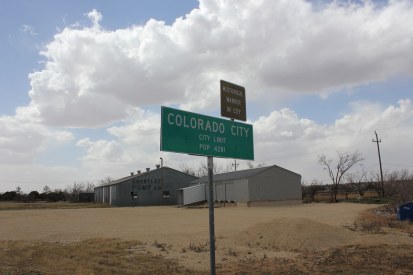
It’s hot in Colorado City
and it’s dry,
But I can’t tell you why.
In that small west Texas
town lives some of my love
But I can’t say much.
The water is bad, yet some things
grow, but I can’t tell you
how. Not much grows,
but they try—I can’t tell you why.
Confinement and warehousing
of living human flesh is done,
down yonder, in some
depressing hole, but I can’t
tell you much. Jobs, I guess.
The big white metallic groaning
wind monsters are there to send
volts and amps and megawatts
to somewhere, but I can’t tell
you where. Colorado City in Texas
has a past, tough people
in a rough place. It has a
future (maybe) but
I can’t tell you what.
They have a liquor store,
I think I know why.
Look both ways and don’t blink or you’ll miss why, or how, or where, maybe what.
Mind the gap near the dip, misery sleeps there.
Today, I’m challenged to write a dramatic monologue poem. I tried to create specific voices of character that act as both narrators of the poem and participants, which could be acted out by someone reciting it.
****
He is just there, out of reach for now.
Or is it us? So waiting and watching his stare.
Dare we touch such darkness, or look upon him,
in a time to sample solutions?
To this time we have come, as you and I will have done,
to seek his work in our lives.
The darkness that follows, at times closer or farther,
but always, always there.
We look not to see into his darkness
as he looks upon us with calm eyes
for seeking an inevitable time, when we
feel his welcome breath as a wind of the wise.
With a song he beckons us to release
this pain of our suffering into his care.
This love has been our personal world,
but now we may touch an eternal threshold of peace.
Release me not, but allow you go with me
in search of our final love of his prize.
With pain and regret I feel deep in my bones,
to him, I send you in my despair.
Such shaking a coward deep within me,
I step into our eternal new home.
As we lie here in the dark, and together we sleep,
for a time never again to rise.
My poetry challenge today is to write a poem of origin. Where am I from geographically, emotionally, physically, and spiritually. And having come from there, where am I now?
It’s not really a home, but it’s where I am from,
a place and a people from whom I’ve come,
other places they called home were not theirs.
Were they as proud as I, of who they were?
My look, perhaps a taste or a talent; a religion
or a language, this tribe of people like me.
Am I good enough? Were they? My foibles,
both pride and shame cloud my reality,
I don’t know what to feel about who or what I am,
or that I am at all, or who or what they were.
Why does it matter now? Is it because
knowing you is knowing me?
Why should I care? Am I a conduit of genes, maybe
I pass on life, survival, perhaps some weakness?
Who am I? Why am I? Why now? What do I want?
Taste, beauty, mindful intelligence, with durability
all passed from them to me, then to continuous family.
Why am I and what did you want? Life until death?
What is it that I don’t know? Not just life, but
thoughts. What did you think? What did you cling to?
Did your strength or weakness pass to me?
We’re from there, and there, and other places.
The you I’ve never met, secrets you’ve never told,
burdens never experienced, fears not shared,
friends, enemies, jealousies, hatreds that
may have traveled, but then died with you.
So much of what I am flowed from you to me.
Maybe I simply pass on, or maybe I just do.
My challenge today was to write a poem that starts from a regional phrase, particularly one to describe the weather. I am not a native Texan, but my wife and children are. I couldn’t do just one because the Texas culture is overflowing with verbal and cultural clever terms and phrases. The dialects for these (and there are so many more) shift, depending upon which part of the state you are in, and whether you’re in a city, small town, or rural setting. Disclosure, I can talk like this and at times, I do.
Boy, howdy!!
Looky o’r yonder,
I could sit still for that,
But she’s in a horn tossin’ mood.
Where y’all from?
It’s so dry Ima spittin’ cotton
Here abouts, it’s drier
than a popcorn fart.
Got all gussied up ta
go shoot out the lights,
but just cuz a chicken got wings,
don’t mean it can fly.
It’s hot, y’all!
Hotter ‘n a two-dollar pistol,
Like a billy goat in a pepper patch.
Yes’m, it’s hotter ‘n blue blazes.
Tomorr’a they’ll be frost on the pumpkin,
cold as my ex-wife’s heart,
I mean, cold as hell
with the furnace gone out.
Y’all come,
Ya hear?
Ain’t no butt ugly,
we all just sweetness an light.
Lord willin’ and
the creek don’t rise.
Speakin’ of suckin’ hind tit,
how ‘bout them Cowboys?
Y’all oughta be a-smilin’
like a jack-ass eatin’ briars.
My mother said, “What did I ever do to deserve this?”
My wife looked at my adult son and said, “Everything happens for a reason.”
The minister looked into the eyes of the congregation and said, “There is no such thing as a coincidence.”
I forget the exact contexts and situations.
To my mom I would say, “You did nothing to deserve cancer; no one does.” While there may be reasons someone gets cancer, it is not punishment for being not good enough or for being bad. However, it is no joke that a lot of people think like this because of religion.
To my wife I say that most things have a cause and effect. Many things happen due to natural causes, environments, and special situations. Some things are random and have disastrous outcomes. Shit happens.
When someone is fired from (or not selected for) a job, and they later get a much better job, that is good fortune probably assisted by the fact that the person is well qualified for both jobs and it is fortunate that they snagged the better one. The opposite also happens. While such a comforting phrase may bring minor, temporary solace; it is not true that everything happens for a (supernatural) reason. A spiritual being causing a temporary problem to bring about a happier or sadder outcome fails any common-sense test.
To the minister I say that coincidence may not mean exactly what you think it means. According to one (MW) dictionary it relates to coinciding of events that happen at the same time by accident but seem to have a connection. Better words might be random, arbitrary, pointless, haphazard, or desultory.
Whether one believes in a god or not, and regardless of the influence of any god, those words exist because things and happenings can be random, pointless, and desultory.
I recall reading a poem in Stumbling Blocks or Stepping Stones: Spiritual Answers to Psychological Questions by the late Father Benedict Groeschel. The poem of unknown authorship is titled “The Weaving.” The last of three, eight-line stanzas goes,
At last, when life is ended,
With Him I shall abide,
Then I may view the pattern
Upon the upper side;
Then I shall know the reason
Why pain with joy entwined,
Was woven in the fabric
Of life that God designed.
While the poem is beautiful and weaving as a metaphor for a life designed by a god is useful, it also points to the unknown reason for the suffering in life. It implies that we will find no reason until after death, and then only if we are in heaven with the deity who will, presumably, make it all clear. In other words, it makes no sense.
I prefer this outlook from the song “The Sad Café” by the Eagles.
*** Now I look at the years gone by, And wonder at the powers that be. I don’t know why fortune smiles on some And lets the rest go free ***
Shit happens. It’s not our fault. Blame it on whatever imaginary entity you choose. That may be the only reason you ever find.
There are other religions besides Christian. They do not believe Jesus was associated with any god in the same way most Europeans and people of the Americas do.
For most of my long life I have claimed to be a believer in god; specifically, I was Christian. I was a cradle Catholic who went to church, as obligated, every Christmas and Easter regardless of the state of my other church participation. The full story is too long, but I ran the extremes from almost nothing (referred to as ‘practical atheism’) to daily religious immersion and leadership.
From a religious participation point of view, for a time I took Advent and Easter more seriously than I did Christmas. From a cultural Catholic/Christian point of view, Christmas was the biggest deal, followed by Thanksgiving. But now I am an American citizen and atheist.
What does it matter? Well, it should not. My family has celebrated Thanksgiving and Christmas for many years. I’m not sure if any of my relatives or friends identify as atheist. But we are a family and those two holidays are all about family to me. For some reason, Thanksgiving seems to be the bigger deal these days. It’s a tradition.
When we moved back to Texas last year, our daughter-in-law said she was pleased because there would be more family stuff during celebration times. My wife decorates our home for most holidays, but not as much as in the past, and we don’t put out any religious items like a nativity scene or other art objects commemorating the birth or death of Jesus.
Around this time each year, I want to clarify my views about Christmas. I have many good memories of Christmas and the holiday season. I enjoy Christmas music for a while, but eventually I need eleven months to recover. I have some on my play list. In fact, religious music is fine. Some of it is great. I love the calm of Gregorian chant. I have written about music and other similar religious things in the past. Just because I don’t do that any longer does not mean that I want it to stop, that I am repulsed, or object. It is fine.
There is one chance in 365 that a male Jewish baby was born on December 25, roughly 2,000 years ago, who was then crucified and rose from the dead. If there was such a man, his date of birth is unknown. Also, in Christendom, celebrating this day as the birth of Christ is relatively new. Some Christian groups still do not celebrate. So, for most of my life Christmas has been kind of a wink-wink religious holiday. But it is a fun time from a secular point of view.
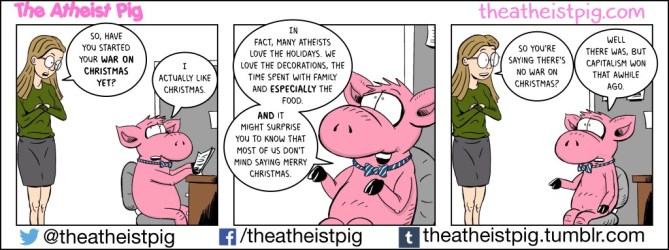
I wish a Merry Christmas to people on the 25th. If someone wishes me a Merry Christmas on some other day, I return the greeting and good wishes. While I prefer the inclusiveness of Happy Holidays, I don’t care what greeting people choose. I doubt if most atheists care, despite all the BS clamoring about wars on Christmas and some objections to verbal acknowledgements. It is not as big a deal as “In God We Trust” or forced prayer.
So, while I admittedly celebrate a secular holiday at Christmas, I do not object to people of any religion or social group celebrating their holidays, if I am not forced to participate or inconvenienced by them. Many of us, non-believers, believers, and everyone in between can do this and appreciate each other. It is the holiday season. If you think me a hypocrite, that’s your choice
I wish you a Happy Christmas Eve, a festive yuletide season, and a wonderful week highlighted with a Merry Christmas tomorrow.
There may not be any gods, but that should not stop us from enjoying life, friends, and family whenever we can.
Bill
Look both ways to see other points of view.
Mind the gaps. They’re everywhere.
Some say it’s the least felt of human emotions. That may be. It seems to be the feeling least written about from a mental health professional perspective. And yet, I’ve read that grateful people are happy people. Are they happy because they’re grateful, or vice versa? I should know because I consider myself one of them.
I am uneasy when people thank me for my military service. While there were days I would not want to repeat; some of those memories are among my best. It was my career – my profession. If people were silently grateful, I’d manage. I used to humbly balk at such comments, but I soon learned to say thank you and move on.
I was walking down a street in Crystal City, VA (just outside of Washington, D.C) with a US Marine Corps colonel. We were headed for a meeting. He was in his uniform, but I wore civilian clothes. As we were waiting to cross the street, an attractive young lady walked up and shook his hand as she thanked him for his service.
After she left, he said, “Since being married, I no longer know how to handle situations like that.”
I replied, “Next time, introduce your Air Force friend and I will take it from there.”
The value of gratitude to our overall mental health is well known. I know of no self-help book that suggests being thankless. Everything from gratitude lists to National Holidays inspire us to be reflective of those things and people we feel have improved our lives.
A Memory
My favorite gratitude story involves the son of my wife’s sister. She had six boys, of which Scott was the youngest. Whenever we visited his family, I would find time to play with Scott. Be it baseball, football, basketball, or some other similar endeavor, Scott and I interacted and played – just the two of us. It never occurred to me, as the youngest boy, Scott’s five older brothers had better things to do. And his father, a borderline workaholic, had been worn down by the first five boys.
Eventually, Scott grew up, got married, and graduated from Texas University. He and Sarah had two lovely daughters. I enjoyed my time with him and never gave it another thought after we had both moved on with life.
Scott matured into a handsome, well-liked, and friendly man. Everyone liked him, despite his reputation as a clever prankster.
On a visit with Scott and his family, he asked to speak with me alone. After we retreated to a private area, he said, “I want to thank you for all those times you played ball with me when I was a kid. No one else did that and I have never forgotten. It meant a lot to me. Thank you.”
By being me and playing with some kid, I created memories for him. Now, my memory is of his expression of gratitude. Within a year, Scott had died of a congenital heart problem. When I learned of that, my first thought was of our chat.
‘Thankless’ Employment
I’ve had some experiences with work-type situations some people call “thankless jobs.” While I understand what they mean, I can never get my brain around what a ‘thankless’ job is.
As an additional part of my real job, I once volunteered to be a Facility Manager for a large building where several hundred people worked. I was paid nothing extra.
A few months into the building job (which my wife titled Permanent Latrine Orderly [PLO], from the movie No Time for Sergeants), I realized that all my voice mail messages were either new problems, or comments about on-going issues related to the building, not my real job. I liked the challenges and the idea that my efforts made a better place for people to work for nine hours or more each day.
I also enjoyed the times people expressed their gratitude to me for doing such a ‘thankless’ job. Even with that irony, I also liked when people sent emails to my boss telling him how much they appreciated what I did. He let me know. One day he introduced me to some visiting VIP as his Facility Manager rather than my real job title. Was that a slip-up, or was it because he most appreciated my building caretaker duties? Thankless? I think not!
Thankfully Happy Few
I admit, as Harvey McKay titled a chapter in How to Swim with the Sharks Without Being Eaten Alive, gratitude is (or may be) ‘the least felt of all human emotions.’ But I also know when we think about it, we are usually grateful.
It’s not a perfect world. We have a fair share of ingrates and thankless souls wandering around. But thankless is the other side of what we ought to be, and most of us seem to know it.
I further admit knowing some who fear happiness. They are normal when complaining or worrying. In those cases, we either simply wait for it, or we speed things up by asking, “How are you doing?”
Their answer is, “Well, let me tell you about it….”
There’s nothing wrong with having an attitude of gratitude and it may even lead to a healthier and happier life. Yet, I’ve known some very happy, but cantankerous old farts who relish the chip on their shoulder. Good for them.
The only thankless jobs are the ones we don’t want. People have been treated for long term depression, only to find relief with a job change. It happens.
And the only thankless people are the poor souls who may be struggling with their own sorrows, problems, or demons.
And isn’t happiness what we ultimately want? I think so.
“…I would like to beg you … to have patience with everything unresolved in your heart and to try to love the questions themselves … to live everything. Live the questions now … then, someday … you will gradually … live your way into the answer.” ~ Rainer Maria Rilke, 1903, Letters to a Young Poet.
For all things and every day, but most especially in love, look both ways.
The gaps will always be there — in your mind.
Live into your answers.
I wish for you and yours a wonderful holiday season.
So many things about other people are none of my business. It is not the same with everyone because my relationship with each person is different. It begins with me, then my immediate family (in my case), then my friends, professional relationships, then people who want something from me like money or my vote. It may include strangers with whom I share driving on roads, rooms (the sign said ‘employees must wash hands’), grocery stores, air, or transportation systems.
Ambivalence, freedom, and self-preservation
If the man sitting across from me on the bus wants to pray, I don’t care. If he puts down a prayer rug that blocks my exit, I do care. If he jumps up and yells something that sounds like god is great in Arabic, I care a lot about his intention. As the behavior of others moves closer to interfering in my life, the more what is not my business is made to be. Not by me. I begin to care.
Pray, pay, and obey
When I lived at home with my parents, I was the youngest child in an Irish Catholic family. For nine years (1950s), I attended a Catholic elementary school (K-8), as did my older siblings. I was taught all traditional things catholic kids were supposed to learn. I memorized the Catechism. I learned about the religion as it was taught to us, about the saints, and some bible history for eight of those nine years. We had to pray. We had to go to confession and to Mass. We had no choice, but I also recall none of us resisting. We saw it as normal.
Millions of children around the world grew up in similar circumstances (and some have spent a lifetime recovering). It was brain washing, of sorts. We prefer to call it religious education and indoctrination, to be more politically correct.
We prayed to start each school day. We memorized new prayers as part of the curriculum, some in Latin if you were gunna be an altar boy. There were no altar girls then (now both sexes are altar servers), but the Latin has been scrapped in most cases. Before and after recess, we prayed. Before lunch, we prayed Grace Before Meals. When we returned after lunch, we stood next to our desks and prayed the Grace After Meals. Before we left for the day, we prayed. We were expected to pray at home.
When old enough, every Friday, or the day before a Holy Day of Obligation, we went to confession as part of the school day. More prayers; and the assigned penance was to say more prayers (five Hail Mary’s, five Our Father’s, and an Act Of Contrition). Think about that for a minute: prayer as punishment? We did that in anticipation of receiving Holy Communion (the body and blood of Christ) at Mass. You’d have thought we were Trappist monks in training (they pray seven times a day).
Reciprocal respect (do your thing)
I am not going to repeat what I’ve said about prayer (mine or other’s) in past posts. But I want to express a concern (PC for pointed rant). I only know what a few other non-believers do in these circumstances, but I want to briefly whine over how I feel about it.
Maybe I’m being picky or over-simplistic about this, but I strongly believe that no gods exist or ever have. Consequently, communication with something non-existent is pointless, if not weird. I do not include mediation, talking with others (including animals), or talking to self in the same way because in each of those situations, the self or other being exists and meditative relaxation is probably healthy. I have talked to my pets my entire life and in many cases I am sure there was some degree and form of understanding me and what my intention was, even if the language was not understood. They never talked back (at least not in a language like English).
My wife (not atheist) and I occasionally have meals with religious friends (Evangelical Protestant, Lutheran of some kind, Catholic of Roman blend, whatever). In most cases, it goes like this. We meet up, we talk, we sit, read menus, we talk more, order drinks, talk more, order food, they talk even more, and then the food comes. That’s usually when the religious people decide to pray.
Now, if we can pray at religious school before we go home or down stairs for lunch; couldn’t they get the prayer part done a lot sooner? Furthermore, praying, especially while holding hands with convinced atheist, is not a social experience. It is a religious one.
Sometimes, they do pray early. If you go to their home for an outdoor barbeque or buffet style meal, they pray in one of those large group things. Usually, the protestants, and often Catholics, still want to hold hands, bow heads, close eyes, and mumble incoherently. Anyway, I will usually hold hands and watch as someone mumbles a long thanksgiving kind of prayer, often as the food cools. Early prayer is possible.
Truth is, these are my wife’s friends much more than mine (she and they may disagree). If I do not feign cooperation, it could affect her relationship with her friends. I don’t want to do that.
In most of these situations I feel awkward (and maybe a bit hypocritical) because of my beliefs. If they did not pray, or would pray on their own, it would be fine. The problems come with the showing off. That’s when I feel like I am socially being made (as in forced) part of the prayer, prayer group, or blessing process. Maybe I should say something like,
“You go on ahead and pray. I don’t do that. I’ll wait, but if you take too long, I’ll start without you. I’m here to interact with you socially and to eat. Not to pray.”
But I won’t do that.
Is my conclusion equally valid?
While I’m willing to speak openly about my atheism with almost anyone (there are limits), I don’t want to cause problems. I’m often demonstrative when arguing or debating religion (or anything). That’s not good.
Moreover, I don’t want to be the cause of my wife’s friends shunning her or pretending out of sympathy. I don’t care what they think about me. (I’m atheist, I know what many think). But there is irony in that. I do care how the world treats my family, especially when I may be the reason for it. (Your father, grandfather, husband, friend, what-evah).
What do you think?
If you have an opinion or experience with this, I would like to hear it. If you pray, how do you feel about a non-believer excusing themselves or feigning participation? If you are not a believer, how do you handle such situations? Please comment, even if it is that you don’t care either way.
If you watch this show, you know that they seldom hold hands: Catholic.
Bill Reynolds, 5/11/2018
Look both ways when crossing to the other side.
Mind the gap of our differences.
The past happened without me, as will the future.
Beginning on what day will I no longer get out of bed?
Unable to remove the mask and walk away,
to pee or whatever. Will I know anything?
On what day will I no longer want coffee?
I can handle not to have. But not to want?
Does nirvana or moksha reflect happiness or denial?
On what morn I’ll no longer begin a day’s reading?
Is not my quest for knowledge stewed in desire?
To have and to hold, to want and to need. To care?
There’s more I want to know. Will I care? Do I?
Must I stop loving her on that day? As the Jones song goes.
Will my dignity be intact, or will it be the first to go?
Will I die in a puddle of shit? As many would see that as fit.
Will I remember my name, yours, where I am? Will I care?
Is there such a thing as death with dignity? Or do we
just pass on to return life for life? Don’t talk like that?
Away and towards. Turn, turn, turn. Say I love you.








 Our Literary Journey