The Battling Bastards

Poem
We’re the battling bastards of Bataan;
No mama, no papa, no Uncle Sam.
No aunts, no uncles, no cousins, no nieces,
No pills, no planes, no artillery pieces.
And nobody gives a damn.
Nobody gives a damn.
~ by Frank Hewlett ,1942

One Survivor’s Story

I was fortunate enough to meet Professor Ben Steele on the day before I completed my fourth Bataan Death March Memorial Marathon: 26.2 miles through a portion of the Chihuahua Desert located in Southeast New Mexico. On 26 March 2011, Ben signed my book of the drawings he had made as a prisoner of war (POW), following the fall of Bataan and Corregidor in 1942. I shook Ben’s hand and we talked about his art.

Three Parts of the Story

This is one of three blog posts about our two journeys that converged when I met this heroic Montana cowboy and historic American icon. The first post is about the war, which the US entered immediately following Japanese attack at Pearl Harbor. The second attack, which followed within hours of the first, was the invasion of the Philippines by Japanese military forces. It happened about four years prior to my birth, but Ben was there.

Prisoner's of War - Bataan Death March
Prisoner’s of War – Bataan Death March

Next Tuesday, a second post will be about my experiences with the Bataan Memorial Marathon, an annual event that takes place at White Sands Missile Range, near Las Cruces, NM. It’ll cover that part of my experience as a 65-year-old runner, in way over his head, leading up to my meeting with Ben, then age 93.

If you’re a marathoner/runner/endurance walker, or even a wannabe, registration signups for this annual patriotic event close on March 5th. The marathon will be on Sunday, March 19th starting early in the cold of the high desert military post, located just east of the breathtaking Organ Mountains. For the link to the web page and instructions, click here. You need be in good physical condition, but not all are. This thing is a rigorous challenge for the average person, and the “casualty rate” is high. The good news is that 85% of the participants walk it – as I did four times.

One survivor would turn 100 this year.

The third post will be about the man I met and his experience. He and others were survivors of the Bataan Death March, and long-term confinement into slave labor. He was a POW survivor, an artist, and a Professor of Art at Eastern Montana College: Benjamin Charles Steele.

The Death March

As we should know, on December 7, 1941, Japanese military forces attacked the USA by dealing a devastating blow to our forces at Pearl Harbor, Hawaii. Few know that ten hours later, the Japanese attacked the Philippines. The Philippines Campaign (Filipino: Labanan sa Pilipinas), or the Battle of the Philippines, raged from 8 December 1941 to the fall of Bataan on 9 April (105 days), and the following surrender of the island of Corregidor on 8 May 1942.

The Japanese military conquest of the Philippines may have been the worst military defeat in United States history. 23,000 US military personnel, and another 100,000 Filipino soldiers, were killed or captured.

Death March route. Train portion was more nightmare.

Bataan is a peninsula on the southwest end of the large Philippine island of Luzon. As the battles raged on, General MacArthur’s forces retreated to Bataan and the small island of Corregidor. Due (in part) to the breakdown of supplies and logistics (in my opinion), the Americans and Filipinos began to lose strength. Following the decision to surrender, the Japanese were overwhelmed with POWs. A torturous and deadly forced march of 65 miles by approximately 75,000 sick, injured, and defeated Filipino and American troops to prison camps ensued. The march took about eight days.

While the exact death toll on the march is uncertain, credible sources report that casualties prior to reaching their destinations were from 5,000 to 18,000 Filipino deaths, and 500 to 650 American deaths. Marchers reported severe physical abuse and wanton killings. The Bataan Death March was later judged by an Allied military commission to be a Japanese war crime.

On January 27, 1944, the U.S. government informed the American public about the march, when it released sworn statements of military officers who had escaped.

My first assignment following Air Force basic training in 1964 was to Dyess Air Force Base, Texas. Over 30 years later, I lived for three years in Albany, Texas. It was not until years later, when I started reading and learning more about the Death March that I learned about Lieutenant Colonel William E. Dyess. Dyess Air Base was named after him, and he was from Albany, Texas (population ~ 2,000).

Dyess was a Death March survivor, and one of the few officers who escaped the Japanese POW camps in the Philippines. Following his return, Colonel Ed Dyess wrote extensively about the March and the prison camps prior to his death in an airplane crash in late 1943.

The drawings you see in the following video are Ben Steele’s. The survivors pictured in wheelchairs are at the starting line of the marathon.

Never Ending Wars

Japan formally signed to surrender on September 2, 1945, ending World War II. After 14 years of war, “nearly three million Japanese were dead, many more wounded or seriously ill, and the country lay in ruins,” most Japanese (not to mention those who had suffered at their hands during the war) saw the end of hostilities as a blessing. The USSR and China suffered the greatest loss of life during WWII – in the tens of millions, mostly civilians, who were killed due to brutal war crimes.

There is no shortage of stories about man’s inhumanity to man, particularly in time of war. The Bataan Death March, and the subsequent treatment of prisoners, was one example. Knowing these realities, meeting those who experienced them, and listening to or reading their stories should serve to teach us the truth of what General Douglas MacArthur said, “In war there is no substitute for victory.”

Life is good and it can be better. But, pay attention.
Look both ways and mind the gaps.
It will not happen again unless we allow it.

Not the Same Kennedy

Do you mentor?
Do you mentor?

Few of us are born with an inaccurately low self-esteem, but the potential is there for disordered self-image. I may have inherited my mother’s negative opinion of personal abilities (hers and mine), but the passing of the flaw was socio-cultural, not biological. How I got that way is unimportant. What is important is that while humility may be a good thing, too often people miss much in life because they found their way to the “I’m not good enough, I can’t, I am too scared, or nobody loves me” quagmire.

Jack was my teenage friend, and the first to motivate my turnaround from I cannot, to I can. I’ve met others who helped me see my greater potential to achieve. They always came into my life at the right time. My post on synchronicity tackled the phenomenon. Some are still involved in my life, and some inspirational souls have recently landed in my patch of life.

When I first met Hilton M. Kennedy he was a Master Sergeant in the US Air Force, and he would soon be my boss and direct supervisor. The man I eventually called Ken, but many called Mac, had olive colored skin, lots of jet black hair, was several inches shorter than I, and smoked too many Salem cigarettes. I don’t know if Ken was a hyper-active child, but he was one for the most effervescent men I had met. Ten years my senior, Ken reeked enthusiasm. Other than being married, where we worked, and the Air Force, we had little in common, at first.

Ken’s personality included talking fast, a trait one seldom finds in a Louisiana native. I enjoyed our many chats where he made me believe that he was interested in me, and that I would have a successful future. Many of those discussions were accompanied by measured amounts of fine liquor. Living in Ankara, Turkey, ensured financial advantages for Americans in the late sixties. Of course, fine liquor required equally fine cigars.

Do what?
Do what?

I began to see good changes in myself. I was becoming more confident. My self-opinion and hopes began to unfold from whatever dark recess of my mind they were held captive. I attribute any success and goodness in my life to many people, some from my past and some in my life today, some from almost 50 years ago. Hilton Kennedy was the right guru at the right time in my life.

We became personal friends and our families got close as he kept tabs on my career following the end of my enlistment and his eventual retirement. We went to visit him, and he and his wife visited our home. Eventually, our relationship was more friendship and less his being my mentor and advisor. One of the last times I saw him, my wife and I were guests of he and his wife in Rome, New York. He played the harmonica and I thought all was well. But it was not to be.

To remember a friend

In the late eighties, I learned that my friend and mentor had been diagnosed with Huntington’s Disease, a dreadful genetic illness with no cure. The mental  and physical degradation was disastrous for someone who was such a fast-paced, high-stepper in life.

It was horrible. I didn’t know what to do, what to think, or how to feel. While I felt bad for him and his family, I regretted the worlds loss of one of the good ones. Fortunately, the regressive disease was stopped when Ken died of a heart attack at the age of 55. I faced the loss feeling that any suffering by Ken and his family was aborted.

Ken has been gone for over 25 years. I remember, and I’m grateful for that man being in my life and the difference he made in me simply by believing in me, showing his faith in me, and his eventual friendship.

Look both ways every day.
You may be the long remembered difference is someone’s life.
But, mind the gaps.

Who Ya Gunna Kill?

Intrigued? It's murder!
Intrigued? It’s murder!

Seriously? Would you? I spent a career in the military. Flying B-52s would have removed me from the carnage by five miles, but I never dropped bombs on people. Fly all day, spend a few minutes dropping whatever (normal or ‘conventional’ bombs, various kinds of nuclear bombs or missiles, or mines into water like harbors or ports), then home and to the club for a night of brews and pizza before going out again in a day or so. I just missed out on that fun (not) routine in Viet Nam.

I was trained to shoot three guns: two rifles and one pistol. But I never shot anyone either. I spent a career as a trained killer, but I’ve never killed. I don’t even hunt. And, at least for now, I don’t own a firearm. However, I have no doubt that I would kill. War is different. Self-defense is different. I am not a pacifist.

Per the United Nations Office on Drugs and Crime, the most dangerous regions in the world for murder and other violent crimes are Africa, Caribbean (toss in Brazil), and Central America. Canada comes in at 89th with about 516 murders, and the US at 92nd with 12,253 (both based on rate by population). Australia seems to have virtual love fest going on and is way down the list. But I want to look at this from a personal, more individualized perspective.

murder-3A few days ago, I wrote a tongue-in-cheek note on Facebook about how I did not whack some guy because my wife would kill me, had I dispatched the fool to his happy hunting ground. The fact remains, people kill people. I cannot imagine doing that except in self-defense or war. Neither of those would be considered murder, even in the biblical sense. Why do humans kill each other? Mental illness aside, why do we do it?

Here’s a little clip from J. D. Robb’s book, Glory in Death, p 138.

“Biblically speaking,” Nadine put in, “murder is the oldest crime.”

“You could say it has a long tradition. We may be able to filter out certain undesirable tendencies through genetics, chemical treatments, beta scans, we deter with penal colonies and the absence of freedom. But human nature remains human nature.”

Those basic motives for violence that science is unable to filter: love, hate, greed, envy, anger.”

“They separate us from the droids, don’t they?”

“And make us susceptible to joy, sorrow, and passion. That’s a debate for the scientists and the intellectuals. But which of those motives killed Cicely Towers and Yvonne Metcalf?”

Later they add thrill as basic human motive for violence.

Can this be for real? Do people kill because it’s fun? Sorry, that can’t be considered normal. But those other emotions can account for a lot of murders. Love, hate, greed, envy, and anger are common human emotions. And yet, people kill strangers for cutting them off in traffic. We call it road rage, but it’s anger. Statistically, murders of women are often done by male mates, partners, or lovers. What’s up with that?

The countries in the high murder-rate areas that I mentioned have significant drug trafficking problems, and many (but not all) have high rates of poverty. Figuring out motives and getting them into the right categories would be a challenge internationally. So, tell us. Who ya gunna kill?murder-4

It can be a dangerous world out there.
Carefully mind any gaps. Look both ways before crossing borders, fences, or red lines. And, watch for droids.

Morality Series: Glutony

I seldom eat the whole pizza any more, at least not in the same evening. My wife may have one slice, but not always. Still, why do some religious folks insist that if, per chance, the wife wants none, I’ll go to Hell?

glutony-3

Am I gluttonous? I eat more than that guy, but less than that one, and maybe about the same as the other dude. When does eating and drinking become one of the deadly or capital offenses? Where do we cross the line that assures our trip to the inferno?

I’m not going to argue that overeating is good for us. We all know it’s not. But the reason is biological, not spiritual. Besides, I do it more than I care to admit. I don’t think I am alone in my gastronomic fault. In fact, for an American, I’m probably about average.

glutony-1In the Summa Theologiae, Thomas Aquinas said, “Gluttony denotes, not any desire of eating and drinking, but an inordinate desire… leaving the order of reason, wherein the good of moral virtue consists.” Inordinate? I only know this limit after I am well past it.

Devils, Demons, and Witchcraft says those who commit the sin of gluttony are punished in Hell by being forced to eat rats, toads, and snakes. Are they cooked or raw? Do we get hot sauce? Since these are eaten by people around the world every day, I feel so not threatened.

I posted about Epicurus back in the Spring, so I want to invoke him here. His name and philosophy has been incorrectly associated with glutinous behavior for centuries. I had it a bit wrong. Further, we’ve also bogarted his name to be associated with fine dining.

The word epicure is linked to indulging the appetite, but that is not the teaching of the man to whom we owe the word. That ancient Greek philosopher taught of simple pleasures, friendship, and a secluded life. He believed in the pursuit of pleasure (as do I), but pleasure for him equated with tranquility and freedom from pain (Dude! Try this plant.) – happiness.

Cannabis
Cannabis

Detractors of Epicurus misrepresented his notions of pleasure to material and sensual gratification. When epicure entered the lingo about 500 years ago, his philosophy had been trivialized. Epicure or epicurean became synonymous with “hedonist.” Way back, he showed a lot of wisdom.

“Let no one be slow to seek wisdom when he is young nor weary in the search of it when he has grown old. For no age is too early or too late for the health of the soul. And to say that the season for studying philosophy has not yet come, or that it is past and gone, is like saying that the season for happiness is not yet or that it is now no more. Therefore, both old and young alike ought to seek wisdom, the former in order that, as age comes over him, he may be young in good things because of the grace of what has been, and the latter in order that, while he is young, he may at the same time be old, because he has no fear of the things which are to come. So we must exercise ourselves in the things which bring happiness, since, if that be present, we have everything, and, if that be absent, all our actions are directed towards attaining it.” —Epicurus, Letter to Menoeceus

His philosophy combines a form of materialism with ethics that emphasizes moderation of desires and cultivation of friendships. His world view was optimistic, stressing a philosophy of not fearing death or the supernatural. It can teach us how to find happiness in almost any situation – without moaning after we’ve eaten the whole thing.

glutony-4The opposite of gluttony is abstinence. Once again, from one extreme to the other. Abstaining from food can be a diagnosable eating disorder. We know how much, and of what things we should eat and drink. We must eat, but not too much; we must sleep, but not too much; we must drink. But there’s no such thing as too much fun.

“Moderation in all things, especially moderation.” ~ Ralph Waldo Emerson

Eating is an essential part of life.
Eat well, be happy, and enjoy all that life offers.
If we mind the gaps and look both ways, we’ll be fine.

Morality Series: Pride

Who or what are you proud of? Do you feel proud of yourself? If so, do you consider it immoral or sin?

Lucifer to Satan
Lucifer to Satan

Pride is an insufficient word for the immoral feeling that is an exaggerated sense of self. Hubris works a little better. Pride is often normal and not bad. As with any of these so called sins, when taken to psychological extremes, pride can become a problem that others often are more aware of than we see in ourselves. Behaviors associated with pride can become annoying, but we expect a proud bow from anyone doing well.

So, here I go again; playing devil’s advocate in the defense of normal human feelings and behavior that many religious people accept as sinfulness of the highest order. What’s even harder to understand is that this one is considered the worst of the worst. This is Lucifer’s sin, if you believe that. This self-opinion allegedly paves the way for all badness (or sin, if you prefer) to follow. In the words of  C. S. Lewis and many other religious writers, its primacy is made clear.

pride-4

Are we to believe that humility, the alleged opposite, prevents us from immoral behavior? I can be most humble and immoral simultaneously. I can lust with humility oozing from my pores, or maybe it’s the other way around. Excuse me while I humbly eat the entire pizza and down a six-pack of beer.

Pride is mostly good, unless you’re Irish-Catholic, in which case you’ll hear, as I did in my youth, who the hell do you think you are? This put-down, shut-down, and buzz-kill phrase is more annoying than piles of pride.

Gay pride, black pride, being proud of self, kids and grands, other family and friends, school pride, pride in state or country, religious pride or pride in non-belief, the overcoming of adversity, pride in relationships, athletic team pride, corporate pride, and the list goes on. What’s wrong, bad, or sinful about any of this? Nothing!

pride-1

My entire life I’ve worked on my humility (minding that gap). One friend made a sarcastically funny plaque for me because I often discussed trying to be humbler. I thought that I’d be a better person if I was humble. Of course, I could be proud of my humility, right?


I like this
I like this

I think power often corrupts, and I’m sure that pride plays into that human fault. We should get this pride deal straightened out. Going overboard on my ego is indeed bad for me and for those around me. Fortunately, my family and friends have the chutzpa to point out my faults. I no longer have my dad to ask me, “Who the hell do you think you are?” I can still hear his voice when others remind me that I may be a bit full of myself. It happens, preferably seldom. Maybe pride is not exactly the correct word for me.

What about the other prideful words? Vanity? I pine for my hair and regret the loss of my locks. Conceit? Probably not me. I’ve known none who admit to this, but we easily see it others. Arrogance? I have the tee shirt for this one. I’m guilty. I can be arrogant as hell. Conversely, I admit when I’m wrong. I’ll apologize for any harm done. I don’t apologize for being wrong unless harm was done. I’ve been accused of arrogance for that. To me, I’m being sincere. Otherwise, I’d constantly be apologizing.

How about self-respect, self-esteem, or self-love? What of narcissism? I know that’s not pride, but we agree it’s an abnormal extreme, unless you’re a politician. Dictionary synonyms include pleasure, joy, delight, gratification, fulfillment, and satisfaction. I think I see a pattern here.

Is it possible that Christianity and some other religions are opposed to people finding pleasure in life?

Yours, mine, or theirs – what’s your take on the pride?

Hold your head up and walk tall. Be the person you are – true to yourself.
Be proud when you have reason.
Be happy in life, but look both ways and be mindful of any gaps.

Morality Series: Sloth

Intentions Count
Intentions Count

Other than writing about it, does anyone ever use this word except for the animal or when referring to the sin? Do we know what sloth means? Is it laziness?

Sloth is the most difficult of the seven biggies to define precisely. An old-fashioned definition might sound like defiant sorrow turning away from God’s good intentions.

Is it really a bad thing? Is the problem its tendency to lead to other problems? I knew it fit with laziness, but it also goes with apathy and a list of other goof-off words.

Thomas Pynchon wrote a great piece about how sloth is tied to writers. Read it all here. I like this paragraph:

“Writers of course are considered the mavens of Sloth. They are approached all the time on the subject, not only for free advice, but also to speak at Sloth Symposia, head up Sloth Task Forces, testify as expert witnesses at Sloth Hearings. The stereotype arises in part from our conspicuous presence in jobs where pay is by the word, and deadlines are tight and final — we are presumed to know from piecework and the convertibility of time and money. In addition, there is all the glamorous folklore surrounding writer’s block, an affliction known sometimes to resolve itself dramatically and without warning, much like constipation, and (hence?) finding wide sympathy among readers.” ~ New York Times, June 6, 1993, “The Deadly Sins/Sloth; Nearer, My Couch, to Thee”, by Thomas Pynchon

sloth-4

If this is a sin, it’s not one we commit. In fact, it seems we commit nothing, we do nothing, and we don’t much give a shit about anything. As I understand it, sloth refers to our mental, physical, spiritual, and pathological states, usually with a strong religious twist. Even the Buddhists have their five hindrances, of which Sloth-torpor is one defined as a heaviness of the body and dullness of the mind which drag one down into disabling inertia and thick depression. That sounds like it needs a DSM IV diagnosis.

With greed, I wrote that we know it when we see it. I’m not sure sloth is as easy to identify. I don’t take the word sin seriously, but sloth is one item that may not get enough attention. Like the others, it is not healthy if it’s a person’s choice for a way of life. I can accept go with the flow, but like many of the big seven, it can be unhealthy when taken to a wrong extreme. And, it can lead to other behavior that is even more damaging. I think that much of what we might perceive as sloth, in others or ourselves, is either a medical problem like depression, or an existential crisis. Here is another example from Mr. Pynchon:

“Any discussion of Sloth in the present day is of course incomplete without considering television, with its gifts of paralysis, along with its creature and symbiont, the notorious Couch Potato. Tales spun in idleness find us Tubeside, supine, chiropractic fodder, sucking it all in, re-enacting in reverse the transaction between dream and revenue that brought these colored shadows here to begin with so that we might feed, uncritically, committing the six other deadly sins in parallel, eating too much, envying the celebrated, coveting merchandise, lusting after images, angry at the news, perversely proud of whatever distance we may enjoy between our couches and what appears on the screen.” ~ New York Times, June 6, 1993, The Deadly Sins/Sloth; Nearer, My Couch, to Thee, by Thomas Pynchon

I like saying that I’m lazy, or that it’s a lazy day. I should say relaxed or comfortable, but lazy adds a pinch of ironic guilt. That troubles some folks, but I think it natural. On my calling card, the leading skill is Leisure Aficionado; a reference to many of my goals in retirement. It got less attention than Pleasure Seeker did.

Sure. Sometimes.
Sure. Sometimes.

The opposite of sloth is said to be diligence: careful and persistent work or effort. I have always liked persistence, and for a long time, I liked some work. Maybe it was the doing that I liked – my ability to make something happen; or maybe it was the fruit of my labor that was my reward. My writing is kind of both, but mostly my reward is the result. That is also my motivation to do it again. For about five years, I ran – anything from five kilometers to marathons. For marathons, diligent training and persistence are keys to success without much injury. I’ve met no slothy runners. To endurance runners, any day with less than five miles is slacking off.

Is it sloth or depression?

One more issue regarding sloth: this whole concept that people who choose to be lazy or sloth are deliberately committing sins is nonsense. People want to feel good, to contribute, to have purpose and success. That is what is normal for humans. We’re unaware of other’s mental, physical, or spiritual health. So, we should focus on ourselves and what’s best for us. If anything is a sin, it’s judgment.


The song Alphie by Lily Allen is a hoot, and refers to the pot induced lethargy of her younger brother. Yes, the Game of Thrones actor – same guy. But it could be sloth. This Youtube version is a bit edited, but worth a look, nonetheless.

We should look upon our own sloth with a critical eye.
Too little or too much may be unhealthy.
Live life to the fullest as long as possible; always look both ways and mind the gaps.

Series on Morality: Greed

Just another desire?

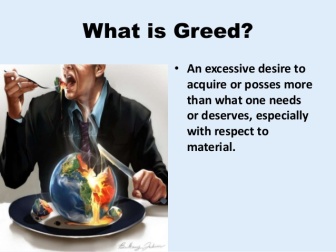
How much is enough? When do our simple desires or wants rise to the level of immoral greed?

Steal to feed your hungry family, and you may go to jail. An investment banker, who makes millions, steals from the public, nearly destroys the economy, and causes financial crises to millions of people; we talk about the banker’s greed and move on – no consequences.

So some of us firmly believe.

Here’s how I see my own greed: my wants become immoral greed when my having too much causes others to go without or suffer. That view is mostly due to culture and my beliefs about human nature. If I lived the aesthetic life of a Trappist, I’d restrict myself so there would be more for others. I want to have enough without taking away from anyone, especially those in need. But not everyone feels that way.

If there are 10 things we both want, and we each take five, that might seem fair. But what if we need only two each, and will never need more? Do we hoard the other six? Collectors spend fortunes adding items to their collections. Is that greed? If so, is it immoral? If they also donate fortunes to philanthropic causes, does that change anything? Am I discussing greed, or is this an issue of caring about others.

Is greediness a normal part of our nature? Is it instinctive to be greedy to survive, but also part of a darker human condition to be immorally greedy? If the answer to both questions is yes, why? From whence does our greedy nature come? Why are some of us incredibly selfish, while others are altruistic to the point of self-denial? If we feel greedy, but don’t act on that feeling, is it ok? If it’s normal, as I contend it is, then we should feel no guilt. If our actions cause unnecessary harm to others, that’s different.

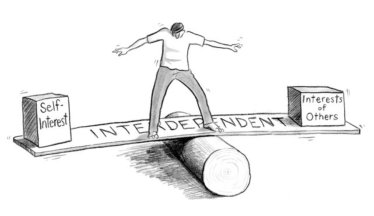
One of life's balancing acts
One of life’s balancing acts

Why do some people think greed is immoral, yet they blindly practice it routinely? Is it really the opposite of liberality, which is defined as the behavior of someone who gives things or money in a generous way? I think these are both normal. We are greedy and generous.

Bill Gates is very wealthy and continues to make a lot of money. He lives a good life that doubtless has some excesses. But, Gates is also very generous and kind. He is both an American capitalist and a kind and generous person. Many wealthy people seem to be. Some are not.

Is greed a form of self-preservation that has gone too far? When humans find themselves in extremely stressful situations, they become not only selfish and greedy, but dangerously so. Starvation changes us. When basic needs are not met, we don’t consider it greed when people take extreme actions to meet those needs.

Behavior in WWII concentration camps and American prisoners in Bataan and other places provide ample evidence to support this. Oddly, there are remarkable altruistic exceptions. Victor Frankl, in his book Man’s Search for Meaning, discusses why one camp prisoner will give away his last morsel of food to another who is dying. Yet, another prisoner will harm others, steal from them, or commit murder or suicide. While this was an observational basis for Frankl’s therapies and personal outlook, these very real human experiences testify to major differences in people.

Can greed be satisfied?

If it has always been that way with people, will it continue? Is greed normal in other animals? Is survival of the fittest a basic instinct of our animal inheritance that now masquerades as greed?

Greed, like quality, is difficult to precisely define. Yet, also like quality, most of us know it when we see it; particularly when we see it in other people. However, we must admit that greed is something we seem to share, want it or not. We need to feel safe and that may mean not trusting that we will manage with enough. More is safer and better.

Our human nature has many facets and sides. Our morality is a big part of our nature, good or bad.
Keep in mind that if we take only what we need, we care for more than ourselves.
May we live our lives in concert with humanity and all of nature.
Let us look both ways and mind the gaps.

Don't even think about it
Don’t even think about it

Series on Morality: Introduction

“…people have inside them something that could bring them to ruin…This basic truth of life has been denied by both believers and unbelievers in every age. Yet anyone who has tried to help others with their problems knows that we all share a common struggle against self-destructive tendencies. Hidden in the human heart are marvelous capacities for good and dreadful possibilities of evil.” ~ Stumbling Blocks or Stepping Stones, Benedict J. Groeschel

7-sins-intro-3Steven stirred the pot when he responded to my previous post on the basic nature of humans with, “One word: Greed.” Reader comments followed with discussions about greed in terms of human nature. Sue V. weighed-in by suggesting that I compose a series of posts on the seven deadly sins alongside their antitheses, the seven virtues. I like that idea. I plan to write a series within the human nature theme reflecting on the human condition, using Sue’s suggestion as a method to breakout specific topics into manageable sized chunks.

I want my posts to be thought-provoking (we think about it), simple (easy to read and understand), and brief (1,000 words or less). If we can read it in five-to-ten minutes, comprehend it, and have an opinion; I’ve achieved those goals. I’m pleased when readers enjoy my dribble. I’m not trying to persuade or educate anyone, but only to explain my take on the topics.

7-sins-intro-4After reading them, maybe you’ll ponder your opinion vis–à–vis either mine or someone’s comment, and share your views. I also want my posts to have a free-thinker flavor; secular, but with an inclusive bent, if that’s possible. I’m not opposed to religious comments. I think secular.

Morality (or immorality) is the series theme. It’s a better word than sin, vice, virtue, or others that I see as rooted in religious belief. Sin is a theist concept; morality seems more secular, at least to the degree that it’s subjective. I’ll borrow from the topics commonly known as sins. Words like vice and virtue are okay, but they add value judgment before discussion.

7-sins-introMoral and immoral may do the same thing, but I see them as opinions that are formed after discussion. Topics are natural, but often seen as immoral under certain conditions. For example, lust seems normal and humans could be extinct without it, but it’s on the list of sins. I’m not sure how or why chastity applies to anything other than medieval devices of questionable utility. How we see our basic nature and religion both affect how we’ll see the seven sins or vices.

I’ll follow Sue’s suggestion to include both sides of the moral coin. Like Pride and Humility (the yin and yang). I’ll begin with Greed on Friday. We can ride that pony until one of us falters. Then, I’ll choose another pair. I plan two posts per week.

I’m open to your suggestions for topics. After I get all boned up on each topic, I’ll post my remarks. Then, I’ll hang them out for your target practice.

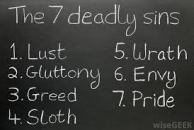
The seven sins I found (with their opposites) are: pride (humility), greed (liberality), lust (chastity), envy (kindness), gluttony (abstinence), wrath (patience), and sloth (diligence). The Catholic Catechism lists virtues as prudence, justice, temperance, courage, faith, hope, and charity. The Bushido Code has seven or eight virtues of a Samurai warrior, four of which are generosity, forgiveness, compassion, and altruism.

7-sins-intro-2

While we’re not all the same, we each have our bright and dark sides.
They are difficult to explain in our personal nature,
but they’re there. Mind those gaps and look both ways.

My Rookie Year


end-of-2016-7

On March 20, 2016, I published my first blog. The person who taught me the basics has a few names, but she blogs here. She encouraged us to take the A-to-Z blog challenge which kicked off about 12 days later. For 26 of the 30 days of April, I wrote and posted blogs six of every seven days. Every day I was trying to learn to use WordPress, pick a theme, and so much more. It was a ‘drinking from the fire hose’ experience, but I learned quickly.

end-of-2016-6

I was also supposed to be dealing with beta reads of my 2015 novel, Crew Dogs. That book has been stored on a cool dry bookshelf since I got my last beta feedback from Tara in August.

Many thanks for the advice and encouragement, especially from fellow Crew Dog, Maddox, who read the book through the eyes of a participant and witness to the time, place, events, and people – thanks to everyone. During the year, if I get to where I can allow the memoir time to steep, I want to rewrite Crew Dogs as an autobiographical novel in first person. The story’s there, but I want to work with the plot to make it more visible and clean up some parts. I’ve picked up so many great hints from Cathy Yardley and I hope to apply her advice.

end-of-2016-5Thanks to Tara for teaching me to blog. I am also grateful to my classmate, friend, fellow writer, and blogger, Sue, for suggesting topics and improvements. Sue’s uplifting and spiritually positive blog, An Artist’s Path, is here.
Thanks also to the many other wonderful people who gave me feedback, comments, and encouragement regarding my blog. It was nice for this rookie to hear, “You’re good at that.”

My problem right now is that I’m still suffering whiplash from writing my memoir. I’ll need many months to get that project out of the ass-wipe stage of an early draft.

I wanna give special thanks to my editor and wife, Yolonda. For over 50 years she has read my dribble, typed more than few papers, and simultaneously corrected my atrocious spelling and borderline grammar. She sees these posts before anyone else and patiently cleans up my mess. The only errors you see are the ones I add after she proof reads.

My limitation last April was that I wouldn’t blog about politics or religion. But by June, I was beginning to talk about atheism. As it turned out, the best liked four of my 89 blog posts addressed that subject. The fifth was about aging. I published the most popular post on September 6th, “Respect, Tolerance, and Silence” (read it here).

end-of-2016-3

Ironically, my first post, “Bloom Later,” (read here) was about memoir. After long consideration, I finally started writing one seven months later. Recently, I’ve published several more posts about that work in semi-progress.

My rooky year was enlightening. I’ve discovered what kind of writing I like to do. In 2017, I want to return to posting twice a week. Finding topic ideas is difficult, so if you have suggestions, let me know.

In January, I’ll return to my Creative Writing group/class. That group may help a bit with topics because Doris, our teacher/facilitator, will provide an essay topic each week. What is interesting about that bunch is our ‘maturity.’ As one of the younger participants, I’m amazed by how skillfully these folks can craft a story and write it well, far into their senior years.

end-of-2016-4When I meet with the SnoValley  Writes writer’s group each Friday, I’m alert for ideas. I have a few stashed somewhere. While they’re not exactly in my lane, they’re not off limits either.

I don’t make New Year’s resolutions, but I have a few goals for 2017. I want to keep learning how to be a better writer.

In addition to my writing groups, I’ll keep blogging. I want to return to writing my memoir, working on it most days. In April, I’d like to do the A-to-Z blog challenge again. In July, I am considering attending the Pacific Northwest Writers Conference in Seattle.

I don’t even wanna think about the fact that I volunteered to be president of my homeowners association for the next two years, but there’s that. Arg!

end-of-2016-2

My wish is for 2017 to bring us each more happiness than we need, gratitude for all the good stuff, and the good health to enjoy life. May we have the strength to deal with the challenges of 2017.

Happy New Year!
Keep your hands on the grips and your eyes on the road, but keep lookin’ both ways and mind the gaps.


Atheist Perspective on Christmas


atheist-xmas-3Since this is my first December and holiday season as an admitted atheist, it seems fitting to discuss Christmas from my nonbeliever perspective.


Much has been said and written about the secularism surrounding the holidays, and I’ve decided to provide my personal perspective. This is my 70th time partaking of the Christmas season celebration. So, much of what I say and do has precedence in that it’s what I’ve been doing for years.

As I write this I’m hearing the news from Germany of a large truck being driven into a crowd of people celebrating the holidays and the Russian Ambassador to Turkey being assassinated. The majority opinion seems to be that both events may be related to terrorism and religion, or at least god politics of some kind. And the list of such deeds goes on. None of this is in the holiday spirit. But as Christopher Hitchens subtitled and wrote in his book, “Religion poisons everything.”

Tantum religio potuit suadere malorum.” (To such heights of evil are men driven by religion) ~ Lucretius

For years, this was the season when we tried to spend quality time with family. Beginning with Thanksgiving, it’s a busy travel season in America as families reunite for celebrations. We’re surrounded by hype. But I enjoy the hype more than I like to admit.

I look forward to Halloween each year, partly because it marks the start of this season. Christmas is a happy time, a great time for most children. There are football playoffs, and bowl games. Winter begins, Yule is celebrated, and I like to look at snow. Dealing with it sucks.

In the home of my birth, the smell of the house changed, mostly due to the tree. But the house would also take on the aroma of whatever adult beverage had been opened. Aunt Lorry, who seldom drank alcohol, always brought port wine. Port is some powerful vino.

The thrill of gifts and happy people occupied our thoughts. We went to church. A little hut was built in the yard next to the church with a nativity scene inside it, behind thick glass and a locked door. There was a slot to deposit money for the poor, until someone started to rob it. Then they stopped using the box, and eventually the little hut went away. They must have assumed the thief was not one of the poor.

I don’t recall going to midnight Mass as a kid, but I probably did once or twice. Years later, I went several times. It was always crowded. All those Catholics who only went to Mass on Christmas and Easter would show up. By then, there was only one Mass on Christmas Day — all the others were vigil Masses on Christmas Eve. Going to church on Christmas day was inconvenient, at best.

Christmas was a “holy day of obligation” which meant that if you did not go to Mass that day, you would burn for eternity unless you made it to confession. I’m oversimplifying, but I was a child back then.

atheist-xmas-4

Some Christian denominations don’t celebrate Christmas at all. And for non-Christians, it’s not celebrated as anything more than a secular holiday. But Christian or not, no one in the USA escapes the hype of Christmas. I provide gifts and greetings appropriate to this time of year and the holiday. I helped to decorate a big tree and to put up other decorations this year. I went to our party and may have sung some Christmas songs.

I fully understand the religious aspect of the holiday season (be it Christian, Pagan, Jewish [Hanukkah], or others). While I don’t agree with any religion, I think the intended spirit of caring is good. For me, family, friends, caring, giving, and delighting in nature are all the good things. So, like many atheists and other non-Christians, I join the party as I have for almost ¾ of a century.

atheist-xmas-2I’ll continue to celebrate the season much as I always have: eating and drinking too much while overdosing on football. It’s a fun cultural and secular holiday with many features that benefit life, whether one believes in any god or not.

I don’t see my enjoying the holidays as a big deal any more than I do saying “bless you” when someone sneezes, or “God damn it” when things go wrong, or when I use the word “god” or “Jesus Christ” to express pain or anger. But cussing is another story for a different blog. Unfortunately, the holiday season is a stressful or bad time for some people.

atheist-xmas-5If it busts someone’s chops that atheists enjoy the holidays, that’s a bummer. We intend no harm by joining the festivities. I suggest those humbugs pass a law that says one must be Christian to enjoy the holidays. Until then, you’ll find me hangin’ ’round the mistletoe.


I suggest you try Joey’s take on this by clicking here.


Happy Holidays.
May there be peace, love, and a thousand sugar plumb fairies dancing in your heart.
Look both ways and mind the gap.