A few weeks back, the headline was about Olympic athletes being robbed in Rio de Janeiro, Brazil. After a few days, it turned out that they were gold medal contenders for the what were you thinking? event. One US swimmer won the liar-liar, pants-on-fire trophy across the world. I wonder how much trust will be restored after all the damage control that followed.

We know what trust is. We trust others. They don’t earn it. Either we give it, or we don’t. We also trust in portions or on a sliding scale. Some get more than others. We also know that trust depends on a lot of things. Past behavior is a big one.
When will Charlie Brown learn that Lucy will pull the football back at the last second? She does it every year (link).
About the same time that some of our athletes were not being robbed at gun point in Rio, I was in a discussion about trust. I thought I had trust figured out. I learned some things (I usually do when I shut up and listen).

I’ve never thought about the fact that we need to trust. Carrying that need a bit further, we also need to not trust. It would be great if we had this perfectly figured out. Often, people we trust teach us valuable but painful lessons on who not to trust, and when. As it is with love, when we trust we become vulnerable.
I once asked a work-mate why he left money on the table when he did not put a small percentage of salary into a retirement account, which our employer matched (free money). He didn’t need the money. His answer was, “I don’t trust them.” I was dumbfounded by his answer and I changed the subject. He paid for his lack of trust.
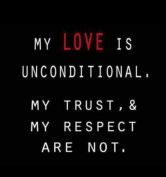 Competence and honesty are two other conditions that effect our trusting others. Our trust may have a few variables and conditions that go with it. I may trust you to suggest a good dentist for me. I will not trust you to be that dentist.
When my cardiologist showed up to place stents into my coronary arteries, I trusted him more when he told me how many he had done. I liked the guy, but that had nothing to with his competence. His experience did.
So, in addition to the things I mentioned earlier, we may trust others in differing degrees. That degree may increase in proportion to competence and experience. Generally, we don’t trust people who we think are dishonest.
When I discuss trust and judgment, I use the word discernment. Our ability to discern improves over time, often with a trail of painful lessons because we trusted people we shouldn’t have. When Ronald Reagan used the oxymoron “Trust but verify,” he was really saying “do not trust them.”
Erik Erikson theorized that trust is learned during the first couple of years of life. Regardless of how accurate that is, it seems logical and emphasizes the importance of trust in our lives from early on.
What I think is important regarding trust is not how much we have in others. We usually have some, even in total strangers. What is important is that we learn to use reliable judgment, based on experience to discern how to trust.
In her TED talk, What We Don’t Understand About Trust, Onora O’Neill says it much better than I can. Click here to watch it.
 Trusting seems natural. America’s motto is In God We Trust. Another is E pluribus unum (out of many, one), but in 1956 we wanted to make sure that our country was not confused with the atheistic USSR.
In America, it seems that we want to trust more as we deal with each other every day. Are we worthy of the trust of others? Who do we trust?
 What It Was Like
 I’ll spare you details. But during the 1990s all hell broke loose in my life and I thought it had gone into the proverbial toilet.
 I like to joke that I’m recovering from middle age. But, I am simply living my life. My life is good now, but recovery is an ongoing process. While many of my decisions may have been random, they seemed logical at the time. I was desperate, but knowing that I was not alone mattered.

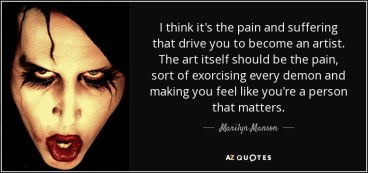
 I do believe that to a degree, suffering is optional. I’ve seen people suffer unnecessarily, and I’ve seen those same people get over it.
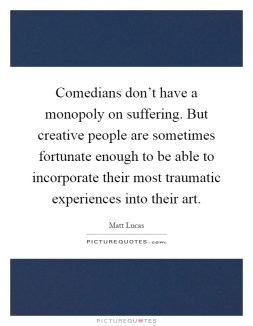 I think that what Liz bemoans is using suffering as justification to be creative, talented, or gifted, thus making an excuse for hanging on to the bottom. We shouldn’t suffer just because we think it improves our work. I’m concerned because I know people die on the bottom. I’ve experienced great things from living artists, suffering or not – nothing from the dead ones.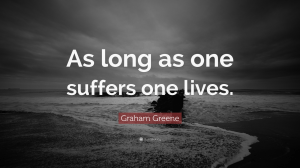
 To love what you do, and the love of doing it, even when it is gruelingly difficult (and maybe more so when it is) may be the answer. What I’ve read seems to recommend this. Love your art! Do it for the love of the work, the art, the creativity, the experience. As Stephen King says, do it for the “buzz.”





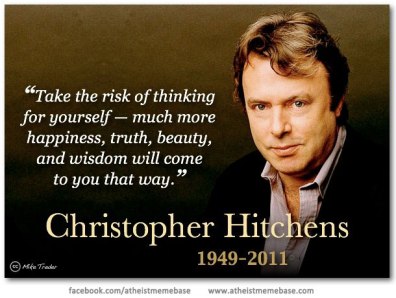
 As I listened to an interview with Christopher Hitchens, I was surprised by something he said. I’ll get back to that in a minute. Frist, I want to talk about the genesis of the question and my answer.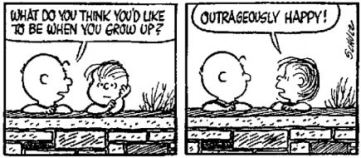
 A satisfaction tax would make a lot more sense. It seems like things may satisfy us, but we decide to be, or not to be happy. How would we measure and estimate a tax on feeling good?
 I do my best not to ‘unintentionally’ hurt somebody’s feelings. However, I’m unopposed to stepping on an emotional toe when I hear the call. As a senior citizen, I sometimes feel a sense of entitlement to do that, but I usually refrain. I once knew one guy who was so Cliff Clavin (from the TV show
  Several years ago, my daughter-in-law said that I was snarky. I appreciated her honesty and courage. I also liked it. She was right; I am snarky. I’m also sarcastic. In fact, being both makes me
 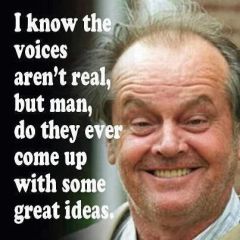 Jack Nicholson in As Good as it Gets (and other movies of his)
 Female Comedians (Yes they are)
 Not everyone has been introduced to my brand of snarkasm. After a while, when most people get to know me, they agree that I can pull it off. Many find it humorous. In fact, that’s the point – humor. I’m not on some kind of anti-PC* crusade here.
 Are you Andy or Barney?
 Some people think that ego is a bad thing. In a way, they are right. In a way, they are wrong. A wooden plaque (given to me by a friend) hangs in my room so that if I (ironically) hold my nose up, just slightly, I can see it. It says, “Humility is not one of my faults, but if I had one, that would be it.” Before you attack my lack of profundity, my friend made and gave the plaque to me as a bit of an ironic joke (I hope).
 I’m making the claim that ego is mostly good for writers. I presume that it is good for artists who work in other forms of artistic expression. I also think that being humble is good and being courageous is good. I also think that each of us should do what works for us. We’re unique individuals who share a passion (if you want to call it that). I admit that an out of control ego is a problem for more than just the narcissist, and egotistical people have their issues. But over-blown personalities write and sell books too.
 We need our ego to launch the work to readers. We need to believe that we can and want to do it. We also need to deal with whatever criticism and rejection we encounter.
 To quote from Poe’s Preface to a republishing of his poems: “These trifles are collected and republished chiefly with a view to their redemption from the many improvements (made by publishers)…I am naturally anxious that what I have written should circulate as I wrote it….” He goes on to say that it is not that his work is that important, but the people who read it are. Ego?
 In my lifetime I’ve been called a wise-guy, wise-ass, and a wise-you-name-it. I don’t recall denying any of it. But until I lost a significant amount of hair, gained a lot of scars (and weight), and dealt with a good bit of life’s experiences, no one has used the words wise or wisdom (without suffix) regarding me. So, as I was running through the w’s (women, walking, wine, wild, Wilde, and why) in search of an ‘a-to-z challenge’ blog topic, my wife says, “How about wisdom? You should know about that.” (Her birthday is tomorrow.)
 To me, the word wisdom has much in common with the word quality. Both are generally positive; we recognize them (or their absence) when we see or encounter either. But, precise definition for both eludes us. We are willing to take on as much quality and wisdom as possible, but with one condition. We want to know the cost. What price must we pay for quality? Can we afford it? What price must we pay for wisdom? Are we willing to pay the price?
 As a college student, I would walk into the Seven-Eleven store and eyeball the beer coolers. I looked only at price per six-pack. Texas Pride was 86-cents for six cans. I still can’t believe I managed to drink that horse piss, but price mattered more on my tight budget. I ignored quality. Little did I know then that years later I would gladly pay eight-to-twelve times as much for top-quality, locally brewed, craft beer. My taste and budget have both matured in quality.
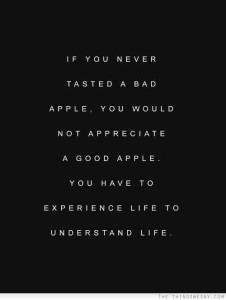 I had a conversation with a friend who was a wonderful, doting, and loving mother to her children. As I listened to her rant-on one day concerning some problem that her son was having, I asked her this question. “You love your son. Why do insist on preventing him from learning life’s lessons simply because they are painful? Be there for him. Protect him from serious harm. But allow him the dignity of learning his own lessons.” Before she got over her hurt feelings about what I had said, she backed off (he owes me). Hard for her, good for him.
 We are wiser when older because we have been schooled in life longer.
 Soon, he’d wake up, but he would not remember. He’d not recall where he’d been, what he’d done, how he got home, or anything that happened. He felt fear—the familiar fear of the blackout. He should know. He’d been there only a few hours earlier. Everyone else would know. Hell yes! They’d remember. When he blacked out like this, he couldn’t recall events from the night before. Even when people would tell him and show him proof, he could recall none of it. He woke up sick – partly due to the effects of the alcohol, but mostly because of the fear, the inevitable embarrassment, and the disgust he felt toward himself. It happened many times before. Slowly, as his eyes opened, he turned his head to see if she was there in the bed. She was not. He would face that guilt soon enough.
 No one wants to look that bad. Sam was disheveled, pale, red-eyed, much older than his 43 years, and generally unhealthy. He also smelled awful. He reeked of stale alcohol, smoke, urine, and vomit—the scene was sad and disgusting. This was a miserable couple. After years of marriage, the only things these two people now-shared were an old love, a constant desperation, and the children. Their mutual love was hidden deep, possibly buried, maybe dead. They both wondered how this was going to end. For Mary, it wouldn’t be soon enough. She forced herself to look at him. He saw that she’d been crying a long time. Tears were still on her face; new ones arising. He poured coffee and tried to look straight at her, like everything was fine.
 “I am so sorry, Mary. I promise it’ll not happen again. All I have to do is not drink. I can do it. I will start back with AA again. It’ll be ok.” She looked at him for a few seconds and then put her face into her folded arms on the table. After a few minutes, she looked up again and said, “Look, you obviously can’t stop. If you could, you would’ve. You can’t or you won’t. Either way, the outcome’s the same. You’re gunna die, or go to prison, or to some institution. You’ve been to rehab. Sam, you’re an embarrassment to your family, to me, to your kids…shit! How you keep getting jobs after being fired so often—I have no idea, but this can’t go on. Sam, you need to move out of the house and stay out.”
 After about an hour he picked up the phone and called his mother. He knew by her tone that it was she who Mary had been talking with when he woke up. He asked to talk with his father, but that relationship had become so strained that his father would no longer speak to him.
 I am an Epicurean. I see nothing wrong with that and even see it as positive. In my house I have food and drink, some of which has minimal or no nutritional value. But I like them and they bring me a certain amount of pleasure. I also have substances that have value in the reduction of pain. Chances are that you do too.
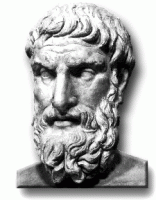 derived from fine food and drink both in a person’s taste and, as it often relates to delight-providing establishments, restaurants. Synonyms for epicureans could include hedonist, sensualist, pleasure-seeker, sybarite, voluptuary, bon vivant, and bon viveur. More related words are epicure, gourmet, gastronome, connoisseur, and gourmand; a generous, life-loving epicurean. Much of how we use the term invites thoughts of fine food and drink. I personally favor the adjective Epicurean to mean leaning more toward an understanding of Epicurus and his ideas.

