Why should anyone want to answer this question? I was asked, then immediately told no answer was expected. It’s not a rhetorical question.
When others ask my name, that’s easy enough. What do I do? Also simple. What are you? begins to get more personal. Who are you? Who am I? In terms of what? Our relationship? Am I your friend, enemy, son, father, or husband? I’m the son of, the father of, the grandfather of; but is that who I am?
I’ve always been willing to allow my pastimes to wrap with my identity. For example: I am a runner, artist, writer, dreamer, reader, etc. I’ve been less willing to do that with my profession. I know people who took their livelihood as an identity, only to feel lost when they could no longer perform at their vocation. I no longer run. When I was forced to stop, I was mildly depressed for two weeks. After that, I was fine.

Apparently, some folks think going public as an atheist raised my IQ, my awareness, and my general knowledge—all by some large measure. Other atheists and believers alike seem convinced that I now must provide answers and solutions, understand deep metaphysical mysteries, and know myself better than ever. It changed nothing about me—certainly not who I am.
Admitting atheist does not inflict anyone with knowing the source of the universe–certainly not me. Of this I am certain: if there is a god, I am not him, her, or it. On that, we must all agree. There is scientific evidence to show that my intelligence is now less than it was in the past. Admittedly, I know more trivia and I should have greater wisdom than when I was younger. My answer to life, the universe, and everything is: 42. (You get bonus points if you know why.)
I am two things. I’m the biological result of generations of genetic selection. The other thing I am is what I’ve become (maybe you’re becoming) as a result of the past 70 years of life, social and physical interactions, and learning. I have no idea why I’m male, bald, mildly pudgy (okay, the beer), or have blue or green eyes (depends who you ask). I’m also one of y’all. We’re exactly the same, yet completely different. And we both know it. But that’s not who I am.

As a writer of stories with human characters, I know more about my characters (everything) than I do about any other person. I understand them better than I get myself. I’m their god. I give them life, and sometimes death. I give them pain and pleasure. I know what they’ll do tomorrow. I know what happens when they enter those secret places where they don’t tell others what happened–I know their secret thoughts.
Last night, before going to sleep, my wife asked, “Are you going to walk in the morning?” I said, “I don’t know.” I walk virtually every morning. Today, I did not. My characters are much more dependable.
I am who I always was, and who I will be. I’m the sum of the past. I am part of you, as you are of me. I know who I am at this moment. Right here and now, I am who and what I am. If any deeper, more esoteric, philosophical, theological, sociological, or scientific answer is required, then my answer shall remain forever insufficient.
I don’t know everything about me, but I know enough. We’re gunna have to live with that.
To you, you are who you say you are, what you believe, and what you do. To me, you are who I say you are—it’s my opinion–subject to error and change.
But, is “who am I?” the critical question? I think the most important question is: who are we? How do we define us? We may add layer upon layer of humanity, and layer upon layer of nature, then layer upon layer of the universe. We are still in this together and we need each other.
As me dear departed Irish fadder often ass’d meh, “Whoda hell d’yeh tink ye’re?” Since that usually precipitated me being in a jam…“Exit stage left!”
Who am I? Look both ways.


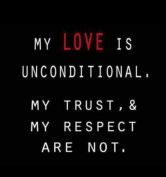 Competence and honesty are two other conditions that effect our trusting others. Our trust may have a few variables and conditions that go with it. I may trust you to suggest a good dentist for me. I will not trust you to be that dentist.
 Trusting seems natural. America’s motto is In God We Trust. Another is E pluribus unum (out of many, one), but in 1956 we wanted to make sure that our country was not confused with the atheistic USSR.
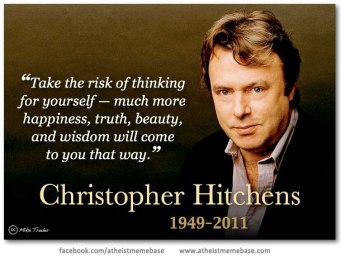 Retiring and moving to the Seattle area provided time for me to consider my beliefs in greater detail. I read more about atheism, and I started to write about it.
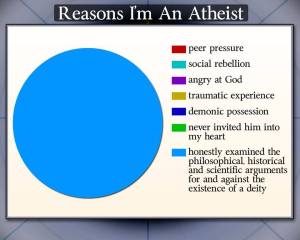
 You have to pass a test to be an Atheist. Did you know that? And the damn test never ends – you take it repeatedly. The questions may be the same, or they may keep changing. Every answer you give will be wrong. You’ll be forced to keep explaining and justifying your wrong answers. You may be criticized by your family and friends for not choosing the correct answers. Knowledge will not help. If you try to use science, you will be told that you know nothing of science. You’ll be given a grade of F for trying to use it to explain your position. If you dare to use logic or philosophy: F. History? F! God forbid that you use religion/scripture/dogma: F-minus.




 Is it all that important to be a thin, white, dark-haired, strong, male member of this country? We seem to think so. I hope that continues to change.
 I am retired. All the shit/crap that I put up with for all those years of school (nuns-groan), yes, sir and no, sir; kissing up to very few idiot bosses (most were great), scrimping and saving and working – it was all worth it. As my wife would say, “Rave on, dog shit!” And so I do. Every day is a weekend and I can do what I want (with her permission—I’m old, not stupid) whenever.

 Two memories from my youth relate to this post. I recall my mother frequently telling me that I was contrary. She would say, “Now Billy, stop being so contrary.” She could have chosen from many words: obstinate, difficult, stubborn, negative, or silly. Actually, that’s not true. She used silly a lot, as in, “Silly-Billy.” I actually liked being called silly and still do. Today, such a fun-loving attitude coupled with silly behavior would prevent a diagnosis of Oppositional Defiance Disorder (ODD).
 As a youngster, I did have more than my share of confrontations with adults, especially those in positions of authority. I admit it. Mom was right (aren’t they all?). I was often contrary and many synonymous terms applied equally well. I confess that I enjoyed being difficult, most of the time. Sometimes, I paid for it. Some say I never outgrew my contrarian attitude.
 The other memory comes from the time of my early to mid-teens. I don’t know where if came from, but we adapted a phrase for a while that was intentionally meaningless, but we said it – a lot. It was kind of an early version of whatever! We would say it to each other and often to adults. We always knew exactly what the adult retort would be. The locution was Yeah, but, or yeahbut. Today, the Urban Dictionary says yeahbut should be followed by f**k, but we seldom used those words in combination.
 However; yet, nevertheless, nonetheless, even so, still, notwithstanding, in spite of that, for all that, and all the same; I do like butts. Some more than others.


 So, I know when I made the change from young to old. It was about 40 years ago.
 Have you resigned yourself to the “it’s just a number that’s too friggin’ big” mentality? I’m not complaining about being old. Old people do not intend to complain about age. It is, after all, a successful result. On the other hand, the various consequences of age can’t be overlooked.
 If we live long enough, we share one important thing with many teenagers – we become bored easily. Old people can be annoying to some young people (15 years, remember). The thought that the feeling may be mutual seems to escape many. Most older folks that I know are working away at life. I know writers in their 80s and 90s who write every day, are working on writing books, and are making plans to publish.
 I live in an over-55, “active” community. Some folks here are more active than others, but most are kind of amazing. I took a blogging class where I met a lady of 92. She’s smart, funny, and still learning. She taught art classes and one of her subjects was art by carving vegetables. She made a scrap-book of pictures and writings on veggie art. She is an expert. Based on her experience, maybe the only nonagenarian expert. She wants to publish this in a blog. I can look past the outer physical things that show up when one is 90+. This lady is a master at her craft and learning another so she can share the first. I think that’s cool. In heart and mind, she is young, enthusiastic, and capable.
 I just returned from a “Personal Creative Writing” class. There are 15-to-20 of us taking the class. Most are interested in writing life stories or memoirs. These folks are talented writers; some are published authors; all are able to tell it like it was. They have the ability to make every life story funny, and even sadder memories are delivered with humor. They are good at their craft, but no one can accuse them of taking life too seriously.
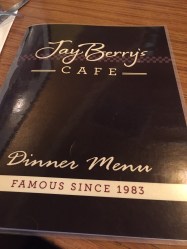 My first restaurant review is of
  The receptionist area is where the cash register probably was back in the day. The two inside seating areas are separated by two steps (ADA?) with no visible ramp. Some tables are a little close for girthy customers, but it’s manageable. Ambiance is comfortable and ok, but should be a ready for a little rehab soon. Most tables seat four, but can be moved to accommodate larger parties. There are no booths. The acoustics are average and loud voices are easily heard.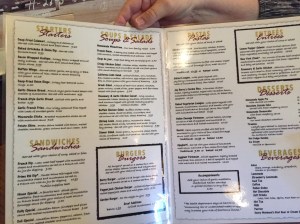

 The server explained some things regarding the pasta and we ordered a Greek salad and Spaghetti Alfredo (they did not have fettuccini). The wait staff was energetic and service was almost too fast. They are a little blunt and straight-up for some customers, but I think it fits the charm and atmosphere of the restaurant. While I’ve had better salads, it was ok. My wife thought the alfredo white sauce was subpar. The waiter boxed up her leftovers. I tried it the next day and found it on par with what comes in a jar from the store.
 Overall
 In my lifetime I’ve been called a wise-guy, wise-ass, and a wise-you-name-it. I don’t recall denying any of it. But until I lost a significant amount of hair, gained a lot of scars (and weight), and dealt with a good bit of life’s experiences, no one has used the words wise or wisdom (without suffix) regarding me. So, as I was running through the w’s (women, walking, wine, wild, Wilde, and why) in search of an ‘a-to-z challenge’ blog topic, my wife says, “How about wisdom? You should know about that.” (Her birthday is tomorrow.)
 To me, the word wisdom has much in common with the word quality. Both are generally positive; we recognize them (or their absence) when we see or encounter either. But, precise definition for both eludes us. We are willing to take on as much quality and wisdom as possible, but with one condition. We want to know the cost. What price must we pay for quality? Can we afford it? What price must we pay for wisdom? Are we willing to pay the price?
 As a college student, I would walk into the Seven-Eleven store and eyeball the beer coolers. I looked only at price per six-pack. Texas Pride was 86-cents for six cans. I still can’t believe I managed to drink that horse piss, but price mattered more on my tight budget. I ignored quality. Little did I know then that years later I would gladly pay eight-to-twelve times as much for top-quality, locally brewed, craft beer. My taste and budget have both matured in quality.
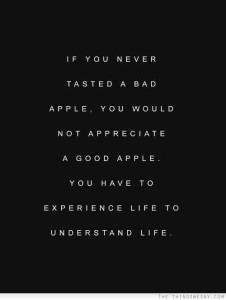 I had a conversation with a friend who was a wonderful, doting, and loving mother to her children. As I listened to her rant-on one day concerning some problem that her son was having, I asked her this question. “You love your son. Why do insist on preventing him from learning life’s lessons simply because they are painful? Be there for him. Protect him from serious harm. But allow him the dignity of learning his own lessons.” Before she got over her hurt feelings about what I had said, she backed off (he owes me). Hard for her, good for him.
 We are wiser when older because we have been schooled in life longer.
 Yolonda, my wife of 50 years (we married at age 2), is a native Texan and has her ‘druthers.’
 Billy on right, (w/Phish bassist Mike Gordon), our oldest child is in his mid-40s, a very nice, loving, big-man. He’s always been an avid reader, a talented writer, a movie aficionado, and a hard-core Phish-head. Add bicyclist, father, hubby, friend, musician, and deep-thinker.
 Steven is our middle-child, now in his early 40s. He’s another good guy. An avid sports fanatic (Spurs and Cowboys) and mountain biker. Add hubby, step-father extraordinaire, house music DJ (Steve Balance), friend, and all-around cool-dude (maybe pragmatic and analytical). He initially said that he had no fav quotes, but when he and his sista’ got to texting, there they were.
 Our beautiful ‘baby’ is Julie. She can recite every line from the movie Grease (oddly did not quote it), is an artist, a thirty-something, 21st Century hippie, a mom and step-mother. I think she is a wonderful writer and, like her mom, a Grammar-Nazi. She lives in the middle of nowhere with her hubby, son, occasionally a step-son, or two lovely elves, too many cats, horses, and sometimes (because he likes to chase the horses) a dog.
