Father Daughter Collaboration Poem

This poem is a collaboration poem written by my daughter, Julie, and me. We both worked on it. In fact, she initially wrote the first part, as a poem to me. It is not renga because it meets none of the normal forms. It is simply two people writing a poem to each other and collaborating, so style and form are free. One could look on it as a duet, or father – daughter billets-doux (love, or sweet letters). Ardor means enthusiasm or passion. My portion is italicized.

Dewey and Dad
by Julie Barber and Bill Reynolds

You are my father, tried and true
And you my daughter through and through.

You know my heart, my feet and hands too.
Some even say I look like you.
From birth and to your life throughout,
I’ve been there for you, without a doubt.

There was a time when things were harder.
I hope I’ve grown and become much smarter.
If we could go back, I’d want you my daughter.
Together we’ve grown older with ardor.

My father, wiser by the day…. Always profound things to say.
Sharing our life keeps misery at bay.

I look to you when the answers are grey.
You say, “let nothing get in our way.”
You heart and your talent come into play,
Find peace therein, as you work away.

Go out and write and use your talents
It will give your life more sense and balance.
Your words are like clay, your pen is your pallet,
Your life is your muse, your mind is your mallet.

Get off your ass and do it already
The world is uncertain, and time is unsteady.
It’s your life to live, you should live it as heady,
Be happy my child, ‘tis all worth it, you’re ready.

The fact you’re so far away makes me sad
But I’m more than proud and grateful you’re my dad.

She’s Julie, but I call her Dewey

Forever you’ll be my daughter to me,
A lifetime of love, we certainly have.

My daughter, our love surpasses all distance
No oceans divide us, our minds unite us.

As we see one to the other, it will always be,
You rank above others swimming the sea.

Mind the gaps, family, love, friends, and the important things in life.
Look both ways, and all around.

Faces in the Mirror

What would it be like today, if I could see all the faces that you have reflected? You only reflect me the way I look today, older and very different than when we first saw each other. I don’t recall that day, because it was almost 70 years in the past. Before that, you had reflected many other faces for as many reasons.

Since before I was born, you always had your place in our home, on the west wall of our dining room. There, you were centered on the wall, above the old sideboard buffet, which was also a permanent fixture. As anyone walked past you going to, or returning from, the kitchen; you reflected their profile. Before leaving home, we all stopped and faced you for your final review and blessing as we took one last look. Mom and Dad used you to check the look of their hats reflected in your glass.

Since your total viewing area is only one foot by a yard wide, you never revealed much about us below the neck and shoulders. Yet, you remained our primary, go-to mirror even after several full-length mirrors were installed. I recall the day my brother stood staring at you when he pontificated, “You know, Billy, you’re only as good as you look.” I never agreed with him. Did you? I suspect that how people look is important to you. It’s your purpose.

Every year, on Palm Sunday, someone would change out the palm frond strip hung prominently across the top of your frame, where it would remain for the year. That was sort of the family way of dressing you up for Easter Sunday. It was always the same.

The only time you, or any of those items around you, were moved, it was for painting walls or changes to the floor coverings. But you, the mirror, and below you, the side board, were always restored to your rightful, prominent places. Mom and Dad did not change furniture often, but they never booted you from your space.

How many photographs, cards, messages, and notes were stuffed between the edges of your glass and your frame? What did they say? Were they important?

You are in old pictures from my grandfather’s house (the one my mother grew up in), taken long before my birth, showing you along with two side sconces, both long gone. I never met any of my grandparents, but you did. I’m sure my Mom’s father looked at his reflection in your glass. Maybe her mother, too. I can envision him holding his young daughter up for you to see. Who else saw themselves, and the reflection of others, in your glass?

Beginning in the 1920s or 30s, every member of my family must have looked at you. When did you come into being? Every friend who ever visited our house saw their reflection, and probably that of others, when they looked at you.

You have survived the Great Depression, the FDR, Truman, Eisenhower, and Kennedy years, World War II (and possibly WWI), several rough moves, and whatever untold disasters that occurred during your 44 years in my parents’ home. For the past twenty-five years, you’ve been undamaged by my hauling you from one end of the country to the other.

Your ornate frame has a few nicks and scratches revealing hints that the wood beneath your gilded frame’s lamination is red. The corners of your frame are secured with two wooden dowels each, all attesting to the creativity and craftsmanship of an earlier time, when some master mirror maker worked magic.

While you’re a handsome and distinguished antique, it’s not you the mirror that provides the mystery and intrigue. It is the many thousands of faces that underwent self-examination as you watched, the hundreds of times a tie or hat was straightened with your approval, or when an Easter Bonnet was set to one side, and then given an approving nod.

Oh, mirror on my wall, holding the history of thousands of changing faces within your glass panes, do you remember their smiles and their tears. What do you remember? What secrets do you hold? Will you show me those reflections so that I may see whose lives you’ve shared? I recall with fondness and sometimes sadness, the pictures in my memory of the many times I stood nearby, and watched, as others used you to reflect a special moment in time. Show me their faces today, so that we might name the names.

When you look in a mirror, wonder.
Who else has looked this way? Who will?
Look! But, look both ways, and mind your gap.
Understanding Poetry

Let’s face it. While poems are to express a feeling or an idea in a certain style, we don’t always understand them. I love poetry. I try to write it. I admit that it can be more complicated than we prefer, and perhaps more than this Old Texas Aggie’s gray matter can process.

poetry-2

Sometimes, as with music, it just sounds so damn good, even though I have no clue about the subject or purpose of the piece. Poetry sounds especially wonderful when read by the right, good voice. It works for me, even with my uncertainties about understanding the art.

I like the synonyms for poetry, chiefly versification, metrical composition, balladry, and the archaic (and perhaps politically incorrect) poesy. Occasionally, I run across a fine piece of balladry that I not only enjoy and understand, but I also relate to with some internal passion — Hell Yes!

I love irony in life, in writing, in humor, and in verse. It strokes my silly ego to find others who give a pass to the literal minds of the world, and share my ironic reality. Last week I was handed a poem that was published in Stanford Magazine (Jan/Feb 2017), written by Mary Poindexter McLaughlin, titled: Alma Mater.

poetry-5

For me, this poem glorifies the wonderful simplicity of ordinary lives, and it resonates in me the value of things like freedom and love and family and friends. All of which wear the tag: priceless!

ALMA MATER

My apologies for using a link, but the publisher is unable to grant permission for me to republish at this time. Please click here to read the short poem from the Stanford Magazine page.

Because this is from the magazine of a prestigious American University (Stanford, I did not go there, but she did), I think Mary is referring to her alma mater. But, she could also mean any parent, friend, or muse who we believe had greater material expectations of us. It reminds me of that meme, “How do you measure success?”

poetry-3

Here are four lines of my own poetic dribble. I have been massaging this clunker for a while, there is more, but it’s nowhere near finished. I wonder if it conveys the right emotion.

Always, you’ve been here with me,
As children, we survived my foolish resistance.
While we ponder our thoughts, I sense yours in me,
As we bind together, into one two-sided life.


poetry-1If you wanna write some, there are on-line poetry challenges, such as NaPoWriMo during April (sign ups begin 1 March 2017). You will be challenged to write a poem each day. I do the A-to-Z blog challenge during that month, so not sure that I could keep up. Maybe.

…. Great love. (In tribute to Pat Conroy)

Poetry or prose, mind the gaps and look both ways.

Our Struggle with Love

valentine-2

Mom frequently told me that she loved me. I don’t recall Dad saying it. If he told me, it was seldom. They both loved me; and while I loved them back, the feeling that I had was not the same for each. What was that? One word with so many meanings.

We even manage to say love to express approval of inanimate objects, “Oh, I love that pizza.” Or, as my young grandchild copied from his mother, disapproval: “I’m not lovin’ it!” He was too young for such a trendy (now trite) phrase, but he understood it.

If we considered all the meanings we have for the word and lined them up on our continuum of human emotions, the variety would defy any logic we use to keep saying it. Fortunately, context helps us out and we socially understand each other’s intent. We would need to invent too many new words to replace love. Someone once told me, “I love you, but I’m not in-love with you, if you know what I mean.” I understood and welcomed the explanation since the first three words could be concerning, but still not necessarily unwelcome.

valentine-1Regarding romantic love, it is one of the most fantastic feelings we can experience. We can even see that love feeling in friends who have fallen into love, head over heels. More evidence for the wonderfulness of amour is that the love and lust emotions get us in so much hot water, but we seem to dive right in anyway. It’s such a good thing. Would we be human without it? Barring some interfering DSM IV, mental problem diagnosis, we all love someone, and usually many people. And each feeling of love will be different from person to person, but it’s still love.

All love makes this world a better place. We’ll never have too much love in the world, but we seem to have too little of it. We have faced that since the beginning of time – too little caring about each other.

Enjoy The Youngbloods as they sing one of my best-liked, hippy love songs from the 1960s: Get Together. I’ve provided the lyrics below, as well as links to two other love-tunes.

The Youngbloods – Get Together lyrics

Love is but a song to sing//Fear’s the way we die//You can make the mountains ring//Or make the angels cry//Though the bird is on the wing//And you may not know why.

Come on people now//Smile on your brother//Everybody get together//Try to love one another//Right now.

Some may come and some may go//We shall surely pass//When the one that left us here//Returns for us at last//We are but a moment’s sunlight//Fading in the grass.

Refrain//refrain//refrain

If you hear the song I sing//You will understand (listen!)//You hold the key to love and fear//All in your trembling hand//Just one key unlocks them both//It’s there at your command.

Refrain//refrain//refrain

Right now…

Right now….

Also, Haddaway’s is a more erotic and fun video of What is Love (click here); and Dionne Warwick finishes up with What the World Needs Now is Love (click here). None of these songs have many lyrics, but I love them anyway.

valentine-3

Happy Valentine’s Day.
Remember, love is a two-way street.
So, mind the gaps and be sure to look both ways.

Pray for What?

prayer-1

If I’m your guest for dinner and your family tradition is to hold hands or bow your heads to pray, or we’re at a restaurant, and you want to pray; I’ll respectfully observe your tradition. I don’t say grace nor will I ask your God to ‘bless the meal;’ however, I’ll not be disrespectful. If you’re my guest, you may expect the same courtesy. I don’t pray, but if you do, it’s ok.

In Catholic grade school, we recited Grace Before Meals before lunch, and Grace After Meals when we returned. I don’t recall saying it with my family. As an adult, I said the short prayer you can see on virtually any episode of Blue Bloods. If you take too long and the food gets cold, I may pray for an end to your jabbering.

prayer-3

I consider some, perhaps most, prayer to be harmless and it maybe even good for you. That’s right. I said some or most. Openly expressing gratitude, which is perhaps the least felt of all human emotions, should be a good thing. But, in my opinion, not always.

Thanking God for the touchdown is silly. So is divine gratitude for a political candidate winning or for scoring in the lottery. These examples are nonsensically selfish and may be harmful. While I’m good with being grateful, I’m not okay with all forms of prayer. I shouldn’t care, but I’ve long held my opinion.

I’m fine with prayers of worship like God is Good, but if I hear God is Great yelled in Arabic, fight or flight may take over. Back as far as I can remember, I had issues with asking God for anything. It made no sense to me — still doesn’t.

My parents told me that God helps those who helps themselves, or a similar form of the phrase. I’ve never given up on the basis for that idea. For example, I went to see a house being remodeled and found the painter sleeping. After inquiring about his health, I asked if he worried about being fired. He said, “The good Lord will provide.” Raising eye brows, I said, “Oh. I see.” Lucky him. I wasn’t the owner.

prayer-4As often happens following severe droughts in South Texas, the many weather gods provided too much rain. Severe damaging floods came after the months of virtually no rain. As Father Conor McGrath was reading announcements from the Parish Bulletin in his wonderful Irish brogue, he adlibbed a joke by saying, “And would the gentleman who is still praying for rain please stop.”

Another time McGrath told us the joke about the man named Thomas, who continuously prayed to win the lottery and began to lose his faith. The gambler blamed God’s failure to grant the prayer as promised. I can still hear Father Conor deliver the punch line from God, “Thomas, I need a wee bit of help here. You’re needin’ ta buy a ticket first.” We must do our part.

Valerie Tarico made some good points in her post about why some prayer is neither valuable nor innocuous. It encouraged me to make my own case.

She said, “Atheists, agnostics and other secular activists may think prayer is hogwash, but a lot of other people like praying and they like to think that it works. So, why not just leave the habit alone? It seems harmless enough.”

Later, after she highlights some of the perks of prayer, she presents her case against the troubling hidden costs of petitionary prayer. This is her list of 7 problems, with comments that are mostly mine.

Petitionary prayer:

  1. Suppresses critical thought. During our meal, if you begin to choke on a turkey bone, would you prefer that I pray for your recovery, or would you like me to perform the Heimlich Maneuver to dislodge the culprit?
  2. Undermines agency and responsibility. Let go and let God, right? We are not responsible for anything this way. Remember the painter? I agree that sometimes it’s good to let go of things. But, we need to do what we can (think Serenity Prayer).
  3. prayer-2Promotes a habit of self-deception. If God is right, why bother? Wouldn’t he do that same thing even if we didn’t explain it?
  4. Distracts from more promising endeavors. This is one of the most profitable things sold by TV preachers. What else might those resources do? Feed the hungry or clothe the naked?
  5. Promotes victim blaming, including self-blame. If God grants requests from some, what does that say about those who get no response? If God heals your wart, but not mine; something must be bad about me.
  6. Teaches people to mistake abuse for love. Deferring to Ms. Tarico, “Being forced to praise and adore a powerful person who requires vulnerable dependents to beg for what they need…and who then grants or denies these requests in some inscrutable pattern, is not love. It is abuse—and as many former Christians have testified, it primes people, especially women—for further abuse.”
  7. Replaces compassionate action. There are times for inaction and times to act. We are all in this together and helping one another is what we do best. Tarico refers to Julia Sweeney’s monologue, “Letting Go of God.” I watched it. It’s well-done and funny, but two hours long. If you’re of the Free Thinker persuasion, watch it — especially if you were raised Catholic.

As I’ve implied, some types of prayer, like contemplative meditation, gratitude, and communing with something greater than ourselves, may be useful even for non-believers. But, Valerie Tarico said it best.

“It’s time to get off of our knees and take care of ourselves and the people around us. We’ve long passed the infancy and adolescence of our species. Regressive fantasies can be delightful, but at some point, clutching a teddy bear and squeezing our eyes shut and lisping “Now I lay me down to sleep” ceases to be sweet. The world needs adults who, in Sweeney’s words, are willing to get up in the morning and mind the store.”

May we all live in the real world and acknowledge that we need each other more than invisible fantasies born from the minds of men.
Mind the gaps, the store, and look both ways.

Atheist Perspective on Christmas


atheist-xmas-3Since this is my first December and holiday season as an admitted atheist, it seems fitting to discuss Christmas from my nonbeliever perspective.
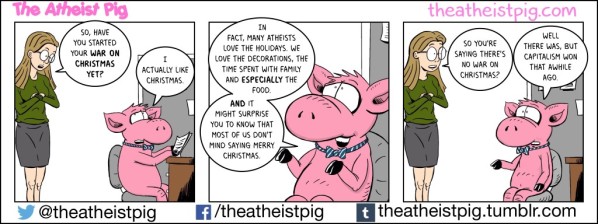

Much has been said and written about the secularism surrounding the holidays, and I’ve decided to provide my personal perspective. This is my 70th time partaking of the Christmas season celebration. So, much of what I say and do has precedence in that it’s what I’ve been doing for years.

As I write this I’m hearing the news from Germany of a large truck being driven into a crowd of people celebrating the holidays and the Russian Ambassador to Turkey being assassinated. The majority opinion seems to be that both events may be related to terrorism and religion, or at least god politics of some kind. And the list of such deeds goes on. None of this is in the holiday spirit. But as Christopher Hitchens subtitled and wrote in his book, “Religion poisons everything.”

Tantum religio potuit suadere malorum.” (To such heights of evil are men driven by religion) ~ Lucretius

For years, this was the season when we tried to spend quality time with family. Beginning with Thanksgiving, it’s a busy travel season in America as families reunite for celebrations. We’re surrounded by hype. But I enjoy the hype more than I like to admit.

I look forward to Halloween each year, partly because it marks the start of this season. Christmas is a happy time, a great time for most children. There are football playoffs, and bowl games. Winter begins, Yule is celebrated, and I like to look at snow. Dealing with it sucks.

In the home of my birth, the smell of the house changed, mostly due to the tree. But the house would also take on the aroma of whatever adult beverage had been opened. Aunt Lorry, who seldom drank alcohol, always brought port wine. Port is some powerful vino.

The thrill of gifts and happy people occupied our thoughts. We went to church. A little hut was built in the yard next to the church with a nativity scene inside it, behind thick glass and a locked door. There was a slot to deposit money for the poor, until someone started to rob it. Then they stopped using the box, and eventually the little hut went away. They must have assumed the thief was not one of the poor.

I don’t recall going to midnight Mass as a kid, but I probably did once or twice. Years later, I went several times. It was always crowded. All those Catholics who only went to Mass on Christmas and Easter would show up. By then, there was only one Mass on Christmas Day — all the others were vigil Masses on Christmas Eve. Going to church on Christmas day was inconvenient, at best.

Christmas was a “holy day of obligation” which meant that if you did not go to Mass that day, you would burn for eternity unless you made it to confession. I’m oversimplifying, but I was a child back then.

atheist-xmas-4

Some Christian denominations don’t celebrate Christmas at all. And for non-Christians, it’s not celebrated as anything more than a secular holiday. But Christian or not, no one in the USA escapes the hype of Christmas. I provide gifts and greetings appropriate to this time of year and the holiday. I helped to decorate a big tree and to put up other decorations this year. I went to our party and may have sung some Christmas songs.

I fully understand the religious aspect of the holiday season (be it Christian, Pagan, Jewish [Hanukkah], or others). While I don’t agree with any religion, I think the intended spirit of caring is good. For me, family, friends, caring, giving, and delighting in nature are all the good things. So, like many atheists and other non-Christians, I join the party as I have for almost ¾ of a century.

atheist-xmas-2I’ll continue to celebrate the season much as I always have: eating and drinking too much while overdosing on football. It’s a fun cultural and secular holiday with many features that benefit life, whether one believes in any god or not.

I don’t see my enjoying the holidays as a big deal any more than I do saying “bless you” when someone sneezes, or “God damn it” when things go wrong, or when I use the word “god” or “Jesus Christ” to express pain or anger. But cussing is another story for a different blog. Unfortunately, the holiday season is a stressful or bad time for some people.

atheist-xmas-5If it busts someone’s chops that atheists enjoy the holidays, that’s a bummer. We intend no harm by joining the festivities. I suggest those humbugs pass a law that says one must be Christian to enjoy the holidays. Until then, you’ll find me hangin’ ’round the mistletoe.


I suggest you try Joey’s take on this by clicking here.


Happy Holidays.
May there be peace, love, and a thousand sugar plumb fairies dancing in your heart.
Look both ways and mind the gap.

Passionate Disbelief: A Testament to Effort

hemmingway-first-draft

It may be just another from there-to-here story, but it is mine.

Officially, I haven’t written in my memoir for about two weeks. Sure, I typed over 50-thousand words for Nano in November, but so what? This isn’t just the telling of any story, it’s the recording of a part of my life. That first whack during Nano (something less than a 1st draft) is like putting primer on the wall before painting or prepping a canvas.

When I tried to make an outline, I ended up with a list of events somewhat out of order. Each time I had a memory or an idea, I quickly added it to the list. I now have a list of 165 items, memories, or events. There are a few duplicates, some ideas aren’t useable, and for some I still have no idea what I was thinking about or why I added it to the list.

I’ve glossed over a few how to write a memoir books. Now I’m slowly reading Your Life as Story by Tristine Rainer. I just finished Writing is My Drink, a memoir by Theo Pauline Nestor. Giving all this thought to autobiographical writing has enlightened me that I prefer non-fiction to fiction. I prefer autobiography to biography, and specifically memoirs. I like history. In fiction, I prefer real life/real world stories to Sci-Fi or fantasy. It’s complicated. I like them all. Anything done well is better than my favorite genre not so well done.

I’m even considering changing last year’s novel to an autobiographical novel, and rewriting it from third to first person. But that’s for later. For now, I want to keep working on this memoir. While I’ve not recently written much in it, I have been working on it. Organizing both it and meh-self has taken a bit of time.

About 80% of my writing is rewriting, and if you know how Nano goes (thou shalt not edit), that effort will require mooch-o rework. It’ll keep me off the streets, out of the bars, and out of most trouble for a while. I enjoy rewriting, editing, correcting, and improving my own work more than writing the first draft. Maybe that’s cuz I don’t have to create (think) and spell simultaneously.

Writers get it.
Writers get it.

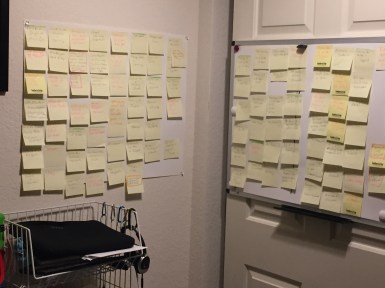
I’ll be right here, in my 11×11 spare room. This is my work-space, set up with folding tables that I can take down to turn it back into a bedroom when we have visitors. While I sometimes find other locations to write, I prefer this one. I got all meh stuff around me. And look at these post-it notes behind me. Each one has one or more of the topics contained in my memoir. Those written in pink or orange highlighter are yet to be written. It’s how I’m organizing the thing until I learn Scribner.

A memoir of post it notes

Below is my view from the chair at my computer. The sock monkey on top is the kind that rolls around and laughs, in case I need a lift, or someone walks in here and asks me what I’m doing. A couple of windows to my right provide an uninspiring view of my neighbor’s rooftop. But I want to know when it’s raining — pluviophile, remember?

The view from my writing nest

Here is a little snippet from my memoir. I was 17, would soon graduate from high school, and was Air Force bound in a few months. Shirley was my sister and Danny’s meh big brudder.

As a senior in high school, my guide and advisor regarding entrance into the military was Shirley’s husband, Jack M. This hard-core, active-duty, career Marine gave me all the advice he could – more than I could assimilate. Jack was a highly decorated First Sergeant (Sergeant Major to be) and a veteran of both WWII and Korea. He would later complete two tours in Viet Nam, and he would resent being denied a third.

Sergeant Major M. was a true warrior. He was the guy you want on your side in a fight, but not necessarily the man you wanted in any situation requiring sensitivity, grace, or political correctness. Despite this, Jack was a boisterous and friendly Italian-American from Ohio who seemed to be liked by everyone.

Jack and Shirley were both Catholics, but were married by a Justice of the Peace because Jack was divorced. Eventually they were married into to the good graces of the Church, which seems strange because they never practiced their religion, or if they did, not for long.

One day Jack and I were browsing through a hardware store so he could tell me what to buy and what was good stuff. This was back when hardware stores had everything or knew where to get it.

Jack pointed at some hunting knives in a case, “Yer gunna want a good knife. Your own. Not too long, but you want good balance, feel, and steel that won’t break on bone. In the Marine Corps, everyone has a knife.”

I looked at him, “Jack, do you think I should join the Marine Corps and not the Air Force? It’s not too late to change.”

“Oh Jesus, no. First off, yer Mom would hate me, if not kill me. But I gotta tell ya, Billy. Yer Air Force material. The Marine Corps don’t work out fer kids like you. Shit, the Marine Corps is not for you.”

Jack was right. The Corps had not worked out well for Danny. Why would it for me?

Jack picked up a knife and pointed it at me. “But, this knife here looks like a good one. It’s Solingen steel and I can tell ya, the Krauts make good stuff like this. Feel it and see how it fits ya. How’s the balance?”

Jack bought the knife as a gift for me. It had a straight, one-inch wide, thick steel blade. The handle was black plastic inlaid with a red and white diamond symbol, and a black metal sheath. I soon realized that Marines have many more good uses for knives than Airmen do.

Note: My Air Force career spanned over 45 years; 22 active duty, the rest civilian. In my last job before retirement, I worked on Eglin Air Force Base for a Marine Corps Colonel. I enjoyed telling him this story.

Only you can tell your story.
Just mind the gaps and look both ways.

Nano Rebel – Dream On

2016 Nano ends at midnight next Wednesday. I’m passing 48 of the 50K goal today, so I’ll meet the challenge this weekend. However, as anyone who writes knows, there is much more for me to do.

musing2

For the past four weeks, my life has been like this: up between 5 and 8 AM, plan to write, but read the news, read and answer emails, look at my memoir and plan some more. But I only write a little. Look at Facebook and write some snarky comments there, read some blogs, go for a walk while listening to music for about an hour; return, eat, stretch, talk to wife, and finally begin to write.

Following an hour of writing; take a break, eat more, get coffee, then back to writing. After pushing out about a thousand words, take a long break and do more useful and constructive things like doing dishes, replacing light bulbs, talking to neighbors, and reading. I write more in the late afternoon and evening with interruptions for football, NCIS, or Blue Bloods. It seems to have worked because I’ve averaged almost 2,000 words each day.

musing1But this memoir – the thinking, remembering, musing, pulling out old photos, doing ancestry research, looking for old friends and finding some, but reading obits of others — it’s so different because it is about me and people who’ve affected my life. Learning and writing about myself every day is interesting for a guy who disliked writing about himself.

Writing fewer words on this blog so you can listen to the song and see the lyrics that say it for me: Dream On, by Aerosmith.


Indeed:

Half my life
Is books, written pages
Live and learn from fools and
From sages
You know it’s true, oh
All these feelings come back to you….

musing3“Sing with me, sing for the years, sing for the tears.”

We dream on, love on, live on;
but look both ways and mind the gaps.


DEATH

The inevitable & unavoidable conclusion to life.

During late October many cultures begin preparing for the first days of November. They remember the dead, acknowledge the end of harvest, and prepare for the dark days of winter. It begins with Halloween, then All Souls’ or All Saints’ Day, The Day of the Dead, and Samhain. Many believe it’s the time of year when we’re closest to the other world and death itself. The Fairy Tree story that ends this blog tells a wee bit more.

death6

It’s our only certainty—we die. Beliefs about what follows the end of human life range from nothing to Paradise and 72 virgins or reincarnation. Let’s not forget the whole Dante’s Inferno thing. Our beliefs about an after life affect our choices while living.

While no one has told of their experience following permanent death (we have near death accounts), there are stories with bits of information. Little of it is dependable or useful. Theories abound, but the database of the deceased is void of demonstrable facts. Only the dead know, and they’re not talking.

Efforts to resist death seem logical, but are eventually fruitless. While many consider death a condition leading to afterlife, most people (not all) avoid dying as long as possible. An exception is when living prolongs a life of hopeless suffering. Others choose death through martyrdom. We disagree about our right to die (whole other blog) and we normally work hard to keep living.

death4In the United States, more than two-million people die each year. The CDC reports the top four causes as heart disease, cancer, respiratory disease, and accidents. I say, smoking, smoking, smoking, and driving plus illicit drugs because they are the major producers or triggers of those four “causes.” The root cause of most preventable premature deaths in the USA is smoking (so quit).
It can be difficult to determine the difference between a still living or recently deceased person. Without more information, we can only define death as an absence of life. Our legal descriptions require a physician to certify the time and cause of death. While absence of all brain activity normally defines death, court cases fog the legal definition. When there are uncertainties, we gain information through autopsy.

death3

While we’re fascinated with death, many of us avoid serious discussion of it and find it morbidly unpleasant. The death of friends, loved ones, and people we hold in high esteem represent the ultimate, painful loss. Our own death signals loss and aloneness, which is sometimes comforted by religious beliefs.

death2

Yet, we sing of death, we write about death, and we (should) discuss it. We often honor death’s inevitability with both art and science.

Since first hearing it, I’ve liked Ralph Stanley’s (died, June 2016) rendition of the song, Oh, Death, which is a plea with the Grim Reaper for another year of life. It was made famous in the movie O Brother, Where Art Thou? Hear a short version by clicking here.

From a list of ten poems about death, I selected two by famous poets. All ten can be found here.

“Death” by Rainer Maria Rilke (died 1926)

Before us great Death stands
Our fate held close within his quiet hands.
When with proud joy we lift Life’s red wine
To drink deep of the mystic shining cup
And ecstasy through all our being leaps—
Death bows his head and weeps.

From Queen Mab, by Percy Bysshe Shelley (became famous after his death in 1822)

How wonderful is Death,
Death, and his brother Sleep!
One, pale as yonder waning moon
With lips of lurid blue;
The other, rosy as the morn
When throned on ocean’s wave
It blushes o’er the world;
Yet both so passing wonderful!

death1Life is the time made precious by our inevitable death. May we fully enjoy the many pleasures and loves discovered and experienced while living. And may we all “…lift Life’s red wine to drink deep of the mystic shining cup…” because death is next for each of us.

Life is uncertain, look both ways.

Why be Atheist?

Disclosing as atheist is personal. Each person’s circumstance and disclosure story is different. The real question is: why should anyone publicly acknowledge being atheist? For some, it’s best kept private. There are legitimate reasons to hide not accepting the existence of any god. The reason is always the same: believers.

coming-out2For many of us, the importance of religion is stressed from a young age–religion must be taught. Logically, we are usually taught that our religion is the correct one and all others are wrong. While atheists have a similar conviction of accuracy, it’s not the same since the basis is no god exists, and consequently no religion is right.

coming-out5

Regardless of the religion or denomination, it seems that most believers don’t understand or accept atheists or atheism without extreme prejudice. Unitarian Universalists are a possible exceptions, as well as a few others such as some pagan groups and Buddhist schools, divisions, or sects.

From my teenage days, I recall my mother telling me that she didn’t care what religion I was, as long as I had one. Mom was raised in a multi-denomination Christian family. I don’t recall Dad saying anything about it. I think he’d approve any religion as long it was “Cat-lick.” I wouldn’t risk telling him anything he might not agree with, certainly not that I didn’t believe in god.

coming-out3I haven’t had to deal with negative family or friend issues regarding my public atheist disclosure, which was fairly recent. Other than a hint or two about someone praying for me, it’s been quiet.

After reading my spiritual memoir blog, Free from Religion, my wife said, “I could have written that.” Her experience was like mine, but she remains a theist. While supportive of my decision, she wonders what our religious friends think.

I’m old and can be cantankerous, but I’m usually laid back, quiet, and friendly. I’m retired, and have outlived many of my friends and family. While I want to be liked and loved as much as the next guy, I stopped caring so much about what anyone else thought of me long ago. At least I no longer care in the foolish manner that I once did. By remembering that what others think of me is none of my business, I find that I function much better in life.

For me, accepting my atheism involved learning, personal analysis and self evaluation—all done on my own over many years. Deciding to go public required me to think deeply about it. I wondered, why bother? I’m out, but I still think about it.

coming-out4While my disclosure has been inconsequential, I’m concerned for anyone struggling with it. While the decision is personal, I think atheists should disclose (come out) as soon as they’re ready. But, preparation and timing are important, if not critical.

We should not disclose when angry, arguing, or with any motive other than share something about ourselves. Even simply answering a question, as in my case, should be at the right time.

My answers to the question about coming out, posed in the first paragraph are:

  • Honesty is the best way to deal with some of the challenges. Experiencing guilt from being deceitful is an unnecessary burden.
  • Support. Depending on where one lives, there are groups of other atheists willing to provide advice and support. Being open allows us to take full advantage of such groups. On line groups are plentiful and helpful. The names and contact information for these groups are available through blogs and books.
  • Mental health. It feels good. Along with the lifting of a mental burden, many of us feel a new enthusiasm for embracing atheism. My experience is like that.
  • Social contribution. It is good for the individual, good for society, and good for atheists and believers alike. The stereotypical view of atheism and atheists is unfair, damaging, and wrong. By allowing others to know we are atheist, it helps them to know the truth. While I’ve been incorrectly labeled an exception, my openness is beneficial to every atheist.

To deal with the idea of disclosure, I recommend the following.

This book: Mom, Dad, I’m an Atheist, by David G. McAfee

Good blog article: 3 Doubts Closet Atheists Should Have Before Coming Out (And 3 Reasons To Do It Anyway)

And another one: Why Come Out As An Atheist?

coming-out1A second book that I’ve not read, but looks promising, is Coming Out Atheist by Greta Christina.

Each of us should stand up for our rights. To do that, we need to be out of the closet. Being honest with ourselves and others isn’t easy, but there’s abundant testimony regarding the lifting of a burden that we can only achieve by letting the truth be known.

Making life changing decisions can be difficult.
Look both ways.