Day 20 prompt: write a poem about a handmade/homemade gift.
What Matters
For the man who has everything
or who could, if he would,
make (don’t buy) to please.
Amazon does not have your heart
nor your hand, and Bezos does not
need your money. In the end, it’s you
that is my gift, so keep it simple
and easy. Go underboard, if you’re able.
Spend less. Write or read, sketch or draw,
don’t buy me a book. Read one and tell me
all about it. Write me a four-line poem.
Sketch a joke caricature of me.
Write a note that says you love me,
put on lipstick, kiss the paper, and send it.
What I want from you is a bit
of your time and attention. Just briefly.
From you to me is all that I need.
Here, let me hand you this notebook
and this pen, in the time it would take
for you to scribble a quickie phrase…
I’ll be happier, no internet search required,
a treasure like no other will I have,
and you will feel better too. Trust me.
It’s not that I ask little,
it’s that I want you. I know what matters.
Look both ways and slightly behind.
Be safe. Mind the gaps in your masks.
Day 19 prompt: write a poem based on a “walking archive.”
The Spring Draw
Spring replaces Winter’s browns and grays
with shades and hues of green, some pinks
and whites in the trees. And more rain,
and wind to help insects spread pollen,
the whole point being new life, hope,
and promises of Summer to come.
Even the trails lay a carpet of green grass,
soft to my steps, comforting. To the sides
more color and tones of red and blue,
orange and proud yellows mixed with white,
every color and shade seems bright.
Both quiet and loud, and deer appear,
rutting passed soon we’ll see fawns running.
I pause often to photograph or admire
this gallery of natural art, walking on my trail,
some path remains, limestone rock
for stepping or tripping as creeks and washes run
wet with rainwater, animal prints in mud,
views obstructed by leaves fresh and green.
There is beauty even in the old dead trunks
of former mighty oaks, with knots and holes,
still standing tall and proud, some down
yielding to stormy winds, the promise still
of awakening even the soil of the Earth.
I sit to rest and to ponder or brood,
to drink and to stare and admire,
and to pity many who have seen
neither tree nor forest, nor felt the happy
heart of a Spring calf.
I walk Texas trails in Spring before
Hell sends Summer to scorch, and it calls
for cream to screen the rays of sun. Before
wet clay turns to dust and water runs rare.
Before the prickly pear cactus turns
its brilliant yellow flower, then to an apple red
bulb, then to a new cactus head. So long
as I am, and I can, out I shall go to treat
my senses to the many glances of nature.
“Me imperturbe, standing at ease in nature.”
Or, at attention, as I want to miss none of it all.
(Quote: credit Walt Whitman)
Always look both ways and all around, up and down.
Mind gaps and ravines in natural beauty if you seek pleasure.
Day 18 prompt: write a poem that is an ode to life’s small pleasures. I did a semi-sonnet of 14, ten-syllable lines.
Ode to My Pillow
You hold my head up with a pleasing touch
you ask nothing, I take you for granted
dressing you only encased, on a whim
I hold you, or tuck you between my legs,
or force you to support me from behind.
I turn, and show you my boring back side,
throwing you to the floor, replacing you
when you get old and dirty and baggy.
I bend and stuff you, your silence supports.
You hold my tears, each a precious diamond.
In nightmares or pleasant dreams, when I call,
I wake for no reason, I find you there
for me. You bolster my brain, hide my mind.
I sleep with you, and you ask for nothing.
Look both ways to fluff a pillow.
Mind the gaps under your head.
Day 17 prompt: write a poem that features forgotten technology.
It’s For You
Privacy was not an issue, there simply was none.
I vaguely recall the telephone first being installed,
owned and operated by the telephone company (till the break up),
on a party line shared with neighbors about four houses over.
It sat on a round table in a short hallway near the unlocked front door,
next to our living room, from where all could listen to every word I said.
I could listen back. Wires were straight or twisted, and got in the way,
or we fumbled with them. You only had to spin-dial three or four numbers.
Learning how to dial was like tying your shoes or walking. You just learnt.
Our number was Valley – forty – eight-hundred, and I’ve known that
for as long as I could say my name, maybe longer, like our address.
The farthest room from the phone was my parent’s upstairs front bedroom.
First my friends would call, mostly Jimmy or Jack. Then later, my girlfriends.
Only one at a time so no one had to ask her who was calling. But they did.
We had to turn down the TV so Dad could hear, but that was because
he couldn’t hear. The sound was always too loud. Dad did not like phones.
As I recall, no one called Dad until my half-brother went into the Maine Corps.
Danny called Dad. And when Danny was in a car wreck, Dad was called.
Few call my smart phone. I, too, have trouble hearing. I’m like my Mom.
Socially, I am like Dad, too. When the phone rang, someone answered it.
I remember when the scams and telemarketing started. If you wanted to text,
you needed to put a stamp on it, but it was only a few pennies for a post card.
Mom called family on weekends, and when I moved out, so did I. Sundays.
Long distance cost extra and over three minutes even more. No more.
Look both ways for someone to answer the phone.
Mind the gaps on a party line.
Day 16 prompt: write a poem of over-the-top compliments. I added my apology.
To all the men and women, to the heroes and heroines
in worlds of history, art, literature, lifestyle, and character;
in science, medicine, and defense, like beacons of hope for humanity
you have been, each individually, a bright star in my sky.
By your exquisite example of perfection personified,
with wit, wisdom, and humor, you were my compass.
I was blinded by your brilliance, deaf to your depth,
ignorant of your veracity. Forgive my foolish denial of
truth by seeing you only as god or goddess, only as
a sunny day with never a shadowed soul, never a flaw,
never as another frail human being. When I placed
you upon pedestals and you proved me wrong,
we both cried.
Look both ways with discernment toward others.
Mind the gaps in every life as perfection is not what we think it is.
Day 13 prompt: write a poem of non-apology for the things you’ve stolen. (Lingo warning)
Ted P. stole your fucking car. Not me.
I didn’t steal it from you. I borrowed it from him.
Scout’s honor, it was just a lesson using locks and keys.
See, in my mind, it was no longer yours. It belonged to Teddy.
You left it unlocked—just gave it up. No key required back then.
Clearly, a case of baiting entrapment, don’t you see?
Use some logic here. Stolen property, like your car,
once taken is fair game. It’s still hot, just on loan. In a way,
it was still Ted’s, I stole nothing. He said it was okay.
From hood to hooligan, if you will. But he took it.
Then he called me. Wait’ll you see what I got, he said.
Holy shit, I said. Are you nuts? I don’t know why I asked.
Ted was a leader of loonies, among which I sometimes loomed.
Don’t ask me why. Doing dumb-ass shit is fun. You got it back.
Not trashed or nothing. It was a six, automatic. You fer real?
Yeh, I knew your black, with red leather bucket seats, Chevy
was cool and hot at the same time. I got blamed for re-stealing it.
If Ted could-a returned your car a little sooner, we’d all be good.
Look both ways with disambiguation.
Mind the mental gaps in the logic of youth,
but learn the lessons.
Day 12 prompt: write a poem in the form of a triolet, which is fixed and straightforward: the first line is repeated in the fourth and seventh lines; the second line is repeated in the final line; and only the first two end-words are used to complete the tight rhyme scheme.
Thus, the poet writes only five original lines, giving the triolet a deceptively simple appearance: ABaAabAB, where capital letters indicate repeated lines. According to Lewis Turco in his classic, The Book of Forms, every line of a triolet is the same metrical length.
this is your nightmare I keep on dreaming
at my best doing that terrible war
don’t lie to me when I wake you screaming
this is your nightmare I keep on dreaming
the death of love for hate’s dreamy feeling
oh, nothing like this have I seen before
this is your nightmare I keep on dreaming
at my best doing that terrible war
Look both ways in war and dreams.
Mind the gaps for traps and schemes.
Day 11 prompt: write a poem in which one or more flowers take on specific meanings. I wrote three poems, but only posting two.
That Special Flower
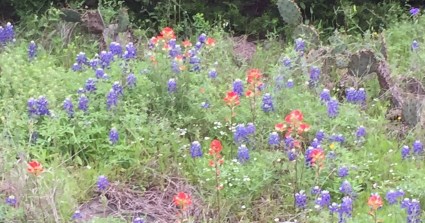
Bluebonnets taking over the crushed granite trail.
March is an alarm clock
if you’re a Texas Bluebonnet,
the official flower of that State
everybody knows.
We have pride of place artfully
set in many homes but few yards
of natives and transplants, alike.
By legislative decree, all species
are official, and abundant,
thanks to Lady Bird who said plant a tree, a bush, or a shrub.
Our blue pedals and white top
mark spring weather as we make
bisexual moves for next year.
We marvel at our neighbor,
Indian Paintbrushes or Blankets
complimentary red and yellow
color of 200 species or more,
as we compete for turf in arid, sandy,
dry soil. It’s Texas, after all.
Crowding where others fear to grow
we push our blue until we turn purple,
near the end of our time, then struggle
and exit the stage for later bloomers.
True Texans must be pictured with
children and pets and flowers all around.
They hunt bluebonnets with cameras,
and drive miles to wait in line,
to see and capture scenes
in the perfect photo or painting,
and they name everything after us.
What’s not the lone star is called
the bluebonnet whatever it is.
It’s nice to be so loved, but our
magical time is brief, yet meaningful.
Here comes the sun of the Texas
Summer following Spring.
Married to Bluebonnets
Texas Bluebonnets mean Yolonda,
and art on our walls, and spares in boxes,
they mean Lady Bird behind so many
wildflowers, like Indian Paintbrush,
or Blankets, they are what early spring is for.
They tell us it’s that time of change.
Close up of Indian Paintbrush seen on my walk.
In Texas, it’s Spring baseball (but not this year)
and bluebonnets and with their blue and white
caps that turn purple (purple bonnets?);
and the red, orange, yellow tease of
200 varieties of Indian whatever wildflowers
that are the first up, pushing their
primary colors quickly into the world,
making seeds to make more flowers for next year.
They mean the toughness of my adopted State,
the arid sandiness and limestonish mix
to be followed in the last few weeks
of spring with more crazy beautiful
flowering weeds, and the colorful,
awesomeness of prickly pear cactus
flowers that remind me of Silvia Plath,
and her poem about Red Poppies, yet to come.
I smile at the flowers, partly because of beauty,
and partly because of what they mean to me;
another season with a new reason, but mostly
because of who they remind me of.
Look both ways but keep your eyes on the road.
Mind the gaps, each one is there for a seed to make a plant.
Day 10 prompt: write one or more hay(na)ku poems, which are six-word stanzas where one word is the first line, two words make the second, and three words make up the third line. I made 11 (66 words).
Goodbye
often means
someone will die.
Life,
the source
of all death.
Find
what will
not kill you.
Would
you cry
as I did?
Care
not what
people will say.
Nobody
likes you
when you’re drunk.
Addiction,
part of
the human condition.
Sometimes
my poem
is not good.
Sometimes
it is
just another poem.
Exercise
is often
the best medicine.
Hayna?
is colloquial
to northeastern PA.
Look both ways crossing new roads.
Mind the gaps.
The pavement’s hard.






 Our Literary Journey