
Definition from Psychology Today.
“It can be difficult to define Wisdom, but people generally recognize it when they encounter it. Psychologists pretty much agree it involves an integration of knowledge, experience, and deep understanding that incorporates tolerance for the uncertainties of life as well as its ups and downs. There’s an awareness of how things play out over time, and it confers a sense of balance.
Wise people generally share an optimism that life’s problems can be solved and experience a certain amount of calm in facing difficult decisions. Intelligence—if only anyone could figure out exactly what it is—may be necessary for wisdom, but it definitely isn’t sufficient; an ability to see the big picture, a sense of proportion, and considerable introspection also contribute to its development.”
 In my lifetime I’ve been called a wise-guy, wise-ass, and a wise-you-name-it. I don’t recall denying any of it. But until I lost a significant amount of hair, gained a lot of scars (and weight), and dealt with a good bit of life’s experiences, no one has used the words wise or wisdom (without suffix) regarding me. So, as I was running through the w’s (women, walking, wine, wild, Wilde, and why) in search of an ‘a-to-z challenge’ blog topic, my wife says, “How about wisdom? You should know about that.” (Her birthday is tomorrow.)
 To me, the word wisdom has much in common with the word quality. Both are generally positive; we recognize them (or their absence) when we see or encounter either. But, precise definition for both eludes us. We are willing to take on as much quality and wisdom as possible, but with one condition. We want to know the cost. What price must we pay for quality? Can we afford it? What price must we pay for wisdom? Are we willing to pay the price?
 As a college student, I would walk into the Seven-Eleven store and eyeball the beer coolers. I looked only at price per six-pack. Texas Pride was 86-cents for six cans. I still can’t believe I managed to drink that horse piss, but price mattered more on my tight budget. I ignored quality. Little did I know then that years later I would gladly pay eight-to-twelve times as much for top-quality, locally brewed, craft beer. My taste and budget have both matured in quality.
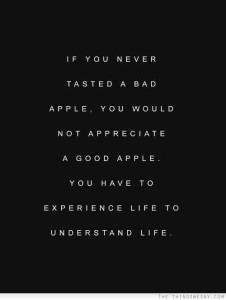 I had a conversation with a friend who was a wonderful, doting, and loving mother to her children. As I listened to her rant-on one day concerning some problem that her son was having, I asked her this question. “You love your son. Why do insist on preventing him from learning life’s lessons simply because they are painful? Be there for him. Protect him from serious harm. But allow him the dignity of learning his own lessons.” Before she got over her hurt feelings about what I had said, she backed off (he owes me). Hard for her, good for him.
Our wisdom sponge is dry at birth. It may be the only thing that is. As we age, that sponge soaks up more wisdom with each life lesson. It seems to me that the more painful the lesson, the better we learn it. I’m not sure that I accept the proposition that there is much intelligence in wisdom. We only need to be smart enough to learn from our best life-long teacher – experience. But I do think that the quality of our intelligence improves as we gain wisdom.
 We are wiser when older because we have been schooled in life longer.

 The other night, as we sat discussing writing projects and their duration, the subject of time came up. There were three of us, representing roughly three generations. The more we talked about time and how each of us currently sees it in terms of the future, the more I realized how differently each one of us viewed it. Time does not change. We do, and thus our view of time changes with age.
 I claim to be a right here, right now kinda guy. I live in the present moment. As I contemplate writing a memoir, this seems to cause me an ‘angst’ problem in that I wanna, and I don’t wanna. (I also struggle with writing about myself, but that’s not the issue.) I like History. It could’ve been considered my second minor at A&M. My manuscript is historical-fiction with too much history and not enough fiction. This morning I was asked if I would write a time-travel book (I’m noticing that Vickie has a knack for asking me thought-provoking questions). I didn’t have a ready answer, but after a lot of discussion and thought, my answer is ‘nope.’
 After doing a bit of reading, I’m no longer positive that I know what ‘this moment’ in time is, or if it exists. My metaphysical (woo-woo) friends get excited about this fascinating subject. When they do, I look at my watch and note, “It is one-forty, PM.” But they’re right. It’s really an interesting topic. Physicists and philosophers are all over it. Check out all the wiki and academic research (
 Yolonda, my wife of 50 years (we married at age 2), is a native Texan and has her ‘druthers.’
 Billy on right, (w/Phish bassist Mike Gordon), our oldest child is in his mid-40s, a very nice, loving, big-man. He’s always been an avid reader, a talented writer, a movie aficionado, and a hard-core Phish-head. Add bicyclist, father, hubby, friend, musician, and deep-thinker.
 Steven is our middle-child, now in his early 40s. He’s another good guy. An avid sports fanatic (Spurs and Cowboys) and mountain biker. Add hubby, step-father extraordinaire, house music DJ (Steve Balance), friend, and all-around cool-dude (maybe pragmatic and analytical). He initially said that he had no fav quotes, but when he and his sista’ got to texting, there they were.
 Our beautiful ‘baby’ is Julie. She can recite every line from the movie Grease (oddly did not quote it), is an artist, a thirty-something, 21st Century hippie, a mom and step-mother. I think she is a wonderful writer and, like her mom, a Grammar-Nazi. She lives in the middle of nowhere with her hubby, son, occasionally a step-son, or two lovely elves, too many cats, horses, and sometimes (because he likes to chase the horses) a dog.
 I claim a few basic beliefs. I believe in love, perseverance, and personal strength through relationships. I believe in memories and in karma. I believe in music, compassion, and empathy. But mostly I believe in the power and value of laughter; the more painful and debilitating the laugh, the better. Striking sadness, awe, loss, illness, and awareness of world misery affect me too. Sign me up for the clichés of humor: to die laughing, having the last laugh, laughter is the best medicine, and a side-splitting belly laugh. If you are infected with the acute illness of laughing for no apparent reason, I want to be infected too. I love to laugh. When I hear a good joke, it’s hard for me to retell it because I laugh so hard in the process. I want to be embarrassed and need to leave because I’m overcome by laughter. I want to laugh at everything. When seeing and hearing the laughter of others, especially children, I want to laugh without knowing why.
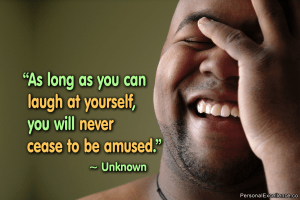 A question I like to ask is, “What do you want?” Answers vary, but mine is, “I want happiness.” Looking back on life, it is difficult to recall happy times with no laughter. It makes me feel good. Laughter is a natural high like no other. It’s free. We can’t over-dose. I thank all kinds of humor for making me laugh. Many things are funny, some are not. But I laugh anyway.
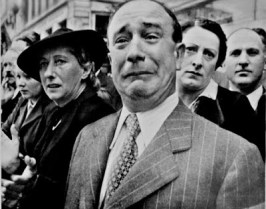 When I ponder c’est la guerre, my thinking goes more toward the conditions or philosophy of war, or the way of life during times of war. As an American, the concept is a little foreign to me (like our wars), since the only ground war we experienced was our war with ourselves: The Civil War. Ironically, it may have been the most destructive of our history in terms of loss of life and property. For at least the past 100 years, we have considered war as something that happens over there. Lucky us.
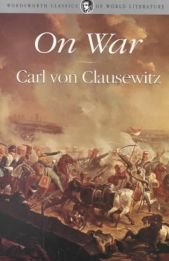 While there are many good books regarding the philosophy of war, the classic gold standard is On War by Carl Von Clausewitz – required reading for virtually every military officer. War and Peace by Leo Tolstoy may be the preeminent novel on the subject. And the classic for weaponry and strategy is The Art of War by Sun Tzu; more required reading, if not necessarily the best reading entertainment.
 More than a year later, I learned a new word that explains my reaction to the painting. It had never happened to me before, and has not since. The word is duende. It is a noun meaning the mysterious power of art to deeply move a person. There is a lot more to and behind this word. You can check it out for yourself by reading the wiki, if you’re curious. Apparently, artists sometimes experience this with their own work. However, if you’re familiar with this, or had a similar event happen, I would love to hear from you.
