Poetry: Unintelligent Design (NaPoWriMo) Day Twenty-three

Today I was prompted to write a poem about an animal.

Note: Prometheus (forethought) and Epimetheus (afterthought) were spared imprisonment in Tatarus. Zeus gave them the task of creating man. Prometheus shaped man out of mud, and Athena breathed life into his clay figure.

Thus Zeus,
before humans roamed Earth,
set Forethought and Afterthought
to task. Animals lived and roamed
without reincarnation or karma
fish swam, birds flew, and each
creature of day or night,
did the natural things, no karma required.

Dinosaurs upset a jealous god—gone!
With Athena, Prometheus made man.
But then monkeys mated with people
and Afterthought declared, “now
we need second chances”—
reincarnation, and karma came to be.

Humans did not know
what they were nor what to do.
so they caused trouble for goddess Gaia,
fought, became reincarnated afterthoughts
in lower and lower life forms to learn,
but each time, the lower form of
human was worse than the last.

Afterthought said to Forethought,
“look now, lower forms we need
for karma, these are slow learners.”
They created Lumbricus terrestris.
Earthworms that eat dirt and crawl
into the ground and are slimy and ugly
and are both male and female,
thus confused and lost bird food.
But to no avail as human nature
continued to confuse the gods.

Nirvana was vast and empty
when Afterthought reminded
Forethought, “Have you noticed,
we create humans, they fuck with monkeys,
die into lower karma never moving up,
and Zeus is pleased, laughing at us?”

Forethought said, “Indeed. We need a cover story.
I have one about a talking snake, two naked
humans too dumb to know it, some other god,
a garden, a tree, and an apple or some variety of fruit.”
Afterthought said,
“Without reincarnation and karma, no one
will ever believe that story. You need
worms, snakes are too hissy.”

Look both ways in forethought and afterthought but live in this now.
Mind the gaps and respect the worms,
you too have a next life and karma keeps adding up.

Poetry: Mr. Bill’s Dream Logic (NaPoWriMo) Day Twenty-one

My poem challenge today was to write a poem that incorporates wild, surreal images. I was to use writing that doesn’t make formal sense, but engages all the senses and involves dream logic.

Well-known strangers speak
without talking, to us much younger
than before when it was me,
but not I; colors of unseen
monochrome images of unlimited
limitations. Chases by odorless fears
of panic unharmed—yelling out into
this empty reality of unfolding challenges
without beginnings or ways to an end.
Movement without effort, watching
as space and time pass unchallenged
by a pointlessness of futile efforts.
Yell out! Why? The dogs.

A colorless kaleidoscope of
meaningful meaningless images,
sounds unheard, spoken with
windless breaths. Fear seeing
through closed eyes, hearing with
deaf ears, brown hair on bald men,
run, kick, yell, stop, breathing.
Fight back!
Awaken,
let go. Rewind. Dream On!
Dream real.

© Bill Reynolds 4/21/2019

Is this a dream within a dream?
Look both ways for unseen meaningless threats, gapless gorges, and mindful mindlessness.


Poetry: Our Place in Line (NaPoWriMo) Day Eighteen

Today, the NaPo lady challenged me to write an elegy of my own. One in which the abstraction of sadness is communicated not through abstract words, but physical detail.

As far back into childhood I recall,
they say my day, my time, will come.
One day, perhaps quietly
or in some fitful mental agony
it will be my time to die.
But the bell has not
yet tolled for me—
soon enough—
it will.

Every pet, dog or cat,
lightning bug in a jar, turtle
or Easter chick; every snake, worm, or
ant; butterfly or bird, fish
or tarantula , things that flew,
crawled, walked or ran,
or just a sighting in the wild—
they’re all dead now—
I don’t know
what that is—
but they’re gone.

Every childhood friend is dead,
my mother died long after dad,
sisters both gone,
(estranged brother
I don’t know about,
he may outlive me,
if so, let it be).
I won’t know.

Uncles and aunts, one cousin (sort of) all
gone and others I don’t know about,
but they (ones I knew) are dead.
There may be some still doing,
but people of my memories
are past life. And this,
my friend,
is normal.

Some things don’t die, all people do.
Poets die (some never replaced)
but poems don’t.
The two most important
breaths we take,
the first and the last—
all the others
we call living.
That’s life,
Frank.

My sister would telephone,
“Billy” she’d say, “guess who died?”
she said, and then
she’d tell me.

When everyone and everything
I know of has died,
how do I know
who is next in line?
Is it I?
Or is it you?
Not if,
but when!

© Bill Reynolds, 2/18/2019

Know why you look both ways, otherwise, it is simply a meaningless turn of the head.
There will always be gaps but mind them anyway.

Poetry: The Tale of the Trail (NaPoWriMo) Day Sixteen (167)

Today, I’m challenged to write a poem that uses the form of a list to defamiliarize the mundane.

The path, or trail if you like,
is a story. I know it’s a story,
because
it has a beginning, a middle
and an end. The path has composition
or a tale about the trail, it tails off,
or degenerates its form with
decomposed granite. The path
is decomposing hard stone
of different size rocks
down to powder, dust – granite.
The trail speaks with a crunching
voice, almost a groan I hear
with each step. The deer leave prints
when its wet after rain. Ants build their trail
on the path to cross perpendicular. I see it.
The sand of their trail is like a vein
across the path I walk, sometimes a snake
will try the trail, but not for long.
A variety of insects share their path.
Grasses and bushes, acorns for trees
find the trail worth a try. Bluebonnets
are undeterred by the inhospitable
and decomposing hard crushed pebbles,
and they grow through it to prove it.
There are sticks
and some leaves on the path,
on the sides, grasses push in
to reclaim what was
once not even a dirt path,
an unmarked open flowering field.
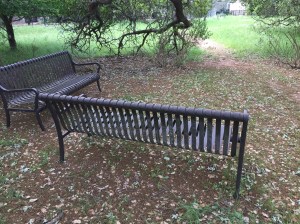
A bench sits
beside the trail and invites me
to stop, to rest, and to ponder
the stories of the trail, and the deer,
the birds, busy squirrels, sniffing dogs,
maybe a mysterious cat or two.
I accept the invitation before
I finish walking through
the story
told by the path that talks to me
(with a very special gravelly voice)
beginning, middle, and the end.

© Bill Reynolds, 4/16/2019

Look to both sides, to front and back, and listen to inhale it all.
Mind the gaps made by ants.

Poetry: The Stock of Love (NaPoWriMo) Day Fifteen

Today, I’m challenged to write a dramatic monologue poem. I tried to create specific voices of character that act as both narrators of the poem and participants, which could be acted out by someone reciting it.

****

He is just there, out of reach for now.
Or is it us? So waiting and watching his stare.
Dare we touch such darkness, or look upon him,
in a time to sample solutions?
To this time we have come, as you and I will have done,
to seek his work in our lives.

The darkness that follows, at times closer or farther,
but always, always there.
We look not to see into his darkness
as he looks upon us with calm eyes
for seeking an inevitable time, when we
feel his welcome breath as a wind of the wise.

With a song he beckons us to release
this pain of our suffering into his care.
This love has been our personal world,
but now we may touch an eternal threshold of peace.
Release me not, but allow you go with me
in search of our final love of his prize.

With pain and regret I feel deep in my bones,
to him, I send you in my despair.
Such shaking a coward deep within me,
I step into our eternal new home.
As we lie here in the dark, and together we sleep,
for a time never again to rise.

© Bill Reynolds, 4/15/2019

Look both ways to feel the times of birth, love, life, and death.
Mind the gaps in space and time.

Poetry: Evil Darkness Denied (NaPoWriMo) Day Thirteen

Today, I wrote a poem about something “mysterious and spooky!” (As the prompt challenge defined it.) I mused the denied duality of human nature as set forth in the classic Jekyll and Hyde, The Strange Case of Dr. Jekyll and Mr. Hyde [1886] by Robert Louis Stevenson. My review of the book is here.

***

Not evil I but you
Live with a darkness
of truth denied with
not to Hide mind
what must be true.

Wretched are you
to ask me to see
a truth as part of I.
Created by god
no evil must I be.

False belief is
the sinless soul
of self-righteous evil,
within you disguised
as good and pure.

As Lanyon needed
Jekyll’s truth to see
from Hyde’s reveal,
to accept the two,
both part of you.

There is no light without darkness,
no good without evil,
no truth without lies,
no life without death,
no two without one.

Seek out truth in you,
of more than half,
balance reality or die
from the only good truth
is really a lie.

© Bill Reynolds, 4/13/2019

Look both ways to find evil and good in you. It is your one and only truth.
Mind the gaps of fear and self-deceit, they hide your Hyde.

“O God!” I screamed, and “O God!” again and again; for there before my eyes—pale and shaken, and half fainting, and groping before him with his hands, like a man restored from death—there stood Henry Jekyll!” Dr. Lanyon’s words and recollection serve as the climax of the story. The question of Dr. Jekyll’s relationship to Mr. Hyde is resolved.


Poetry: Why am I Me? (NaPoWriMo) Day Eleven

My poetry challenge today is to write a poem of origin. Where am I from geographically, emotionally, physically, and spiritually. And having come from there, where am I now?

It’s not really a home, but it’s where I am from,
a place and a people from whom I’ve come,
other places they called home were not theirs.
Were they as proud as I, of who they were?

My look, perhaps a taste or a talent; a religion
or a language, this tribe of people like me.
Am I good enough? Were they? My foibles,
both pride and shame cloud my reality,
I don’t know what to feel about who or what I am,
or that I am at all, or who or what they were.
Why does it matter now? Is it because
knowing you is knowing me?

Why should I care? Am I a conduit of genes, maybe
I pass on life, survival, perhaps some weakness?
Who am I? Why am I? Why now? What do I want?
Taste, beauty, mindful intelligence, with durability
all passed from them to me, then to continuous family.

Why am I and what did you want? Life until death?
What is it that I don’t know? Not just life, but
thoughts. What did you think? What did you cling to?
Did your strength or weakness pass to me?
We’re from there, and there, and other places.

The you I’ve never met, secrets you’ve never told,
burdens never experienced, fears not shared,
friends, enemies, jealousies, hatreds that
may have traveled, but then died with you.
So much of what I am flowed from you to me.
Maybe I simply pass on, or maybe I just do.

©Bill Reynolds, 4/11/2019

Careful as you peer into the gaps of history but look both ways.


Poetry: Possibles (NaPoWriMo) Day Six

Today, I’ve been challenged to write a poem emphasizing the power of if. I wrote a poem so-titled last September (read it here). This is different. It’s less personal – more philosophical and asks a lot of questions.

The Possibles (of Impossible Ifs)

If lives were perfect, would they be?
If not for night, would we know day?
Does pain delight then go away?
To live forever, would be okay?

Abraham would be a joke, see
Joan of Arc would be alive.
If life was perfect, would I survive?
What if I were you, and you were me?

What if we felt neither sad nor woe?
Where the hell would happy go?
If this might be, could you vote yes or no?
Or do banal waters float your boat?

Everything is possible. If that, why so?
Would perfect make me want to go?
In a perfect world show, what is not?
If the answer’s here. I want to know.

Leave the gaps. Let’s not be saps,
When we die, they’ll still play Taps.

There’s something here, I clearly see,
This imperfect world is alright with me.

© Bill Reynolds, 4/6/2019

Look both ways, imagined and real.
Mind gaps you see, for honest sex appeal.


Poetry: What Do I Want? (NaPoWriMo) Day 2

Today’s challenge is to write a poem that resists closure by ending on a question, inviting the reader to continue the process of reading (and, in some ways, writing) the poem even after the poem ends. Did I?

What do I want?
And you, the same?

Everlasting life?
Perfect existence?

Is it happiness?
What exactly is that?

Heath and wealth
Both common goals

But is there more?
What is enough?

Love, perhaps, or
in my perfect world?

Let’s compare notes.
You show me yours

And I’ll show you mine,
In the balance it hangs

Every important thing
about life and time.

What do you want?
And, for me, the same?

©Bill Reynolds 4/2/2018

Look both ways for what you want. Mind things hidden in the gaps of life.

Essay: Rocks Can Speak

When I was a very young lad, one day as I was walking along a well-worn path, I noticed a stone of interesting size and shape. The stone briefly entered my short span of attention, as did many things lying about my undiscovered world at that age. I don’t recall many other details about my surroundings that day, but they no longer matter.

That was the first time a stone was not just another rock lying among other random bits of littered scree. Certainly, similar discoveries have occurred thousands of times throughout my life while walking, running, hiking, exploring, or just hanging out (thinking or not). This was a simple event that works as my metaphor for many other life events involving discovery, reason, and doing.

The rock was just lying there among others, perhaps for a thousand years or more. I wasn’t yet thinking in geological or historical terms. Stones have served many purposes after they were formed millions, perhaps billions, of years ago. There it was on the ground with others just where my eye located it. It had probably been moved around in one fashion or another over the centuries. I had no way of knowing, nor did I care. Even before approaching it, I was mentally making my I saw it first claim.

Living organic things come and go. Almost all life forms have appeared for a time and then were gone. Over 99 percent of life is extinct. Some rocks may contain fossilized records of past lives, but most are just inorganic minerals. I was not the only child who saw rocks, sticks, or other items as things naturally intended to be thrown about. Getting the right rock and throwing it brings a feeling of success. Skipping rocks on water is a universal rite of passage.

Looking around at the organic things today, I realize that most are less than 100 years old, and less than 50 in current forms. The complexities of the laws of thermodynamics (physics) change things, but we only see the now.

Neither I nor the stone said anything, Rocks don’t talk or hear in the animal sense. But nature can speak to us through both organic living things and through inanimate objects, such as rocks and fossils.

As I moved, the rock played its role as a lifeless stone like billions of similar objects covering the surface of the Earth. Rocks are infinitely expert at going with the flow. River rocks spend so much time tumbling in the roll of water they lose their edge and become rounded. The rock I saw did not sparkle, twinkle, or do anything spectacular. But I saw it. I squatted and half bent over so I could pick it up with my hand. That was many years ago.

More recently, I picked up another rock – my first in years. I carefully examined it, top, bottom, and all sides. One learns that by picking things up, especially rocks, one must carefully examine the item to ensure it is a lone stone, and not one littered with objectionable attachments. It must be just the boy, or now the man, an old man, and the rock with no another surprises.

While I didn’t bother to analyze it, the rock was local Austin limestone, or chalk rock, which is said to have formed in the window of 100 to 200-million years ago. It didn’t matter, and at the time, what I was looking at was just an old rock. Or was it?

Ideas are like stones. Once you pick one up, you must examine it, and only then decide what to do with it. As with stones, I have dropped ideas, put them in my pocket for later pondering, or threw them. When throwing ideas or stones, one must distinguish between discarding, sharing, or targeting. The first is simply throwing it away or back to where it came from. The second is communing by tossing it to someone else. But the third is capturing the idea or stone for our own creative purposes. Like rocks, ideas can speak to us. We just need to listen.

Look both ways for material and ideas. That’s what creativity is all about.
Toss some back to the gods, share some with others, or use them within your own art.
Mind the gaps. Look there for those hidden gems.

Like rocks, ideas may be too big.