Atheism a Religion?

Atheism religion4

I was once amused by religious propaganda I read explaining what a Catholic was and what they believed. What I found interesting was that none of these articles sanctioned by the Catholic Church or written by a practicing Catholic. They were derogatory and always wrong.

When I discussed this with a catholic priest he gave me an explanation, which I have not forgotten, always liked, and apply to outsiders telling me things about what groups believe.

Church windows1

You’re outside. ‘Tis (he’s Irish) a lovely, sunny day. You’ve been told the stained-glass windows in the local church are beautiful works of art. You walk to the church and gaze upon the windows. You wonder how something so dark and dreary can be considered beautiful art. The wee folk inside the church open the doors and invite you in. You go inside the church. You now see the windows from the inside (from a different point of view or in a different light?). The sun is passing through from the outside. Now, you see the beauty of the art and craftsmanship. Being on the inside makes a difference. (Paraphrased)


Atheism religion6

While researching atheism and the question of it being a religion I discovered something that reminded me of that priest. I can find many non-atheists who claim that it is a religion. I have not discovered anyone claiming to be atheist who agrees with that. Some folks even claim to breakdown certain atheist opinions further into denominations. One even went so far as to list 15 basic beliefs of all atheists (dogma? 14 were wrong). Of course, none of the people who wrote these things are either complimentary of (critical of, yes) atheism, or self-identified atheists. But, they do claim to know all about it. Interesting, right?

Saying that atheism is a religion is not only wrong, atheists find it silly. Consider the following from The American Atheist web page.

Atheism is not a belief system nor is it a religion. While there are some religions that are atheistic (certain sects of Buddhism, for example), that does not mean that atheism is a religion. Two commonly used retorts to the nonsense that atheism is a religion are: 1) If atheism is a religion, then bald is a hair color, and 2) If atheism is a religion, then health is a disease. A new one introduced in 2012 by Bill Maher is, “If atheism is a religion, then abstinence is a sexual position.” (American Atheist web page)

A friend of mine asked, “What do atheists believe? I want to know exactly what they believe.” As stated in the quote below from the web page, I said, “You can ask one, then you can ask another. If you are specific, you are likely to get two different answers. If you are not specific, you may be asked, ‘About what?’


Atheism religion2

“The only common thread that ties all atheists together is a lack of belief in gods and supernatural beings. Some of the best debates we have ever had have been with fellow atheists. This is because atheists do not have a common belief system, sacred scripture or atheist Pope. This means atheists often disagree on many issues and ideas. Atheists come in a variety of shapes, colors, beliefs, convictions, and backgrounds. We are as unique as our fingerprints.” (American Atheist web page)

Indeed, atheism can be called (or associated with) a movement. Some of their organizations may be identified. Some church ministers who are now atheists may even have something like a Sunday service. Some people say it is a philosophy or a world view. But the audacity and ignorance of people who are religious to write long essays (in which they usually admit that it’s hard to define religion) making the claim that atheism is a religion puts them in the same category as those wonders who never set foot in a Catholic Church, but knew all about it. They don’t know shit!


Frat Friday (12 Step Programs)

12 step 7

I’ve experienced much of life. Part of that experience included years associated with, learning about, and practicing aspects of a 12-step program. While I wasn’t trying to recover from chemical addiction, I wanted to know if this was a viable option for friends and loved ones. The experience was beneficial.

The aspect of the human condition that allows us to be overcome by addiction or related problems (eating disorders, sex, food, etc.) is an interesting and frightening mystery. Loss of control is one of our shared basic fears.

I attended numerous Al-anon, AA, and NA meetings. I’ve talked to people who support “the program” and some who don’t. I have read about the successes, failures, and marketing deceptions (or just lies) of recovery treatment programs.

I loved this movie.
I loved this movie.

Critics and supporters of these programs abound. While I don’t take a position for or against, there are several pro or con issues that should be pointed out. I want to write this for two reasons.

Disclosure: I have not actively participated in a program of this nature in more than four years. But I did for over 16 years.

First, 12-step programs are generally religiously or godly (“higher power”) based. While many members will take issue with this, many others will not. Furthermore, steps 2, 3, 5, 6, 7, 11, and (to a lesser degree) 12 are based on involving or invoking a god. Meetings within the USA usually  are specifically of a Christian nature and theme. Because Christianity is the predominant religion of America (and much of the world), it brings a clear religious bias to meetings, groups, and fellowships. However, at least initially, groups are generally open and accepting of members who are not Christian. They are supposed to be. However, the discomfort level experienced by non-believers at such meetings is understandable.

Second, I’ve been asked about, and I have wondered about, how non-believers manage a program that is so obviously in opposition to their core beliefs, or non-beliefs. I recently read a blog by a former meth user, Jerome. He got me to thinking about ‘the program’ again, and about this question. His view of NA is rather caustic. Based upon what he told me, he has a point – several, actually. It was not just that it was based on god or religion that was off-putting for him. It seems to me (and he may correct me) that his biggest problem was the negatively obnoxious “this is the only way” attitude of the group leadership he encountered. In my experience, this is one of the unfortunate problems with AA and NA. Less so in Al-anon, but those members are not trying to overcome addiction.

12 step 5To be fair, when I was in a leadership position with a 12-step program, I told members that they either worked the program, or they did not. It was up to them. However, them telling me that the program was not working when they were not ‘doing’ anything but attending meetings indicated other issues. I was taught, and I have always believed that we each have a right to our own program. If that program is not working, something should change. Recovery is too complicated to go into all of that detail in one blog.
I think many aspects of the program provided me with a path to better things in life. Criticising the program for its faults is fair enough, but I prefer not to throw the baby out with the bath water (cliché, but apropos). Twenty years ago, the program helped me to deal with ‘me’ and how I felt mentally, physically, and spiritually.  Eventually, because of my experience with ‘the program’, I decided that life for all of us is really all about how we feel.

12 step3

The following short list of adaptations reflect my program. I think everyone can benefit from this approach, addict or not, believer or not. It reflects what many program people might call Bill’s (me, not Bill W.) ‘experience, strength, and hope.’ In parenthesis, I credit the AA program step I adapted for my personal use.

  1. People die from denial. When we have a problem, we need to admit it. (AA step 1)
  2. Do you know you? You can do your own self-analysis (or get help from a counselor, shrink, or knowledgeable friend). It’s fun and rewarding, but it can be difficult (took me about a year). In past blogs, I’ve written about three questions I came up with while teaching a secular recovery program. I consider them helpful: What do you want? How do you want things to be? If you could change anything about the future, what would that be? There’s a lot more to this ‘self-inventory’ and discovery process. It could be a whole program unto itself, but I think it’s worth doing. (AA step 4)
  3. If you do harm to someone, apologize for it (if you mean it). If you owe a debt, pay it. (AA step 9). Sooner is better, in my opinion.
  4. My favorite is when you are wrong and you realize it, admit it quickly – to yourself and to someone who cares. I don’t know how much drama this removed from my life. I suspect even more of my drama was removed for my friends, family, and work-mates. (AA step 10). I personally don’t advocate apologizing for error, if no harm is done. I have been called arrogant for this. It’s a personal choice. We are all often wrong and that’s okay.12 step6
  5. I think there is something good and symbiotically beneficial in helping others. We should help people where and when we can, and we should be open to receiving help. (AA step 12)
Seriously.
Seriously.


This is a limited list. In many ways, living a healthy and happy life is much more involved than what I have said.

I suggest we each intentionally choose and do our own program in life, live as healthy as possible, keep learning, and laugh until it hurts.

If you are considering a 12-step program for any reason, I see no reason not to give it a try. As they are fond of saying, “We will gladly refund your misery.”


Frat Friday (Ego)

The Paradox of The Writer’s Ego 

EGO: “Noun. A person’s sense of self-esteem or self-importance. Synonyms: self-worth, self-respect, self-image, self-confidence.”


Ego4Some people think that ego is a bad thing. In a way, they are right. In a way, they are wrong. A wooden plaque (given to me by a friend) hangs in my room so that if I (ironically) hold my nose up, just slightly, I can see it. It says, “Humility is not one of my faults, but if I had one, that would be it.” Before you attack my lack of profundity, my friend made and gave the plaque to me as a bit of an ironic joke (I hope).
I recall my father using descriptive phrases like “too big for your britches” and “Who the hell do you think you are?” One might think such comments  damaging to my ego or creativity and may have hampered my development. My ego survived and my limited creativity seems fine.

In my thinking, ego has little direct effect on creativity regardless of its health or condition. We writers (all artists?) are diverse people. But we are people. All kinds of folks paint great landscapes. George W. Bush paints, and he is better at it than I am. Who knew? The former Prez was hiding an artist all that time.

There are many web sites and books to help us write better. Most of the tidbits I learn from them are helpful. However, I often wonder if Stephen King isn’t right — they are all BS (from somewhere in On Writing). My point is that while we’re all different in many ways, we seem open to writing better.

I spent my entire life preparing to do (and doing) something else. After I gave all that up and retired, I woke up one day and declared that I am a writer. It was not who do I think I am? It was what I am – a writer, because I said so. That is ego. But is it evil or bad? Am I egotistical? I said nothing of quality, and I am a QA professional. I am as good at writing today as I can be. Tomorrow I want to be better. I am also as good as I can be at spelling, and my spelling is horrible. My writing gets better each day, my spelling does not, and my ego is managing.

Ego1


Most of the be-a-better-writer advice I’ve read says we need to dump our ego to write (or do anything) well. Other things say we should believe in our abilities and work hard at it. Unfortunately, changing who we are is more difficult than changing the tire on the family Ford. I think that if I work hard on this blog and do the research, it should be good enough. My ego tells me that I can do this. I can do it. I can get my point of view across. That is self-confidence – ego.

Ego3I’m making the claim that ego is mostly good for writers. I presume that it is good for artists who work in other forms of artistic expression. I also think that being humble is good and being courageous is good. I also think that each of us should do what works for us. We’re unique individuals who share a passion (if you want to call it that). I admit that an out of control ego is a problem for more than just the narcissist, and egotistical people have their issues. But over-blown personalities write and sell books too.

Narcissism: “Noun. Excessive or erotic interest in oneself. Synonyms: vanity, self-love, self-admiration, self-absorption, self-obsession, conceit, self-centeredness, self-regard, egotism, egoism. In Psychology, it’s an extreme selfishness, with a grandiose view of one’s own talents and a craving for admiration.”


“Egotistical is excessively conceited or absorbed in oneself; self-centered. Synonyms: self-centered, selfish, egocentric, egomaniacal, self-interested, self-seeking, self-absorbed, narcissistic, vain, conceited, self-important; boastful.”

Then there is the paradox. I like to refer to myself as a “wannabe” and I see no reason to reject that. I think my skill and my work improves each time I make changes or corrections. My writing improves every time someone reads it and tells me what they think of it. My ego can, and often does, take a beating. At some point we stop all of that. We are ready for what is the painful process known as “getting it published.”

Ego2We need our ego to launch the work to readers. We need to believe that we can and want to do it. We also need to deal with whatever criticism and rejection we encounter.

Our poor egos. Our old friend stands ready to push emotional pain buttons with every rejection or criticism. It happens. And it happens most often to wannabes. But it’s part of the process, if you want to be published. After enough of this ego pounding us with emotion (can our egos survive all of this?) we may want to stop writing.

sad6To quote from Poe’s Preface to a republishing of his poems: “These trifles are collected and republished chiefly with a view to their redemption from the many improvements (made by publishers)…I am naturally anxious that what I have written should circulate as I wrote it….” He goes on to say that it is not that his work is that important, but the people who read it are. Ego?
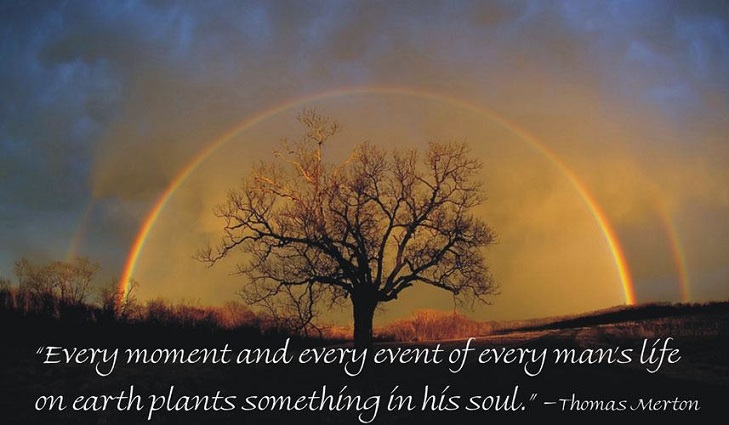
The writer’s ego is a good thing. From day one, it is at the core of our being able to do what we want to do. But ego is not good at dealing with the humbling experience of rejection. I am sure the damage done too often leads to quitting. But, if we quit, do we say, I am not a writer?

If you want to read more on this topic, check out the following.

Insecure Writers Support Group (IWSG). This looks like a good site for all writers, insecure or not. Two other interesting blogs on writer’s ego are here and here.

Frat Friday with Thomas Merton

Disclosure: I do not practice or align myself with any religion. I have in the past, I no longer do. This blog is not about what I do or don’t believe.

I’ve never known when someone would come into my life and make a difference. There have been many, both good and bad. Many have shaped who and what I’ve become. Such influential encounters have happened more times than I can remember. One of those people is the subject of today’s Frat Friday blog.

I’ve never met this man. He was accidently killed in 1968 during my sophomore year in college. At that time, I had never heard of him, and if I had, I would’ve had no interest in him, his life, or his outlook. I discovered Thomas Merton in the late 90s, almost 30 years after his death. I was inspired and intrigued by his autobiography, The Seven Story Mountain, published in 1948. Through his writing, I met the right person at the right time.

As I see the man.
AS I PICTURE HIM – REAL

Thomas Merton was one of the most prolific spiritual writers of the 20th Century, a Cistercian Monk, and a mystic. In 1915, he was born in France of a New Zealander father and American Quaker mother, both artists. His mother died in 1921 and he was raised by her family. Merton wrote and published more than 60 books, mostly on spirituality, social justice, and pacifism. He wrote many essays and reviews. Another 30 (or so) of his works were published posthumously and many other of his writings have been released to the public.

Merton1What impressed me about this man was his complexity, his courage, and what I see as his wisdom. His life journey and the decisions he made will likely prevent him from ever being canonized a saint by the Catholic Church. Yet those foibles are exactly what attracted me to him twenty years ago, and continue to influence my thinking. The man was a real person – a human being who behaved like one. If they did make him a saint, I think he would be among the most human of that group.
In the early 1940s, Merton went to a Trappist Monastery in Kentucky, knocked on the door, and told whoever answered that he wanted to be one of them. Trappist Monks are strict aesthetics and followers of the Order of Saint Benedict. Merton chose this life and lived it until his death. The Frank Sinatra song, I Did It My Way, comes to mind despite the obedience pledge of Trappists.

Beginning about 1937 during his conversion to Catholicism, Merton was fascinated by what he learned about the eastern religions. From then on, he studied Buddhism, Taoism, Hinduism, Jainism, and Sufism.

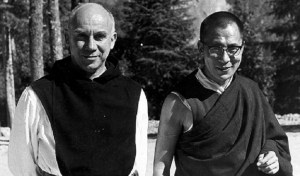
Thomas Merton with Dalai Lama
THOMAS MERTON WITH THE DALAI LAMA

His primary interest was in Zen, particularly as it applied to Christianity, from his point of view. Within limits, Merton supported interfaith understanding. He pioneered dialogue with the likes of the Dalai Lama, the Japanese writer D.T. Suzuki, the Thai Buddhist monk Buddhadasa, and the Vietnamese monk Thich Nhat Hanh. Many of Merton’s books on Zen Buddhism and Taoism are still in print.


“Art enables us to find ourselves and lose ourselves at the same time.” ~  Thomas Merton, No Man Is an Island

My favorite description of him was by Paul Hendrickson in the Washington Post on December 22, 1998: “Thomas Merton: that bohemian and poet and extreme sensualist, lover of jazz, prolific man, traveler of the new idea. A 20th-century prophet and mystic. Not a theologian so much as a kind of freelance spiritual thinker.”

While I can’t honestly say that Merton makes as much of a difference in my life today, he did at a time when he was the right person with the right thinking. He had prepared for me, fifty years before I needed it. I am not sure exactly what it is that still holds my admiration for and curiosity about him, but I suspect it is how he lived within his human condition.