“Look, Garrett, I’m closer to the end than to the beginning. So, some of this stuff, I just don’t have it in me to care anymore…It’s the rest of it, the posturing, the little digs, the wasting my time….” ~ Police Commissioner Frank Reagan; from the TV show Blue Bloods, Season 6, Episode 9, “Hold Outs.”
I can relate. I often say, “I don’t care.” But I do; in an odd, almost cavalier way. Normally, when I think I can help someone or fix something, I give my time and effort to the issue. I now care less about many of the things that were high on my list when I worked at my paying job. I haven’t lost my motivation; I now own it.
Opinions others have of me have lost much of their importance. Nowadays, I care more about issues that were of little interest during my past. Conversely, my “that’s bull shit” list is longer than ever. I worked, if you can call it that, for about 50 years. Now retired, my perspective on what’s important is changed.
Since age 18, excluding my time as an undergrad, I had one six-month period of unemployment. Even then, I treated my job search and being Mr. Mom, as two jobs. I enjoyed them both. The pay was horrendous, but the benefits were good.
I learned about myself during that time, simply by being me. That was the early 90s, the decade that I like to call my figure it out for myself years. Looking back, I now recognize that I was depressed and confused. I worried about things like money, a job, and my kids. I was more overwhelmed than I like to admit. I paid my dues. But now?
You know you want it, right?
I wear blue jeans, shorts, or sweat pants. It’s like every day is casual Friday, but it’s really another Saturday. I’ve not worn khakis more than twice in 18 months. I haven’t worn a tie, suit, or sports jacket either.
I care about style, as long as it’s casual. While I still think wearing argyle socks with sandals is a sin for which any man should burn for eternity, there’s something to be said for not caring what others (like me) think, even in the choice of clothing styles. I toy with the idea of wearing a kilt cuz wife says I have great legs. Some opinions will always count.
It shouldn’t matter what most other people think. I’ve read that what they think of me is not my business. But it often does matter. If I ask you what you think, feel, or believe, you should want me to care about your answer. If I do, it’s fair enough.
If I like your idea, I may accept it, implement it, or otherwise go with it. When someone says, “You should do a blog on that,” it gets my attention. I often write with inspiration like that from someone else.
I’m a grandparent. A parent called to complain about a grandchild. I listened, but said nothing. I allowed my child to rant and get it out. My wife wasn’t home, so I was on my own for the call and the associated drama. These are my monkeys in my family circus, after all.
Then I hear, “You haven’t said anything, Dad. What do you think?”
I take a deep breath and wonder if I should respond (the answer here is no).
Raising my kids, I made the same mistakes. But now, I have a different perspective. I answer with a quetion, “Are you sure you want to know?”
My ranting offspring responds, “Yes.” The tension builds. While I knew that this wouldn’t end well that day, I also knew it would eventually pass, and it did. I blurted out my answer as the Frank Reagan of my family.
“It doesn’t matter. What you’re so upset about is no big deal. There are more important issues in your child’s life. This is minor and kind of expected. As children, we’ve all had problems like this. We get over it and so will he. Allow him the dignity of experiencing and learning about life on life’s terms, not your conditions. I suggest you calm down and wait.”
Dial tone.
Blue Bloods writers would handle this scene at the family dinner table with everyone drinking wine.
I’m a here and now kind of guy. While I firmly believe in living in the present, I acknowledge that each life has a future and that’s the direction we live it. Today’s crisis is tomorrow’s funny dinner chat or neighborhood gossip.
Life goes on, and everyone should enjoy every possible breathtaking minute. What other people think is probably unimportant, and may be dangerous. So learning when to have had enough, to be tired of the BS, and to move on; to no longer give a shit, is good.
“But Mikey’s father, champion of all pint drinkers, is like my uncle Pa Keating, he doesn’t give a fiddler’s fart what the world says and that’s the way I’d like to be myself” ~ From Angela’s Ashes, by Frank McCourt
So, care as you must. Live in your world and in your time. Figure out what’s important to you and to people close to you. Make choices, change your mind, look back and look forward. That makes perfect sense to me, I hope it does to you, too.
Meh takes a big swig of the foamy grog and grunts, “I don’t give a feck.”
Live life forward, understand it backwards,
mind the gap, and look both ways.
“The literal mind does not understand the ironic mind, and sees it always as a source of danger.” ~ Christopher Hitchens
Once we perceive something and it gets into our brains, the confusion begins. We communicate by employing methods or techniques to stimulate the senses of others, intentionally or not. Face-to-face, we can bring out all the best guns. Teachers employ every conceivable technology to get students to learn by seeing, hearing, touching, smelling, and tasting.
I doubt that our individual minds are exclusively either literal or ironic. I suspect that some of us have trouble communicating, especially on the receiving end, because we lean one way or the other. When the ironic mind works with the literal, caution and precision must be applied. The reverse seems to be less of a problem.
I recall a conversation with my daughter about a man who, in my opinion, was an irresponsible pet owner. I forget the details of his transgression toward the pets, but I used a rather common and innocuous phrase regarding what she told me: “He should be shot.” Julie became upset with me (he may have been a boyfriend at the time). It was quite a while before I knew the reason. Apparently, she took what I said literally. Even after our discussing and my explaining the idiom, she never quite seemed to grant me a full pardon for promoting the demise of her friend. While this may appear extreme, it’s not uncommon.
Another example involves a writing quote I like from Steve Almond.
“All readers come to fiction as willing accomplices to your lies. Such is the basic goodwill contract made the moment we pick up a work of fiction.” ~ Steve Almond
When I posed this quote to another writer, she asked, “Is that how you see it?” I confessed agreement before I realized the problem with the noun lies. What makes this even more interesting is that at the time, I was writing historical fiction (an oddity in its own) and my friend was wrestling with a memoir (a quest for truth). Her efforts were focused on discovering the truth while mine were based on developing an untrue story in a true, but flexible, setting.
Fiction is only a lie when it is not presented as such. While neither of us set out to deceive anyone (truth is not in every memoir), her goal was fact with interest. Mine was interest with a false story based upon fact. My friend’s literal mind-set related to her concern with the accuracy of her project. Mine was based more on fiction, which is not the truth, thus figuratively can be called lies.
I enjoy the humor of sarcasm and irony. Without awareness of the intended humor, harm is frequent. Furthermore, if someone does not share another’s sense of humor regarding irony, even more so, sarcasm; the exact opposite of the intended communication is inevitable. Damage control using a follow-on explanation never seems to completely mend the fence, “I can’t believe you thought that was funny.” My personal sense of humor gets me into that sort of bind on a regular basis.
A humorous book I enjoyed was Lamb: The Gospel According to Biff by Christopher Moore. The book is full of tongue-in-cheek humor, innuendo, sarcasm, and other forms of witty humor. It even has an angel who is so literal as to be the best heavenly straight man I can imagine.
I (somewhat proudly) wear the label snarkastic to fit my fondness for being both snarky and sarcastic. But, I’ve learned that how I communicate makes a difference. In writing, I am advocate for a sarcasm font (we need one). In person, I exaggerate facial expressions, gestures, and voice inflection so that I can give others the opportunity to get it right. I don’t enjoy the struggle of trying to explain my humor to someone who I know will never get it, but I try. And, I’m watchful for things not turning out as planned after I shoot off my mouth.
Sometimes I don’t get it either. Like when I say something and someone bursts out laughing and yells, “Bill, I love your sense of humor.” I smile and nod, then lean to the person next to me and ask, “What did I say that was so funny?” Literally?
We live in an ironic world.
Love, laugh, get wet, look both ways,
and mind the gap.
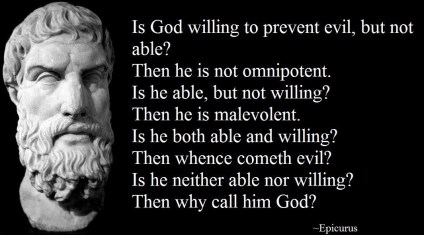
Monotheistic believers have no convincing way to deal with this issue. Because it has been around for a long time, it has been written about, answered, explained, taught, or discussed in groups of one kind or another. But it remains a problem that can only be settled one way—ignore it. Ignorance is bliss.
Or, you might end up where I did, facilitating a classroom discussion of the topic in the Adult Education program at my Catholic church. Preparation for teaching, and then leading the group discussion, led me to an enlightenment. I was not, at the time, spiritually or religiously challenged by the problem of evil, but I learned a lot.
Most of what I learned involved getting deep into a topic that I’d not seriously considered. As I was reading the Bible, especially the Old Testament, I started coming to terms with my own evolving beliefs and conclusions.
I was a believer (or wannabe) at the time. My biggest aha moment was when I realized that I had no qualms pinning evil on god. And, of course, that led to the uh-oh moment. That’s when I realized that god could not be so good after all. That disconnect was not gunna work for me. “Houston, we have a problem.”
If you’re fuzzy on what the problem of evil is about, click here to link with a youtube that provides a quick-n-dirty review in ten minutes. Pay attention because that guy talks fast and covers a lot of ground.
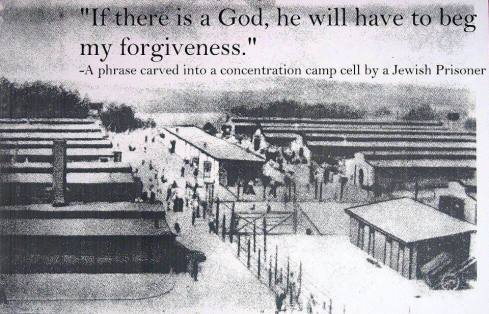
I’m intrigued when a priest, deacon, nun, or any religious person says, “I can’t understand why God allowed that to happen.” Pick any natural disaster, which some people do not consider evil, or some other moral evil such as mass murder. We have heard it said.
In the case of Islamic terrorism and other nut cases, evil is even done in the name of god, ostensibly with god’s help, followed by a hefty reward from god. (WTF does anybody want with 72 virgins anyway?). I know there are other kinds of murderers, but everyday that religion is used to justify slaughter around the world.
I know, “one man’s terrorist is another man’s freedom fighter.” But, along with most Americans, I consider 9-11 the mass murder of innocents. My point is: there is evil—lots of it, and all kinds of it. If you believe in a god who knows, cares, and can fix it; you should radio Houston Control with your problem.
We mere humans, when not being the perpetrators of some evil, expend energy preparing for and dealing with it in some way. We know it’s coming. So, in that way, it’s logically a problem that is often taken for granted (i.e., shit happens). Even the religious folks mentioned above devote their lives to promoting the goodness of god and fighting evil, albeit usually they focus on moral evil, as defined by them, of course. Other groups do a wonderful job of providing aid to victims, after the fact.
Since there is evil, it must ultimately be permitted by, if not created by, the god one believes exists. Depending on the religion, reconciling this with religious belief takes some doing and may call for a heavy dose of denial. Maybe a little help is in order? Enter the best scape goat ever—Satan. Next best are Adam or Eve. If someone says, “It’s god’s way,” you should be reaching for your bullshit flag because here it comes.
In some way, religious folks must be working through or around this problem. Last I checked, monotheists aren’t switching to polytheism or finding another way to make it work. Or are they?
Atheists and believers seem to agree; there is evil in abundance. My definition of it is probably broader than many religious folk, but it’s close enough.
Atheists don’t have to determine why evil is permitted. We only need to acknowledge its existence, do what we can to make others aware of it, and prevent it when possible. If not, maybe we can find ways to deal with it when we must, which is more often than I like. I never have to ask why god did, or didn’t, do something. But you have every right to ask me why I don’t do something.
There is both good and evil in the world
and too often within us. Look both ways.
Here I go again—trying to write a short blog on a topic suited for a book. I’ve taught classes on forgiveness, so I gained some insight. But that doesn’t mean I’m better than others at forgiving–I’m not. Two short stories for you, one related to the other.
First, as I was listening to a minister talk to his congregation about topics to teach in adult classes, he rattled off some that he thought his flock might struggle with. A few hands went up with each topic, until he mentioned forgiveness. I looked around to see two-thirds of them requesting instruction on forgiveness.
I taught the series of classes. To those people, this was the topic most of them wanted to deal with. I suspect that it was the most important.
Then, as I was teaching and near the conclusion of that class, one man asked, “Do I need to forgive Madalyn Murray O’Hair?”
I looked at him as I ran snarkastic comments through my mind, working on being kind to those who might have missed the point.
I said, “She was an atheist who died a tragic death about ten years ago. Why would you need to forgive her? Did she harm you?”
He said, “She took prayer out of our schools.”
If standing and glaring while trying to maintain composure sends a message to the rest of the class, that’s what I did. I scratched me head, hoping to end this soon. Insulting and vulgarities seemed inappropriate to the church venue.
I responded, “Well, I feel certain that Madalyn could not care less. She never had power to remove prayer from public schools, but the Supreme Court did. However, that case was not hers. Official, sponsored prayer had been voted to be unconstitutional two years before her case was decided. Hers involved her son and forced bible reading. Do you want to make a list of the Justices who decided that case so you can work on forgiving them? You don’t need to forgive her. But I think you should know exactly what it is that you are not forgiving her for.”
I don’t know what he was after, or if I was as condescending as I felt. Maybe he was wanting to discuss people that we might all have trouble forgiving. Hitler was and is still available, if we want to include the dead.
When I’ve harmed others and I feel remorse, I’d like to be forgiven. I realize such forgiveness is not a dismissal of my behavior. For that, I’ll always be responsible. When I’m forgiven, the personal relationship may be open to reconciliation. While it’s forever changed, the relationship may be worth saving. If so, the burden is mine.
When I’ve been harmed, I don’t need the person who wronged me to want forgiveness. They need not apologize, although that helps considerably. I do need to know exactly what they did that requires forgiving. I’ve learned that forgiveness has no easy on-off switch. I must want to forgive; then I must begin the process of forgiving.
Forgiveness may take considerable time. But forgiving gives me a personal freedom and comfort that I enjoy, not to mention it frees my mind for other uses. Forgiving doesn’t mean that the transgression wasn’t serious or damaging. If it happens again, discernment trumps forgiveness. I want to forgive because it’s good for me. Any benefit to the transgressor is supplementary to my own.
I am not preaching forgiveness. I’m advocating happiness. We don’t need to forgive everyone or everything. In the link here, are several articles on the mental health advantages of forgiveness. They also warn about some issues with forgiveness. There may be advantages to not forgiving in cases of sexual abuse, since anger and a demand for justice seem to empower victims. I’ll add victims of spousal abuse for similar reasons. There may be other situations where forgiveness needs to wait.
Finally, there must always be justice. We strive for life to be fair. When Pope JPII went to forgive the man who shot him in an assassination attempt, they hugged and the Pope made is forgiveness known. Then, the Pope left, leaving the man to complete his prison sentence.
The power of forgiveness rests with, and benefits most, the person wronged or harmed. Forgiving does not mean it was ok. If we can get on with our lives and rise above harmful difficulties, we can find relief and maybe happiness.
May we all find the strength and wisdom to move toward forgiveness when and where it’s wise and we’re able.
Pain is inevitable. Suffering is optional. Look both ways.
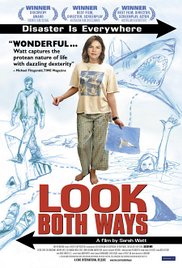
I just finished watching Look Both Ways, a 2005 Australian independent movie. I watched it because I had one of those idea moments today.
As I was walking on a sidewalk next to a busy street, I approached a minor street to cross. I glanced left, but was not yet crossing when a car came from behind me and turned right, quickly passing directly in front of me. She was driving a little too fast, did not signal, and may not have seen me. I checked to my left again for traffic and safely crossed the street.
Before I reached the opposite side, I realized that I had not looked to my right to ensure no cars were coming from that side. I recalled being told repeatedly, as a child of five or six, to look both ways before crossing the street. While the threatening traffic was on my left, I should have looked right.
I’m also in the process of reading How to Write Short, a book by Roy Peter Clark. Dr. Clark’s book has me thinking about how effective we can be with few words. Thus, I had one of those rare moments when an idea comes to me.
Look both ways can serve as my metaphorical phrase for living life—staying alive and healthy. I can see it as considering all sides of an issue (pro and con), hearing people out who may think different than I, discerning dangers of life, being careful, remembering lessons from our childhood, trying different things and new places. Can you add to my list?
Here is my advice: look both ways.
There are about a half-dozen books with the title Look Both Ways. I only found the one movie and I’m glad that I watched it. I enjoy that kind of flick. If you like artsy, emotional, love-story-ish movies with lots of music and relevant singing in the background, give it a go, mate. I had to get my ear tuned to the Aussie English, but I managed. I found it for two bucks on Amazon, but you might find it for free on YouTube. Warning: tear jerker. See the official trailer here.
There is no vegemite in the movie, but she does say, “Are you giving me the flick?” That must be Australian for Are we breaking up or Are you dumping me?
Furthermore, starting this Tuesday, each blog I post on Our Rainy Journey will end with some comment about “look both ways,” at least until I tire of it. And, yes, there is rain in the movie—they get wet.
A few weeks back, the headline was about Olympic athletes being robbed in Rio de Janeiro, Brazil. After a few days, it turned out that they were gold medal contenders for the what were you thinking? event. One US swimmer won the liar-liar, pants-on-fire trophy across the world. I wonder how much trust will be restored after all the damage control that followed.
We know what trust is. We trust others. They don’t earn it. Either we give it, or we don’t. We also trust in portions or on a sliding scale. Some get more than others. We also know that trust depends on a lot of things. Past behavior is a big one.
When will Charlie Brown learn that Lucy will pull the football back at the last second? She does it every year (link).
About the same time that some of our athletes were not being robbed at gun point in Rio, I was in a discussion about trust. I thought I had trust figured out. I learned some things (I usually do when I shut up and listen).
I’ve never thought about the fact that we need to trust. Carrying that need a bit further, we also need to not trust. It would be great if we had this perfectly figured out. Often, people we trust teach us valuable but painful lessons on who not to trust, and when. As it is with love, when we trust we become vulnerable.
I once asked a work-mate why he left money on the table when he did not put a small percentage of salary into a retirement account, which our employer matched (free money). He didn’t need the money. His answer was, “I don’t trust them.” I was dumbfounded by his answer and I changed the subject. He paid for his lack of trust.
Competence and honesty are two other conditions that effect our trusting others. Our trust may have a few variables and conditions that go with it. I may trust you to suggest a good dentist for me. I will not trust you to be that dentist.
When my cardiologist showed up to place stents into my coronary arteries, I trusted him more when he told me how many he had done. I liked the guy, but that had nothing to with his competence. His experience did.
So, in addition to the things I mentioned earlier, we may trust others in differing degrees. That degree may increase in proportion to competence and experience. Generally, we don’t trust people who we think are dishonest.
When I discuss trust and judgment, I use the word discernment. Our ability to discern improves over time, often with a trail of painful lessons because we trusted people we shouldn’t have. When Ronald Reagan used the oxymoron “Trust but verify,” he was really saying “do not trust them.”
Erik Erikson theorized that trust is learned during the first couple of years of life. Regardless of how accurate that is, it seems logical and emphasizes the importance of trust in our lives from early on.
What I think is important regarding trust is not how much we have in others. We usually have some, even in total strangers. What is important is that we learn to use reliable judgment, based on experience to discern how to trust.
In her TED talk, What We Don’t Understand About Trust, Onora O’Neill says it much better than I can. Click here to watch it.
Trusting seems natural. America’s motto is In God We Trust. Another is E pluribus unum (out of many, one), but in 1956 we wanted to make sure that our country was not confused with the atheistic USSR.
In America, it seems that we want to trust more as we deal with each other every day. Are we worthy of the trust of others? Who do we trust?
I’ve read some good essays on this subject. In this one, I attempted to present from a viewpoint of addressing someone who may be considering open declaration of no belief in gods, nor support of any religion, especially if they currently practice, or belong to, a religion. This is my first of several. I wrote one similar blog in June. You can see it here.
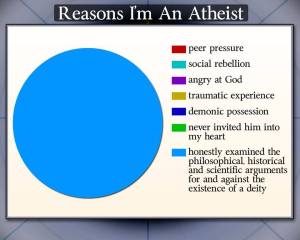
So you want tell people that you’re an atheist?
Select all applicable answers
If you think you might want to be known as an atheist, you should know this. Perhaps your idea is that all it takes is to not believe in any god. That’s true on the inside and in your mind, not so on the outside where you’ll have to deal with other people. You may think that your beliefs are private, and not anyone else’s business. You may think that no one cares. Maybe you have the incredibly naïve opinion that no one will judge you. Maybe you foresee other atheists waiting in the shadows to welcome you with open arms. Some are. They’re not in the shadows. There are groups which you may join, but first this.
In your naiveté, you may believe that your only life change will be that you’ll stop pretending and covering up. Thus, finally being truthful about what you do, or do not, believe. Maybe you think that you’ll continue to be the same moral, loyal, loving friend, family member, and citizen that you have always been. Of course you will, but not in everyone’s eyes. And, I’ll bet you did not know this: there is a test and there’s a penalty. A test for all, and a penalty for most.
The Never Ending test.
You have to pass a test to be an Atheist. Did you know that? And the damn test never ends – you take it repeatedly. The questions may be the same, or they may keep changing. Every answer you give will be wrong. You’ll be forced to keep explaining and justifying your wrong answers. You may be criticized by your family and friends for not choosing the correct answers. Knowledge will not help. If you try to use science, you will be told that you know nothing of science. You’ll be given a grade of F for trying to use it to explain your position. If you dare to use logic or philosophy: F. History? F! God forbid that you use religion/scripture/dogma: F-minus.
Are you willing to pay the price?
If you come out as an Atheist, you will be penalized (test results notwithstanding)– up to and including the death penalty (unlikely, but possible). At some level, you may be ostracized. It may be by people close to you, some group that you belong to, or perhaps at your job.
You can forget about being POTUS. Almost anyone can be president regardless of race, sex, number of marriages/affairs, baldness (or silly hair), borderline mental health condition, or creed. But, no creed at all? No cred! If you don’t believe in a god, you will not be elected. Religions with much lower percentage of population numbers, such as Muslim, Hindu or Buddhist have a better chance. But they are not atheists. (Okay, maybe some Buddhist sects are.)
If you live in the Americas, most of Europe or Asia, and are of Christian or Jewish background, you’ll probably not be killed. But, if you live in many countries, some fundamentalist religious groups, or the government, may decide to enforce the laws of god according scripture (yes, they do say that) and your ass will be dispatched into the fires of Hell. It happens. Even in Hebrew/Old Testament scripture, apostates must be gone. Few people continue to follow that old law of god, thank god.
An alternative for some.
For some people who don’t believe in any gods, they admit atheism, but they stop there. They refuse to take any test. They either don’t care about consequences or aren’t affected by them. They realize that no answer will ever be sufficient for most concerned believers.
The quiet, timid, in the shadows non-believer is a personal choice for many. But so is not ever fighting for or defending your rights and the rights of others. Many believers may wish you’d be quiet. Some may enjoy the fray and attempt to stump-the-chump. While a few others may be legitimately curious or some combination of all three.
Be honest and wise.
May you make wise, informed, and well-considered decisions. May you find the patience and grace to face the challenges of life with aplomb. May each day bring you joy, and may you spread that joy with love around the earth.
Note: A blog post on the test is under construction.
There’s too much information available to cover this area adequately. My research indicates that we become less creative as we age. Perhaps we do. But I would not say ‘less.’
We change with age: physically, mentally, and emotionally. I think we also change creatively. I don’t think we become less creative so much as our creativity becomes altered as we adjust to all changes in our lives. Certainly, significant aging and mental problems (dementia) and physical illness have their effect.
Blocks to creativity
Creativity is an attitude. Our curiosity sleeps with our creativity. The more curious we are, the more creative we seem to be.
There are too many blocks to mention each one. We all sometimes have blocks.
When I tell people that I am not as creative as they are, they often want to fix me – to give me advice on how to be more like them (do as they do, believe as they do, be as ‘open’ as they are). They would also advise me to be myself, blinking not an eye at the irony.
I don’t say that I’m not creative. Of course I am. Everybody is creative. But we are not all the same. My creative nature is more sensitive to that of other people, thus they are my preferred source of inspiration. I confess: I struggle with creativity. Many of us do. So what?
I think the blocks to our creativity begin at birth. We are born creative. As far as we know, it is a uniquely human trait. Children are wild with the creative process (in most cases) based upon the behavior we can see. We don’t know what we can’t see. We do not know the thoughts of others. We only hear what they tell us. Over time, our creativity struggles with life, society, judgement, our own human condition and nature, as well as that of others.
We don’t know what creativity is (no, we really don’t). We only know when we have it or when we do not. We can see it in the work or behavior of other people, but we cannot see into their minds and hearts. Like quality, we know it when we see it.
Value of music in creativity
I can read while listening to classical music (no lyrics), but no other genre. I must write in virtual silence. But I also find music as stimulating to my own creative process as anything. I have no idea how it would go if I did what a so many other artists do with music. But I know this: it helps in two areas.
One is in the magic of creativity itself. The other is in the execution of the work. Think of these two aspects as you watch Jonas Gerard (age 75) in the video below, creating with live music at his studio in Ashville, North Carolina.
“The rhythmic influence of music is an important part of his (Jonas Gerard’s) artistic process…. The music allows him to work unpredictably and intuitively, kicking it into another mode and bringing it home to a subconscious space where he can respond to the rhythm, and the direction the paintings suggest to him.” (from http://www.xanadugallery.com/2013/Artists/ArtistPage.php?ArtistID=7399)
The following is good regarding music.
“In addition to stimulating creativity, music can help contribute to the development of a more creative mind.”
“Creativity is within each of us and the very reason the world exists.” ~ Frank Fitzpatrick, Why Music, Part 6: Music and Creativity
Einstein was interested in both creativity and music. He tied the two, even suggesting he would be a musician, were he not a physicist.
“If I were not a physicist,” he once said, “I would probably be a musician. I often think in music. I live my daydreams in music. I see my life in terms of music … I get most joy in life out of music.” ~ Albert Einstein from Alice Calaprice, The Expanded Quotable Einstein (as quoted by Fitzpatrick)
Afflatus [əˈflātəs/] (n)
Afflatus is a divine creative impulse or inspiration. The word literally means inspiration. It does not refer to the usual sudden originality, but to the staggering and stunning blow of a new idea, an idea that the recipient may be unable to explain.
Add music to this and creativity becomes limitless, in my opinion.
Duende [do͞oˈendā/] (n)
Your Duende?
Duende is the mysterious power of art to deeply move us. It’s a quality-level of passion and inspiration that may be felt by anyone. It can be the artist as they work. It can be the observer of the piece, the reader of the text, the listener of the music, the watcher of the act or dance.
When you are next moved like this, speak to the spirit within you, “Ah, my Duende, you feel it too?”
Mental health and Creativity
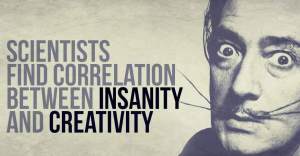
This is confusing, and for some of us, maybe a bit dangerous. No one is more artistic, creative, or on a higher creative plane because they suffer a mental malady. We can be both mentally ill and creative. How one effects the other is unknown.
There is sufficient research to indicate some correlation between the two. But nothing indicates that being drunk, high, depressed, or any other mental condition causes people to be more creative. Normal healthy people can be, and are creative. Throughout history, the same can be said for troubled artists and creative souls. It’s the difference between ‘because of’ and ‘in spite of.’
Letting Go
I can now move all books on creativity from my writing table to the bookshelf from whence they came. I want to thank Elizabeth Gilbert for Big Magic and I am grateful to my friends and fellow artists/writers who suggested it. While I still have a lot of issues with what Gilbert proposed, I wouldn’t have taken the time to do the work had I been in total agreement with her.
From whatever source your creative ideas flow, may they flow to you in abundance. May you be orgasmic, chilled and thrilled with ideas, concepts, and plans. May you make the best of all your days being creative and doing your thing (art, writing, music, etc.) and enjoying the universal gifts shared by others. May the spirit of duende haunt your heart and mind, thus bringing you to a spiritual bliss as only we humans can experience.
I don’t think I suffer more than average. When I find the enthusiasm to write about myself, I’ll include those painful and dark times from my past, along with the many good ones. I will be unable to link any of it to my creativity because I see no connection.
I do believe that to a degree, suffering is optional. I’ve seen people suffer unnecessarily, and I’ve seen those same people get over it.
In my blog tagline, I intend rain as a metaphor for my dark side, but it could also be for pain, suffering, or difficulty in life. The reaching for the sky is either embracing our human dark side or recovering from painful times. Such painful times often come with lessons making them valuable.
Until I read Big Magic, I gave little thought to suffering’s association with creativity, talent, and giftedness. I thought Elizabeth Gilbert’s treatment of the topic was a bit condescending (maybe it’s not). Perhaps it’s me, but telling alcoholics (or drug addicts) to get over it has limited success. On the other hand, many alcoholics told me that the painful consequences handed them by life at the bottom was motivation to recover.
I think that what Liz bemoans is using suffering as justification to be creative, talented, or gifted, thus making an excuse for hanging on to the bottom. We shouldn’t suffer just because we think it improves our work. I’m concerned because I know people die on the bottom. I’ve experienced great things from living artists, suffering or not – nothing from the dead ones.
I don’t take the relationship between our creativity and suffering too seriously, but I am less apt to dismiss it as some others may do. Conversely, I believe talented people do not need to suffer to be talented or creative. I am a happy guy who loves dark poetry, stories, and the dark side of human nature. Following my review of a memoir recently, I told the author “This is a sad story. Your job is to make me cry.” I’m advocating emotional writing, not suffering, hers or mine.
I avoid pain and consider that normal. Just ask my nurses when I’m having surgery — higher is better. And don’t even talk to me about my dental appointments.
While researching this topic, I discovered that I’m not the only person who finds this subject interesting. The available resources on the topic are sufficient for a doctoral dissertation, followed by two books.
I found this link to a blog (here) and a video of a talk (here), both involving Sharon Salzberg. Both are pretty good and not too long (the video excerpt relates to happiness and creativity).
And who does not love this song by Don McLean? It certainly relates to suffering and art.
I also found a site (here) with a collection of information on this and associated topics. It links with other sites and pages for developing creativity and personal growth. Be sure to check it out if you’re interested in any challenges to a creative life.
“Creative artists are fifth in the top 10 professions with high rates of depressive illness. But does depression attract them to the job? Or does the job make them depressed?” “…the reality for the sufferer is that depression is so debilitating it’s impossible to create anything at all.” ~ Helienne Lindvall
To love what you do, and the love of doing it, even when it is gruelingly difficult (and maybe more so when it is) may be the answer. What I’ve read seems to recommend this. Love your art! Do it for the love of the work, the art, the creativity, the experience. As Stephen King says, do it for the “buzz.”
The concept of a reciprocal relationship with our art was also introduced to me in Big Magic. Doing the art because we love it and love the act of doing it, despite the challenges is one thing. The idea that our art can love us back took me some pondering. Liz Gilbert says “why not?” I’m on board with her. Why not? Maybe not always and forever (although our art will likely outlive us), but at least sometimes.
Gilbert balks at calling our work of art our ‘baby,’ but this seems totally normal to me and many others. We don’t equate art to human babies. But it does vocalize the love we may have for our hard work, often more than nine months worth.
From “Steal Like an Artist” by Austin Kleon
In Steal Like an Artist, Austin Kleon provides two excellent graphic depictions. One describes the challenges and difficult process of creating from an idea. The other depicts that love relationship we have with our creations.
From “Steal Like an Artist” by Austin Kleon
May you be lucky in your love with people and with your work. As Austin says, “Do good work and share it with people.”
Have a wonderful weekend and be happily creative to your heart’s content.
Forty years ago tomorrow, I was the father of two boys: one age five, the other was two (two years later we added a daughter to the pride). Tomorrow would be my 30th birthday.
I was the navigator on a B-52 bomber crew. I recall that as I was taking a shower about fifty yards (roughly 45 meters) from a nuclear armed airplane cocked and ready to go blow the crap of somebody, I was quietly lamenting my age.
B-52D Navigator’s Position
I would no longer be in my twenties. I thought that I was not young and never would be again. I was knocking on the door of middle age, or so I thought. I was feeling down because I was turning the dreaded big three-zero. “Don’t trust anyone over thirty” was the phrase. I still don’t really know what that means. I just knew it was bad.
A Young B-52 Crew Dog
Our society convinced me that I was getting old and that I should be sad about it. In four days, that five-year-old I mentioned turns 45. He and his 42-years young brother really are middle aged, and their baby sister is knocking on that door. I was not old, but I was depressed thinking that I was. Thanks to our shallow, f***ed-up, foolish American culture that values all the wrong stuff in people, my thinking was foolish (and not only about age).
Is it all that important to be a thin, white, dark-haired, strong, male member of this country? We seem to think so. I hope that continues to change.
We have to pass laws to keep people from discriminating against older people, and the age in the law is 40. WTF? Forty is not old. Again, forty is not old! At most, it’s lower-middle aged.
And if you plan to call this foul-mouthed, hard-drinking, Fightin’ Texas Aggie, Irish-Welshman elderly; you best be certain that you can kick his ass. Because this one is standing straight-up and walking your way (in silence) to demonstrate that old is not elderly!
But, I will indeed become a septuagenarian at midnight tonight. In the game of life, I will be at ‘Level 8.’ I’ve literally been there, done that, and have the scars to prove it (which I wear proudly). I am on a first-name basis with my cardiologists, and if my peripheral vascular surgeon would do a better job, I would be running three miles a day, instead of walking. I ride a Honda Forza motor scooter because my 800-pound, 2007 Yamaha Royal Star Tour Deluxe touring motorcycle got too heavy to pick up (last year). But I still ride on two wheels. I’ve retired from the jobs that pay, but I work every day. I’m a writer and do volunteer work. My only boss is the one I’ve been married to for 50 years.
I like people and I want them to like me. But I also don’t give a flying f**k what anyone else thinks of me or my opinions, politics, religion (or lack thereof), foul language, or beer breath. I do not, and never will, wear socks with sandals. I remain a teenager of the 60s.
I am retired. All the shit/crap that I put up with for all those years of school (nuns-groan), yes, sir and no, sir; kissing up to very few idiot bosses (most were great), scrimping and saving and working – it was all worth it. As my wife would say, “Rave on, dog shit!” And so I do. Every day is a weekend and I can do what I want (with her permission—I’m old, not stupid) whenever.
I want to be happy and I am. My last meal will truly be a good pizza (my wife makes the best) and a fine stout brew. When the time comes, I want to walk into Dr. G’s office and say, “Time to shut it down, Doc. It’s been a great ride and I’ve loved it all. Let’s talk about the final git-er-done.” But that day is some ways off. Getting old is not dangerous, driving on our roads is.
Get ready big eight-zero ‘cuz here I come. ~ Me
I toast the good health of my birth year (1946) peers: Cher, Barry Gibb, George and Laura Bush, Bill Clinton, Donald Trump, Linda Ronstadt, Sally Field, Ed O’Neill, Reggie Jackson, Daryl Hall, Jimmy Buffett, Dolly Parton, Tommy Lee Jones, Al Green, Loni Anderson, Cheech Marin, and others. We’re still kickin’ the can down the road.
May you have love that never ends, much money, and many friends.
Health be yours, whatever you do and may the universe bless you and yours. Rock on, my friends.
I’ll publish my promised blog on creativity this next Friday. I am also tinkering with one on recovering from middle age (men only, I am unqualified for the experiences of the softer, better looking, and smarter sex) because I have been there and done that too.


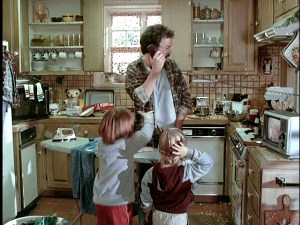 Then I hear, “You haven’t said anything, Dad. What do you think?”
 I’m a here and now kind of guy. While I firmly believe in living in the present, I acknowledge that each life has a future and that’s the direction we live it. Today’s crisis is tomorrow’s funny dinner chat or neighborhood gossip.
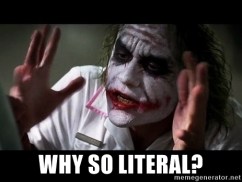 A humorous book I enjoyed was Lamb: The Gospel According to Biff by Christopher Moore. The book is full of tongue-in-cheek humor, innuendo, sarcasm, and other forms of witty humor. It even has an angel who is so literal as to be the best heavenly straight man I can imagine.
 Sometimes I don’t get it either. Like when I say something and someone bursts out laughing and yells, “Bill, I love your sense of humor.” I smile and nod, then lean to the person next to me and ask, “What did I say that was so funny?” Literally?
 Or, you might end up where I did, facilitating a classroom discussion of the topic in the Adult Education program at my Catholic church. Preparation for teaching, and then leading the group discussion, led me to an enlightenment. I was not, at the time, spiritually or religiously challenged by the problem of evil, but I learned a lot.

 Then, as I was teaching and near the conclusion of that class, one man asked, “Do I need to forgive Madalyn Murray O’Hair?”
 Look both ways can serve as my metaphorical phrase for living life—staying alive and healthy. I can see it as considering all sides of an issue (pro and con), hearing people out who may think different than I, discerning dangers of life, being careful, remembering lessons from our childhood, trying different things and new places. Can you add to my list?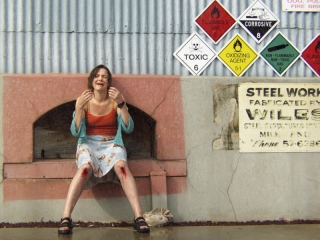


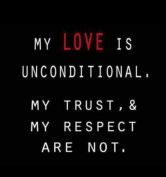 Competence and honesty are two other conditions that effect our trusting others. Our trust may have a few variables and conditions that go with it. I may trust you to suggest a good dentist for me. I will not trust you to be that dentist.
 Trusting seems natural. America’s motto is In God We Trust. Another is E pluribus unum (out of many, one), but in 1956 we wanted to make sure that our country was not confused with the atheistic USSR.
 You have to pass a test to be an Atheist. Did you know that? And the damn test never ends – you take it repeatedly. The questions may be the same, or they may keep changing. Every answer you give will be wrong. You’ll be forced to keep explaining and justifying your wrong answers. You may be criticized by your family and friends for not choosing the correct answers. Knowledge will not help. If you try to use science, you will be told that you know nothing of science. You’ll be given a grade of F for trying to use it to explain your position. If you dare to use logic or philosophy: F. History? F! God forbid that you use religion/scripture/dogma: F-minus.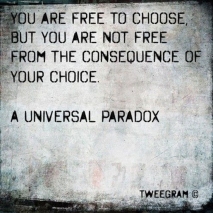


 There are too many blocks to mention each one. We all sometimes have blocks.
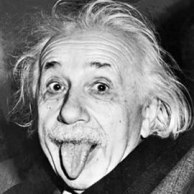 Einstein was interested in both creativity and music. He tied the two, even suggesting he would be a musician, were he not a physicist.
 er source your creative ideas flow, may they flow to you in abundance. May you be orgasmic, chilled and thrilled with ideas, concepts, and plans. May you make the best of all your days being creative and doing your thing (art, writing, music, etc.) and enjoying the universal gifts shared by others. May the spirit of duende haunt your heart and mind, thus bringing you to a spiritual bliss as only we humans can experience.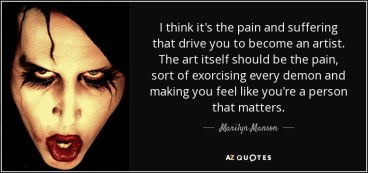
 I do believe that to a degree, suffering is optional. I’ve seen people suffer unnecessarily, and I’ve seen those same people get over it.
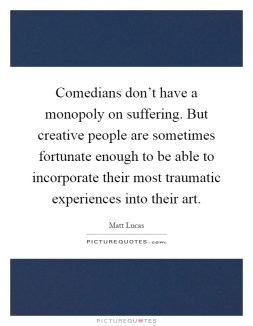 I think that what Liz bemoans is using suffering as justification to be creative, talented, or gifted, thus making an excuse for hanging on to the bottom. We shouldn’t suffer just because we think it improves our work. I’m concerned because I know people die on the bottom. I’ve experienced great things from living artists, suffering or not – nothing from the dead ones.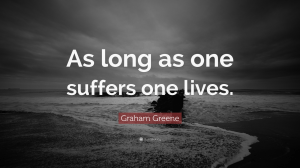
 To love what you do, and the love of doing it, even when it is gruelingly difficult (and maybe more so when it is) may be the answer. What I’ve read seems to recommend this. Love your art! Do it for the love of the work, the art, the creativity, the experience. As Stephen King says, do it for the “buzz.”



 Is it all that important to be a thin, white, dark-haired, strong, male member of this country? We seem to think so. I hope that continues to change.
 I am retired. All the shit/crap that I put up with for all those years of school (nuns-groan), yes, sir and no, sir; kissing up to very few idiot bosses (most were great), scrimping and saving and working – it was all worth it. As my wife would say, “Rave on, dog shit!” And so I do. Every day is a weekend and I can do what I want (with her permission—I’m old, not stupid) whenever.

 Our Literary Journey