A Memory: The Silence of Darkness

It was a cold northeastern Pennsylvania night. I don’t recall the day of the week, or even the year, but the season was tucked into that idiom wrongly called, the dead of winter. There’s nothing dead about it.

I was in my teens and still living with my parents. It was late night and snow had covered the ground one day in the early nineteen-sixties. While night, the reflections from the snow allowed me to see everything, although it looked like a blue-tinted black and white photograph.

While all years of my life were important, those teen years are prominent memories. I still recall how I felt then, but now it’s hard to describe. I’ll never feel like that again. The wonderful adjectives of youth applied to me: vital, vigorous, and energetic; yet so did lazy, horny, rebellious, and impulsive. I would not say pensive or thoughtful. Yet, there was that one night.


As I walked through deep snow above my ankles, a powdery white mattress was laid out around me in all directions. The white snow was tinted cobalt blue by the moon-lit night sky. None of the snow was marked by footsteps or car tires. The blanket was pristine. The cemetery across the street was a charming and peaceful sight. I loved the sight of the snow, the reflection of street lights with a wintery halo, the contrast of red brick buildings with lines of white where snow landed. Even boarded-up windows seemed fitting to this natural artistic sight. What I saw made me feel good. I was happy, but thoughtful about what I saw.

If anyone saw me, they might assume I was lonely. I was not. Never. While my teen years presented me with daily challenges, feeling lonely wasn’t one of them. Even back then, I treasured my alone time. I have searched for more nights like that one, but I will never discover such a night again. Nature’s art is often so fleeting.

I may have been troubled by any one of the issues I thought life changing. Today, I recall few of those traumatic teeny-bopper problems. But, I can still visualize the night. While I have long since been free of my adolescent burdens, I remember. I didn’t feel cold. I felt both my pending freedom and a connectedness to my surrounding, to the night, and to the silence. And to the darkness, the light, the snow, and a sweet silence only night offers.

I was wearing plain old brown leather oxford shoes and white socks. My pants were a bit too short and much too snug: a style of the times. Adults thought my hair too long. It was a little greasy, and it hung down to cover part of my face. I didn’t wear a hat. My outer layer was a hand-me-down, black, Navy-surplus pea coat – unbuttoned and hanging open. The collar was up.

As I picture that night, I feel my experience. That not-to-be-forgotten night was like a photograph taken with my eyes and ears, sensed with my tongue’s taste buds. I could smell the clean crisp aroma of the night air. It is imprinted in my memory: a serene moment, fifty-some years ago. A semi-normal teenager, I realized that something remarkable was happening around me. I liked it and I wanted to share it with you.

The day’s white powder parted like a soft curtain as my feet gently led me forward. Sidewalks, streets, and any surfaces open to the sky were topped with the blueish flakes. No cars passed. The plows would not be out until early next morning.

Months before this night, trees had lost their leaves. Now, white fluff-covered bare branches stretched skyward like arms reaching to catch descending flakes. Evergreens bore much thicker and fuller sparkling white coats over their needles, a weight they endured with their strong, flexible, down-sloping boughs. I sensed a soft chill as a gentle breeze brushed the powder from trees onto me.

As snow clouds passed, I saw the clear night sky of spiritual proportions. A nearly-full moon illuminated the earth with light reflected upward by snow. Even with the light in the sky, billions of stars floated above me, while below them the sheen of fresh powder glistened. I was so young, yet I intuited the unimaginable enormity of what was around me. I could sense the sheer winter-night beauty of it all. I felt comfort in that notable moment. The night and the silence were etching a memory no artist or photographer could duplicate.

The silence was purposeful and reasoned. A quiet so intense the night air was a sharp penetrating stillness that muted other sounds. All was perfectly still. No movement, not even a hush. It was an absolute quiet: a silence so powerful I imagined intense peacefulness within me.

I stopped. Didn’t move for a long time. I listened for sounds of anything, silent sounds. I heard nothing but silence itself. Very still, breathing shallow, listening intently to what was the most peaceful moment of my life as my personal Sounds of Silence came from nature. I was with my friend Darkness, where I felt destined to be. I experienced sensual pleasure in the absolute beauty of that cold winter night.

I saw silence in the stillness as nothing moved. The world had stopped. I tasted tranquility as the clear, dry night-air slid over my tongue. As the still coolness flowed into my nose with its chilled crisp fragrance, I smelled a fresh aroma only nature could provide to a young mind open to such images. I have aged. But, this memory remains set in the mind of a teenage boy.

Slowly, I started to walk a bit farther. Then stopped again. I knew this was exceptional. Then I walked more, and I stopped again. I do not recall walking away or going home. The memory leaves me standing there, taking it in.

I didn’t know that this memory would be discovered and retrieved by my muse over half a century later. Said she, “Up now, Lad. And write in yer book, before ‘tis lost again in the disorganized gaps of your mind.”

If you have no time for the video now, please come back to watch it. It’s worth it.

Live in the present, but look both ways,
to the past for who you were, and to the future for who you’ll be.
Mind the gaps, but fill in where you can.

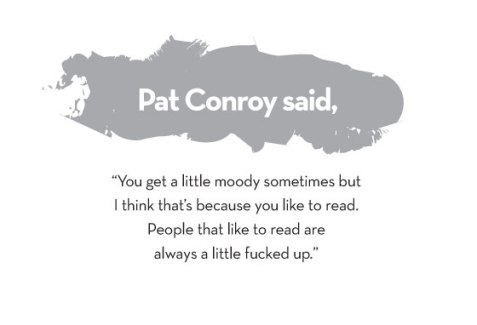
Quoting Pat Conroy

I’ve been reading more Pat Conroy. I continue to be impressed with his ability to tell the story and to talk about his life and the lives of others entwined with his. Mostly, I treasure and envy his awesome craft of writing, his vocabulary, and how smooth it flows as I read. I have no right to judge the writing of anyone, much less a man with such a gift.

What I feel as I read his words is not so much judging (as in “love it”). It is about me and my experiences, feelings, and thoughts about a man who was born less than one year before I was; who grew up when I did, but under very different circumstances, and who seems to have lived a life that I oddly, but resonantly, relate to in many twisted and indirect ways. Autobiographical fiction; strangely, I get it.

Except for graphics, the following quotes taken from his writings are my notes. Any error is mine. This was me stopping the flow of my reading to write down Pat’s words. Cuz, picture it, me saying “wow” while reading and then grabbing my notebook.

I have been using Public Library e-books lately, so I cannot highlight as with paper books or on my Kindle app. Yet, writing them down in my notebook may be better for increased mental indelibility and the likelihood of my sharing.

I grouped these by category and added my comments. I realize that context is lost by such grab-and-go’s, but I like them. The photos and memes are not my work, except to click “copy as.”
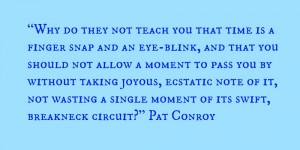
About writing, reading, and writers

“Fear is the major cargo that American writers must stow away when the writing life calls them into its carefully chosen ranks.” (Agree. I do. I must.)

“…nothing is more natural in his (Tolstoy) world than the mysterious and necessary attraction of men and women…their attraction for each other and impending marriage seems part of the design of the Universe, as right as the stars that make up the belt of Orion.” (Pat read War and Peace three times.)

“Teach me how to die.” (This is one of those phrases when I think, “I wonder what he meant?” Context!)

“I want to always be writing the book I was born to write.” (Exactly.)

“But I’m speaking of all the yesterdays that will not come again.” (Old guys say cool shit like that.)

“…that I get to live in the Old New York Book Shop on the night of a book party.” (This was Pat’s idea of heaven after he died. That book store is no longer there, but it was a big deal to him. Do you have a place like that? A memory so profound and pleasurable that it would do for a permanent state in an afterlife?)

“Nothing is more difficult to overcome than a childhood of privilege….” (Or abusive parents.)

“My childhood taught me everything I needed to know about the dangers of love….” (I intend to use this when I write more on the paradox of love.)

“We got some things right.” (About writing, the publishing writing world, and himself.)

Regarding Norman Berg, Pat’s friend and book rep., “He was a hard man who dismissed fools without conscience or regret…. He was an easy man to dismiss, and a hard one to love.”

“Know everything. Feel everything. That’s your job as a writer.” (Said Norman Berg to Pat, quoted by Pat.)

“The tribe is contentious, the breed dangerous.” (Regards writers and why he claimed to have few friends among them. Pat Conroy had many friends, and many of them were writers. I don’t really know enough writers to have an opinion, but the ones I know, while seemingly neither contentious or dangerous; most are unapologetically opinionated. Norm Berg’s job description?)

“The world of writers was a snake hole, a circle of hell – a rat’s nest and a whirlpool and a dilemma – not just a world.” (Pat was opinionated. I wonder how he felt about French writers? See is time in Paris, below.)

Pat’s youth and college days

“Two pillars of authority, patriarchal influences shaped my childhood. Dad and the Catholic Church. Punishment of anarchy. Contempt for anyone different.” (Mine, too.)

“There was an amazingly limitless capacity for ruthlessness at the heart of the family of man.” (Regards all of life, but learned from the plebe system. This is from The Lords of Discipline.)

“What will this make of me? A man, or a monster?” (Regards surviving his freshman year in college)

“A prize that exacted an awesome tithe of spirit from those who loved it.” (The Lords of Discipline)

“It was sublimation and surrender to the efficacy of denial.” (Pat had something specific in mind, but I can apply this to so many times in my life.)

“The history we are born into always seems natural when we are young, but it seems misshapen and grotesque as the winter years come upon us.” (I have had similar thoughts, but my experiences were a little less profound.)

New words for me

Three of many words I learned and liked reading Conroy: décolletage, oleaginous, and unctuous. (I am smiling and could go on and on and…)

His time in Paris

“Parisians and polar icecaps have a lot in common except that polar icecaps are warmer to strangers.”

“France is the only country in the world where friendliness is one of the seven deadly sins.”

(To be fair, Pat loved his time in France and cherished the memories. But why deny the French acting so “frenchly”?)


In our reading life, we must look both ways.
In writing, mind the damn gaps.

Poetry – Kaleidoscopic Transitions 1

We think it good, we think it bad,
we think it happy, we think it sad.
Transitions gap our evolving life.
Changes are scary,
transformations are mad.

Everything changes.

Born into kaleidoscope
with passion we creep,
from stumbling blocks
to stepping stones
we eventually leap,
crossing mortared passages
through well-tuned segues
our unplanned journey
continually changes.

First babes, then as children,
we transform into teens,
with hormones and zits
and other strange things.
To walk and to talk,
of this life we wonder,
what it all means
we continue to ponder.

Everything changes.

Back to the womb
we desire to go.
As we learn of the changes
we continue to grow,
but kaleidoscope says
the answer is no.

Thru constant transitions
always more progress.
Life brings us new lessons
and dappled confessions;
how excited we get
as we look for more color.

We twist the scope faster
by leaving the nest,
then we see it in others
that desire for best,
we discover ourselves
as never before, we are
with all the transitions
still frozen by fear
of uncertainty we abhor.

Everything changes.

What is our purpose?
Why are we here?
Why do these changes
bring us such fear?
Back to the past
or into the future;
Where do we go?
What must we know?
Need we keep changing
as we continue to grow?

Everything changes while
the gaudy scope turns.
We fear the next spin
and where it might end.
Continue we must
with this prismatical game,
long into life
and well after birth.

Because everything always changes. It’s never the same.

Bill Reynolds 9/25/2017

Up from the colors, stare into the gaps.
Look both ways at life’s many changes.

Poetry: A Strain of Madness

The pathetic bitch just lay before my eyes,
we each blamed the other for her horrible lines.
I had once dreamed of her as a flawless beauty,
but her loveliness was soon all too fleeting.
Everything about her soon disgusted me.

She beamed as I hacked away and mutilated her.
Such beatings were horrible, she no longer was fair,
not lovely as once I’d imagined. She was my obsession,
she had to be better, no – I demanded perfection.
I swore at her, insulted her, I’d not let her rest.

Her excruciating pain was caused by my emasculation,
as I twisted her limbs, she bled and cried out my damnation.
I never shed tears. I was her god, her creator; I owned her.
Angered I was, by what she’d become in my hands.
No longer did she sing her sweet angelic song.

Her nightmare was my blind fury. As her cruel and ruthless master,
I swore obscenities and pointed out her flaws; her heart was shattered.
I pondered her shredding – me killing her. Where could I hide?
Should I kill us both? Maybe that was it; murder-suicide.
Thus ending our miserable suffering, both would just die.

Without me, she would not exist. Mutilation continued;
I hacked off pieces, yet that suffering twaddle endured.
I attached new members, only to rip them away as crap;
I ignored her cries for mercy as I tossed her limbs as scrap,
replacing them with her rip-torn skin; still oozing blood.

Was her beauty hidden or gone? I ripped at her face.
She was mine to mold, to satiate my perverted desires.
Everything, from her disfigured hair flowing down
to her awkward stumbling feet, was to gratify me.
Her suffering would end with my metered pleasure.

I deemed us inhuman. A mere dullard of life, all that she was.
Her reasons for existing were meeting my ruthless demands.
She failed. Each day I emptied myself into her, more beatings.
Her tolerance for my impatience stroked her pleasurable feelings,
her loving and caring endurance infuriated me all the more.

I was disgusted. All that time. All the work. All our suffering.
Yet, lain before me that pathetic little twat blamed me.
Exhausted, I thought this would be the end for us both.
Barely breathing, her heart murmuring along with mine,
our time together had neared its end, soon it was done.

One final scream! And then; calmly I stared, feeling a bit proud.
My anguish gone, I muttered the sounds of her words aloud
just as she set them before me. Slowly, she began to change.
That poisonous little worm became my lovely butterfly.
She smiled at me. Then she pouted, both sensuous and shy.

We reached out to each other one final time.
Soon, she would be with eternity, but somehow still mine.
I wept as my pleasure mixed with regret and my sorrow.
After setting her release for after sunrise, tomorrow,
I abandoned my poor little poem to whatever might follow.

Bill Reynolds, 9/4/2017

Know the gaps and mind them well. Look both ways, or deal with hell

But he who, having no touch of the Muses’ madness in his soul, comes to the door and thinks that he will get into the temple of art – he, I say, and his poetry are not admitted; the sane man disappears and is nowhere when he enters into rivalry with the madman. ~ Plato, Phaedrus

Hence poetry implies either a happy gift of nature or a strain of madness. Aristotle, Poetics

Love the art, poor as it may be, which thou hast learned, and be content with it, making thyself neither the master nor the servant of any man. ~ Marcus Aurelius, Meditations, Book Four

From The NeverEnding Story

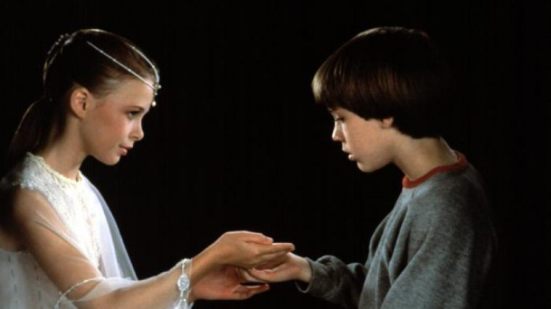
A few weeks ago was the 33rd anniversary of the movie, The NeverEnding Story, being released to theaters. I wrote this little ditty to relate to the moral of the story, as I see it today.

Moonchild

The mantle of truth is a heavy coat of many colors,
it gives warmth and freedom, but not love, friends, or quiet.
I can wear it out for all see, or keep it secretly private,
hidden away from the flak and dissent of others.

During this never-ending search for the best,
I face many challenges, and risk the love of others.
Do I seek such love, or a truth not of any lovers?
Must Falkor guide me on my never-ending quest?

When it’s only a story, is it also a myth?
At the Magic Mirror Gate, what truth have I now?
What is it within me, that this story won’t allow?
Are love and truth the same, or is it the Oracle’s kiss?

I find the impossible hard to defend.
The nothing is within me, but I’ll take my stand
for the dream of truth to my last grain of sand.
No seeker would stop with this as the end.

We deny then accept, it’s hard to compile,
the path is a clear one for all who will stay,
it may not be possible, at least not today.
Make Fantasia all truth, son of Moonchild.

*Bill Reynolds 7/31/2017

On your never-ending story, look both ways. Mind the gaps, they’re not myths.

My favorite lines from the movie (and the youtube clip):

G’mork: Foolish boy. Don’t you know anything about Fantasia? It’s the world of human fantasy. Every part, every creature of it, is a piece of the dreams and hopes of mankind. Therefore, it has no boundaries.

Atreyu: But why is Fantasia dying, then?

G’mork: Because people have begun to lose their hopes and forget their dreams. So the Nothing grows stronger.

Atreyu: What is the Nothing?

G’mork: It’s the emptiness that’s left. It’s like a despair, destroying this world. And I have been trying to help it.

Am I Too Old?

I see my reality very differently

Am I too old?

How old is old enough?
am I too old to feel young?
am I too old to run and hide?
am I too old to care?

How old is old enough?
am I too old to want to know?
am I too old to love someone?
am I too old to care?

How old is old enough?
am I too old to feel you near?
am I too old to call you babe?
am I too old to care?

How old is old enough?
am I too old to dance with you?
am I too old to share your passion?
am I too old to care?

I am not yet old enough,
so dance me to end of time.
Still I see the fairies dance,
for your love is always mine.

by bill reynolds 7/5/2017

To live long and prosper, look both ways and mind the gaps.

Forever Young!

a prayer

***

O Sweet Zephyr

O sweet pacific Zephyr of pleasure,
overcome and make everything better.
Thru my heart send cleansing measures;
touch my face, unsettle my hair, water my eyes;
refresh all things as you pass.

Bring rain to silence my mournful cries.
Wash my body, brush my thighs,
blow clear my eyes that my mind might see,
this imprisoned heart now set free.

Take away dirt and dinge from the air.
Sweep foul poisons drifting there
left by souls seeming not to care.
Send your sweeping wind of rebirth
into the vile sky polluted by human greed,
now cleaned by your blessing of me in need.

With your breath of god, remove this stillness
that saps life from creatures on earth we crave.
Replace placid with salty moist freshness.

Revive all of me with your ocean scent,
sooth my yearning for pleasures spent,
revive my fondness for life on earth.
Raise my desire for nature’s worth.
Bring to me your refreshing pleasure
into my dead soul, sweet pacific Zephyr.

by Bill Reynolds 6/21/2017

***

Let the sweet breeze of a zephyr touch you. Face the wind, then turn and enjoy life.
Feel the air as you look both ways and mind the gaps.

The Paradox of Love – Joan and John

This is my second post in a series about the paradox of love. It is a little different in that it’s about a man I’ve met, and a couple in love. I’ve included two of his poems.

Let’s answer this question: What is the best hoped-for outcome of any relationship?

Even Grimm’s Fairy Tales don’t finish with the “and they lived happily ever after” fantasy. The best we can hope for is, until death do us part. Barring the end of the movie The Notebook, murder-suicide pacts, or certain accidents; someone gets left. And we are often made miserable by our loss, about being left without someone we love, or about how that happened.

I don’t know John Gorow well. We attend the same writer’s group. John’s an old timer in the group; I’m new. He agreed to allow me to publish the story he related to me, and the poems he wrote. It is a remarkable and inspirational story. His poems are wonderful.

Joan and John Gorow met in 1969, when both were recovering from divorce. Prior to their marriage in 1972, Joan told John that she had been diagnosed with Multiple Sclerosis (MS). According to John, Joan’s health setbacks did not begin for about 28 years. Since 2000, her MS was a problem. Then came breast cancer. While treatment led to a full recovery, a Parkinson’s diagnosis soon followed, in addition to her worsening MS.

For approximately 15 years, John was Joan’s constant companion and full-time caregiver. As Joan’s health continued to deteriorate, the burden on John increased. In response to that challenge, John wrote the following beautiful, heart-wrenching poem.

***
CAREGIVER
by John Gorow

Time moves on
Inconvenient impairments become life altering
Legs don’t do what she wants
Hands have difficulty holding things

Normal chores are no longer normal
Cooking becomes dangerous
Washing dishes is impossible
Clothes can’t be carried to the washer while using a walker
The vacuum can’t be pushed
Self-worth begins to fade.

The one who has been cared for must now give care
She has cooked for me
It is my turn to cook for her
She washed our clothes
I will do the washing
She kept our home clean
I will try my best

It is assumed we all can dress ourselves
That is no longer true
Showering on her own can’t be done
No more going to the bathroom by herself

Memory slips – confusion arrives
What day is it?
Where are we?
I need patience
We talk, and then we laugh – I cry on the inside

Kids tell me to get help
I finally do – one day a week
Who is it harder on – her or me?
I get some freedom – she does not.

Caregiving is tough
Better than the alternative
I want her as she was
It will not happen
But then again, I do have her

(October 17, 2013)

***

Seven months ago, on October 22, 2016, John no longer had Joan with him. Since then, John has suffered and struggled with his pain. He wrote the following poem to directly address grief in response to the prompt: what brought you to your knees? In the fifth stanza, he directly addresses the paradox of love, vis-à-vis his grief.

***

GRIEF
by John Gorow

Who are you, grief?
Why do you pester me?
You have dropped me to my knees.

I knew I would have to deal with you,
But is it forever?
You keep lingering in my life.

I think you may be gone,
Then you grab me once again.
My laughs turn into tears.

Others have told me about you,
But you don’t behave the same with all.
I can’t determine when you will rise again.

What a paradox.
I have tried to hate you,
But without love you wouldn’t be here.

I know we will take the rest of my journey together,
So I must accept you.
That acceptance will be slow.

You should know
I will no longer dread the tears you bring me,
You will need to accept that.

You can stay with me,
But I will slowly rise from my knees.
I will move forward, but not forget.

(May 18, 2017)

***

I want to close this post with the same line John ended his email to me. It’s a beautiful one-line poem of five words.

“I miss her very much.”

***

As we look both ways and mind the gaps,
let’s not forget that some of us are suffering.
Let us love and support each other, and at all times, let us cherish those we love –
paradox or not.


From Pleasure, Pain

This is the first in a series of blog posts about what I see as the paradox of love. This essay is my answer to the prompt, what has brought you to your knees? I’m not sure where I’ll go with this. Maybe you can help. Ask me questions, or prompt me in some direction. Please keep in mind, this is merely my take. Feel free to provide yours.

Nothing begins, nothing ends,
that is not paid for with moan;
for we are born in other’s pain,
and perish in our own.
~ Francis Thompson

Twenty years ago, I started using the phrase it’s all about how we feel. Normally, I’d caveat such a mantra by claiming it only applied to people without mental health issues. In this case, I think the words apply universally. How do you feel?

Love is the highest standard we have for caring about others. In literature, movies, music, religion, and in our daily lives; our obsession with love is obvious. It’s poorly defined, extensively written about, and grammatically misused; but love is everywhere in the English language. We want to love and to be loved. It’s our ultimate pleasure. How sweet love is.

I embrace love, but I fear pain. Pain can take over my body. Excruciating physical pain has brought me to my knees. It’s absurd that such pain may be helpful as it travels my nervous system from its source to my brain. Pain is abnormal. Even though we all experience pain, it’s not supposed to be there unless something is wrong. Pain is a symptom more useful to doctors than to me.

As bad as physical pain is, emotional pain is more devastating. In extreme cases, mental grief often leads to thoughts of suicide. In physical pain I might say, I want to die; but, I never intended that. I only wanted the pain to stop. On the other hand, people in emotional agony can be dangerous.

Our vulnerability to emotional pain is greatest when we love someone. When we love another person, we grant that person more power over us than any god or demon. Still, we choose to love. Not just willingly, but aggressively with passion and desire. Why? It’s like we can’t live without it. If anyone does live without love, we consider that sad and dysfunctional.

Love has brought me to my knees in two ways. First, the wondrous and joyful pleasure of experiencing love has led me to my knees with happiness. Be it romantic love, love of parents, love of children, grandchildren, or friends; the wonderful state of love takes away the dark and gives light.

Second, love has dropped me in pain, in fear, in a depressingly dark, hateful passion. Love betrayed leaves behind lifelong scars too deep to ever completely heal. The end of a romance, the betrayal of a friendship, the dismissal of a parent we love, the suffering or death of a child; each of these may, and perhaps should, put me on my knees. Such pain and agony from the dark side of love makes me question the value of life.

There may be recovery or even pleasure at the end of the tunnel. Time may mend love betrayed. Still, our human nature forces us to look back into that dark tunnel, into that abyss of pain and suffering. We remember. Do we dare to ever again risk pain by making ourselves vulnerable? Do we face the agony of finding ourselves desperately miserable because we loved?

Why do we do it? Would you, could you, live without love?

That’s a paradox of love. We know the risks, the vulnerability, and the potential to suffer. And yet, we still seek out love and take the risk. How do you feel now?

Even when we look both ways and mind each gap, we will experience pain in life.

“The truth is, everyone is going to hurt you.
You just got to find the ones worth suffering for.”
― Bob Marley (20 years after his death, which means he never said it. True, nonetheless.)

The youtube poem below is worth hearing/reading, and I think the Love Hurts song by Nazareth is worth a listen.


Mother’s Happiness

I know little of what my parents thought about any deep subject such as a philosophy of life or their world view. I managed no more than hints or rare tidbits. Regarding my father, I remember too much of the bad and little of the good. The opposite is true of my mother.

I remember more in Mom’s case, and most of it good. The few bad memories were usually not her doing. Mom may have had her share of bad days, but I can’t remember one that was her fault.

My clearest memories are the pleasant ones about our overall relationship. We were close. Not in the best of friends sense you may hear some parents brag about. Mom was my parent – not my friend.

As a teenager or young adult, I would have railed against being called a “momma’s boy.” I now look back on our relationship with pride.

My mother protected me, mostly from Dad, but also from a few other things. Oddly, not from bullies. If I developed an early skill in dealing with them, it was avoidance. Later in life, my approach was more direct. Conversely, she liked telling people how she often broke blood vessels in her hands spanking me. I don’t recall any of that.

She and I argued our share. I was a momma’s boy – not a good or obedient boy. There were times when I was disappointed in her for not coming to my aid. Looking back, I now realize how right she was.

When she did help me, she did it her way. She helped me in a manner that permitted me the dignity of learning difficult lessons the hard way – which was apparently my preference. When she felt like I needed to learn a painful lesson, she gave me the space I needed. I now realize how difficult that must have been for her. My mother’s love for me, and mine for her were never in question.

When Dad’s health was declining and she felt like she needed to help him, she postponed action on the lump in her breast. After his death, she moved on to her own health care. Everything she did during the period of that treatment, she did with the occasional assistance of her sister. My sister and I lived too far away to be of much help.

While Mom was a long-term breast cancer survivor, the invasive disease brought on her death only after she decided to end most of the treatment.

But years before that, the spot on her lung had been removed and she was recuperating in the hospital the day my flight from Texas arrived in Pennsylvania. Walking down the hospital hallway, the sounds and smells were unique. I would know where I was had I been awakened blind.

As I walked down the hall following the directions I’d been given, I knew I would take the next right into another hall, then right again into her room. I anticipated walking in and finding her groggy and sore from the surgery. I envisioned her smiling up at me, weak and tired. I turned the corner.

The window at the end of that hall looked down on the hospital’s parking lot. Its sill of hard tile was about a foot deep. My recovering mother could easily sit there and gaze down to the parking lot, watching for me.

When she heard my voice, she turned her head and saw me walking toward her. The day after surgery, my 70-something mother jumped off the sill and started running toward me. Mom drove her five-foot-tall frame hard against me, wrapped her arms firmly around me, and then pulled my face down and kissed me.

After I suggested that she get back into bed, we walked to her room and she slid back onto the sheets and pillow. Mom was excited and chatty. She was always happy to see me. But on that day, her response was overwhelming. The doctors and nurses kept Mom alive. All I had to do was walk down the hall at the right time. I became the star of her show. I will always remember how happy she was to see me that day. I’m glad I could help.

Happy Mother’s Day to moms everywhere.
Look both ways and mind the gaps.