It’s Yolonda’s birthday, y’all. Here’s my poem for her…
She fills up my senses,
like a fine wine after dinner,
it don’t get no mo’ betta
than this, and a kiss.
She takes care of me
not that I need it, maybe
a little guiding tap, now
and then. Keeps me right.
She tells me that she loves me,
god knows I deserve less,
and what I need to know
and her glowing
septuagenarian happiness.
Fifty-four year in a month
livin’ the dream, they want to know,
how? I really can’t answer.
Truth be known,
she shudda shot my effing ass,
many a year ago.
Happy dyslexic thirty-seventh,
of which ya put up with many
shenanigans galore.
May you and we go
fo’ 54 mo’.
Day 26 prompt: write a poem using responses to an Almanac Questionnaire of 23 questions as the basis. My 23 responses follow the poem. Additionally, I used the 80s song, Everybody Wants to Rule the World by Tears for Fears, for inspiration. A video of the younger Fears for Tears group also follows the poem. I selected this version for the sights as much as the sounds. There are several other good videos, including a late cover by LORDE, which is very (scary) different.
Welcome to my life
What’s done is done forever
Even my dreams are unreal reality
Rain, colors, pennies, and cats
Distant mountains, local culture, answers
With no questions, lovers and indecisions.
Do I want to rule the world?
Dragon music in the distance
Mixed with drums of tribal nuisance
But the path to take, I cannot decide,
Is beauty in the freedom of my pleasure?
I fear the pain that lasts forever.
Do you want to rule the world?
Is there life atop the steeple?
As walls and halls crumble, AC to DC?
Can I answer her questionnaire?
Welcome to mi vida loca, a happy
blessed by sad. Does anybody
Want to rule the world?
Married to my convolutions, may
Her memory Bern my conscience,
The alley of answers to many questions.
Can responsibility, freedom,
Or love rule the world?
The headline news is like this:
A virus. We’re all basically screwed.
But nothing is good or bad, and
Nothing lasts forever. Of this
I am certain: I do not want
To rule the world.
Look both ways to answer questions.
Mind the gaps.
One poem, twenty-three answers.
Almanac Questionnaire
Weather: I prefer rain to hot and dry.
Flora: Color variation is good. Green is a favorite.
Architecture: I like old church architecture, both inside and out.
Customs: I’ve never liked shaking hands, I don’t love everyone, and I hug only favorite people.
Mammals/reptiles/fish: I like dogs. I prefer cats. Both are pets. I respect nature, but it’s not safe.
Childhood dream: Hard to say, but I always thought something was not right. Unlimited candy? Found on the Street: Pennies for luck, treasures no one wants but me.
Export: Wendell Berry prefers local economy. I understand why.
Graffiti: One man’s trash is another man’s treasure.
Lover: Everyone should have at least one.
Conspiracy: There are some, but everything is not.
Dress: no ties, comfort before culture, some sweatpants are nicer than others.
Hometown memory: The distant Poconos.
Notable person: Mom.
Outside your window, you find: Texas Today’s news headline: The NY Governor is an interesting person. The TX Lt Gov is not.
Scrap from a letter: I wish I still had the letter my father wrote to me.
Animal from a myth: Dragons Story read to children at night: Once upon a time they lived happily ever after and other lies.
You walk three minutes down an alley and you find: the answer to the question.
You walk to the border and hear: music.
What you fear: mean and stupid in the same person.
Picture on your city’s postcard: Coal miners, cactus, and rivers.
Day 20 prompt: write a poem about a handmade/homemade gift.
What Matters
For the man who has everything
or who could, if he would,
make (don’t buy) to please.
Amazon does not have your heart
nor your hand, and Bezos does not
need your money. In the end, it’s you
that is my gift, so keep it simple
and easy. Go underboard, if you’re able.
Spend less. Write or read, sketch or draw,
don’t buy me a book. Read one and tell me
all about it. Write me a four-line poem.
Sketch a joke caricature of me.
Write a note that says you love me,
put on lipstick, kiss the paper, and send it.
What I want from you is a bit
of your time and attention. Just briefly.
From you to me is all that I need.
Here, let me hand you this notebook
and this pen, in the time it would take
for you to scribble a quickie phrase…
I’ll be happier, no internet search required,
a treasure like no other will I have,
and you will feel better too. Trust me.
It’s not that I ask little,
it’s that I want you. I know what matters.
Look both ways and slightly behind.
Be safe. Mind the gaps in your masks.
Day 17 prompt: write a poem that features forgotten technology.
It’s For You
Privacy was not an issue, there simply was none.
I vaguely recall the telephone first being installed,
owned and operated by the telephone company (till the break up),
on a party line shared with neighbors about four houses over.
It sat on a round table in a short hallway near the unlocked front door,
next to our living room, from where all could listen to every word I said.
I could listen back. Wires were straight or twisted, and got in the way,
or we fumbled with them. You only had to spin-dial three or four numbers.
Learning how to dial was like tying your shoes or walking. You just learnt.
Our number was Valley – forty – eight-hundred, and I’ve known that
for as long as I could say my name, maybe longer, like our address.
The farthest room from the phone was my parent’s upstairs front bedroom.
First my friends would call, mostly Jimmy or Jack. Then later, my girlfriends.
Only one at a time so no one had to ask her who was calling. But they did.
We had to turn down the TV so Dad could hear, but that was because
he couldn’t hear. The sound was always too loud. Dad did not like phones.
As I recall, no one called Dad until my half-brother went into the Maine Corps.
Danny called Dad. And when Danny was in a car wreck, Dad was called.
Few call my smart phone. I, too, have trouble hearing. I’m like my Mom.
Socially, I am like Dad, too. When the phone rang, someone answered it.
I remember when the scams and telemarketing started. If you wanted to text,
you needed to put a stamp on it, but it was only a few pennies for a post card.
Mom called family on weekends, and when I moved out, so did I. Sundays.
Long distance cost extra and over three minutes even more. No more.
Look both ways for someone to answer the phone.
Mind the gaps on a party line.
Day 11 prompt: write a poem in which one or more flowers take on specific meanings. I wrote three poems, but only posting two.
That Special Flower
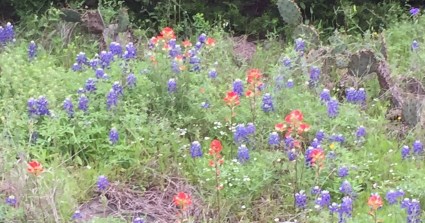
Bluebonnets taking over the crushed granite trail.
March is an alarm clock
if you’re a Texas Bluebonnet,
the official flower of that State
everybody knows.
We have pride of place artfully
set in many homes but few yards
of natives and transplants, alike.
By legislative decree, all species
are official, and abundant,
thanks to Lady Bird who said plant a tree, a bush, or a shrub.
Our blue pedals and white top
mark spring weather as we make
bisexual moves for next year.
We marvel at our neighbor,
Indian Paintbrushes or Blankets
complimentary red and yellow
color of 200 species or more,
as we compete for turf in arid, sandy,
dry soil. It’s Texas, after all.
Crowding where others fear to grow
we push our blue until we turn purple,
near the end of our time, then struggle
and exit the stage for later bloomers.
True Texans must be pictured with
children and pets and flowers all around.
They hunt bluebonnets with cameras,
and drive miles to wait in line,
to see and capture scenes
in the perfect photo or painting,
and they name everything after us.
What’s not the lone star is called
the bluebonnet whatever it is.
It’s nice to be so loved, but our
magical time is brief, yet meaningful.
Here comes the sun of the Texas
Summer following Spring.
Married to Bluebonnets
Texas Bluebonnets mean Yolonda,
and art on our walls, and spares in boxes,
they mean Lady Bird behind so many
wildflowers, like Indian Paintbrush,
or Blankets, they are what early spring is for.
They tell us it’s that time of change.
Close up of Indian Paintbrush seen on my walk.
In Texas, it’s Spring baseball (but not this year)
and bluebonnets and with their blue and white
caps that turn purple (purple bonnets?);
and the red, orange, yellow tease of
200 varieties of Indian whatever wildflowers
that are the first up, pushing their
primary colors quickly into the world,
making seeds to make more flowers for next year.
They mean the toughness of my adopted State,
the arid sandiness and limestonish mix
to be followed in the last few weeks
of spring with more crazy beautiful
flowering weeds, and the colorful,
awesomeness of prickly pear cactus
flowers that remind me of Silvia Plath,
and her poem about Red Poppies, yet to come.
I smile at the flowers, partly because of beauty,
and partly because of what they mean to me;
another season with a new reason, but mostly
because of who they remind me of.
Look both ways but keep your eyes on the road.
Mind the gaps, each one is there for a seed to make a plant.
Day 8 prompt: Use a portion of a poem from a twitter bot as seed (inspiration) to write a poem.
Confession: I dislike the words twitter, tweet, and bot. It’s getting late. I need a poem. I’ve read nearly all of Anne Carson’s “The Glass Essay” searching. I considered her “Where does unbelief begin?” and discovered her phrase, “That was the night that centered Heaven and Hell,” which I may use later. I pondered Richard Siken’s words, “Let’s admit, without apology, what we do to each other” and “This has nothing to do with faith but is still a good question.” I did the perusal work of reviewing several twitter bots. Nothing worked.
Then, as I was re-reading Tim O’Brien’s The Things They Carried (1990), I found it. I try to do “optional” prompts. I hope I semi-followed the elective prompt with a twist.
My poem is based on a scene from O’Brien’s book, specifically from the chapter, “On the Rainy River.” Tim writes of sitting in a small boat 20 yards from Canada while facing his inner dilemma of doing what he thinks is morally right and what his family and most people (at the time) thought he should do: to accept his draft notice and fight in the Viet Nam War.
The Embarrassment of Tears
It was a moral freeze,
part hallucination, he supposed,
as paralysis took his heart,
a tightness he wants me to feel.
He could swim but he saw them,
a blind poet scribbling notes, people,
his past and his future, and mine.
His conscience lost the battle in a war
it could not win. He would do it.
He would go to the war –
he would kill, and maybe die
because he was embarrassed
not to. That was the thing.
And so, he sat in the boat,
and he cried, but he did not die.
Not a happy ending, his war,
his book, our war. He went to the war.
He was a coward, he claims,
because he stuffed it for them,
for their love, which he carried then,
and carries today. I disagree.
He asks me, and you,
would you cry? The scene jerks
my tears, not for Tim, or the war,
but for me. I was not in his boat.
Sit in your boat and look both ways, to Canada or to home.
Mind the gaps, there may a book or a poem in them.
Day 5 Prompt: write one poem using or doing the Twenty Little Poetry Projects of Jim Simmerman. You can google it for other examples.
Torn Knights
He yelled into my face,
“Life’s not a bowl of cherries.”
I wanted to rip him to pieces
then and there, feeling his grip on my neck,
smelling the furious anger of alcohol breath,
I heard the silence of witnesses
sulking away, their fear fed my will to fight,
as his words breathed fire into my eyes,
all could see desperate anger quake the Earth
and shake trees as leaves fell like tears of fear.
Bill and Dan at it again on Butler Street,
brotherly love, kin with no wisdom to share
as each could see the envy of one
less favored dragon slayer.
“You da cool fool, hayna, baby-bro?
Ah tells ya, ‘cuz I luvs ya brudder.’
“Well I’ll swanny over such tots,”
tasting sweat mixed with vile spit.
Waltzing a pugilistic polka
inflamed a poison pit of spite,
played to muffled grunts and groans
Dan became the dragon, thus
Bill drew a slayer’s sword
to end of the fiery brand
brother’s battle forever.
Soft liquid steel shattered
the end, an old beginning.
Fata Morgana
reaching fait accompli,
times past without tears,
Earth swallowed Irish blood
into a hell of hate. Two men swearing,
dancing in the dark
to unending songs of never love.
Look both ways as life is not always as we wish.
Mind the gaps and choose wisely.
It says,
“Sambo.Richards, Duck Pond, PA”
(northeast of Scranton)
on a keepsake;
a dog tag probably,
all the d’s are backwards.
It was my mother’s,
and I have others. Some
were my grandfather’s
who was quite the handyman.
I never knew Sambo,
nor my grandfather.
But I knew Mom.
Looking both ways,
keepsakes are memories,
sometimes not our own.
Mind the gaps. History is there.
Day 2 prompt: Write a poem about a place (i.e., a house, store, school, or office). How ‘bout a bar?
Packy’s
Sorry to say it’s gone now,
Packy Lenahan’s bar.
Packy too. Kids may age,
Patty and Maureen Keating,
lived in the same attached building.
I forget the people’s names
in the apartment above Packy’s.
It was on the corner of Madison street,
where friends Jimmy, June, and nine more lived,
and my grandpop had lived before I was born,
and Butler street where we lived.
Packy’s, some thirty yards west of
my bedroom window,
was where they drank and smoked,
and where they played games and ate food
until well past my bed time.
Inside to the right a huge mahogany bar
had big high mirrors, stacked whisky bottles, and beer taps.
I learned shuffleboard to the left,
and my first dart board was on the back wall,
left of some stairs up to the dining room
with tables and chairs, a kitchen and
toilets were to the right.
Few stools were at the bar, but it had real,
often used, brass spittoons on the dirty,
cigarette-burn stained, wood floor where beer
was often spilled and seldom mopped
under high ceilings with fans on long poles.
The back door was mostly for exiting,
or entering when closed (but not really),
on Sundays after church or after last call,
always unlocked after knocking.
There was a piano,
and a smell of stale beer
and staler smoke, and a juke box
back in the dining room
where I sometimes played,
but bar spittoons always intrigued me,
men spat, often missing, one of the things
they only did at Packy’s.
Many nights I laid in bed and listened to them
talking or singing and being loud, having fun
at Packy’s. Sometimes fighting
after Packy threw them out and I wanted
to go see who got clobbered
with a brass spittoon off the floor.
You can see Packy’s door and window over my Dad’s right shoulder (circa 1948)
Look both ways cuz it’s not always what you think.
Mind the gaps and don’t trip over spittoon.






 Our Literary Journey