Mother’s Happiness

I know little of what my parents thought about any deep subject such as a philosophy of life or their world view. I managed no more than hints or rare tidbits. Regarding my father, I remember too much of the bad and little of the good. The opposite is true of my mother.

I remember more in Mom’s case, and most of it good. The few bad memories were usually not her doing. Mom may have had her share of bad days, but I can’t remember one that was her fault.

My clearest memories are the pleasant ones about our overall relationship. We were close. Not in the best of friends sense you may hear some parents brag about. Mom was my parent – not my friend.

As a teenager or young adult, I would have railed against being called a “momma’s boy.” I now look back on our relationship with pride.

My mother protected me, mostly from Dad, but also from a few other things. Oddly, not from bullies. If I developed an early skill in dealing with them, it was avoidance. Later in life, my approach was more direct. Conversely, she liked telling people how she often broke blood vessels in her hands spanking me. I don’t recall any of that.

She and I argued our share. I was a momma’s boy – not a good or obedient boy. There were times when I was disappointed in her for not coming to my aid. Looking back, I now realize how right she was.

When she did help me, she did it her way. She helped me in a manner that permitted me the dignity of learning difficult lessons the hard way – which was apparently my preference. When she felt like I needed to learn a painful lesson, she gave me the space I needed. I now realize how difficult that must have been for her. My mother’s love for me, and mine for her were never in question.

When Dad’s health was declining and she felt like she needed to help him, she postponed action on the lump in her breast. After his death, she moved on to her own health care. Everything she did during the period of that treatment, she did with the occasional assistance of her sister. My sister and I lived too far away to be of much help.

While Mom was a long-term breast cancer survivor, the invasive disease brought on her death only after she decided to end most of the treatment.

But years before that, the spot on her lung had been removed and she was recuperating in the hospital the day my flight from Texas arrived in Pennsylvania. Walking down the hospital hallway, the sounds and smells were unique. I would know where I was had I been awakened blind.

As I walked down the hall following the directions I’d been given, I knew I would take the next right into another hall, then right again into her room. I anticipated walking in and finding her groggy and sore from the surgery. I envisioned her smiling up at me, weak and tired. I turned the corner.

The window at the end of that hall looked down on the hospital’s parking lot. Its sill of hard tile was about a foot deep. My recovering mother could easily sit there and gaze down to the parking lot, watching for me.

When she heard my voice, she turned her head and saw me walking toward her. The day after surgery, my 70-something mother jumped off the sill and started running toward me. Mom drove her five-foot-tall frame hard against me, wrapped her arms firmly around me, and then pulled my face down and kissed me.

After I suggested that she get back into bed, we walked to her room and she slid back onto the sheets and pillow. Mom was excited and chatty. She was always happy to see me. But on that day, her response was overwhelming. The doctors and nurses kept Mom alive. All I had to do was walk down the hall at the right time. I became the star of her show. I will always remember how happy she was to see me that day. I’m glad I could help.

Happy Mother’s Day to moms everywhere.
Look both ways and mind the gaps.

W – Wilkes-Barre’s Deer (NaPoWriMo #27)

The deer statue has been resting on the Luzerne County Courthouse lawn, in Wilkes-Barre (pronounced berry), PA, since 1909. However, it was first placed in the city’s central area, where the old courthouse was, in 1866. That was a year after President Lincoln was assassinated, the Civil War ended, and Walt Whitman wrote the poem, Oh Captain, My Captain (all in 1865).

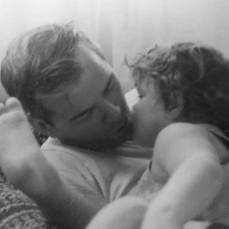
I wrote this poem from the persona of the deer, who never seems to complain. Since home cameras and photography became popular, people have been taking pictures of friends and family sitting on the deer. The photo I used is of my mother holding me on the deer, circa. 1947. Thanks to Sue for tweaking it to look mo’ betta here.


***

I Knew You When…
by Bill Reynolds

Oh, deer me! As you can see,
my time here’s been so long.
The Civil War was in the past,
all memories aren’t quite gone.

One year after Whitman wrote
his poem of woe, his poem of hope,
I came to this city, I thought quite pretty.

On Public Square, I stood so proud,
for twenty-four years, I knew that crowd.

In nineteen-oh-nine, to a new home I moved,
to guard this lawn where I now stand.
O’er a hundred years, as I’ve now proved.

Six generations I’ve watched them grow,
grands both ways I got to know.

Been standing here without a sound,
through floods and droughts upon this ground,
storms and disasters all around.

I’ve felt your touch and bore your weight,
There’s more to come, so here I’ll wait.
Bring your camera and your smile,
for here I’ll be yet quite a while.

I was here, you all should know
the day yer granddad stood so near.
I’m sure we’ve met, but before I go,
It’s me they call the Court House Deer.

***

Remember the past, look to the future, live in the present.
Mind the gaps and be well.

NaPoWriMo #16 (No AtoZ on Sunday)

This poem is about underground coal miners – people who did, or do, very dangerous work. My father and grandfathers were three. This is also about life in our home when Dad still worked in the mines.

During my early teens, the mining business shut down in northeastern Pennsylvania. This was due to the Knox Mine Disaster in the late 1950s and the easy, cheaper, and cleaner use of oil to heat homes. Today, most coal mined in the USA is exported, but the industry continues to decline. Only 30% of electrical power in America is produced by coal.

Old coal mine entrance. A dark abyss.

Nearer My Hell to Thee
By Bill Reynolds

Before leaving the daylight, and going into the pits,
They look deep into the ground, to the soul of the abyss.
The blackest of blacks, the darkest of darks, and danger,
The dank abyss peers back as men descend into nature.

Far below ground, the mine was there lurking, waiting;
That dangerous, disgusting damnation of sound,
For some small wages, they go into that hole far underground.

Deadly it was and deadly it is, they never know when…
Many wives cried at the loss of their men,
Who died in the gut of the deplorable depths.

It was frightening work miners chose, those jobs that killed.
Black hard hats on heads, mining lamps on to cut the dark,
But still never safe. In denial or not, it was dangerous work.

Blackjack and Brass Knuckles same as my father had.

Father was, and so were both grandfathers, miners all.
Walking home through muddy fields and dark alleys,
Dangerous on pay days; all cash in their pockets,
With blackjacks and knuckles, maybe a gun.

He’d push open the gate, then let it slam with a thud.
Dad would stomp up the stairs and in the back door,
It was always the back way after a day’s work.

Covered with coal dust,
The sweat of the labor, and the stink of the mines;
Smoking his Camels, always coughing and coughing.
But he was my Dad, and it was always like this.

I remember Dad much blacker.

Everything filthy, his clothing all rotting,
Black on his skin, and in his gray hair,
He didn’t know about the black in his lungs,
the deadly back dust was glued on hard, but not to his soul.

White at his eyes and over his lips,
he’d set down his lunch pail. No hugs, no kisses,
just “hiya,” and not much of a welcome.

His coat and his cap, and his boots all come off.
Trounced upstairs to the bath, footsteps pounding the way,
Transformation, about to take place.

In cold water each day, he washed coal dirt away,
From his face and his hair, his neck and his chest,
From his waist to his feet, but not from the rest.

Nothing could wash the coal miner away.

Not the water, the union, the beer, or smokes.
Not on the inside, from his throat nor deep in his lungs.
Black dust in his body and in with his blood.

In a coal mine.

It was always the same, until the disaster.
Miners to work, to suffer and die.
Returning to homes, dirty but to homes they came.

Then one day, the depression set in.
The mines all shut down, proud miners, no work.
One day it all ended and everything changed.

Miners laid off, the mines were all closed.
Oil was king, and nobody noticed.
No more abyss, just a new kind of dark.

If you not yet sufficiently depressed, watch this.

Mind the gaps and look both ways.

Insult Poem

Who knew? A form a poetry I can closely relate to. Disclosure: I enjoyed writing this. I went a little overboard with the vernacular — worked for me.

No real person, living or not, is depicted in this piece (except pics) — it’s a joke. A rotter is a cruel, stingy, or unkind person.

Ain’t Seen the Like

Yer ugly and a stupid lout.

I heerd ya drink da bath water,
Af’n yer old lady warshed da diapers out.

But, cha’ ain’t never gettin’ old; yer too rotter.

Yee’d have one redeeming feature,
If’n ye was dead, bu’cher sorry-ass ain’t.

Too bad, so sad, yer a hor’bile slimy creature.
Nah sir, lil’ fart, bu-chew never make’n saint.

Yer jis’ so feckin’ rotten, yer feets be a stinkin’
Yer mudder too asham’ ta le’cha go out.
If’n Ah wuz yer pappy, I’d be a-thinkin’
‘bout given yer nasty ass a good clout.
So I bin-a-tinkin, ‘bout nex weekind,
And yer putrid discustin’ slothy fate,
If’n ya steel wanna, an’ she’s still-a-willin’

Yer free ta take meh daughter on a date.


***

See the humor in life, lighten up, and look both ways.
Mind the gaps on country roads.

Elegy Poem for Mom

An elegy is a mournful poem. I wrote this elegy regarding the loss of my mother, more than 25 years after her death. The elegy is one of the oldest poetic forms. It’s identified by what it says, not how it says it.  The Greek word elegeia means song of mourning, and is often included in classical Greek tragedies.

Missing Mom

The day Mom died, I stood there and cried.
To the surface my guilt came out of my eyes,
Beside her deathbed, letting go of our life.
Her suffering had ended, and I was alone.

No person is perfect, no human unsoiled.
Enshrined mother’s love, was sunshine to me,
‘twas the essence of my childhood memory,
My loss just the same, never again she will be.

She’d lived a rough life, through to the end,
But she loved me as only the mother to son,
That unconditional love, will never be done.
Only her death could end our last day.

Alone. Just alone.

Her voice and her scent, ecstasy to me.
So much I still miss them. I can still see.
“Hiya,” she’d say, to even the worst.
As kind as she was, so how she asked me to be.

Mom we still miss you, your face and your smile,
The sound of your voice, the look in your eyes.
Never again, will you be for us to see.
The loss that brings a sadness, one forever I’ll feel.

Mind such gaps, look both ways, and remember love.

Father Daughter Collaboration Poem

This poem is a collaboration poem written by my daughter, Julie, and me. We both worked on it. In fact, she initially wrote the first part, as a poem to me. It is not renga because it meets none of the normal forms. It is simply two people writing a poem to each other and collaborating, so style and form are free. One could look on it as a duet, or father – daughter billets-doux (love, or sweet letters). Ardor means enthusiasm or passion. My portion is italicized.

Dewey and Dad
by Julie Barber and Bill Reynolds

You are my father, tried and true
And you my daughter through and through.

You know my heart, my feet and hands too.
Some even say I look like you.
From birth and to your life throughout,
I’ve been there for you, without a doubt.

There was a time when things were harder.
I hope I’ve grown and become much smarter.
If we could go back, I’d want you my daughter.
Together we’ve grown older with ardor.

My father, wiser by the day…. Always profound things to say.
Sharing our life keeps misery at bay.

I look to you when the answers are grey.
You say, “let nothing get in our way.”
You heart and your talent come into play,
Find peace therein, as you work away.

Go out and write and use your talents
It will give your life more sense and balance.
Your words are like clay, your pen is your pallet,
Your life is your muse, your mind is your mallet.

Get off your ass and do it already
The world is uncertain, and time is unsteady.
It’s your life to live, you should live it as heady,
Be happy my child, ‘tis all worth it, you’re ready.

The fact you’re so far away makes me sad
But I’m more than proud and grateful you’re my dad.

She’s Julie, but I call her Dewey

Forever you’ll be my daughter to me,
A lifetime of love, we certainly have.

My daughter, our love surpasses all distance
No oceans divide us, our minds unite us.

As we see one to the other, it will always be,
You rank above others swimming the sea.

Mind the gaps, family, love, friends, and the important things in life.
Look both ways, and all around.

Faces in the Mirror

What would it be like today, if I could see all the faces that you have reflected? You only reflect me the way I look today, older and very different than when we first saw each other. I don’t recall that day, because it was almost 70 years in the past. Before that, you had reflected many other faces for as many reasons.

Since before I was born, you always had your place in our home, on the west wall of our dining room. There, you were centered on the wall, above the old sideboard buffet, which was also a permanent fixture. As anyone walked past you going to, or returning from, the kitchen; you reflected their profile. Before leaving home, we all stopped and faced you for your final review and blessing as we took one last look. Mom and Dad used you to check the look of their hats reflected in your glass.

Since your total viewing area is only one foot by a yard wide, you never revealed much about us below the neck and shoulders. Yet, you remained our primary, go-to mirror even after several full-length mirrors were installed. I recall the day my brother stood staring at you when he pontificated, “You know, Billy, you’re only as good as you look.” I never agreed with him. Did you? I suspect that how people look is important to you. It’s your purpose.

Every year, on Palm Sunday, someone would change out the palm frond strip hung prominently across the top of your frame, where it would remain for the year. That was sort of the family way of dressing you up for Easter Sunday. It was always the same.

The only time you, or any of those items around you, were moved, it was for painting walls or changes to the floor coverings. But you, the mirror, and below you, the side board, were always restored to your rightful, prominent places. Mom and Dad did not change furniture often, but they never booted you from your space.

How many photographs, cards, messages, and notes were stuffed between the edges of your glass and your frame? What did they say? Were they important?

You are in old pictures from my grandfather’s house (the one my mother grew up in), taken long before my birth, showing you along with two side sconces, both long gone. I never met any of my grandparents, but you did. I’m sure my Mom’s father looked at his reflection in your glass. Maybe her mother, too. I can envision him holding his young daughter up for you to see. Who else saw themselves, and the reflection of others, in your glass?

Beginning in the 1920s or 30s, every member of my family must have looked at you. When did you come into being? Every friend who ever visited our house saw their reflection, and probably that of others, when they looked at you.

You have survived the Great Depression, the FDR, Truman, Eisenhower, and Kennedy years, World War II (and possibly WWI), several rough moves, and whatever untold disasters that occurred during your 44 years in my parents’ home. For the past twenty-five years, you’ve been undamaged by my hauling you from one end of the country to the other.

Your ornate frame has a few nicks and scratches revealing hints that the wood beneath your gilded frame’s lamination is red. The corners of your frame are secured with two wooden dowels each, all attesting to the creativity and craftsmanship of an earlier time, when some master mirror maker worked magic.

While you’re a handsome and distinguished antique, it’s not you the mirror that provides the mystery and intrigue. It is the many thousands of faces that underwent self-examination as you watched, the hundreds of times a tie or hat was straightened with your approval, or when an Easter Bonnet was set to one side, and then given an approving nod.

Oh, mirror on my wall, holding the history of thousands of changing faces within your glass panes, do you remember their smiles and their tears. What do you remember? What secrets do you hold? Will you show me those reflections so that I may see whose lives you’ve shared? I recall with fondness and sometimes sadness, the pictures in my memory of the many times I stood nearby, and watched, as others used you to reflect a special moment in time. Show me their faces today, so that we might name the names.

When you look in a mirror, wonder.
Who else has looked this way? Who will?
Look! But, look both ways, and mind your gap.

Understanding Poetry

Let’s face it. While poems are to express a feeling or an idea in a certain style, we don’t always understand them. I love poetry. I try to write it. I admit that it can be more complicated than we prefer, and perhaps more than this Old Texas Aggie’s gray matter can process.

poetry-2

Sometimes, as with music, it just sounds so damn good, even though I have no clue about the subject or purpose of the piece. Poetry sounds especially wonderful when read by the right, good voice. It works for me, even with my uncertainties about understanding the art.

I like the synonyms for poetry, chiefly versification, metrical composition, balladry, and the archaic (and perhaps politically incorrect) poesy. Occasionally, I run across a fine piece of balladry that I not only enjoy and understand, but I also relate to with some internal passion — Hell Yes!

I love irony in life, in writing, in humor, and in verse. It strokes my silly ego to find others who give a pass to the literal minds of the world, and share my ironic reality. Last week I was handed a poem that was published in Stanford Magazine (Jan/Feb 2017), written by Mary Poindexter McLaughlin, titled: Alma Mater.

poetry-5

For me, this poem glorifies the wonderful simplicity of ordinary lives, and it resonates in me the value of things like freedom and love and family and friends. All of which wear the tag: priceless!

ALMA MATER

My apologies for using a link, but the publisher is unable to grant permission for me to republish at this time. Please click here to read the short poem from the Stanford Magazine page.

Because this is from the magazine of a prestigious American University (Stanford, I did not go there, but she did), I think Mary is referring to her alma mater. But, she could also mean any parent, friend, or muse who we believe had greater material expectations of us. It reminds me of that meme, “How do you measure success?”

poetry-3

Here are four lines of my own poetic dribble. I have been massaging this clunker for a while, there is more, but it’s nowhere near finished. I wonder if it conveys the right emotion.

Always, you’ve been here with me,
As children, we survived my foolish resistance.
While we ponder our thoughts, I sense yours in me,
As we bind together, into one two-sided life.


poetry-1If you wanna write some, there are on-line poetry challenges, such as NaPoWriMo during April (sign ups begin 1 March 2017). You will be challenged to write a poem each day. I do the A-to-Z blog challenge during that month, so not sure that I could keep up. Maybe.

…. Great love. (In tribute to Pat Conroy)

Poetry or prose, mind the gaps and look both ways.

Our Struggle with Love

valentine-2

Mom frequently told me that she loved me. I don’t recall Dad saying it. If he told me, it was seldom. They both loved me; and while I loved them back, the feeling that I had was not the same for each. What was that? One word with so many meanings.

We even manage to say love to express approval of inanimate objects, “Oh, I love that pizza.” Or, as my young grandchild copied from his mother, disapproval: “I’m not lovin’ it!” He was too young for such a trendy (now trite) phrase, but he understood it.

If we considered all the meanings we have for the word and lined them up on our continuum of human emotions, the variety would defy any logic we use to keep saying it. Fortunately, context helps us out and we socially understand each other’s intent. We would need to invent too many new words to replace love. Someone once told me, “I love you, but I’m not in-love with you, if you know what I mean.” I understood and welcomed the explanation since the first three words could be concerning, but still not necessarily unwelcome.

valentine-1Regarding romantic love, it is one of the most fantastic feelings we can experience. We can even see that love feeling in friends who have fallen into love, head over heels. More evidence for the wonderfulness of amour is that the love and lust emotions get us in so much hot water, but we seem to dive right in anyway. It’s such a good thing. Would we be human without it? Barring some interfering DSM IV, mental problem diagnosis, we all love someone, and usually many people. And each feeling of love will be different from person to person, but it’s still love.

All love makes this world a better place. We’ll never have too much love in the world, but we seem to have too little of it. We have faced that since the beginning of time – too little caring about each other.

Enjoy The Youngbloods as they sing one of my best-liked, hippy love songs from the 1960s: Get Together. I’ve provided the lyrics below, as well as links to two other love-tunes.

The Youngbloods – Get Together lyrics

Love is but a song to sing//Fear’s the way we die//You can make the mountains ring//Or make the angels cry//Though the bird is on the wing//And you may not know why.

Come on people now//Smile on your brother//Everybody get together//Try to love one another//Right now.

Some may come and some may go//We shall surely pass//When the one that left us here//Returns for us at last//We are but a moment’s sunlight//Fading in the grass.

Refrain//refrain//refrain

If you hear the song I sing//You will understand (listen!)//You hold the key to love and fear//All in your trembling hand//Just one key unlocks them both//It’s there at your command.

Refrain//refrain//refrain

Right now…

Right now….

Also, Haddaway’s is a more erotic and fun video of What is Love (click here); and Dionne Warwick finishes up with What the World Needs Now is Love (click here). None of these songs have many lyrics, but I love them anyway.

valentine-3

Happy Valentine’s Day.
Remember, love is a two-way street.
So, mind the gaps and be sure to look both ways.

Pray for What?

prayer-1

If I’m your guest for dinner and your family tradition is to hold hands or bow your heads to pray, or we’re at a restaurant, and you want to pray; I’ll respectfully observe your tradition. I don’t say grace nor will I ask your God to ‘bless the meal;’ however, I’ll not be disrespectful. If you’re my guest, you may expect the same courtesy. I don’t pray, but if you do, it’s ok.

In Catholic grade school, we recited Grace Before Meals before lunch, and Grace After Meals when we returned. I don’t recall saying it with my family. As an adult, I said the short prayer you can see on virtually any episode of Blue Bloods. If you take too long and the food gets cold, I may pray for an end to your jabbering.

prayer-3

I consider some, perhaps most, prayer to be harmless and it maybe even good for you. That’s right. I said some or most. Openly expressing gratitude, which is perhaps the least felt of all human emotions, should be a good thing. But, in my opinion, not always.

Thanking God for the touchdown is silly. So is divine gratitude for a political candidate winning or for scoring in the lottery. These examples are nonsensically selfish and may be harmful. While I’m good with being grateful, I’m not okay with all forms of prayer. I shouldn’t care, but I’ve long held my opinion.

I’m fine with prayers of worship like God is Good, but if I hear God is Great yelled in Arabic, fight or flight may take over. Back as far as I can remember, I had issues with asking God for anything. It made no sense to me — still doesn’t.

My parents told me that God helps those who helps themselves, or a similar form of the phrase. I’ve never given up on the basis for that idea. For example, I went to see a house being remodeled and found the painter sleeping. After inquiring about his health, I asked if he worried about being fired. He said, “The good Lord will provide.” Raising eye brows, I said, “Oh. I see.” Lucky him. I wasn’t the owner.

prayer-4As often happens following severe droughts in South Texas, the many weather gods provided too much rain. Severe damaging floods came after the months of virtually no rain. As Father Conor McGrath was reading announcements from the Parish Bulletin in his wonderful Irish brogue, he adlibbed a joke by saying, “And would the gentleman who is still praying for rain please stop.”

Another time McGrath told us the joke about the man named Thomas, who continuously prayed to win the lottery and began to lose his faith. The gambler blamed God’s failure to grant the prayer as promised. I can still hear Father Conor deliver the punch line from God, “Thomas, I need a wee bit of help here. You’re needin’ ta buy a ticket first.” We must do our part.

Valerie Tarico made some good points in her post about why some prayer is neither valuable nor innocuous. It encouraged me to make my own case.

She said, “Atheists, agnostics and other secular activists may think prayer is hogwash, but a lot of other people like praying and they like to think that it works. So, why not just leave the habit alone? It seems harmless enough.”

Later, after she highlights some of the perks of prayer, she presents her case against the troubling hidden costs of petitionary prayer. This is her list of 7 problems, with comments that are mostly mine.

Petitionary prayer:

  1. Suppresses critical thought. During our meal, if you begin to choke on a turkey bone, would you prefer that I pray for your recovery, or would you like me to perform the Heimlich Maneuver to dislodge the culprit?
  2. Undermines agency and responsibility. Let go and let God, right? We are not responsible for anything this way. Remember the painter? I agree that sometimes it’s good to let go of things. But, we need to do what we can (think Serenity Prayer).
  3. prayer-2Promotes a habit of self-deception. If God is right, why bother? Wouldn’t he do that same thing even if we didn’t explain it?
  4. Distracts from more promising endeavors. This is one of the most profitable things sold by TV preachers. What else might those resources do? Feed the hungry or clothe the naked?
  5. Promotes victim blaming, including self-blame. If God grants requests from some, what does that say about those who get no response? If God heals your wart, but not mine; something must be bad about me.
  6. Teaches people to mistake abuse for love. Deferring to Ms. Tarico, “Being forced to praise and adore a powerful person who requires vulnerable dependents to beg for what they need…and who then grants or denies these requests in some inscrutable pattern, is not love. It is abuse—and as many former Christians have testified, it primes people, especially women—for further abuse.”
  7. Replaces compassionate action. There are times for inaction and times to act. We are all in this together and helping one another is what we do best. Tarico refers to Julia Sweeney’s monologue, “Letting Go of God.” I watched it. It’s well-done and funny, but two hours long. If you’re of the Free Thinker persuasion, watch it — especially if you were raised Catholic.

As I’ve implied, some types of prayer, like contemplative meditation, gratitude, and communing with something greater than ourselves, may be useful even for non-believers. But, Valerie Tarico said it best.

“It’s time to get off of our knees and take care of ourselves and the people around us. We’ve long passed the infancy and adolescence of our species. Regressive fantasies can be delightful, but at some point, clutching a teddy bear and squeezing our eyes shut and lisping “Now I lay me down to sleep” ceases to be sweet. The world needs adults who, in Sweeney’s words, are willing to get up in the morning and mind the store.”

May we all live in the real world and acknowledge that we need each other more than invisible fantasies born from the minds of men.
Mind the gaps, the store, and look both ways.