An allegory of conclusion

The Man in the Room

I don’t recall exactly when I learned a man was in the room. I’m sure someone told me.

For years, I watched as other people behaved as if they knew he was there. This was serious business. People (called martyrs) died because of this man. As a child, I never doubted what I was told about the man in the room. I not only believed he was there, I also knew a lot about him. He was old with a long gray beard, but handsome. He was quite distinguished and grandfatherly.

The man in the room was more important than anyone, even more than the President or the Pope. The President, and especially the Pope, also believed there was a man in the room. The Pope even had secrets that the man had entrusted to him. The man in the room was even more important than I was, or my parents, or any king.

Everything was about this man.

People wanted me to devote my life to the man in the room. We gave up things and made sacrifices either for him or to him. We did good things, like give money and stuff to the poor and needy because the man in the room wanted us to. The more we showed that we cared about the man, the better we were treated by our teachers, preachers, and parents.

The man in the room made the rules for everybody. He picked special adults and told them what the rules were for all of us. Everyone I knew agreed that there was a man in the room, and he was in charge forever. He was super powerful. He could do anything. He was in total control of everything. He could be invisible and even bring dead people to life.

He had always existed and always would.

Eventually, I learned that the man in the room made everything; even me, and you, and the Pope. I learned that he made me for a reason. I was to love and serve him and to do his will outside of the room. Everyone was. Even people who didn’t know it were supposed to serve him. That was my first world view, my purpose for being, but I didn’t fully realize it.

People would talk to the man in the room. Sometimes, they would ask for something. I was taught how to talk to him. I did this for a long time, but the man never talked back to me. Apparently, he only talked to certain people using his thoughts. That made sense. I sometimes asked the man for things. I was told he was always watching me, so I assumed that was why he never gave me anything I requested.
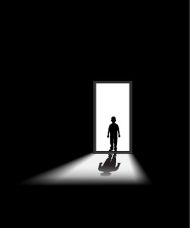
I knew people went into the room to see the man. One day, I decided to follow some people, hoping to see him. When I opened the door and stepped in, I saw no one, not even the people I had followed. It was an empty room and there was no man or any person to be seen. I wondered why I had seen no one else and why he apparently left the room as I entered. I had been assured that he always remained in the room.

I decided to find out why I had seen no one, especially not the man I was searching for. Since everyone was so positive about the man, I was sure that I had made some mistake.

After leaving the room by the only door, I decided to ask my mother why I had not seen the man. Mom got nervous and seemed upset. She told me to ask my father. I did. That was a mistake. Dad became angry and sent me to my room. He told me that next time he might beat some sense into me.

I decided to try a more neutral person.

I asked one of my teachers who I could trust if there was a reason that I couldn’t see the man. I could see her irritation, but she kindly explained to me that if I could not see the man, it meant that I did not believe strongly enough. I needed to have more faith. If I believed strongly enough, I would see the man.

As I asked others and I talked with friends, I realized that some people did not see the man either. A few of them never went into the room, or they denied any room existed. But they never told me that there was not a man to be seen. Most others told me that they did see the man. I was told that those of us who did not see the man were at fault. The issue was our lack of faith. And my lack of faith was evidenced by the fact that I asked too many questions and talked about it.

I thought the problem was clearly with me. I could see the room, but never saw the man. Others did. I needed more faith. I simply had to try harder.

If others could see him, why not me?

Years passed. I lived my life and almost forgot about the man. However, the man in the room issue never went away. I noticed that people began to assume I could see the man, just as they claimed. I stopped talking about him as though I could not see him. In a way, I lied by pretending.

For a while, I returned to the room often. I decided to ask a ‘man in the room’ expert if there was reason for my failure and if there was anything I could do. Again, the blindness was my doing. If I would believe more, I would see him. That still made sense to me.

I wondered how to have more faith.

Since I was certain that there was a man in the room, that it was my lack of faith that prevented me from seeing him, I decided to take even more drastic action.

I became a man in the room fanatic. I joined organizations. I took all the classes and attended all the learning groups I could find. My expertise allowed me to teach classes to both children and adults regarding the man in the room and the things they should do to be better followers. Eventually, I became a man in the room leader in a large and important relevant group.

I held firmly to the belief that there was a man in that room. Finally, one day I saw the room again. No one could have done more than I to be a true-blue follower, believer, and expert. I had not seen the room in years, but then one day there it was.

That was my moment, my time, my life-long goal of seeing the man was to be that day.

I proudly opened the door and triumphantly marched into the room, and there sitting in the chair in the corner was me as a child.

The child looked up and said, “I have been sitting here your entire life. I wanted nothing more than to meet the man in the room. For over 50 years, I have waited and searched, while you have worked and prayed and believed. But, look around. There is no man in this room and there never has been. I have gone to other rooms with the same discovery.”

I felt broken and deceived. I had wasted so much of my life hoping to see a man who never existed. Again, I walked out through the only door. When I looked back, the room was gone. I thought, and I wondered, and read and studied all the possibilities. I felt myself changing. I began to say negative things to people regarding what may be in the room.

I had lived most of my life with almost constant thought about the man in the room. Over many months I slowly became a person who openly expressed doubts.

Then one day a friend asked if I still believed that there was a man in the room.

I looked at my friend and said, “For more years than you have been on the earth I have searched for the man in the room. I did more than enough. I have decided that I was deceived. After a lifetime of trying to find a man, it is my conclusion that he does not exist and never has. The man is a myth and has always been.” I was relieved to know that I had finally found a truth that escapes so many.

One day, someone asked, “What is the point of you saying that there is no man in the room?”

I responded, “There is no room, only one told in stories. There is no man, invisible or otherwise. Too much life is wasted over nothing. Either there is man, or there isn’t. Faith is irrelevant. Belief does not make it so anymore than failure to believe makes it not so. It is reality based upon evidence.”

Another man overheard that comment. He approached me and said that I may not make such a statement if I have no proof that there is no man in the room. He said that I was asserting a fact that I could not prove. He wanted me to say that I believed that there is no man in the room.

I objected by claiming that I was asked a question (what is the point?) to which I provided my best answer. I postulated nothing. My answer to the question is not an affirmation that there is a man, but a admission that there is no evidence that there ever was a man in the room. Since he was not in the room when I looked, that was all the proof I needed. The fact that others believe there is a man in the room because someone told them has no bearing on reality. It only supports what they already believe.

My conclusion is different than their belief. No one ever told me that there was not a man, only that there was. When I tried to find the man, or to ask why I could not see him, no one said he was not there. They only told me that my inability to find him was my fault. I no longer believe what people told me. But since I did everything I could, and I did what they told me I must do, and I still did not find any evidence of the man, I concluded he does not exist.

One of the things that helped me with my conclusion is the story, and the resulting idiom, of The Emperor Has No Clothes. I should have known from the beginning that there was no man to see because I could not see him. That should have ended it. But I did not want to accept that people were telling me the same lies they had been told.

Almost everyone I knew insisted that I was wrong. When I realized that the Emperor was naked, I knew why I wanted there to be a man in the room. I wanted there to be a man, and I wanted him to be as I was told he was. I wanted to be like most people. I’m not.

Now, I know the truth. I need no proof of what does not exist.

©Bill Reynolds, 11/12/2018

Look both ways. Look again, and again, and ….
Mind the gaps dearly, they may hide truth.


The Emperor Believed.

(pingback: https://grabaspine.wordpress.com/)


Essay: Grace Before Rant (and why I care)

So many things about other people are none of my business. It is not the same with everyone because my relationship with each person is different. It begins with me, then my immediate family (in my case), then my friends, professional relationships, then people who want something from me like money or my vote. It may include strangers with whom I share driving on roads, rooms (the sign said ‘employees must wash hands’), grocery stores, air, or transportation systems.

Ambivalence, freedom, and self-preservation

If the man sitting across from me on the bus wants to pray, I don’t care. If he puts down a prayer rug that blocks my exit, I do care. If he jumps up and yells something that sounds like god is great in Arabic, I care a lot about his intention. As the behavior of others moves closer to interfering in my life, the more what is not my business is made to be. Not by me. I begin to care.

Pray, pay, and obey

When I lived at home with my parents, I was the youngest child in an Irish Catholic family. For nine years (1950s), I attended a Catholic elementary school (K-8), as did my older siblings. I was taught all traditional things catholic kids were supposed to learn. I memorized the Catechism. I learned about the religion as it was taught to us, about the saints, and some bible history for eight of those nine years. We had to pray. We had to go to confession and to Mass. We had no choice, but I also recall none of us resisting. We saw it as normal.

Millions of children around the world grew up in similar circumstances (and some have spent a lifetime recovering). It was brain washing, of sorts. We prefer to call it religious education and indoctrination, to be more politically correct.

We prayed to start each school day. We memorized new prayers as part of the curriculum, some in Latin if you were gunna be an altar boy. There were no altar girls then (now both sexes are altar servers), but the Latin has been scrapped in most cases. Before and after recess, we prayed. Before lunch, we prayed Grace Before Meals. When we returned after lunch, we stood next to our desks and prayed the Grace After Meals. Before we left for the day, we prayed. We were expected to pray at home.

When old enough, every Friday, or the day before a Holy Day of Obligation, we went to confession as part of the school day. More prayers; and the assigned penance was to say more prayers (five Hail Mary’s, five Our Father’s, and an Act Of Contrition). Think about that for a minute: prayer as punishment? We did that in anticipation of receiving Holy Communion (the body and blood of Christ) at Mass. You’d have thought we were Trappist monks in training (they pray seven times a day).

Reciprocal respect (do your thing)

I am not going to repeat what I’ve said about prayer (mine or other’s) in past posts. But I want to express a concern (PC for pointed rant). I only know what a few other non-believers do in these circumstances, but I want to briefly whine over how I feel about it.

Maybe I’m being picky or over-simplistic about this, but I strongly believe that no gods exist or ever have. Consequently, communication with something non-existent is pointless, if not weird. I do not include mediation, talking with others (including animals), or talking to self in the same way because in each of those situations, the self or other being exists and meditative relaxation is probably healthy. I have talked to my pets my entire life and in many cases I am sure there was some degree and form of understanding me and what my intention was, even if the language was not understood. They never talked back (at least not in a language like English).

My wife (not atheist) and I occasionally have meals with religious friends (Evangelical Protestant, Lutheran of some kind, Catholic of Roman blend, whatever). In most cases, it goes like this. We meet up, we talk, we sit, read menus, we talk more, order drinks, talk more, order food, they talk even more, and then the food comes. That’s usually when the religious people decide to pray.

Now, if we can pray at religious school before we go home or down stairs for lunch; couldn’t they get the prayer part done a lot sooner? Furthermore, praying, especially while holding hands with convinced atheist, is not a social experience. It is a religious one.

Sometimes, they do pray early. If you go to their home for an outdoor barbeque or buffet style meal, they pray in one of those large group things. Usually, the protestants, and often Catholics, still want to hold hands, bow heads, close eyes, and mumble incoherently. Anyway, I will usually hold hands and watch as someone mumbles a long thanksgiving kind of prayer, often as the food cools. Early prayer is possible.

Truth is, these are my wife’s friends much more than mine (she and they may disagree). If I do not feign cooperation, it could affect her relationship with her friends. I don’t want to do that.

In most of these situations I feel awkward (and maybe a bit hypocritical) because of my beliefs. If they did not pray, or would pray on their own, it would be fine. The problems come with the showing off. That’s when I feel like I am socially being made (as in forced) part of the prayer, prayer group, or blessing process. Maybe I should say something like,

“You go on ahead and pray. I don’t do that. I’ll wait, but if you take too long, I’ll start without you. I’m here to interact with you socially and to eat. Not to pray.”

But I won’t do that.

Is my conclusion equally valid?

While I’m willing to speak openly about my atheism with almost anyone (there are limits), I don’t want to cause problems. I’m often demonstrative when arguing or debating religion (or anything). That’s not good.

Moreover, I don’t want to be the cause of my wife’s friends shunning her or pretending out of sympathy. I don’t care what they think about me. (I’m atheist, I know what many think). But there is irony in that. I do care how the world treats my family, especially when I may be the reason for it. (Your father, grandfather, husband, friend, what-evah).

What do you think?

If you have an opinion or experience with this, I would like to hear it. If you pray, how do you feel about a non-believer excusing themselves or feigning participation? If you are not a believer, how do you handle such situations? Please comment, even if it is that you don’t care either way.

If you watch this show, you know that they seldom hold hands: Catholic.

Bill Reynolds, 5/11/2018

Look both ways when crossing to the other side.
Mind the gap of our differences.

Un-shunned, But Out

Several people suggested that my experience with religion may have moved me to embrace atheism. I don’t deny the experience. But, religion was not responsible for my conclusion that no gods exist.

I was born not knowing. Somebody told me there was a god and I trusted they knew what they were talking about. As a child, I ‘believed’ in god because I believed who told me. For shorter periods of time I also believed in Santa Clause and the tooth fairy. I was also convinced monsters existed even though no one told me they did. I never saw a god, Santa, or the tooth fairy. I was sure I saw the monsters, and some lived under my bed.

I was initially told that all these entities existed except for the monsters, but they were the only ones I reacted to and lost sleep over.

I was emphatically told by my parents that there were no monsters and no ghosts. I was agnostic about the ghosts, having seen Casper cartoons. But no monsters? Bull shit! I knew what I saw was real! I began to have doubts about parental honesty.

Eventually, I unwillingly figured out the deal with Santa and the tooth fairy. I also gave up on the monsters, or perhaps they tired of me. Maybe the tooth fairy turned them into dust bunnies.

I figured out the god thingy last, around age fourteen. I was never dumb enough to tell anyone, even friends, that I no longer was buying the eternal life package. My father was the type of Irish-Catholic coal miner who would have attempted to pound belief into me. Besides, the religion thing worked to my social advantage. I often wonder how many of us practice religion for some social advantage or for financial gain, but don’t buy it either.

When my Catholic parish learned that I was an active participant in the protestant Episcopal church down the street, it pissed them off. That pleased me. If I could in some way return the ‘love,’ my parish seemed to have toward me, I was all for that.

Not so much with my parents, who were more upset. Those poor folks had a real shit-head difficult lad to raise, so church was the least of their concerns. Yet, I heard my mother say, “It may not be Catholic, but at least he has a religion.” I did not. But, if she was accepting, I wasn’t going to change it.

The church down the street was a playground of youthful debauchery. I was one of several Catholic teens (boys and girls) who participated in their youth group. My motivation for participation was likely untoward and had nothing to do with religion or god. That was then.

Now, my overall philosophy is a moving target that even I find difficult to corral and define. So, I stole this idea of a three-legged stool from somewhere. One of the legs of the stool is god, which is why the damn thing keeps falling over. Any god or gods get to share one leg and no more. The leg is there, but it’s symbolic. You could call it atheism, but not exactly.

Religion, which I define as the rules regarding humans dealing with gods, is the second leg of the stool. Religion and god relate but are not the same. The religion leg casts an unfavorable shadow upon the god leg. As splintered and twisted as it is, religion exists.

While the non-existence of god is almost a neutral, unemotional, changeable conclusion that came to me from thoughts; my vehement enmity toward all religion, especially the known ‘organized’ faiths, is unwavering and continues to grow as I age and reflect upon what I see and know. If god were to appear before me right now and provide enough proof to roll any skeptic, I would morph to belief in a New York minute, but I would continue to detest religion.

This is where my atheism gets confused with my religious experience. My bitter feelings about religion stem from experience and knowledge. While I am accepting of religious folks and I extend kindness to most believers (and they to me), what they believe I tolerate but don’t respect.

Religious mumbo-jumbo has nothing to do with whether any gods exist. Yet, I remain open to the tiniest of possibilities that something may change my mind. However, throughout history, nothing has ever happened to any human that would convince me otherwise.

What most people seem to believe about god and how to relate or interact with that god is manmade. However, religion has a lot to do with how people act toward each other. Call it morality. Theoretically, that should be good. Historically and practically, it has been otherwise.

The third leg is my spiritual philosophy, which is influenced by the other two legs (no-gods exist, and bad religion). The three legs support the seat, which is my overall philosophy (of life, my world view, reason for…whatever). The analogy isn’t perfect but it works for now.

In a debate Rev Al Sharpton and Christopher Hitchens once struggled to find disagreement because Sharpton kept trying to debate the existence of god (which he admitted he couldn’t prove) while Hitch pointed to problems with scripture, evil, and religion (Hitch admitted he couldn’t prove the non-existence of god). Two separate topics that influence the third philosophical leg of my metaphorical stool.

Atheism is not a religion, a belief system, a philosophy, or anything other than an acceptance of one’s opinion that god might not exist, or probably doesn’t. Atheists have divergent views as do most human groups. Some atheists are nihilist. Most are not. A few atheists go to church. Most do not. Some atheists make room for unscientific things in their opinions and how they live. Others claim that such opinions are not those of true atheists.

It can be confusing. But can’t the same be said of believers? Since I was a child, I was told that TV preachers were nonsense. I still think so. Many believers agree with me. Many believers reject the idea of a virgin birth, others call that heresy. I could go on about divergent religious beliefs, even within a specific religion such as Roman Catholic, Shiite Muslim, or Mahayana Buddhist. Dare I add Southern Baptist or Mormon? But that’s not my point.

While many atheists say that reading scripture will lead to disbelief, I contend that not believing in god is a rational decision not based on religion, dogma, or scripture, even though any of that will support atheism once the no-gods conclusion is reached.

While I claim to be rationally atheist for logical reasons, I think I’m also intrinsically incapable of believing in god without very concrete proof. No religion or religious person; priest, pedophile, or persecutor drove me away from believing in god. I tried to believe. I just couldn’t. Now, I openly don’t. I’m as pleased with that as believers are who foresee their blissful eternity simply because they believe and nothing more. I’m okay with that.

Look both ways in life. Learn from the past. Plan for the future.
Mind the gaps for denial and confusion.

Friday’s Birthday Poems

Party Time at 5

Poem about a birthday

I remember, I remember, oh how
I was turning five and still alive
entering the world of kindergarten.
Grown-up, is what I was now.

Friends came with gifts
names and trinkets long forgotten,
we romped and played and we
yelled and screamed and gamed.

We played on and on into
the reality of life, that secret
so well kept that it was a time
of passage into an elementary world.

© Bill Reynolds 7/27/2018


72

I’m now seventy-two –
So, what’s it to you?
‘at depends I suppose
On where my life goes.

Think I’m set in my ways?
that it’s how I stays?
Well, I got news for ya,
I’m still learning, too.

To them’s who’s gone before meh,
I’m glad ya got to know meh.
For if it’s me yer comin’ after,
Drink one to the old bastard master.

© Bill Reynolds 7/27/2018

Again, to the past, look both ways and you’ll last.
Still mind the gap, lest you get an unwanted trip.

Happy Father’s Day

Glad Dad

this very day it’s been about
those many years you called me out
by a that tag without a name
with rules never quite the same

i must admit and i’m truly glad
yet sometimes i was very sad
the years i called my father dad
now it’s this time for me to add

it was easy as you may see
in the game of one two three
to wish the better for me to see
dad is neither simple or free

days were good yet sometimes bad
i still love my kids to call me dad
my special treasure to be had
their father’s name my greatest fame

Look both ways and mind the gaps.

Poetry: A Blaze of Glory

Warned ya: F-word used cuz I do.

A Blaze of Glory

I should be dead.
Hush! Be quiet.
Listen to me.

I shudda been dead years ago.
Every rock wall or cliff I ever saw
was for climbin’ up or down
got kinda hairy sometimes, ripped pants,
scrapes, scratches, and snakes
got bee stung once.

Every train was our ride, tracks for playing
and high trestles for wide river crossings.
A train’s comin’?
I knew two guys who
killed themselves
jumpin’ off a them bridges.

Every roof was to be jumped from
after a building’s been climbed, got
wrenched, twisted, and sprained —
never broken.

Me and Jimmy swam
butt-naked
in that filthy, dirty, Susquehanna
in our bathing suits, which means naked.
Immunity.

We climbed up shit.
Like towers, bridges, trees, buildings.
Shinnied up rusty poles. If we fell,
we’d die. Motivation!
If a train came, we’d die.

Fucking people jumped
from there
into the river
to kill their selves.
My uncle did – Dad’s brother,
Was his name? James maybe,
Something. Yes it was James. Same as Dad’s dad.
His sons said he was trying to save a dog.
Uncle Jimmy weren’t savin’ no fucking dog,
But glorious if he had.

We poached – fish. Got shot at!
Fuckers missed us – on purpose likely.
When you get shot at,
you hear the bullets buzz past.
Crack, crack,
buzz
buzz.
We left — pronto.
Fish were prolly scared anyway.

It was fun to be
scared. And nothing
scared us more than
death.
But Jimmy and me – we
would live forever.

Then Jimmy died
after heart surgery.
Took him off a machine that
breathed
for him – how fucking
inglorious!

I’ll die too.
Too fucking late for
glorious.
Or is it?

Tom died too. Jumped
off a tower. ‘chute didn’t open.
BASErs say gear malfunction.
Midnight. New Year’s Eve.
BASE jump. Glorious.

Jack died of fucking cancer.
He knew. He called me cuz
he knew. I knew too. When his
wife called to tell me. I
fucking couldn’t talk – I
went totally fucking Dumb.

Give me the Light Brigade.
Fuck pas. Gimme a rifle,
a cause, a revolution, a reason.
Fernando!

Teach me how to
die. All the lessons of
life – not one teaches
me how to die.

Love hard, live fast,
die old. But die for a reason.
If yer gunna die, have a cause.

¡viva la revolución!
Aces’n eights ain’t my hand.
I’m not motherfucking dead yet.

There’s more.
More to tell, more to do.

I toast my comrades: to their glory. Salute!

(Bill Reynolds, © 14 May 2018)

In life, there is a reason for each season. Look both ways and mind the gaps.

NOTES: While I think a poem should stand on its own without gloss, my editorial reconsiderations include these.

If you like, read the Charge of The Light Brigade (esp. last stanza) by clicking here.

Pas is physician assisted suicide.

Fernando is the song by ABBA, click here to listen.


Poem — NaPoWriMo: Anecdotally in the middle

The day 17 poem prompt of the 2018 National Poetry Writing Month challenges me to write a poem re-telling a family anecdote. I picked three, all involving stories about one of my sons.

Our middle child, Steven, had three incidents resulting in family anecdotes. I hope he forgives me for blabbing to the blogosphere. I just got his permission to publish this.


Steven in the middle


Anecdotally in the middle

Home before dark meant street lights on, it was time
But in friend’s house with curtains closed
Did not notice when lights came on
So sorry your friend has no clocks at home.

Teacher calls to announce rule was broken
Thou shall not eat departing school cafeteria
Why did you break such a simple rule, my son?
I was not eating. I was chewing. No rule broken.

Where is your new jacket, my son?
I don’t know where it is, dear father.
You lost it already, says I with surprise.
Not lost, says he, just don’t know where it is.

Now, mid-forties, with charges his own
This engineer surely missed his call
A gifted barrister would be so natural
The Prez needing new lawyers and all.

(Bill Reynolds, 4/17/2018)


Same guy with a touch of gray


If you’re in the middle, look both ways.
Mind the gaps.

Click link to National Poetry Writing Month

Poem — NaPoWriMo: It’s Never Just a Game

The day 16 poem prompt of the 2018 National Poetry Writing Month challenges me to write a poem that prominently features the idea of play.

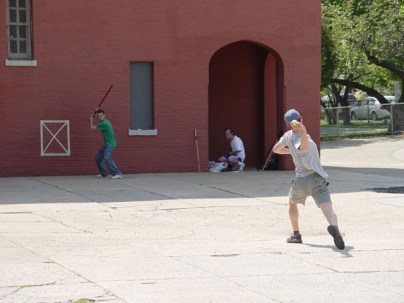
My poem is about my memory of a game we played as children – a game still played today, albeit differently. It has been played for over a hundred years by boys and girls, now also by men and women. Essentially, it is street or vacant lot baseball played with a broomstick for a bat, bases like the manhole cover or the flag pole, and most often a rubber ball.

My gang used all sorts of balls including wiffle balls of various sizes. No one wore gloves or any form of protective gear. Our classic favorite was to use those small plastic practice golf balls with all the holes in them to increase the challenge. They could bounce off any window or person with no damage. No coaches, no adults, highly flexible rules, and we worked out our disagreements without paying lawyers.

My poem is this old fart’s memories of playing the game and living totally for the moment, for the game, to be as good as we could be, and to have fun for the sake of play.

We used handles cut from broom sticks or mops. I do not recall anyone buying a ball, but it would not surprise me to learn that the ones we used were found, or “found” (as in the bottom of dad’s golf bag). The first commercially produced stickball bat came out in the early 1950’s and sold for 89 cents. Today, you can buy a high-tech, Easton T10 Thunderstick stickball bat for $50.00.

One of the problems today is that it has become difficult to find a good wooden broom or mop handle not being used, and games like that have fallen out of favor. However, I have included a photo and video about the game. In both cases, commercial bats are used.

It’s Never Just a Game

I was in the game that day
when it was a hot midsummer afternoon
when we played in the Courtright elementary school yard
when Jimmy Lipinski hit a double off of Joe Mullins’ chest
when time outs were for injury or just to pee.

I was in the game that day
when the fight broke out between Balochi and the new kid
Smitty was new and wanted us to play by New Jersey rules,
Balochi and Smitty became close friends and grew old together
and we learned to play by Jersey rules, East End rules, and league rules,
but mostly we made up the rules based on many things.

I was in the game that day
when Teddy tripped on second base and broke his nose
when the Daniel’s kid at shortstop lit a cigarette in the third
when the school janitor came and ran us all off or he would call the cops,
when we vandalized the school cuz the Janitor was a dick,
when I got my first hit, and when I hit my last.

I was in the game that day
when Lipinski made his behind the back flyball catch
when the worst player on the team hit a grand slam
when cuts and scrapes and twisted ankles were part of growing up,
when it started to rain that day and we played on anyway,
when the game was just the game, and both sides always won.

I left the game that day
when we walked away cuz it was getting dark
when we were thinking of what in life came next
when we thought there were better things to do,
when we walked away one last time
from the game we all so loved.

Let’s go play some stickball.

(Bill Reynolds 4/16/2018)

Look both ways as you play the game.
When at bat, mind you, hit the gaps.

Click link to National Poetry Writing Month

Poetry – NaPoWriMo: The Sad Warrior

Day 1. My first 2018 National Poetry Writing Month Prompt: Write a poem that is based on a secret shame, or a secret pleasure.


The Sad Warrior

Young and strong the warrior stood,
Seeking prey with eyes so sharp
with gleam of heart and prideful soul
The tiger walked and looked and stalked.

The sun was warm that wistful day,
All such power was closed in hand
To fell his victim by trebu-shay
Trophy kill – the warrior’s way.

The test took light within his sight,
on proud knee shot from his right.
Song he heard had a bitter bite,
First quarry down and there it lay.

The warrior now was just a boy
The bird just killed was not a toy,
The ache he felt was not of joy,
Tears of guilt now filled his day.

(Bill Reynolds 4/1/2018)

Poetic license, “trebu-shay” for trebuchet, an up-scale name for a weapon (slingshot).

Look both ways, inside and out.
Mind the gaps or feel the guilt.


Click link to National Poetry Writing Month

A Memory: The Silence of Darkness

It was a cold northeastern Pennsylvania night. I don’t recall the day of the week, or even the year, but the season was tucked into that idiom wrongly called, the dead of winter. There’s nothing dead about it.

I was in my teens and still living with my parents. It was late night and snow had covered the ground one day in the early nineteen-sixties. While night, the reflections from the snow allowed me to see everything, although it looked like a blue-tinted black and white photograph.

While all years of my life were important, those teen years are prominent memories. I still recall how I felt then, but now it’s hard to describe. I’ll never feel like that again. The wonderful adjectives of youth applied to me: vital, vigorous, and energetic; yet so did lazy, horny, rebellious, and impulsive. I would not say pensive or thoughtful. Yet, there was that one night.


As I walked through deep snow above my ankles, a powdery white mattress was laid out around me in all directions. The white snow was tinted cobalt blue by the moon-lit night sky. None of the snow was marked by footsteps or car tires. The blanket was pristine. The cemetery across the street was a charming and peaceful sight. I loved the sight of the snow, the reflection of street lights with a wintery halo, the contrast of red brick buildings with lines of white where snow landed. Even boarded-up windows seemed fitting to this natural artistic sight. What I saw made me feel good. I was happy, but thoughtful about what I saw.

If anyone saw me, they might assume I was lonely. I was not. Never. While my teen years presented me with daily challenges, feeling lonely wasn’t one of them. Even back then, I treasured my alone time. I have searched for more nights like that one, but I will never discover such a night again. Nature’s art is often so fleeting.

I may have been troubled by any one of the issues I thought life changing. Today, I recall few of those traumatic teeny-bopper problems. But, I can still visualize the night. While I have long since been free of my adolescent burdens, I remember. I didn’t feel cold. I felt both my pending freedom and a connectedness to my surrounding, to the night, and to the silence. And to the darkness, the light, the snow, and a sweet silence only night offers.

I was wearing plain old brown leather oxford shoes and white socks. My pants were a bit too short and much too snug: a style of the times. Adults thought my hair too long. It was a little greasy, and it hung down to cover part of my face. I didn’t wear a hat. My outer layer was a hand-me-down, black, Navy-surplus pea coat – unbuttoned and hanging open. The collar was up.

As I picture that night, I feel my experience. That not-to-be-forgotten night was like a photograph taken with my eyes and ears, sensed with my tongue’s taste buds. I could smell the clean crisp aroma of the night air. It is imprinted in my memory: a serene moment, fifty-some years ago. A semi-normal teenager, I realized that something remarkable was happening around me. I liked it and I wanted to share it with you.

The day’s white powder parted like a soft curtain as my feet gently led me forward. Sidewalks, streets, and any surfaces open to the sky were topped with the blueish flakes. No cars passed. The plows would not be out until early next morning.

Months before this night, trees had lost their leaves. Now, white fluff-covered bare branches stretched skyward like arms reaching to catch descending flakes. Evergreens bore much thicker and fuller sparkling white coats over their needles, a weight they endured with their strong, flexible, down-sloping boughs. I sensed a soft chill as a gentle breeze brushed the powder from trees onto me.

As snow clouds passed, I saw the clear night sky of spiritual proportions. A nearly-full moon illuminated the earth with light reflected upward by snow. Even with the light in the sky, billions of stars floated above me, while below them the sheen of fresh powder glistened. I was so young, yet I intuited the unimaginable enormity of what was around me. I could sense the sheer winter-night beauty of it all. I felt comfort in that notable moment. The night and the silence were etching a memory no artist or photographer could duplicate.

The silence was purposeful and reasoned. A quiet so intense the night air was a sharp penetrating stillness that muted other sounds. All was perfectly still. No movement, not even a hush. It was an absolute quiet: a silence so powerful I imagined intense peacefulness within me.

I stopped. Didn’t move for a long time. I listened for sounds of anything, silent sounds. I heard nothing but silence itself. Very still, breathing shallow, listening intently to what was the most peaceful moment of my life as my personal Sounds of Silence came from nature. I was with my friend Darkness, where I felt destined to be. I experienced sensual pleasure in the absolute beauty of that cold winter night.

I saw silence in the stillness as nothing moved. The world had stopped. I tasted tranquility as the clear, dry night-air slid over my tongue. As the still coolness flowed into my nose with its chilled crisp fragrance, I smelled a fresh aroma only nature could provide to a young mind open to such images. I have aged. But, this memory remains set in the mind of a teenage boy.

Slowly, I started to walk a bit farther. Then stopped again. I knew this was exceptional. Then I walked more, and I stopped again. I do not recall walking away or going home. The memory leaves me standing there, taking it in.

I didn’t know that this memory would be discovered and retrieved by my muse over half a century later. Said she, “Up now, Lad. And write in yer book, before ‘tis lost again in the disorganized gaps of your mind.”

If you have no time for the video now, please come back to watch it. It’s worth it.

Live in the present, but look both ways,
to the past for who you were, and to the future for who you’ll be.
Mind the gaps, but fill in where you can.