Poetry: Forgave You – Not

I opened the door and walked into a crowded room.
People, most I did not know, were sitting around,
all seats taken. I had a right to be, and should have been,
invited to the meeting, but since I’m a half-breed — excluded.

Everyone stopped talking and stared at me. I knew I was
the unwanted black sheep in a room of wolves and vultures,
there only to devour carrion and pick the bones of the dead.
Something in my nature delighted in their obvious discomfort.

They declared the meeting over and said I should have
been there. I did not ask the location of my invitation.
I thought, y’all low life vulture mother fuckers,
but I said, “No problem. Things will somehow work out.”

Oh, the sweet feeling of justice and the touch of revenge,
oh, the fine fit of the suit called, we’re even.
Did they think I would not know or gain?
I almost felt guilty for twisting the knife,
but guiltlessly I prompted their pain.
Putting things right feels real nice.

Look both ways in rooms empty or full.
Mind the gaps. That’s where the evil hides.

Poetry: Boys Only

Jimmy and me, and his sister June,
all about the same age
of seven or eight were standing
in the alley behind my house.

On that day I did not know
that in seven or eight more years,
me and June would share the experience
of lost virginity, the one and only day
she did not spurn my teenage romantic advances.

We three friends were all shirtless and discussing
whatever pre-pubescent children talked about
in the 1950s, when the shrill voice of their aunt
Dorothy demanded June not remain shirtless.

June did not get a satisfactory answer to her ‘why?’
(did we ever?), only that girls don’t do topless.

I looked June over, brown hair to barefoot toes
and could see no reason but forced socialization
of such things was commonplace and
in some circles probably still is.

Jimmy and his aunt died years ago. June is
a great-grandmother and we don’t keep in touch.
That’s too bad. I wonder what June remembers.

Look both ways before removing your shirt in the alley behind my house.
Mind the gaps, not the nipples, and aunt Dorothy, too.

Sammies Weekend Writing Prompt 122 — Museum

Monet at Kimbell

Not a big fan of Claude,
I wanted the experience
of seeing his original later work
at the Kimbell Art Museum
in Fort Worth.

In Cow Town, I ran
marathons and we danced
at Billy Bob’s near the stockyards,
and went to see Elvis, Marty Robbins,
and two of our three were born there.

A shining light of cowboy culture,
the Kimbell is one of many
attempts to not be Dallas.
DF dubya is nearby and
Cowboys play football in Arlington,

where the Rangers play baseball
and Six Flags (over Texas)
amusement park resides.
But what is most important
is not the museum or foot races,
not the water garden or train station,

what matters most to me about Cow Town
are the memories. The comrades, the friends,
the scandals and the hanky-panky,
the music (up against the wall, redneck mother)
Oh Lord, I knew it all so well.

But gunna miss the Monet.

Look both ways between Dallas and Fort Worth (I love you).
Mind the endless gaps in between.

Be a Stranger to Death: Know his Work

A first funeral for me was in our church. I was too young and didn’t know him. But I cried—it was so sad. Others did too. My family all asked me why I cried. A man I didn’t know had died. They took me to his funeral, and I cried because I felt so sad. Why did they ask me why? It was a funeral. I saw others cry. But I felt sad for his friends and family, and for him. My family seemed to be telling me that I should not cry or feel sad. They were telling me how I should feel.

It was my first taste of ultimate reality and sadness at a level I had not yet known. Six decades later I still recall their questions and the implication that I should not be sad because some man had died. And since I did not know him, I should not care about his death.

They knew him. But none of my family cried. I was confused by their lack of sadness. How could they not feel it? I didn’t wonder then why we went to the funeral, but I do now.

I should not feel emotion or act out my feelings if I do. I did not understand why others didn’t feel as I did. Too young, but already being told not to feel too deeply—to not be a sensitive man boy (later a man). Stoicism was and is associated with strength and manliness. Strong silence.

Years later I attended an emotional funeral for two young children of a workmate (auto accident). Later, another workmate criticised the people who cried at that funeral. I wonder more about former than the latter. How could he not cry and why criticize those who did?

Now, I am sometimes spoken of as a sensitive man by some; as one who reflects sensitivity back upon people. They say so because they read my writings. Not because of how I behave.

But not always. I suffer fools poorly and bullies with quite limited tolerance. I am sensitive to violence toward others, but I can do what it takes to be just and fair.

I cannot ask why they tried to teach me not to cry, or not to feel, or to be not sensitive about those who died. And they cannot answer. I doubt any would understand why. I went to their funerals and I cried because they had died and I loved them.

I cried when each of them died. Nobody asked me why. But I still hid my tears. I cried when I was alone. They had taught me well, but they never changed me. Show them only the face they wish to see. Be the strong, stoic, liar.

I remain an emotional little boy society calls sensitive (or weak or worse). They, in their curiously socialized hearts and minds will never understand me—nor will I, them.

Why cry? Must you ask?

Look both ways and deeply into the abyss of human emotions.
Mind the gaps but be consistent. Be yourself.

Poetry: Sammi’s Weekend Writing Prompt

A song played on the radio
from WARM Top 40,
rock and roll—
sinful music station
in nineteen sixty-four.

Joe Dreier was driving when
I looked at the speedometer.
We’d not be doing a hundred
except Joe was drunk.

Me too. Maybe Ron
(who we called Dobbie)
Ganick wasn’t there,
he didn’t drink, but we did.

We all got home that night
of senior graduation parties.
Later when I was away in Texas
with the Air Force,

I learnt Ganick died.
His VW bug threw him in a crash.
I bet there was a song on the radio,
probably WARM 590 AM.

Look both ways for “fortune smiles on some,
and lets the rest go free.”*
Mind the gaps and wonder why.

(* from Sad Café by the Eagles)


Poetry: Kitchen Visits

Growing up, it was foreign land—
to me, yet, it was favored by all,
a magic kingdom of food and warmth,
a homework headquarters.

It had a coal stove for heat and
cooking. Mom (sometimes Dad) did laundry
there with a wringer machine filled and emptied by hose,
when new to the tribe, I was bathed in that sink,
perhaps after laundry and dishes were done.

Later in life it was (and still is) wife’s land.
Maybe it’s sexist, but barefoot in
the kitchen was her idea.
Actually, it was all her house
where we all lived. At home,
it was where the core of many lives
transpired—in the kitchen.
Meetings, parties, family dinners,
games and puzzles, some business.
It was our mother-ship’s headquarters.

When between jobs, I was given
the helm of house to navigate;
cooking, cleaning, laundry,
paying bills, and giving some homework
help. Dropping off, picking up,
taking to kid’s thingies. For a dad,
I believe I made a passable mom.

But the jury remains out.
Now those kids are gone
to their own kitchens,
it’s still the same in our lovely
(if mostly empty) nest. It’s her kitchen,
somewhere in the middle of
Texas. I don’t really
cook but would like to. I am the
dish washer, maybe replaced now
by a newer and quieter, a younger one
with fingerprint proof silver skin.

No man has ever been murdered
while doing the dishes.
Perhaps I
should be worried and observant,
or apply for the position of official
dishwasher loader and unloader.

It’s not my kitchen and it never will be.
Perhaps the laundry room?
Household poet laureate is a good job,
I eat well, and the beer is cold.

Look both ways, near and far.
There will always be gaps, in love and lust,
but in the kitchen, it’s Mom we trust.

Poetry: Silence is no Coward

I am strong, but I am tired, Stephen, tired of always having to be the strong one, of always having to do the right thing.” Brenda Joyce, An Impossible Attraction


I’m not always much of anything.
I’ve been an old white man for a long time,
a branded stereotype with good teeth
and a bad attitude,

apparently not supposed to ask for
some things, cuz I am old and white.

It’s okay. Perhaps they’re fucking right.
Equality is in, unless you happen to be
old…
white…
and have what’s left of an old hard on.

Others were (and still are) treated like shit
by white guys. Nazis were, are, white,
male; no fucking idea how old fits.

Some old men are idiots, non-millennial
impotent bastards who hate everyone,
and everything, especially women.
Stereotyped, hairless shit heads
with nothing to do
but make mankind worse.

It’s a tough world, but we can try
to make it better each day.
To make it last.

©Bill Reynolds, 6/13/2019

Look and listen both ways for real equality. At least, don’t be unkind.
Mind the gaps like lifelines with stories to tell.

Poetry: It’s Not For Everybody. Is it?

I almost never wanted this – to be a writer,
but I write, I drink too,
seldom too much
anymore.

That’s not discipline or pride,
it’s from bein’ too fuckin’ old.
Thinking of words, I write them and then
I point, and I say, “Hey look, I’m a writer.”

Quite certain that of the many who
thought they had taught me English
as an academic subject, who gave me
perhaps deserved grades without motive
with one exception, may groan in their graves.

A good man, Thornton looked at me, “Why
are you even here?” I think he knew.

School was mostly bull shit. I learned little,
but it was still involuntary servitude crap
I never wanted to do again. Not like that.
Even college.

Today, I might not kill them,
but they might think I would. Back then,
I thought I needed them. Now I know.
One or two might scare a bit. Maybe.

A few. Very few. Assholes are not
educated out of it. But I write.
Look at me.

I think I always liked it (writing that is),
but nobody ever (till years later)
said that I was good at it. Maybe Thornton
hinted. Even Miff W. said, “You know,
college is not for everybody.”

Maybe not Miffy baby, but it was for me.
Surprised? Don’t be. You motivated me.

Look both ways, maybe with some bitterness and sarcasm.
Find motivation in the gaps.

Poetry: A Place for Weeds

Jim was watering his experiment
for his ag doctorate, Grasses of the Brazos.
The good ol’ country boy let his smile show
when I observed and laughed at him
for making a big deal out of a bunch of weeds.
They were not flowers or cash crop plants.

Jim said, without looking at me,
“a weed is just a plant out of place.”

Over fifty years now. Where did they go?
I remember Jim
and his greenhouse full of weeds at A&M,
we’d go spray water on them weeds daily.
Later Jim would defend his dissertation about
Brazos Valley dirt and river bank weeds.
Doctor Jim was a dirt man, agronomist.
Just a plant out of place.

Jim got his Ph and D in dirt.
Then, he moved away to California;
who with his high-pitched, out yonder,
Texas drawl, old Jim
was decreed Doc Jim, the good-old-boy
from Meridian, Texas.
In his own way, he became
a plant out of place.

Many times, I have been a weed,
a person out of place,
or so I felt.
I needed to be in a different place,
to feel unweedly,
wanted by anyone,
or not. Was I where I belonged?
Or, was I just another plant
out of place?

Was I
in the place I was supposed to be?
Bloom where you’re planted,
that’s what they say.
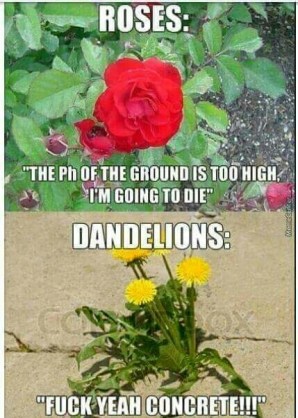
Weeds need to grow everywhere,
but it is nice to find your space.

No longer, am I,
a plant out of place.

©Bill Reynolds, 5/23/2019

Look both ways crossing but look all around for misplaced plants and people.
Mind the gaps, weeds grow there.

Poetry: Linguistic Serengeti Maps (NaPoWriMo) Day Twenty-four

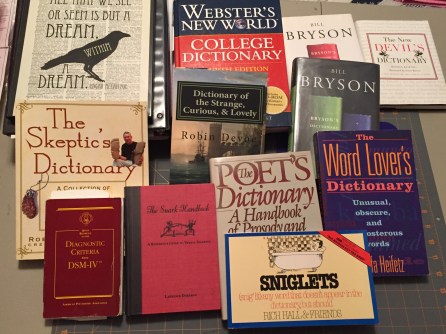
Today’s poetry prompt is to write a poem inspired by a reference book.

Today, I learned what I am.
I’m a Stan, no longer a mere fan,
I’m a Stan—the man.

Normal words
help me each day, also
clever and unusual, obscure (and obscene),
preposterous; the strange,
curious, and lovely lexicon.
In a word: troublesome!

Secretly, I hide in a closet
(or bathroom) where I read
books — about words,
of their history, called etymology;
how to say them, and maybe see
an idiom for future reference.
The meaning of words, the lexemes.

Every word has its morphology,
its synonymy family and
antagonistic antonymy gangs.
Some are humorous, others so literal,
I like snarky things and even
the devil has his own dictionary.

Semantics are arguable,
but without words there is
nothing to say, to communicate
we’d have to find another way.
Do words grow in semantic fields?

My blessing upon the wordies,
the lexophiles, logophiles,
lingua-(and lingo) philes, also
called word buffs.

A poet without a word is like
a seashell without an ocean,
a cow without a patty,
a day without a sun.

© Bill Reynolds (word-Stan) 4/22/2019

Mine. Raven printed on page out of dictionary.

Front to back, or look both ways, books about words have much to say.
Mind the gaps or stick in some adjectives.