Atheist Perspective on Christmas


atheist-xmas-3Since this is my first December and holiday season as an admitted atheist, it seems fitting to discuss Christmas from my nonbeliever perspective.

Much has been said and written about the secularism surrounding the holidays, and I’ve decided to provide my personal perspective. This is my 70th time partaking of the Christmas season celebration. So, much of what I say and do has precedence in that it’s what I’ve been doing for years.

As I write this I’m hearing the news from Germany of a large truck being driven into a crowd of people celebrating the holidays and the Russian Ambassador to Turkey being assassinated. The majority opinion seems to be that both events may be related to terrorism and religion, or at least god politics of some kind. And the list of such deeds goes on. None of this is in the holiday spirit. But as Christopher Hitchens subtitled and wrote in his book, “Religion poisons everything.”

Tantum religio potuit suadere malorum.” (To such heights of evil are men driven by religion) ~ Lucretius

For years, this was the season when we tried to spend quality time with family. Beginning with Thanksgiving, it’s a busy travel season in America as families reunite for celebrations. We’re surrounded by hype. But I enjoy the hype more than I like to admit.

I look forward to Halloween each year, partly because it marks the start of this season. Christmas is a happy time, a great time for most children. There are football playoffs, and bowl games. Winter begins, Yule is celebrated, and I like to look at snow. Dealing with it sucks.

In the home of my birth, the smell of the house changed, mostly due to the tree. But the house would also take on the aroma of whatever adult beverage had been opened. Aunt Lorry, who seldom drank alcohol, always brought port wine. Port is some powerful vino.

The thrill of gifts and happy people occupied our thoughts. We went to church. A little hut was built in the yard next to the church with a nativity scene inside it, behind thick glass and a locked door. There was a slot to deposit money for the poor, until someone started to rob it. Then they stopped using the box, and eventually the little hut went away. They must have assumed the thief was not one of the poor.

I don’t recall going to midnight Mass as a kid, but I probably did once or twice. Years later, I went several times. It was always crowded. All those Catholics who only went to Mass on Christmas and Easter would show up. By then, there was only one Mass on Christmas Day — all the others were vigil Masses on Christmas Eve. Going to church on Christmas day was inconvenient, at best.

Christmas was a “holy day of obligation” which meant that if you did not go to Mass that day, you would burn for eternity unless you made it to confession. I’m oversimplifying, but I was a child back then.
atheist-xmas-4

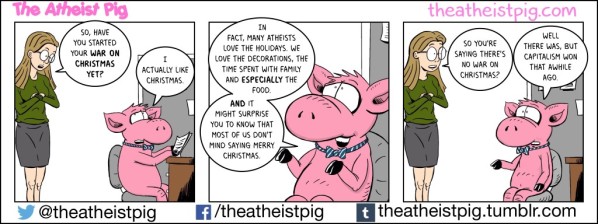
Some Christian denominations don’t celebrate Christmas at all. And for non-Christians, it’s not celebrated as anything more than a secular holiday. But Christian or not, no one in the USA escapes the hype of Christmas. I provide gifts and greetings appropriate to this time of year and the holiday. I helped to decorate a big tree and to put up other decorations this year. I went to our party and may have sung some Christmas songs.

I fully understand the religious aspect of the holiday season (be it Christian, Pagan, Jewish [Hanukkah], or others). While I don’t agree with any religion, I think the intended spirit of caring is good. For me, family, friends, caring, giving, and delighting in nature are all the good things. So, like many atheists and other non-Christians, I join the party as I have for almost ¾ of a century.
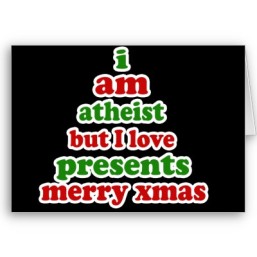
atheist-xmas-2I’ll continue to celebrate the season much as I always have: eating and drinking too much while overdosing on football. It’s a fun cultural and secular holiday with many features that benefit life, whether one believes in any god or not.

I don’t see my enjoying the holidays as a big deal any more than I do saying “bless you” when someone sneezes, or “God damn it” when things go wrong, or when I use the word “god” or “Jesus Christ” to express pain or anger. But cussing is another story for a different blog. Unfortunately, the holiday season is a stressful or bad time for some people.

atheist-xmas-5If it busts someone’s chops that atheists enjoy the holidays, that’s a bummer. We intend no harm by joining the festivities. I suggest those humbugs pass a law that says one must be Christian to enjoy the holidays. Until then, you’ll find me hangin’ ’round the mistletoe.


I suggest you try Joey’s take on this by clicking here.


Happy Holidays.
May there be peace, love, and a thousand sugar plumb fairies dancing in your heart.
Look both ways and mind the gap.
Evil’s Not My Problem

Monotheistic believers have no convincing way to deal with this issue. Because it has been around for a long time, it has been written about, answered, explained, taught, or discussed in groups of one kind or another. But it remains a problem that can only be settled one way—ignore it. Ignorance is bliss.

problem-of-evilOr, you might end up where I did, facilitating a classroom discussion of the topic in the Adult Education program at my Catholic church. Preparation for teaching, and then leading the group discussion, led me to an enlightenment. I was not, at the time, spiritually or religiously challenged by the problem of evil, but I learned a lot.
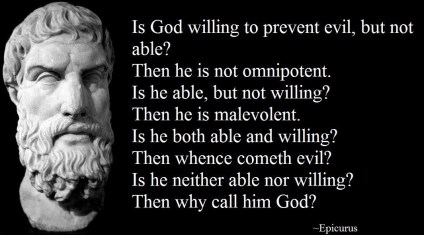
Most of what I learned involved getting deep into a topic that I’d not seriously considered. As I was reading the Bible, especially the Old Testament, I started coming to terms with my own evolving beliefs and conclusions.

I was a believer (or wannabe) at the time. My biggest aha moment was when I realized that I had no qualms pinning evil on god. And, of course, that led to the uh-oh moment. That’s when I realized that god could not be so good after all. That disconnect was not gunna work for me. “Houston, we have a problem.”

problem-of-evil4

If you’re fuzzy on what the problem of evil is about, click here  to link with a youtube that provides a quick-n-dirty review in ten minutes. Pay attention because that guy talks fast and covers a lot of ground.

I’m intrigued when a priest, deacon, nun, or any religious person says, “I can’t understand why God allowed that to happen.” Pick any natural disaster, which some people do not consider evil, or some other moral evil such as mass murder. We have heard it said.

In the case of Islamic terrorism and other nut cases, evil is even done in the name of god, ostensibly with god’s help, followed by a hefty reward from god. (WTF does anybody want with 72 virgins anyway?). I know there are other kinds of murderers, but everyday that religion is used to justify slaughter around the world.

I know, “one man’s terrorist is another man’s freedom fighter.” But, along with most Americans, I consider 9-11 the mass murder of innocents. My point is: there is evil—lots of it, and all kinds of it. If you believe in a god who knows, cares, and can fix it; you should radio Houston Control with your problem.

problem-of-evil3

We mere humans, when not being the perpetrators of some evil, expend energy preparing for and dealing with it in some way. We know it’s coming. So, in that way, it’s logically a problem that is often taken for granted (i.e., shit happens). Even the religious folks mentioned above devote their lives to promoting the goodness of god and fighting evil, albeit usually they focus on moral evil, as defined by them, of course. Other groups do a wonderful job of providing aid to victims, after the fact.

Since there is evil, it must ultimately be permitted by, if not created by, the god one believes exists. Depending on the religion, reconciling this with religious belief takes some doing and may call for a heavy dose of denial. Maybe a little help is in order? Enter the best scape goat ever—Satan. Next best are Adam or Eve. If someone says, “It’s god’s way,” you should be reaching for your bullshit flag because here it comes.i-dont-care4

In some way, religious folks must be working through or around this problem. Last I checked, monotheists aren’t switching to polytheism or finding another way to make it work. Or are they?

Atheists and believers seem to agree; there is evil in abundance. My definition of it is probably broader than many religious folk, but it’s close enough.

Atheists don’t have to determine why evil is permitted. We only need to acknowledge its existence, do what we can to make others aware of it, and prevent it when possible. If not, maybe we can find ways to deal with it when we must, which is more often than I like. I never have to ask why god did, or didn’t, do something. But you have every right to ask me why I don’t do something.problem-of-evil2

There is both good and evil in the world
and too often within us. Look both ways.

DEATH

The inevitable & unavoidable conclusion to life.

During late October many cultures begin preparing for the first days of November. They remember the dead, acknowledge the end of harvest, and prepare for the dark days of winter. It begins with Halloween, then All Souls’ or All Saints’ Day, The Day of the Dead, and Samhain. Many believe it’s the time of year when we’re closest to the other world and death itself. The Fairy Tree story that ends this blog tells a wee bit more.

death6

It’s our only certainty—we die. Beliefs about what follows the end of human life range from nothing to Paradise and 72 virgins or reincarnation. Let’s not forget the whole Dante’s Inferno thing. Our beliefs about an after life affect our choices while living.

While no one has told of their experience following permanent death (we have near death accounts), there are stories with bits of information. Little of it is dependable or useful. Theories abound, but the database of the deceased is void of demonstrable facts. Only the dead know, and they’re not talking.

Efforts to resist death seem logical, but are eventually fruitless. While many consider death a condition leading to afterlife, most people (not all) avoid dying as long as possible. An exception is when living prolongs a life of hopeless suffering. Others choose death through martyrdom. We disagree about our right to die (whole other blog) and we normally work hard to keep living.

death4In the United States, more than two-million people die each year. The CDC reports the top four causes as heart disease, cancer, respiratory disease, and accidents. I say, smoking, smoking, smoking, and driving plus illicit drugs because they are the major producers or triggers of those four “causes.” The root cause of most preventable premature deaths in the USA is smoking (so quit).
It can be difficult to determine the difference between a still living or recently deceased person. Without more information, we can only define death as an absence of life. Our legal descriptions require a physician to certify the time and cause of death. While absence of all brain activity normally defines death, court cases fog the legal definition. When there are uncertainties, we gain information through autopsy.

death3

While we’re fascinated with death, many of us avoid serious discussion of it and find it morbidly unpleasant. The death of friends, loved ones, and people we hold in high esteem represent the ultimate, painful loss. Our own death signals loss and aloneness, which is sometimes comforted by religious beliefs.

death2

Yet, we sing of death, we write about death, and we (should) discuss it. We often honor death’s inevitability with both art and science.

Since first hearing it, I’ve liked Ralph Stanley’s (died, June 2016) rendition of the song, Oh, Death, which is a plea with the Grim Reaper for another year of life. It was made famous in the movie O Brother, Where Art Thou? Hear a short version by clicking here.

From a list of ten poems about death, I selected two by famous poets. All ten can be found here.

“Death” by Rainer Maria Rilke (died 1926)

Before us great Death stands
Our fate held close within his quiet hands.
When with proud joy we lift Life’s red wine
To drink deep of the mystic shining cup
And ecstasy through all our being leaps—
Death bows his head and weeps.

From Queen Mab, by Percy Bysshe Shelley (became famous after his death in 1822)

How wonderful is Death,
Death, and his brother Sleep!
One, pale as yonder waning moon
With lips of lurid blue;
The other, rosy as the morn
When throned on ocean’s wave
It blushes o’er the world;
Yet both so passing wonderful!

death1Life is the time made precious by our inevitable death. May we fully enjoy the many pleasures and loves discovered and experienced while living. And may we all “…lift Life’s red wine to drink deep of the mystic shining cup…” because death is next for each of us.
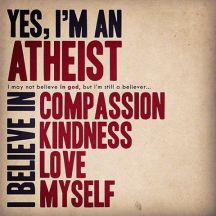
Life is uncertain, look both ways.

“What Do You Believe?”

Last week, I wrote about who I am. Today, it’s about what I believe. A dictionary tells us that when we think something is true, we believe it. Among things I don’t believe exist are of few hundred thousand gods, a living Elvis, and good-tasting light beer.

what-i-believe1You might ask, “Ok, Bill, I understand what you do not believe. What do you believe?”
I want to answer, “Observe my behavior and you’ll know.” But I can’t. You can’t tell from my behavior what I believe. I have to tell us both. We all know the jokes about Southern Baptists drinking, Catholics and birth control, or Mormons and stimulants. The word dissonance comes to mind. At the extreme, celebrity hypocrisy is regular news.

Despite human disparity between belief and behavior, contemplating our beliefs often changes behavior (true to self, and all that). I need to answer this question for myself, but it’s not easy. I’ve heard that you are what you believe. That seems sensible, but human behavior is its own mystery.

what-i-believe4Atheists have no written creed, profession of faith, or official paradigm of beliefs. While some have written non-dogmatic manifestos (public declarations of policies and aims), there’s no agreement or authority to which anyone is bound. You could read dozens of books that provide hints about what some atheists may believe, but many are crap. When you see or hear words like atheists believe or atheists think, false generalizations often follow.
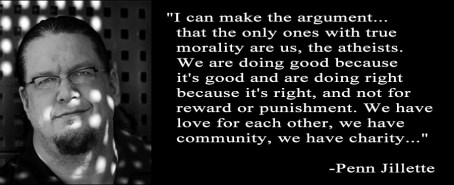

My jury’s out on some things because I don’t know the truth, have insufficient evidence, or I suspect superstition and confusion. The power of humans is awesome. The things people can do are amazing. Our nature interests me more than anything. Some things I would like to be true include karma (for you, not me), unconditional love, time travel, mysteries of the universe, and Mother Nature. If people can levitate—cool, and I want to bend spoons with my mind. I’m skeptical about all of that.

I certainly believe things. Here’s today’s list.

  • We live in one true reality. Psychologically, we each have our personal reality. The real world will remain mysterious.
  • People are basically good. But, we have two conflicting natures—a yin and yang, if you will.
  • Nature is marvelous. It’s the closest thing to a god there is.
  • Love conquers all and nature always wins. So love nature.
  • Human spirit is real. We are more than chemicals (awareness, consciousness, morality, emotion).
  • Morality is subjective. We usually know what the right thing is. We should do it because it is the right thing.what-i-believe3
  • It is not necessary to believe in god to be good. Many who do, are not. Many who do not, are.
  • As a plea to a god, prayer is useless. As a mechanism to raise the human spirit, it may be useful for believers. Meditation is a good, healthy thing to do for everyone.
  • All religious and spiritual writings were done by people. They were not inspired by any god.
  • Much scripture is nonsense. But it contains some wisdom and, like all literature, is valuable.
  • Capital punishment is illogical. I believe that in the USA we have executed innocent people.
  • Compassion is a good human trait. We’ll never have enough.
  • To love is to make yourself vulnerable (be sure it’s worth it).
  • Love is forever, even when minds forget it.
  • Passivism is not moral.
  • Music, art, and writing are important—so is learning.
  • Magic is usually good and always real. Eventually, it can be explained (thus, spoiled fun).
  • Everything is impossible, until we know how to do it.
  • Religion is not good for science or human freedom of thought, organized religion is worse. Today, Islam is the scariest of religions. Muslims must fix that.
  • All the good things done by people of religion could have been done by those same people without it, and in many cases better.
  • We’re all in this together. There is a joining and togetherness within humanity that I don’t understand. But it’s there.
  • When we die, we are physically dead. The living should celebrate life and love. I don’t know what happens to that spirit.
  • Life is unfair. We can’t change that, but we can improve it.

For your listening pleasure, two links to a little belly-rubbin’ music about love and I believe:

https://www.youtube.com/watch?v=RksFhgayhtY (Don Williams)

http://www.bing.com/videos/search?q=tom+t+hall&view=detail&mid=CA19A63D49165A99FE94CA19A63D49165A99FE94&FORM=VIRE (Tom T. Hall)

May your spirit bring love and compassion to everything you do. May our interactions be sincere, respectful, and caring. I hope that we all come to believe that humanity and nature are either all we have, or all we’ve been given, and we need to take care of both. May we love and care for one another with, or without, the help of a higher power.

That’s enough for today.

To choose your beliefs, look both ways.

Who Am I?

who am i2

Why should anyone want to answer this question? I was asked, then immediately told no answer was expected. It’s not a rhetorical question.

When others ask my name, that’s easy enough. What do I do? Also simple. What are you? begins to get more personal. Who are you? Who am I? In terms of what? Our relationship? Am I your friend, enemy, son, father, or husband? I’m the son of, the father of, the grandfather of; but is that who I am?

I’ve always been willing to allow my pastimes to wrap with my identity. For example: I am a runner, artist, writer, dreamer, reader, etc. I’ve been less willing to do that with my profession. I know people who took their livelihood as an identity, only to feel lost when they could no longer perform at their vocation. I no longer run. When I was forced to stop, I was mildly depressed for two weeks. After that, I was fine.

Do I need all the answers?

Apparently, some folks think going public as an atheist raised my IQ, my awareness, and my general knowledge—all by some large measure. Other atheists and believers alike seem convinced that I now must provide answers and solutions, understand deep metaphysical mysteries, and know myself better than ever. It changed nothing about me—certainly not who I am.

Admitting atheist does not inflict anyone with knowing the source of the universe–certainly not me. Of this I am certain: if there is a god, I am not him, her, or it. On that, we must all agree. There is scientific evidence to show that my intelligence is now less than it was in the past. Admittedly, I know more trivia and I should have greater wisdom than when I was younger. My answer to life, the universe, and everything is: 42. (You get bonus points if you know why.)

I am two things. I’m the biological result of generations of genetic selection. The other thing I am is what I’ve become (maybe you’re becoming) as a result of the past 70 years of life, social and physical interactions, and learning. I have no idea why I’m male, bald, mildly pudgy (okay, the beer), or have blue or green eyes (depends who you ask). I’m also one of y’all. We’re exactly the same, yet completely different. And we both know it. But that’s not who I am.

Who do I think I am?

As a writer of stories with human characters, I know more about my characters (everything) than I do about any other person. I understand them better than I get myself. I’m their god. I give them life, and sometimes death. I give them pain and pleasure. I know what they’ll do tomorrow. I know what happens when they enter those secret places where they don’t tell others what happened–I know their secret thoughts.

Last night, before going to sleep, my wife asked, “Are you going to walk in the morning?” I said, “I don’t know.” I walk virtually every morning. Today, I did not. My characters are much more dependable.

Some answers are simple

I am who I always was, and who I will be. I’m the sum of the past. I am part of you, as you are of me. I know who I am at this moment. Right here and now, I am who and what I am. If any deeper, more esoteric, philosophical, theological, sociological, or scientific answer is required, then my answer shall remain forever insufficient.

I don’t know everything about me, but I know enough. We’re gunna have to live with that.

To you, you are who you say you are, what you believe, and what you do. To me, you are who I say you are—it’s my opinion–subject to error and change.

But, is “who am I?” the critical question? I think the most important question is: who are we? How do we define us? We may add layer upon layer of humanity, and layer upon layer of nature, then layer upon layer of the universe. We are still in this together and we need each other.

As me dear departed Irish fadder often ass’d meh, “Whoda hell d’yeh tink ye’re?” Since that usually precipitated me being in a jam…Exit stage left!”

Who am I? Look both ways.

Respect, Tolerance, and Silence

Imagine this. What if we could talk about anything—face-to-face? We each could honestly tell the other what we really think. Why can’t we? Should we? Why would we want to? Somehow, after adolescence, I lost that open and honest relationship with the world.

Respect1You might say, “Bill, I don’t agree with you. Explain how you decided that.” I may provide my information based upon my experience, reading, some internet or TV source, or maybe I’d inform you about some scientific evidence. If you still disagree with me, you may then counter what I said by presenting similar evidence.
Or you might look at me and say, “I don’t care what evidence you have. I still don’t agree with you. I prefer to believe otherwise.” Maybe you think I’m nuts (get in line). Then I might say, “Ok, I suppose we need another round. It’s your turn to buy, right?”

A dictionary defines respect like this.

  1. A feeling of admiring someone or something that is good, valuable, important, etc.
  2. A feeling or understanding that someone or something is important, serious, etc., and should be treated in an appropriate way.
  3. A particular way of thinking about or looking at something.

Respect5We may respect each other—people, not necessarily ideas or beliefs. I think we should always be civil, polite, and treat each other well. I don’t mean politically correct. Maybe we like (or love) each other. If we share any common opinions, those should make our relationship better. At some point, we may even find respect (see 1 or 2, above) for each other’s opinions.

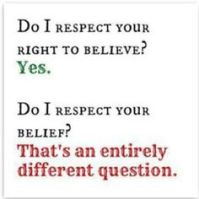
If we differ in some of our opinions, do we opt to keep our opinions or beliefs private (not talk)? Or, we may publicize some or all of what we think. We may share beliefs only between us or within a limited group—semi-private.

Respect2

What about our opinions or beliefs regarding sports, movies, music, restaurants, work issues, pot legalization, politics, or religion? How should we balance our differences while keeping with the priority of our relationship? What is our relationship? Are we family, friends, co-workers, or acquaintances in some other way? May we discuss or argue?

Is the metaphorical elephant in the room? If I am an atheist and you are religious (Christian, Jew, Pagan, Muslim; you pick), how is that going to work? Should we have that talk? If not, case closed. If we do talk, how do we do it? It seems to me that for some people, this is no problem. While others should not discuss religion or politics.

REspect4Respect for, or tolerance of, religious belief is an interesting topic in itself, especially to an atheist. All atheists want equal treatment (or respect, if you prefer) and tolerance in return from believers and religious persons—equal to what those folks want from everyone else. Look at the definitions of respect above one more time. Does the believer choose number 1 or 2 regarding someone’s atheism? Stop rolling your eyes and answer the question. Ok, then we shouldn’t talk about it. We need to move on.
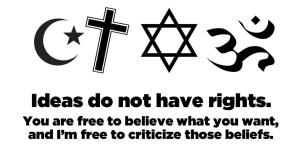
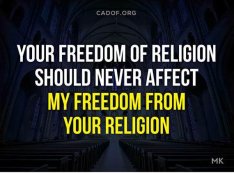
Let’s drop a level and try tolerance. It’s defined as the willingness to tolerate (duh!) something, in particular the existence of opinions or behavior that one does not agree with. That can work, but respect is gone. We don’t need it. However, we’re back at square-one because we still can’t have that talk. The elephant now wants to leave us because it’s grown impatient with our conundrum and is tired of us being wishy-washy. We’re merely putting up with each other’s crazy ideas.

Two weeks ago, someone objected to atheists saying, “I don’t believe in God.” Somehow, that is a profession of faith in her view. It’s not, but I agree with her point, sort of. I would prefer to say, “There are no gods.” It’s not so much a question of what I believe, or don’t believe. It is a fact and should be so-stated.

Following that comment, some believers would be personally offended by my blasphemy. They would be off, following the elephant down the street brooding about how insensitive and rude I was. They might rant about me in their blog. Perhaps they’d unfriend me on Facebook. Maybe they’d call my mom. Why? Because I was not respectful of their religious beliefs.

REspect3

If you are a religious person, I don’t need to have feelings regarding the goodness, value, or importance of your religion any more than you need to regarding my atheism. We do not, and we will not, agree. We may tolerate each other’s opinion or beliefs, up to a point. We should be respectful of each other’s dignity and rights. But opinions and beliefs are not rights.

Respect6We should certainly not be limited in our actions by any religion, nor are we under any obligation to pay for any religious practice.
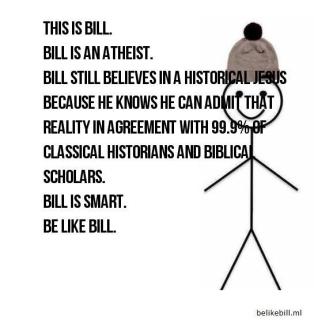

I am still working through this delicate, walking on egg shells, situation. How do you handle this? Are you willing and able to have the talk? What advice would you have? Have you had any good, or disastrous, outcomes to these personal, face-to-face discussions?

Life is complex, look both ways.


This Atheist and Jesus….

I was asked a good question. This is my response, which is based on my religious views and my personal version of atheism. I cannot speak for any other atheists. The person asking was sincerely curious.

I don’t like the word atheist, but I know none better. So, I’ll roll with it. We have varying concepts and definitions of what an atheist is and what one believes or should think. That’s why I’m writing this explanation. Those differences aren’t going to change soon.

I was asked because I had linked to a song in last week’s blog on questions. The song was Spirit in The Sky by Norman Greenbaum. (Linked again here.) It’s tied to my answer to “What happens after we die?” (Answer: I don’t know.)

atheist and jesus

I enjoy spiritual music and I’ve liked this song since first hearing it in the 70s. It’s uplifting and has a lot of hand-clapping and singing about what happens following human death. All of that is good, based on the song. However, there’s a condition.

The lyrics say I “gotta have” a friend to intervene for me if I plan to make a deal with the spirit in the sky.

Prepare yourself you know it’s a must
Gotta have a friend in Jesus
So you know that when you die
He’s gonna recommend you
To the spirit in the sky

Never been a sinner I never sinned
I got a friend in Jesus
So you know that when I die
He’s gonna set me up with
The spirit in the sky

My friend asked, “How does being a friend of Jesus resonate with an atheist?”

Resonate means “to attach particular meaning or importance for someone, or to affect or appeal to someone in a personal or emotional way.”

I can’t say that Jesus or an afterlife resonate with me. My personal belief is that when we’re dead, we are simply dead and gone. There are no fires, no trials, no judgements, no hooking up again with the old bod – it’s simply over. If there is more to it, as with my answer to the question, I’ll have to wait to find out. I’m in no rush to learn the answer.

To be clear: I am an atheist, Norm Greenbaum is a Jew, Jesus (actually Yeshua) was also a Jew.

Now, consider these three points of view.

  • Atheists do not believe in any gods. Any belief in a historical Jesus is personal. And for an atheist, that is only a belief that the man existed. Any opinion or judgement of that man is also a personal opinion.
  • Most observant Jews (that I know of) do not believe that Jesus was the messiah, or is God. Yet, one of them wrote and sang this song – Norm Greenbaum.
  • Christians seem to believe Jesus was the messiah prophesied in scripture for the Jews. They also seem to believe that Jesus was, or is, the Son of God. Thus, as the second person of a holy trinity, also God. But, this is about me, not Christianity.

Notice anything? I never said that Jesus never existed. I never said he was not a nice guy, or a great religious prophet and leader, or a Jewish Rabbi. Simply not believing that someone is a god isn’t as negative as some folks may think.

It is what it is
It is what it is

Jesus also allegedly said and did a lot of cool things that I, and many other atheists, do agree with. Whether Jesus existed or not, I’m not, and never have been, anti-Jesus just because I don’t think he or anyone else is a god.

Richard Dawkins wearing my shirt

Besides, if Richard Dawkins supports Jesus’s philosophy (contrary to what many Christians may think), I certainly feel comfortable plugging songs that may include the name of Jesus.

I’ll not dismiss music simply because it uses his name, is religious in nature, or invokes any other god. I may for other reasons.

Here is another great Jesus song I like: ‘Jesus is Just Alright,’ covered most famously by the Doobie Brothers in the early 70s. It’s not much for lyrics, but was an upbeat hit.

I neither hate nor love Jesus. I accept that he probably lived about 2,000 years ago and he may have been one of the world’s first hippies (something I like). If so, I also think he is long dead.

May we unite in love and friendship. Let’s end dividing into tribes and against each other. Would Jesus want us to join our humanity together with peace and love in our hearts? May we acknowledge what we need from, and share with, each other. And, let each of us also be true to ourselves.


Atheist and Jesus4

It’s Magic

Magic2

I like the word magic. I like magical things. I like to use it to explain things I don’t understand. I like to say it – magic. I enjoy the way it sounds and how it feels when I say it. I like words ending with the hard K sound. Duck, truck, shmuck, fu**…; you get the idea. Back in the day, when something was unexplainable, we used to say it was PFM (pure fu**ing magic). I still use that initialism.

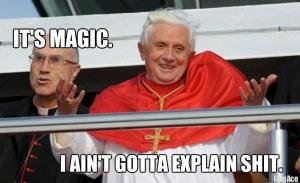
Magic1While I may not believe that supernatural beings exist (okay, maybe some duende), I still like to refer to unexplainable, cool happenings as magic. I try not to use the words miracle or miraculous in a serious sense. But magical works for me. If others want to use words like miracle to describe things, I have no issue with that. If the Pope wants to use it’s magic to explain anything, who am I to object?


Rally cap (inside out, upside down)

I avoid serious superstition, but I’m not opposed to having fun with it. I’m a baseball fan. Consequently, I also enjoy words like jinx, luck (bad or good), the rally cap behavior, and the movie Field of Dreams is a favorite.

The Hail Mary pass by Roger the Dodger.

And has not American football brought new meaning to the Hail Mary? A heavenly pass to win the game (apparently attributable to the mother of Jesus) – thus, a miraculous win. It could have just been a PFM pass. But no. We had to bring somebody’s mom into it.

One definition of magic is the use of things to exploit supernatural forces in the universe with the power to influence earthly events.

Our belief in magic has been around since the earliest humans. It continues to have important spiritual, religious, and medicinal purposes.

Magic can also be used to mean wonderful or exciting, which is my preferred usage.

Magic3The origin of the word, or the concept of magic, seems to be rooted in the religions of ancient times.

Witches allegedly performed magic, and we know how that worked out for many of them in years past. I am no more opposed to witchcraft than I am to magic tricks – just saying. I don’t need wiccans raining fire down on me.

All of that definition and historical stuff is too much for my contemporary old brain. We change the definitions and uses of words all the time. When I say magic, I don’t mean any of that religious stuff, nor do I think it is spiritual (okay, maybe just a nudge, for fun). It’s just my way of saying that “I don’t know why. It just is.”

I’ve written about the magic of art, the magic of relationships, the magical beauty of nature, the magical feelings we have, and many other uses of the word. I must like it. And regardless of anyone else’s religious, spiritual, or superstitious beliefs; I can use the word magic as much as I want. Right?

Penn Jillette
Penn Jillette

I like musicians and magicians. I’m not sure which one I enjoy more, but watching magic is more interesting whereas music is more about how I feel. I may need music, maybe not so much magic. I enjoy the same song many more times than I would the same magic trick.

I don’t think I can name a magician who believes that his or her magic has a religious basis. There may be some, but I am not talking about shamanism. I know of one magician who is also, conveniently, a musician. But he would deny any spiritual connection to his performances.

Penn Jillette is an entertainer. He is a magician, musician, juggler, comedian, actor, and a best-selling author. He is also an atheist. Penn detests any misleading deception regarding the essence of his magic. He clearly states that what he does are essentially tricks to fool people. He is known for openly divulging how entertainer magicians do their tricks.

Here is clip of Penn and Teller magic.

May the magic in life produce wonder, awe, and gratitude in your heart. May you find your own personal brand of magic in people, nature, art, music, and love. Then you can spread your joyful fairy dust around the world to magically make it a better place for all.

Click here to watch Pilot perform It’s Magic. Lordy, those boys were young. Since this is no wonder of lyrical magic, no need to watch it all to get the point.

Finally, a little Doris Day magic for you—just click here.

A Test for Atheists


Test9

The Pew Research Center, in the 2014 Religious Landscape Study, asked self-identified atheists how often they shared their views on gods and religion with religious people.

Nine percent said they did so at least weekly. Two-thirds said they seldom or never discuss their religious views with religious people. That may be changing as secularism becomes more acceptable. On line, these discussions often take the form of Q&A sessions.

Here are eleven sample questions that I promised to blog about. I Bogarted the questions from a variety of internet sources, but the responses are mine.

Why don’t you believe in a god? This is a difficult one to answer without appearing rude or offensive. The bottom-line, and most simple answer is that there’s no proof.

Are you really an atheist? Kind of insulting, but easy to answer. Atheists should not be drawn in by the temptation to be sarcastic. Leave out really from the question, or be young enough to excuse, and the answer is there.Test4

Are you absolutely sure there is not (are no) a god (gods)? The problem here is that the subject has now changed from belief to certainty. Absolute certainty of anything normally requires abundant proof of some sort – often, repeatable and testable evidence. My honest answer is no. I wonder what percentage of believers are absolutely sure of what they say they believe.

What happens when we die? Why would anyone ask this of an atheist? But again, easy for me to answer. I don’t know.

However, I still love this song. It’s fun and uplifting. Hear it Here (The Spirit In the Sky). Norm is something of a one-hit-wonder, but he wrote and sang a good one way back then. Interesting side note: while this is clearly a Christian song, Norman Greenbaum, to this day (age 73), is an observant Jew.

What if you’re wrong? That depends. Wrong about there being supernatural beings? Is that any different than being wrong about which religion, or which god is real or true? Again, I have no idea.

Without a god, where do you get your morality? First, I have some morality. Second, the same place you get yours. Morality comes from learning and being human. How often are immoral atrocities committed in the name of a god? Where do those offenders get their morality?

How does life have any meaning without a god? My life has meaning just as yours does. Mine may have more meaning to me than someone who believes they will be in Heaven or Paradise. I believe that this world is all there is for us (right here and now). As for the universe, it is the same but we only have access this part of it: Earth.

What about the love and appreciation of nature and art? We love nature as much as any believers, maybe more than some. I love art, read and write about it, and consider myself an artist. While atheists may not see nature as the work of a creator or supreme being, they have the same, if not more, appreciation of nature than believers do.

Where did the universe come from? This is where I might begin to lose it. Seriously? Do I have to explain the origin of the universe simply because I don’t believe there is a god to have created it? I don’t need to know and neither do you. Read Carl Sagan or something, then pick one of the theories. I was not there when it happened, no matter what my grandchildren think.

test1


What about miracles? Have you ever noticed how the number of miracles has reduced as methods to record them has increased? I don’t think there are supernatural beings out there to bring about miracles. Unexplained things have always happened and perhaps science never will explain everything. At times in the past, believers decided that unexplainable events were witchcraft, or from the devil, and not miracles from a good deity or spirit.

Four Gods to believe in

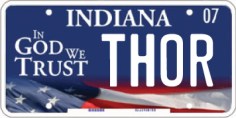
Why do you hate God? Do you hate Santa Claus? Or Krishna? Or Thor? Zeus, Jupiter, and Saturn are all gods. If you don’t believe in them, is it because you hate them? I’ve known believers who were angry with their god. I always thought that was awesome. Being angry with an omnipotent being has to be special. I guess their god wasn’t doing a good job.

Test6

I admit that face-to-face, such questioning events are rare, especially following someone’s commitment to atheism. But they happen and I think they are fair enough.

Test8Personally, I don’t see why people shouldn’t discuss religion and atheism (or agnosticism or humanism, or any such subject), if they want. I realize two problems come into play. Human emotion and the need to defend turf, opinions, friends, or in some cases, a god.
Criticizing religion in general, or any religion specifically, is taboo. Oddly, that taboo is not applied equally to lack of religion or atheism. While insults and criticism may fly, I’ll wager that no atheist has marked someone for death because they criticized, or drew a picture of, anyone.

I hope that we can find ways to exchange ideas, discuss beliefs, and venture into better understanding of our diverse and complex world. I once had a man tell me this, “I don’t even know anyone who is not Christian.” How sad.

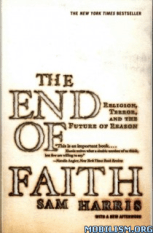
Book review: The End of Faith by Sam Harris

The End of Faith: Religion, Terror, and the Future of Reason by Sam Harris

Disclosure: I like Sam Harris and agree with much of what he says.

End of Faith2The End of Faith has been reviewed extensively since its first publication, but I need to pipe my opinion. With my gradual understanding and knowledge of Sam Harris, this book came to my attention as an eventuality. I’ve read only one other of his books (Islam and The Future of Tolerance), but I intend to read them all. I like his approach and what is, in my opinion, his open mind regarding universal principles which not everyone (atheist or not) shares. Anyone who thinks that all atheists share the same thoughts, opinions, or principles with each other does not understand them. The thesis of this book is no exception.

Many people see the book as his attempt to dissuade people away from their faith, and maybe Sam would agree. Knowing what I have experienced with people of strong religious faith, it will take more than this or any other book. But, for those with serious doubts and deep questions, this is a valuable resource. This is a book written by an atheist who is critical of all religion, especially Islam; at least in terms of the radical elements of that faith. So for anyone emotionally sensitive about the criticism of religion, this may not be the book to read.

Sam begins The End of Faith with a bit of historical fiction based upon fact. He describes a scenario in which a young man boards a bus and explodes a bomb killing many people, including himself. This act of terrorism sets the stage for the remainder of the book.

In several chapters, Sam makes a number of claims which I first thought were outlandish. But after reading his explanations, I came into agreement with him. Two such examples are the problems enabled by western religious moderates and the evil of pacifism.

End of Faith1

The textual material in the paperback version that I read was only 238 pages. That includes an Epilogue and an Afterword. It is not enough. However, these are followed by 64 pages of extensive end notes that provide more details. The bibliography is comprehensive and furnishes the more curious reader ample resources on the topic for more than a year of study. A useful index ends the book.

The copyright page indicates the years 2004 and 2005, so he probably wrote this in the 2002 to 2003 timeframe – a year or two after September 11, 2001. The world has not been static since then. In other places I have heard Sam admit that he has learned much in the dozen or so years that followed publication of this bestseller.

In at least a couple of his podcasts, Sam talks about this book and defends a lot of what he says. But he also explains what he might say differently today, or what different words he might now use to say things and why he would. The two podcasts can be found here and here and are worth the time of the serious reader. In the second, he spends a lot of time talking about presidential candidates and what he thinks of them. He is not a supporter of Donald Trump, but he also sees Clinton as a ‘lesser evil’ vote. Eventually, he gets around to the book.

I enjoyed reading The End of Faith. I’ve never found anyone who writes on such topics with whom I agree 100%. Sam Harris is no exception, but close. For me, this book is informative and educational. As he says, “I know of no society in human history that ever suffered because its people became too reasonable.” A comment right up my ‘snarkastic’ alley. I selected a couple of quotes from the book that I liked.

“There is no denying that a person’s conception of the afterlife has direct consequences for his view of the world.”

“Religious moderates are, in large part, responsible for the religious conflict in our world, because their beliefs provide the context in which scriptural literalism and religious violence can never be adequately opposed.”

I need to get busy reading because I think Sam Harris is working on a new book. I don’t like it when these guys get ahead of me like this. God knows, I may actually learn something.

End of Faith3