Taco Tuesday (Big Block Brewery)

Big Block2Big Block Brewery is a nano-brewery about fifteen miles east of Seattle. When I first visited on a Saturday afternoon, it wasn’t crowded, but it was busy enough. Parking was plentiful and close.

About a dozen customers were either sitting at the bar or around tables. Big Block1 (2)Another twelve were seated in a spacious outdoor courtyard area while a few more played a game that involved the tossing small bean bags into a hole in a wooden target. Several other games were available outside.

The on-tap beer menu was neatly listed on a large, black chalk-board over the bar. Of the four columns, three listed house brews. The fourth column listed several beers from other places. They post this menu on-line so customers can see what is being served.

Big Block 3

I thought the atmosphere pleasant. 1970’s soft-rock music was playing low enough for customers to converse in normal voice, but loud enough to be clearly heard. I have tried taking a book and reading — worked fine when I did it. Who needs Starbucks? Restrooms were clean.

The name Big Block refers to big, powerful muscle-car engines. The industrial décor, which was based on cars, engines, and tools was comfortable and consistently themed. The service was good, but I had to go to the bar to order my second beer and to pay my tab.

The porter and black ale that I sampled were good; the stout was better. One customer told me that he liked the IPA. He mentioned that you need to like the taste of hoppy beer for that (I don’t).

Beer samples served in red tool box.

The sampler package is cleverly presented encased in a small, red, metal tool box containing five small, four or five-ounce glasses of a variety of the brew on tap. A big part of the business appeared to be filling growlers (one gallon bottles) with beer. Several customers left carrying one or two full growlers.

Big Block1 (6)I am a beer drinker and a bit of a beer snob. I don’t pretend to be a beer aficionado. But based on what I could see, the beer is good—if you drink beer. If you do not, there is an issue. I asked what they serve for people who don’t drink beer (like my dear wife). They have a limited supply of wine, water, and nothing else.

Big Block Brewery doesn’t have food service and offers virtually no snacks. However, customers may bring in anything they want to eat or drink. Making a trip to the convenience store next door seems inconvenient (pun, sorry), but reasonable. So bringing in a sack lunch (open for lunch on weekends only) is acceptable.

Pizza delivery is also okay and Uncle Si’s Pizza is only about 40-paces south. I’m okay with that. I suppose that they have a good reason for the limit (or the freedom, depending upon your point of view). If it works for the owner, I am good with beer and pizza anytime. But there is no in-house point-of-sale for munchies. I think I saw a couple of bags of something on one shelf.

The web page is passable. It has a good backstory about the business and description of beers. It is not as useful as their other sites. The web page beer menu was outdated when I looked at it. The Instagram link from their web page takes you to some great pictures of the establishment. Click the Twitter link from the web page for an updated list of beer on tap. I couldn’t find a link for their Facebook page, but it is useful and has a current menu (Facebook page link).

Big Block4In my opinion, Yelp also does a good job providing information. The reviews were very positive (4.5 stars). There’s a nice review and announcement on Washington Beer Blog.

Anyway, I will be going back and I hope to see you there. Do you have any favorite places like this near you?

Big Block Brewery:
3310 East Lake Sammamish Pkwy SE,
Sammamish, WA 98075

Operating Hours (49 hours per week):
Closed on Mondays.
Open on Tuesday, Wednesday, and Thursday (3:00 pm – 9:00 pm),
Friday, Saturday (11:00 am – 10:00 pm), & Sunday (11:00 am – 8:00 pm)

Frat Friday (12 Step Programs)

12 step 7

I’ve experienced much of life. Part of that experience included years associated with, learning about, and practicing aspects of a 12-step program. While I wasn’t trying to recover from chemical addiction, I wanted to know if this was a viable option for friends and loved ones. The experience was beneficial.

The aspect of the human condition that allows us to be overcome by addiction or related problems (eating disorders, sex, food, etc.) is an interesting and frightening mystery. Loss of control is one of our shared basic fears.

I attended numerous Al-anon, AA, and NA meetings. I’ve talked to people who support “the program” and some who don’t. I have read about the successes, failures, and marketing deceptions (or just lies) of recovery treatment programs.

I loved this movie.
I loved this movie.

Critics and supporters of these programs abound. While I don’t take a position for or against, there are several pro or con issues that should be pointed out. I want to write this for two reasons.

Disclosure: I have not actively participated in a program of this nature in more than four years. But I did for over 16 years.

First, 12-step programs are generally religiously or godly (“higher power”) based. While many members will take issue with this, many others will not. Furthermore, steps 2, 3, 5, 6, 7, 11, and (to a lesser degree) 12 are based on involving or invoking a god. Meetings within the USA usually  are specifically of a Christian nature and theme. Because Christianity is the predominant religion of America (and much of the world), it brings a clear religious bias to meetings, groups, and fellowships. However, at least initially, groups are generally open and accepting of members who are not Christian. They are supposed to be. However, the discomfort level experienced by non-believers at such meetings is understandable.

Second, I’ve been asked about, and I have wondered about, how non-believers manage a program that is so obviously in opposition to their core beliefs, or non-beliefs. I recently read a blog by a former meth user, Jerome. He got me to thinking about ‘the program’ again, and about this question. His view of NA is rather caustic. Based upon what he told me, he has a point – several, actually. It was not just that it was based on god or religion that was off-putting for him. It seems to me (and he may correct me) that his biggest problem was the negatively obnoxious “this is the only way” attitude of the group leadership he encountered. In my experience, this is one of the unfortunate problems with AA and NA. Less so in Al-anon, but those members are not trying to overcome addiction.

12 step 5To be fair, when I was in a leadership position with a 12-step program, I told members that they either worked the program, or they did not. It was up to them. However, them telling me that the program was not working when they were not ‘doing’ anything but attending meetings indicated other issues. I was taught, and I have always believed that we each have a right to our own program. If that program is not working, something should change. Recovery is too complicated to go into all of that detail in one blog.
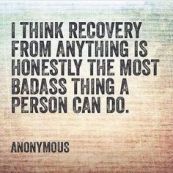
I think many aspects of the program provided me with a path to better things in life. Criticising the program for its faults is fair enough, but I prefer not to throw the baby out with the bath water (cliché, but apropos). Twenty years ago, the program helped me to deal with ‘me’ and how I felt mentally, physically, and spiritually.  Eventually, because of my experience with ‘the program’, I decided that life for all of us is really all about how we feel.

12 step3

The following short list of adaptations reflect my program. I think everyone can benefit from this approach, addict or not, believer or not. It reflects what many program people might call Bill’s (me, not Bill W.) ‘experience, strength, and hope.’ In parenthesis, I credit the AA program step I adapted for my personal use.

  1. People die from denial. When we have a problem, we need to admit it. (AA step 1)
  2. Do you know you? You can do your own self-analysis (or get help from a counselor, shrink, or knowledgeable friend). It’s fun and rewarding, but it can be difficult (took me about a year). In past blogs, I’ve written about three questions I came up with while teaching a secular recovery program. I consider them helpful: What do you want? How do you want things to be? If you could change anything about the future, what would that be? There’s a lot more to this ‘self-inventory’ and discovery process. It could be a whole program unto itself, but I think it’s worth doing. (AA step 4)
  3. If you do harm to someone, apologize for it (if you mean it). If you owe a debt, pay it. (AA step 9). Sooner is better, in my opinion.
  4. My favorite is when you are wrong and you realize it, admit it quickly – to yourself and to someone who cares. I don’t know how much drama this removed from my life. I suspect even more of my drama was removed for my friends, family, and work-mates. (AA step 10). I personally don’t advocate apologizing for error, if no harm is done. I have been called arrogant for this. It’s a personal choice. We are all often wrong and that’s okay.12 step6
  5. I think there is something good and symbiotically beneficial in helping others. We should help people where and when we can, and we should be open to receiving help. (AA step 12)
Seriously.
Seriously.


This is a limited list. In many ways, living a healthy and happy life is much more involved than what I have said.

I suggest we each intentionally choose and do our own program in life, live as healthy as possible, keep learning, and laugh until it hurts.

If you are considering a 12-step program for any reason, I see no reason not to give it a try. As they are fond of saying, “We will gladly refund your misery.”


Taco Tuesday (Chips or Crisps)

IMG_0767 (2)I thought my previous Taco Tuesday was to be my last post of that category. That’s not the case.
This is about a brand of potato chip (or crisp) that was recommended to me. Before I tell you about the chips…

  1. Americans call them chips; Brits call them crisps.
  2. Potato chips are thinly sliced cooked potatoes. Other ingredients are used for chips, but they’re different (corn chips, Pringles, tortilla chips, etc.). Cooking methods vary, but I’m writing about chips boiled in oil (usually corn or sunflower oil, which are basically the same.)
  3. The world-wide market for potato chips claims approximately $16.5-billion of the total savory snacks revenue of $45+-billion, total per annum.
  4. Previously, I selected chips based on price. That’s now changed.
  5. Potato chips were introduced during the early 19th Century (boiled in lard).
  6. They were once known (in USA) as Saratoga Chips for a humorous reason.
  7. The amount of salt on a serving of commercially prepared chips is probably less than many foods in your cupboard, such as canned items, cereal, and bread (again USA, it’s a big planet).
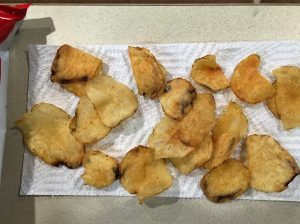
Tim's Chips showing variety in size, shape, and color
Tim’s Chips showing variety in size, shape, and color

Tim’s Cascade Potato Chips are different. I’m not sure if it’s the thickness or cooking time (their web page doesn’t confess). They’re very crunchy and filling.

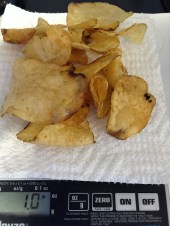
One ounce serving
One ounce serving

If you’ve seen the Lay’s TV commercial and slogan ‘betcha can’t eat just one,’ you know that with theirs, it’s true. With Tim’s, I think you could eat just one. If a potato chip can be called robust, these qualify. I suggest limiting intake to a single 1-ounce serving. I tested this and more is not better.

I prefer thick, crispy, and lightly salted chips that are cooked longer. Not so the pale, evenly-boring, normal-fare of many brands. I want to see the various shades of brown and black from cooking. Tim’s delivers. To be fair, my wife was not a big fan, but she’s a corn-chip chick.


Chip color variation due to cooking.

My chips weren’t exceptionally oily. They’re produced in a variety of flavors and the company claims that the Jalapeño flavor is consistently most popular (on my to buy list). If you’re a fan of Tim’s, let us know what you think. Unsalted and reduced fat varieties are in the inventory (may not be available in all stores). But, I have no idea why someone would abuse a chip like that.


Nutrition Facts from my package of original (per 1 oz. serving): 140 calories; 1.5 grams total fat; 110 mg salt (U.S. FDA recommends max of 2,300 milligrams per day.); 15 grams carbs.

Chips inside the bag


Tim’s Chips are available in twelve US states and may be ordered by the case through the company’s web page. My 8-ounce bag cost $2.00 at the grocery store. Buying on line is more expensive ($16.50 for a case of 6). Tim’s was double the price of the cheapest brand in my store. But in my opinion, worth it.

Bon Appetit

Disclaimer: I do not accept payment in any form or gratuities of any kind for my food, drink, or restaurant reviews. Not that anyone has ever offered, but I don’t. I only review things I like and would suggest to a friend.

Frat Friday (Ego)

The Paradox of The Writer’s Ego 

EGO: “Noun. A person’s sense of self-esteem or self-importance. Synonyms: self-worth, self-respect, self-image, self-confidence.”


Ego4Some people think that ego is a bad thing. In a way, they are right. In a way, they are wrong. A wooden plaque (given to me by a friend) hangs in my room so that if I (ironically) hold my nose up, just slightly, I can see it. It says, “Humility is not one of my faults, but if I had one, that would be it.” Before you attack my lack of profundity, my friend made and gave the plaque to me as a bit of an ironic joke (I hope).
I recall my father using descriptive phrases like “too big for your britches” and “Who the hell do you think you are?” One might think such comments  damaging to my ego or creativity and may have hampered my development. My ego survived and my limited creativity seems fine.

In my thinking, ego has little direct effect on creativity regardless of its health or condition. We writers (all artists?) are diverse people. But we are people. All kinds of folks paint great landscapes. George W. Bush paints, and he is better at it than I am. Who knew? The former Prez was hiding an artist all that time.

There are many web sites and books to help us write better. Most of the tidbits I learn from them are helpful. However, I often wonder if Stephen King isn’t right — they are all BS (from somewhere in On Writing). My point is that while we’re all different in many ways, we seem open to writing better.

I spent my entire life preparing to do (and doing) something else. After I gave all that up and retired, I woke up one day and declared that I am a writer. It was not who do I think I am? It was what I am – a writer, because I said so. That is ego. But is it evil or bad? Am I egotistical? I said nothing of quality, and I am a QA professional. I am as good at writing today as I can be. Tomorrow I want to be better. I am also as good as I can be at spelling, and my spelling is horrible. My writing gets better each day, my spelling does not, and my ego is managing.

Ego1


Most of the be-a-better-writer advice I’ve read says we need to dump our ego to write (or do anything) well. Other things say we should believe in our abilities and work hard at it. Unfortunately, changing who we are is more difficult than changing the tire on the family Ford. I think that if I work hard on this blog and do the research, it should be good enough. My ego tells me that I can do this. I can do it. I can get my point of view across. That is self-confidence – ego.

Ego3I’m making the claim that ego is mostly good for writers. I presume that it is good for artists who work in other forms of artistic expression. I also think that being humble is good and being courageous is good. I also think that each of us should do what works for us. We’re unique individuals who share a passion (if you want to call it that). I admit that an out of control ego is a problem for more than just the narcissist, and egotistical people have their issues. But over-blown personalities write and sell books too.

Narcissism: “Noun. Excessive or erotic interest in oneself. Synonyms: vanity, self-love, self-admiration, self-absorption, self-obsession, conceit, self-centeredness, self-regard, egotism, egoism. In Psychology, it’s an extreme selfishness, with a grandiose view of one’s own talents and a craving for admiration.”


“Egotistical is excessively conceited or absorbed in oneself; self-centered. Synonyms: self-centered, selfish, egocentric, egomaniacal, self-interested, self-seeking, self-absorbed, narcissistic, vain, conceited, self-important; boastful.”

Then there is the paradox. I like to refer to myself as a “wannabe” and I see no reason to reject that. I think my skill and my work improves each time I make changes or corrections. My writing improves every time someone reads it and tells me what they think of it. My ego can, and often does, take a beating. At some point we stop all of that. We are ready for what is the painful process known as “getting it published.”

Ego2We need our ego to launch the work to readers. We need to believe that we can and want to do it. We also need to deal with whatever criticism and rejection we encounter.

Our poor egos. Our old friend stands ready to push emotional pain buttons with every rejection or criticism. It happens. And it happens most often to wannabes. But it’s part of the process, if you want to be published. After enough of this ego pounding us with emotion (can our egos survive all of this?) we may want to stop writing.

sad6To quote from Poe’s Preface to a republishing of his poems: “These trifles are collected and republished chiefly with a view to their redemption from the many improvements (made by publishers)…I am naturally anxious that what I have written should circulate as I wrote it….” He goes on to say that it is not that his work is that important, but the people who read it are. Ego?
The writer’s ego is a good thing. From day one, it is at the core of our being able to do what we want to do. But ego is not good at dealing with the humbling experience of rejection. I am sure the damage done too often leads to quitting. But, if we quit, do we say, I am not a writer?

If you want to read more on this topic, check out the following.

Insecure Writers Support Group (IWSG). This looks like a good site for all writers, insecure or not. Two other interesting blogs on writer’s ego are here and here.

Taco Tuesday (Mexican Food)

When we lived in San Antonio, Texas, we had Mexican food often. We seldom changed for variety. If you visit San Antonio, visit the River Walk and the Alamo, because that is what you do there. But please don’t rate the food by eating Mexican at the River Walk restaurants. I have tried them all and they all pass. While some are better than others (in my Tex-Mex opinion), there are much better places. Wherever you chose to dine, in South Texas you should eat all the Mexican food you can find.

What you might find in other states may also be good Mexican food. But it is not necessarily Tex-Mex. A lot of what is called Tex-Mex, simply isn’t. It may be good, but it ain’t Tex-Mex. Fish tacos are good, but they aren’t Tex-Mex. Ask locals, if you can.

On the northeast side of town, my personal favorite is La Pasadita Restaurante Mexicano, in Schertz. My family and friends agree. This guy makes his own tortilla chips (he tried the bagged ones and his customers rebelled) and salsa. Honestly, if no pizza is available, this place would do for my last meal. As with most of these places, Negra Modelo is the darkest beer they have (it’s a lager), but it works. So, what happens if you’re in Lincoln City, Oregon and you want Mexican food?

Both tables and booths

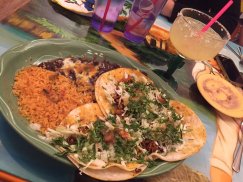
There are a few. The answer is that you pick one, which is what we did. Puerto Vallarta Mexican Restaurant is at 3001 NW U.S. 101, Lincoln City, OR 97367. Right up front, this place has two drawbacks. The parking is insufficient on a dirt lot. The building is too small for its popularity. But if you get past those minor items (as I did), you’re in for a treat.

Presentation is great

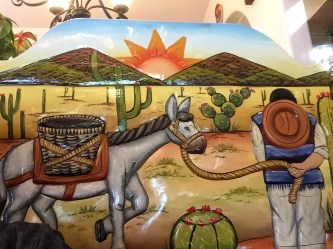
The food is good. But for me, all Mexican food is good, as indeed all pizza is good, and all beer is good. It is only a question of how good it was. These folks had laid a claim to some interesting things I liked. The atmosphere is great – you know immediately what kind of place you’re in (the atmosphere of the place in Schertz can use help like this). The staff is friendly and laughed at this gringo’s humor. When we walked in, we were told it would be a ten-minute wait. It was more like two. We were seated at a table with a Mexican mural on the table top and a matching one behind me.

Art is on table tops and over booth back rests

When the waiter came to take our drink orders, he and my wife struck-up an in-depth conversation about Tex-Mex food. It turned out he has a daughter living in Houston. But he agreed, the food in this place was not like that. Now, most menus in Mexican restaurants tend to be long. This is because (in most cases) it is a matter of packaging and presentation, as opposed to the details of varied ingredients. If you eat vegetarian, you should ask questions. A lot of animal products are used in Mexican cuisine.

True Mexican Décor
True Mexican Décor

I had a pork dish and my wife had enchiladas. No complaints. The portion sizes are large, but that is the norm these days. Prices are very reasonable and the total cost was less than half of the previous night’s dinner in the same city. One lady on Yelp commented that the food was not salty (as she believed most Mexican food is) and I agree. Yelp gives them 4.5 out of 5.

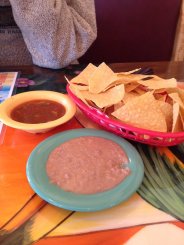
Refried beans with chips and salsa

Two special touches included good chips that were not from a bag. I didn’t ask if Mamacita made them. The other was the inclusion of a small plate of refried beans in addition to the dipping salsa with the tortilla chips. That is a nice touch.

If you are on trek up (or down) the Oregon Pacific Coast, and you want a good place to eat in Lincoln City, give Puerto Vallarta Mexican Restaurant a try. I bet you enjoy it.


Frat Friday (I felt that, Mr. Poe)

When our child was ill, my task was to directly address her illness with an emotionally written letter. I was to tell the illness how I felt, about or toward it, or how it made me feel.

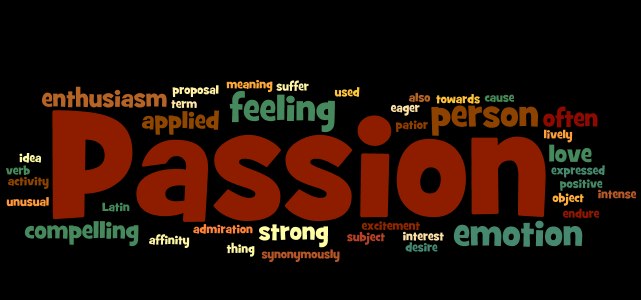
passion15Three days of toil produced words born of emotion, but laying bare only thought and opinion. That challenge to produce expressive discourse full of feeling was riddled with notion and conviction of purpose, while lacking passion. Such analysis had merit and value, but I had so missed the deeper inside of myself that it might have been mere opinion drawn from a detached stranger. Those mindful barnacles of human grief remained anchored to my thoughts, thus hidden except from me.
Why, I wondered, could I not find letters for my aguish? My internal emotional awareness was no less keen than my intellectual understanding of the presence of the illness that was harming our family.

passion16Knowing my feelings was not enabling my telling about them. Had I created a self, unable or unwilling to express feeling? I wondered deeper if I had co-opted with a force to create an emotional Dorian Gray. Were my feelings doomed to be confined in the shadowy attic of my mind? Had I become so adept at emotional deception that I habitually prevented expression of feelings? Had I become factually superficial and emotionally shallow, thus apparently less than a human lacking outward feelings?

 

Consciously or not, my ability to express emotionally was crippled. Historically, I’d been an extremely emotional child, inside and out. Perhaps as an adult, I was the same, but kept my feelings hidden. I had emotional awareness and comfort. But learned how to mask emotion and display a filtered emotional public persona. I was willing to affectively express my feelings, but until attempting to express them in writing, I was unaware of my handicap.

passion7Twenty years hence, my awareness is of two worlds. An external world full of social interactions, judgements by and of others, and basic human needs. This is the world of people wearing masks, hiding feelings, and struggling silently with internal and external burdens. It is a world we need in order to sense the other world – a deep world that is hidden from others and often from our own self-awareness.
 

The other world is not physical. It has no physical activity. But, it has a silence that we hear, a darkness that we see, and a hearing to which we speak. The other world has no touch, but we feel it. It has no eye, but it sees all. It has no physical strength or power, but it controls our external world in every way. We each have this real world, and it is exclusively ours, separated from the independent and silent world of others.passion12

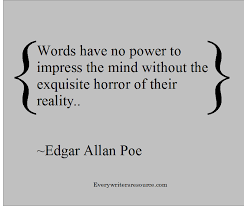
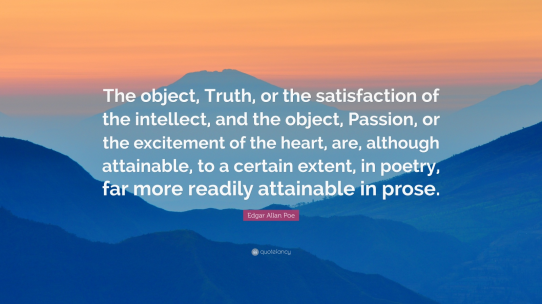
Real physical life is driven by emotion. While I know nothing of death other than its certainty exceeds all other events, if I must lament any loss – it is losing my emotions. Furthermore, the one I will regret most is same emotion that Edgar Allen Poe held so dear when he said…

“With me poetry has been not a purpose, but a passion; and the passions should be held in reverence: they must not – they can not at will be excited, with an eye to the paltry compensations, or the more paltry commendations, of man-kind.” (1845)


passion14


I want passion like that – uncontrolled by logic, analysis, profit, adulation, science, or ego. I want my reason for being and my reason for doing to leap from the shallows of purpose to the depths of passion. Whatever my passions, I want to keep them and to take them with me. I want to feel passionately happy, to be passionate about art and poetry. Maybe I will learn to write passionately about my feelings. Just for now I want to let the world know that I love my passions and lament their loss with life itself. And before I go, I want to write with emotion.

Frat Friday (Book Review)

Islam3 bookThis blog is about a book. If you look at my ‘about’ tab, under Frat Friday, think of topics 1, 2, 3, 9, 11, 12, and 13. While I will not include my personal religious or political opinions today, the book I want to talk about is about religion and politics. It is a lot about hate, causes, and it’s certainly in the news. The religion is Islam. The book is Islam and the Future of Tolerance by Sam Harris and Maajid Nawaz. It is a dialog (not a debate) and only about 120 to 140 pages long. I preferred the audio version with Sam and Maajid reading their parts, but it’s a good read.

Ratings

On Amazon, 315 reviews awarded an average of 4.5 stars with 92% being either 4 or 5 stars. Most of the low critiques are more personal attacks on the authors with little concern for future readers of the book. I read the book and will read it again.

The writers/talkers

Both men are intelligent, experts in their fields, and well-spoken.

Sam Harris
Sam Harris

Harris is a well-known American atheist, philosopher, neuroscientist, and author of several books.

Maajid Nawaz
Maajid Nawaz

Nawaz is a British Muslim and chairman of Quilliam, a counter-extremism think tank. He is a former member of the radical Islamist group Hizb ut-Tahrir, which he left in 2007 when he renounced his Islamist past. He now advocates Secular Islam.

“What is Islamism? Islam is a religion; Islamism is the desire to impose any version of that religion on society. It’s the politicization of my own religion. What is Jihadism? The use of force to spread Islamism.” ~ Maajid Nawaz

“The only conclusion I can draw from everything you’ve just said is that the problem of ideology is far worse than most people suppose.” ~ Sam Harris

The essence and differences

While the two people in the dialogue have vastly different views on religion, they each allow a pass for the other in order to have this discussion. What they do agree upon is that there is a significant problem and threat within the Islamic faith regarding danger from some of the members. I’m not sure that they agree on who is dangerous, or how many, or exactly why.

(Not addressing this conversation, but similar ones.) “The people I really worry about when we have this conversation are feminist Muslims, gay Muslims, ex-Muslims – all vulnerable…in many cases violently assaulted or killed….” ~ Maajid Nawaz

It may take more than one pass through to glean their exact positions. Precision of understanding and clear definition of terms are goals of both men, something Harris works to ensure. They agree that the discussion needs to take place, but efforts are confounded by people on both the fundamentalist right (mostly Muslims) and what Nawaz refers to as the regressive left (or liberals).

“…The general picture is of a white, liberal non-Muslim who equates any criticism of Islamic doctrines with bigotry, ‘Islamophobia,’ or even ‘racism.’…they deny any connection between heartfelt religious beliefs and Muslim violence….de facto organs of Islamist apology – The Guardian, Salon, The Nation, Alternet, and so forth. This has made it very difficult to have public conversations of the sort we are having.” ~ Sam Harris

The biggest problem for America, if not the world

Europe currently faces a much greater problem than America in dealing with Islamists. By comparison with Europe, America has 3.3 million Muslims (1%), while France (9.6%), Belgium (6%), and United Kingdom (4.5%) have Muslims as significantly higher percentages of their total population. What Harris and Nawaz agree on is that attempts to discuss how to solve the problems created by Islamic Extremism are taboo topics.

I think they have a point. While Sam points to the fundamentals of Islam as problematic, understanding of his basic premises regarding religion (and the same can be said of virtually any contemporary, well-known atheist) reveals that he gives no religion a pass – especially no Abrahamic religion.

The context of what is said

“One of the problems with religion is that it creates in-group loyalty and out-group hostility, even when members of one’s own group are behaving like psychopaths.” ~ Sam Harris

The best way to follow what these two men are saying is to know the context of what they are saying supported by their beliefs or philosophy. To do this, it would be helpful to read other books, particularly Harris’s The End of Faith.

They’re both attacked continually and called insulting names and threatened. Both spend a good deal of effort justifying their positions and protecting themselves. Both have done TED talks that are worth viewing to understand their positions.

Sam Harris link to TED.

Maajid Nawaz link to TED.

The video is good up to the Q&A part, but kind of long. Link to Youtube discussion at Harvard University (over an hour).

Taco Tuesday (Seattle Beer Week)

I grew up around beer. We had several breweries in town. One (Stegmaier Brewing Company) is still in business but is owned by a competitor of many years (The Lion Brewery). My parents drank beer since before I was born, and I was sucking suds long before I was of legal age. I still drink beer. When people see me with the occasional glass of wine, they ask if I am feeling well.

Here’s to a long life and a happy one.
A quick death and an easy one.
A good girl and an honest one.
A cold pint and another one.

No blog of mine on beer would be complete without the wonderful pub song by Tom T. Hall, I Like Beer.


seattle beer week1So this week’s Taco Tuesday recognizes Seattle Beer Week, which is actually 11 days long. It is a huge beer celebration in terms of both participation and geography. The Pacific Northwest has more breweries and beers than I can imagine.

When we drink, we get drunk.
When we get drunk, we fall asleep.
When we fall asleep, we commit no sin.
When we commit no sin, we go to heaven.
So, let’s all get drunk, and go to heaven!
–Old Irish toast

Walking down the beer isle in my grocery store I experience sensory overload, and that is just a wee sample of the plethora of brews one may imbibe in these parts. Beer week brings together retail establishments, all kinds and sizes of brewers, and beer aficionados of all levels. This thing runs from the cities of Tacoma and Kent south of Sea-Tac Airport to the city of Lynnwood north of Seattle. It runs from Puget Sound to the west then past Lake Washington to Bellevue on the east side.

Here’s to cheating, stealing, fighting, and drinking.
If you cheat, may you cheat death.
If you steal, may you steal a woman’s heart.
If you fight, may you fight for a brother.
And if you drink, may you drink with me.

The links below are blogs related to Seattle Beer Week, and a few others I thought you might enjoy.

http://seattlebeernews.com/ Professionally presented blog with news about beer.

https://www.facebook.com/washingtonbeerblog Could not get link to blog to work, but the Facebook page is cool. Got it to work (yay) and worth a read: http://www.washingtonbeerblog.com/

http://brewdad.com/ Great blog. It has a long list of other beer blogs and more useful beer information.

http://nwbeerguide.blogspot.com/ Good blog about general Pacific Northwest area, including Alaska.

http://seattle.taplister.com/ Not a blog, but a cool little app site on finding beer.

I included a clip from the Washington Beer Festival that was last month, simply because it looks like fun to me.

Of all my favorite things to do,
the utmost is to have a brew.
My love grows for my foamy friend,
with each thirst-quenching elbow bend.
Beer’s so frothy, smooth and cold–
It’s paradise–pure liquid gold.
Yes, beer means many things to me…
That’s all for now, I gotta pee!

Frat Friday with Thomas Merton

Disclosure: I do not practice or align myself with any religion. I have in the past, I no longer do. This blog is not about what I do or don’t believe.

I’ve never known when someone would come into my life and make a difference. There have been many, both good and bad. Many have shaped who and what I’ve become. Such influential encounters have happened more times than I can remember. One of those people is the subject of today’s Frat Friday blog.

I’ve never met this man. He was accidently killed in 1968 during my sophomore year in college. At that time, I had never heard of him, and if I had, I would’ve had no interest in him, his life, or his outlook. I discovered Thomas Merton in the late 90s, almost 30 years after his death. I was inspired and intrigued by his autobiography, The Seven Story Mountain, published in 1948. Through his writing, I met the right person at the right time.

As I see the man.
AS I PICTURE HIM – REAL

Thomas Merton was one of the most prolific spiritual writers of the 20th Century, a Cistercian Monk, and a mystic. In 1915, he was born in France of a New Zealander father and American Quaker mother, both artists. His mother died in 1921 and he was raised by her family. Merton wrote and published more than 60 books, mostly on spirituality, social justice, and pacifism. He wrote many essays and reviews. Another 30 (or so) of his works were published posthumously and many other of his writings have been released to the public.

Merton1What impressed me about this man was his complexity, his courage, and what I see as his wisdom. His life journey and the decisions he made will likely prevent him from ever being canonized a saint by the Catholic Church. Yet those foibles are exactly what attracted me to him twenty years ago, and continue to influence my thinking. The man was a real person – a human being who behaved like one. If they did make him a saint, I think he would be among the most human of that group.
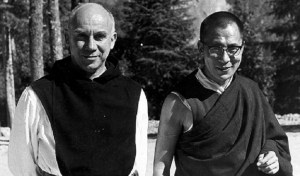
In the early 1940s, Merton went to a Trappist Monastery in Kentucky, knocked on the door, and told whoever answered that he wanted to be one of them. Trappist Monks are strict aesthetics and followers of the Order of Saint Benedict. Merton chose this life and lived it until his death. The Frank Sinatra song, I Did It My Way, comes to mind despite the obedience pledge of Trappists.

Beginning about 1937 during his conversion to Catholicism, Merton was fascinated by what he learned about the eastern religions. From then on, he studied Buddhism, Taoism, Hinduism, Jainism, and Sufism.

Thomas Merton with Dalai Lama
THOMAS MERTON WITH THE DALAI LAMA

His primary interest was in Zen, particularly as it applied to Christianity, from his point of view. Within limits, Merton supported interfaith understanding. He pioneered dialogue with the likes of the Dalai Lama, the Japanese writer D.T. Suzuki, the Thai Buddhist monk Buddhadasa, and the Vietnamese monk Thich Nhat Hanh. Many of Merton’s books on Zen Buddhism and Taoism are still in print.


“Art enables us to find ourselves and lose ourselves at the same time.” ~  Thomas Merton, No Man Is an Island

My favorite description of him was by Paul Hendrickson in the Washington Post on December 22, 1998: “Thomas Merton: that bohemian and poet and extreme sensualist, lover of jazz, prolific man, traveler of the new idea. A 20th-century prophet and mystic. Not a theologian so much as a kind of freelance spiritual thinker.”

While I can’t honestly say that Merton makes as much of a difference in my life today, he did at a time when he was the right person with the right thinking. He had prepared for me, fifty years before I needed it. I am not sure exactly what it is that still holds my admiration for and curiosity about him, but I suspect it is how he lived within his human condition.