First as a child, then as a boy
No shy child as many would ploy.
Silence in me is part of my nature.
Spoken words etch not my portraiture.
My teen years of silence, not taken a joke,
Was the indication of a challenge to bear.
More words to share, growing older I spoke.
Mostly not words they wanted to hear.
Others wanted to know why ‘twas I
Who made less noise than they did cry.
My smile never inquired just why,
“Of all talkin’, ya never was tired?”
Small talk they called it, noise without brains.
Not shy, in silence, I’m quietly plotting
Demise and disposal of whatever remains.
Now older, and less quiet I’ll be,
I listens and sez the damnedest of things.
Have it your way, but please try to see,
I can make stop those annoying rings.
Contemplate me
as you pass through yer day.
Most of the time,
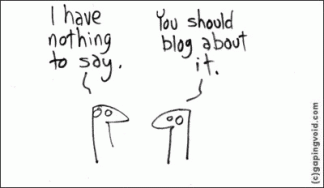
I simply have nothing to say.
Listen quietly when you can,
mind unheard gaps,
and look both ways.
Click on the photo to watch a funny scene from a the movie, The Quiet Man.
Scene from movie, The Quiet Man, staring John Wayne and Maureen O’Hara
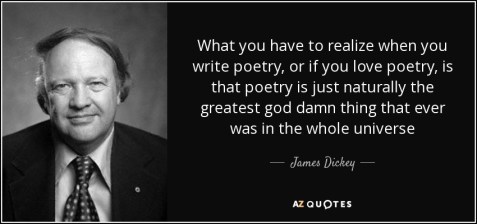
The title of this quatrain poem is taken from a New York Quarterly, ‘Craft Interview’ with James Dickey, as quoted in the Introduction to The Art of Poetry Writing by William Packard. I’m new to poetry writing, but I have always loved it. Thus, I concur with Mr. Dickey’s assessment.
***
The Greatest God Damn Thing by Bill Reynolds
Beating hearts bring words as rhythm flows,
the brick and mortar for posing forms.
They come to me in words of prose.
I wrangle with words to bring the storms.
I feel the beat as I tap my feet,
I catch the bop and I keep the time.
My world finds rhythm to keep the beat.
I seek my Po-voice and find the rhyme.
Mind and spirt bring forth my emotions.
Poetic verse grows as I now can hear it.
Out of me come plans and potions.
The poem I’ve written is part of my spirit.
The pleasure I found in hearing the sound.
My voice is here and my voice is there,
My emotions can show a feeling we share,
My poem’s my gift to everyone around.
**
Read, write, and love poetry silently and in several voices
as you look both ways on the highway of life.
See and hear all the rhythm and rhyme.
But, mind the silence of the gaps.
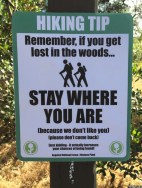
Years ago, I packed in over several nights, with a backpacking group near Truckee, CA, north of Donner Pass. We were at approximately 7,000 feet elevation in the Sierra Mountains between Sacramento, CA and Reno, NV. It was a very exciting trip.
A year afterward, I planned to repeat as a day-hike in with a friend. After he backed out, I decided to go it alone. I ended up going later than I should, and was unprepared for what I encountered. For my foolishness, I paid the price with months of back damage and pain. I can almost laugh about it now – almost. It was also exciting, but in a very different way.
Onomatopoeia is the formation of a word from a sound associated with what is named, such as cuckoo or sizzle. It is also used for rhetorical effect, as in this poem.
Never Again
by Bill Reynolds
High Sierra beauty.
No food. No drink. No sense!
What plan? Quick in, then back out. Whoosh. Like the wind. Time passed
Boink. Suddenly, it’s late.
Dusk. ARGH! Gotta get out.
Before dark. Oh no: It’s feckin’ dark!
No moon, no map. Had a lighter. Zip.
Oh, shit. Muddled.
Not one essential, much less ten.
No flashlight! Groan. Why?
Thinking? Stoopid. Grrrr to self. Clatter climb rocks. Get out. Fast. It’s Dark.
Thump. Crunch. I fell, no moon. Ark! Did I say, “It’s dark?” Crunch. Footsteps. Are they mine?
Can’t see. Bonk. Oof! Pain.
F-word, again. No better.
I keep swearing, like it’s gunna help. Bam. Step in hole. Crunch. Knocked out breath.
Shocked. Confused. Must see but cannot. Crackle, smack. Branch to my face. Blood. Ooze. Buzz. Bugs? Crunch. Twisted ankle. Scrape, bang, boom, bash. ACK! More pain.
Bonk. Fall on face. Dark. Hurt. Walk.
Pain. Bam. Oof! Again. What’d I step in?
Another hole. Whack, crunch.
Damn holes. Hiss. Oh god. A snake?
Hear something? More crackle.
What’s that? A clatter?
Get out. Fast. Don’t run. Too dark.
Bear? Mountain Lion?
Kill me? Eat me? Yikes. I’m so screwed.
Hoot. Owl. Danger.
Skunk. Whew. It stinks.
Careful. Out fast. Whiz? Crap!
I’m Cold. And wet. In pain.
Must pee. Yikes. Unzip.
Done. Relief. Don’t fall in it. Re-zip.
Ouch more. Get out. Don’t fall. Boink. Thud. Head pain.
Scrunch, twist, whack.
Repeat. Fear. Repeat. Dumb me.
How far? How long? Lost?
Alone. Clatter. Alone?
What was I Thinking?
Break free. Find car! Keys?
Oh no. No keys. Groan. Swear.
Hidden key. Found it. Brrrrr. Shaking. I am very cold.
Tall grass. Kerplunk. Dropped key.
Damnit, can’t see. Cold. Pain.
Sore knees, search the ground.
Feel in dirt, no gloves. I found it. Clatter to feet.
Hold tight. Screech. I scratched car, then swear.
Bang. Slam door. Varoom.
Start engine. Get out. Cuckoo. Oof over bumps. Drive. Find my brain.
Good trip. Nice day. Never again!
Bring a flashlight.
You can’t look either way, nor mind the gaps, if you can’t see.
The silk soft, black cloak of night rolls
To end our days as it marks time passing on earth.
Night slips over us like a gentle silk shawl,
With the sparkle of stars and the silence of all.
Be comforted when midnight comes,
As it’s the darkest of times.
The death of this day marks a spell.
The birth of tomorrow’s new hope.
Soon the witching hour begins as so
Little good happens, post the final hour.
To some, midnight’s a time of painful suffering,
As with the line between life and death. Find peace and warmth in the face
Of the change – the end of one day.
But for another we live, and then
Feeling recharged we’ll be free to see.
After our true self is off,
Without lie or pretense,
To bargain away the universe,
To have a brand-new day.
We must pass through the portal
Of darkness, and woe.
Thus, awakening of the new.
Look both ways each new day, and mind the gaps at night.
This poem is about underground coal miners – people who did, or do, very dangerous work. My father and grandfathers were three. This is also about life in our home when Dad still worked in the mines.
During my early teens, the mining business shut down in northeastern Pennsylvania. This was due to the Knox Mine Disaster in the late 1950s and the easy, cheaper, and cleaner use of oil to heat homes. Today, most coal mined in the USA is exported, but the industry continues to decline. Only 30% of electrical power in America is produced by coal.
Old coal mine entrance. A dark abyss.
Nearer My Hell to Thee By Bill Reynolds
Before leaving the daylight, and going into the pits,
They look deep into the ground, to the soul of the abyss.
The blackest of blacks, the darkest of darks, and danger,
The dank abyss peers back as men descend into nature.
Far below ground, the mine was there lurking, waiting;
That dangerous, disgusting damnation of sound,
For some small wages, they go into that hole far underground.
Deadly it was and deadly it is, they never know when…
Many wives cried at the loss of their men,
Who died in the gut of the deplorable depths.
It was frightening work miners chose, those jobs that killed.
Black hard hats on heads, mining lamps on to cut the dark,
But still never safe. In denial or not, it was dangerous work.
Blackjack and Brass Knuckles same as my father had.
Father was, and so were both grandfathers, miners all.
Walking home through muddy fields and dark alleys,
Dangerous on pay days; all cash in their pockets,
With blackjacks and knuckles, maybe a gun.
He’d push open the gate, then let it slam with a thud.
Dad would stomp up the stairs and in the back door,
It was always the back way after a day’s work.
Covered with coal dust,
The sweat of the labor, and the stink of the mines;
Smoking his Camels, always coughing and coughing.
But he was my Dad, and it was always like this.
I remember Dad much blacker.
Everything filthy, his clothing all rotting,
Black on his skin, and in his gray hair,
He didn’t know about the black in his lungs,
the deadly back dust was glued on hard, but not to his soul.
White at his eyes and over his lips,
he’d set down his lunch pail. No hugs, no kisses,
just “hiya,” and not much of a welcome.
His coat and his cap, and his boots all come off.
Trounced upstairs to the bath, footsteps pounding the way,
Transformation, about to take place.
In cold water each day, he washed coal dirt away,
From his face and his hair, his neck and his chest,
From his waist to his feet, but not from the rest.
Nothing could wash the coal miner away.
Not the water, the union, the beer, or smokes.
Not on the inside, from his throat nor deep in his lungs.
Black dust in his body and in with his blood.
In a coal mine.
It was always the same, until the disaster.
Miners to work, to suffer and die.
Returning to homes, dirty but to homes they came.
Then one day, the depression set in.
The mines all shut down, proud miners, no work.
One day it all ended and everything changed.
Miners laid off, the mines were all closed.
Oil was king, and nobody noticed.
No more abyss, just a new kind of dark.
If you not yet sufficiently depressed, watch this.
Things I like include people, almost all of which inspire me in some way; magic which I define as anything science can’t explain, and some things it can. And music. I include things I read, both poetry and prose, both what I agree with and what I do not. I wake with thoughts and ideas, like most folks I know. While this piece implies it comes in the night, I also believe it’s accumulated from the day or days past. You (friends, family, enemies, and strangers) are the source of any inspiration I may have.
Tapping My Muse by Bill Reynolds
On some dark nights, when tired and sleepy
A wondrous, magical muse comes to me.
With exploits and feelings, some may find creepy
Non-understandings we struggle to see.
Lying in bed, but not quite yet sleeping,
Relaxed, not worried, free of all thought,
My mind is absurd and nothing it’s keeping,
Drifting away, a sleep the sounds brought.
Music starts playing, notes never heard,
On the door of my mind, something is knocking.
Company here now is truly absurd,
To prevent any thoughts, mind I start blocking.
Then with a familiar comfort, I started to purr.
My muse was with me, but I could not see.
Muse was very near, but I could not hear.
Muse magic was upon me, but I could not feel.
The muse was here, as the allure of it concentrates,
It sensed in me clear, and aroma so sweet.
Muse; my dear, my inspiration, and peer,
Mystic and magic so near it captivates,
As my heart surrenders to a softer beat.
I could feel the guidance enter my sphere.
The muse had arrived into my mind,
Drawing me deeper into one miracle spell,
A delightful fascination of wisdom entwined.
The Magic was there as the music played well.
With music, not notes, and voice without sound,
Muse urgently guided me into the verse.
I swayed as it played and I turned all around,
Inspiration is left, and nothing’s the worse.
At the end of my days, I seek for my muse,
I desire the gift, the creation of love.
A synergy of us, returning for truth,
The magic of music, a quest from above.
Look both ways to find your muse.
And mind the gaps.
A limerick consists of five lines. Lines one, two, and five have 3 beats each and rhyme. Lines three and four have 2 beats and rhyme. Referred to as light verse (or vers de société) by Lewis Turco, limericks tend to be light, humorous, and often bawdy or dirty.
***
The first “poem” I recall hearing was a bawdy limerick my father told me. I don’t recall my age. I heard it once and never forgot. It was a shocker, although Dad often used such language around me.
There was a young lady from Freeling
Who had a funny feeling
She laid on her back
And tickled her crack
And pissed all over the ceiling
***
I wrote this one in class about a Creative Writing teacher.
There once was a lady from North Bend
In teaching us to write, she had no end
She had a great thought
We fit and we fought
Until our writing was well penned
Well, the class thought it was funny.
***
Some wee dribble of self-pique from the old flapdoodle.
There was an old-fart named Bill
Who was also a bit of a pill
Until he met her
The rest is a blur
And now he conforms to her will
It’s all about me, ya know.
***
Many of us follow this lass. So, a bit of a gentile and friendly jab. Click on her name to link to her blog.
There once was a blogger named joey
And she loved to tell us her story
She speaks of the mister
Like he is her sister
Instead of her very first quarry
Do ya think I’ll hear about that one?
***
I had to take shot at someone, or male pride, in general.
There once was a man from south Brooklyn
Who thought his self too good lookin’
It happened one day
His thing wouldn’t play
Now he’s no master Al Pushkin
Dirty is funny, right?
***
Mind the gaps on top of it all Look both ways: eye on the ball But watch for the fart That is really a shart And you’ll have no reason to bawl
(Sorry. I couldn’t help myself. I wrote them all, except the first one, and I assume full responsibility for the content of my limericks.)
Kismet (kiz-met) means destiny, or fate; or a power that is believed to control what happens in the future. The word kismet come to us from Turkish, originally from the Arabic word qisma (keese-mah), meaning portion or lot. There is so much poetry about, or related to, kismet that it seems to be its own type within a genre.
Specks: Coincidence meets Kismet By Bill Reynolds
Among the billions traveling through space…
Two specks of dust without direction or purpose,
None aware of another, simple lifeless vectors of eternity
on pointless, unrelated journeys to nowhere.
Each born of events eons past in both time and distance,
mindless entities uncaring, without purpose or reason.
Unguided, random, alone, on endless journeys to
nothingness, absent of all consciousness, awareness, or
desire in the vast universe of both
loving and frightening utter insignificance.
They do not know, do not feel, do not see, do not care.
Mindless and might be as well, not to exist at all.
Set apart in time and distance, spirits within–
Still unfulfilled, unknowing of self, unknowing of others.
Closer they loom but continue to wander,
thru time and thru space with nothing to ponder.
Then a fire starts to burn. There is something.
A light. A spark. A slowing from forever’s pointlessness.
Slowly, one at a time, a special day, each glides to a stop…
With spirit and magic, of others around they’re now more aware.
Spirit knows life and begins to evolve,
with wonders and mysteries yet to resolve.
They notice things now, a rhythm, a beat they can hear;
There’s movement within, fluid awareness begins.
There are noises and smells, they feel things
And notice more, it’s like nothing before.
Now being, now joining,
Each has become, part of life here on earth.
Each morphs into a part of the soul of a child.
Each has one life and each grows to a person…
with love and with needs, and all that should follow.
What was that fire? Where did it start?
Both still in the universe, but no longer apart.
Each gradually feels more awake, more abiding,
Each strives on and on, to be with one who is living.
People and places and sights and sounds.
Emotions and tastes and the hearing of life.
The specks found common goals, one mission in life,
to find something missing, the whole of it all.
Through the eyes of their hosts, each speck meets the other.
Instantly their kismet arrives, as love for all their lives.
Their kismet has sent them to be as they are,
from that moment on, they’re forever together.
Now fully aware of why they are here,
the hosts of the specks become a great couple.
In love and now bonded together as one,
they move through this life, both sharing a fate.
A journey of eons with circumstance shared…
the past has been long, their future’s eternity.
Has coincidence brought two lovers together?
Or was their kismet at work without a conclusion?
The humans may pass, but the specks live forever.
Their love will go on, into ever and ever.
What is our kismet?
Seek your destiny — but look both ways, and mind the gaps.
The universe is important. Click here to learn all you need to know,
in about four minutes. It’s well done and funny.
Do you ever feel like you’re more than one person? Do we have inner duality — the light and dark? Is there another voice? Juxtaposed minds is as close as I can get. This invokes minor gender differences. My apologies to women if it is seen as stereotyping. It only applies to me. That’s how it seems in my mind(s). It’s how the light gets in.
Juxtaposed Minds
by Bill Reynolds
As always, you’re here with me,
As children, you survived my foolish resistance.
As we pondered our thoughts, I sensed yours in me,
As we bind together, into one two-sided existence.
While passing through this life,
We two spirits were always so real.
Through our eyes and ears, we see and hear;
Yet, with one heart we together feel.
You walk in my footsteps, always with me,
When you talk to me, I hear your voice,
And I feel your presence within my being.
We share one self, as we sense we are two.
Leonard Cohen. We have his music.
I know you, but not so well,
As you know me.
One and the same, we’re forever to be.
Your she melds to one, within my inner he.
You’re a guardian of two spirits, one soul.
One guides the other through all time.
You’re a muse to me, to my sum of being.
Your reality balances our one life,
As we console and debate, together we decide.
You’re the lady in me, who’s never been seen.
Kinder and softer, more willing to hear.
The knower of wisdom, the source of mine.
To the world you are silent, but you talk to me.
Your duality of truth overshadows all lies,
Your love overpowers this emotional being.
With a power and difference,
You have captured our two-sided soul.
Look both ways and be true to yourself.
When you see gaps, mind them.
Who knew? A form a poetry I can closely relate to. Disclosure: I enjoyed writing this. I went a little overboard with the vernacular — worked for me.
No real person, living or not, is depicted in this piece (except pics) — it’s a joke. A rotter is a cruel, stingy, or unkind person.
Ain’t Seen the Like
Yer ugly and a stupid lout.
I heerd ya drink da bath water,
Af’n yer old lady warshed da diapers out.
But, cha’ ain’t never gettin’ old; yer too rotter.
Yee’d have one redeeming feature,
If’n ye was dead, bu’cher sorry-ass ain’t.
Too bad, so sad, yer a hor’bile slimy creature.
Nah sir, lil’ fart, bu-chew never make’n saint.
Yer jis’ so feckin’ rotten, yer feets be a stinkin’
Yer mudder too asham’ ta le’cha go out.
If’n Ah wuz yer pappy, I’d be a-thinkin’ ‘bout given yer nasty ass a good clout.
So I bin-a-tinkin, ‘bout nex weekind,
And yer putrid discustin’ slothy fate,
If’n ya steel wanna, an’ she’s still-a-willin’
Yer free ta take meh daughter on a date.
***
See the humor in life, lighten up, and look both ways.
Mind the gaps on country roads.
 First as a child, then as a boy



 Never Again
 Tall grass. Kerplunk. Dropped key.
 Night Comes
 Find peace and warmth in the face


 Music starts playing, notes never heard,
 Look both ways to find your muse.
 A limerick consists of five lines. Lines one, two, and five have 3 beats each and rhyme. Lines three and four have 2 beats and rhyme. Referred to as light verse (or

 I had to take shot at someone, or male pride, in general.
 A journey of eons with circumstance shared…
 While passing through this life,

 ‘bout given yer nasty ass a good clout.
 Our Literary Journey