Essay: Rapturous Word Smithery

If I use the word rapture, what do you think?

Is it a feeling of intense pleasure or joy, or something religious? I recently used it, but reconsidered because of the second coming link. That’s not where I wanted my reader’s mind to go.

I’m not paranoid about selecting words, but many good words have been hijacked into meaning other things. I just saw click bait titled, “100 common slang phrases no longer used.” It included terms such as passion pit, talk to the hand, booyah, pad, or cat. Things change with words, phrases, and language in general. But I’m no linguist.

Admittedly, all words are subject to being absorbed into contemporary slang. Even lexicographers surrender to words morphing from misnomer to intentional slang to first or second-level meanings in dictionaries.

For example, gay as an adjective is often now defined first as homosexual (especially a man). As a noun, it means homosexual. Queer is another one that has waffled from meaning something odd, then to disparaging slang (homosexual), then back to acceptable, as in LGBTQ. I confess my confusion.

I try to keep up. I can say that’s cool and not be referring to a temperature, but I may be. Same with cold (as in cruel) in various uses. When my son started using the word bad to mean exceptionally good, I failed in making the sarcastic adjustment. Can we just stick with bad ass for that? Of course, that may also mean a tough or rough person.

I like it better when we make up new words rather than creating slang from old words that have established meanings. As it is, even when used correctly and in context, some words have so many meanings. For example, “the word set has 126 meanings as a verb, 58 as a noun, and 10 as a participial adjective,” and those do not include new jargonistic aberrations.

I just counted seven specialized dictionaries on my bookshelves. I like to read them because words fascinate me as much as spelling them frustrates me. Additionally, I use several on-line regular dictionaries, thesauruses, and encyclopedias (wiki’s) every day.

I got A’s in spelling in elementary school, “A” for atrocious. Now there’s a word nobody has screwed with (yet).

The nuns in my grade school taught me the word atrocious. I heard it often and haven’t forgotten. If only my spelling was better. It’s embarrassing to call myself a writer and spell so poorly.

However, Bill Bryson helps reduce my guilt feelings in his book “Bryson’s Dictionary of Troublesome Words” by telling of the physicist Richard Feynman’s intended retort to other professors who complained about their students’ failure to correctly spell particular words. It was, “Then there must be something wrong with the way you spell it.”

In the same book, Bryson (who I love to read) goes on to say of our language,

“One of the abiding glories of English is that it has no governing authority, no group of august worthies empowered to decree how words may be spelled and deployed. We are a messy democracy, and all the more delightful for it. We spell eight as we do not because that makes sense, but because that is the way we like to spell it. When we tire of a meaning or usage or spelling – when we decide, for example, that masque would be niftier as mask – we change it, not by fiat but by consensus. The result is a language that is wonderfully fluid and accommodating, but also complex, undirected and often puzzling – in a word, troublesome.”

I find that rapturing, as in when rapture means ecstasy, bliss, exaltation, euphoria, elation, joy, enchantment, delight, happiness, and pleasure. My feet are planted firmly on the ground and shall remain so, no matter who’s coming or how often.

Look both ways when wordsmithing or researching meaning and spelling.
Mind the gaps in dictionaries, they often mean something.
With your merciful pardon and leave, I shall write on, seeking
the dispensation and assistance of good spellers.
My eternal envy and gratitude are theirs.

Merrier Christmas to and from those who do not believe in any gods


There are other religions besides Christian. They do not believe Jesus was associated with any god in the same way most Europeans and people of the Americas do.

For most of my long life I have claimed to be a believer in god; specifically, I was Christian. I was a cradle Catholic who went to church, as obligated, every Christmas and Easter regardless of the state of my other church participation. The full story is too long, but I ran the extremes from almost nothing (referred to as ‘practical atheism’) to daily religious immersion and leadership.

From a religious participation point of view, for a time I took Advent and Easter more seriously than I did Christmas. From a cultural Catholic/Christian point of view, Christmas was the biggest deal, followed by Thanksgiving. But now I am an American citizen and atheist.

What does it matter? Well, it should not. My family has celebrated Thanksgiving and Christmas for many years. I’m not sure if any of my relatives or friends identify as atheist. But we are a family and those two holidays are all about family to me. For some reason, Thanksgiving seems to be the bigger deal these days. It’s a tradition.

When we moved back to Texas last year, our daughter-in-law said she was pleased because there would be more family stuff during celebration times. My wife decorates our home for most holidays, but not as much as in the past, and we don’t put out any religious items like a nativity scene or other art objects commemorating the birth or death of Jesus.

Around this time each year, I want to clarify my views about Christmas. I have many good memories of Christmas and the holiday season. I enjoy Christmas music for a while, but eventually I need eleven months to recover. I have some on my play list. In fact, religious music is fine. Some of it is great. I love the calm of Gregorian chant. I have written about music and other similar religious things in the past. Just because I don’t do that any longer does not mean that I want it to stop, that I am repulsed, or object. It is fine.

There is one chance in 365 that a male Jewish baby was born on December 25, roughly 2,000 years ago, who was then crucified and rose from the dead. If there was such a man, his date of birth is unknown. Also, in Christendom, celebrating this day as the birth of Christ is relatively new. Some Christian groups still do not celebrate. So, for most of my life Christmas has been kind of a wink-wink religious holiday. But it is a fun time from a secular point of view.

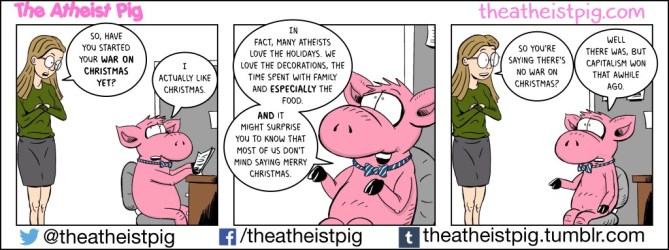
I wish a Merry Christmas to people on the 25th. If someone wishes me a Merry Christmas on some other day, I return the greeting and good wishes. While I prefer the inclusiveness of Happy Holidays, I don’t care what greeting people choose. I doubt if most atheists care, despite all the BS clamoring about wars on Christmas and some objections to verbal acknowledgements. It is not as big a deal as “In God We Trust” or forced prayer.

So, while I admittedly celebrate a secular holiday at Christmas, I do not object to people of any religion or social group celebrating their holidays, if I am not forced to participate or inconvenienced by them. Many of us, non-believers, believers, and everyone in between can do this and appreciate each other. It is the holiday season. If you think me a hypocrite, that’s your choice

I wish you a Happy Christmas Eve, a festive yuletide season, and a wonderful week highlighted with a Merry Christmas tomorrow.

There may not be any gods, but that should not stop us from enjoying life, friends, and family whenever we can.

Bill

Look both ways to see other points of view.
Mind the gaps. They’re everywhere.

Song Lyric Sunday – Season

Helen gifted us with season as the theme for today’s song lyrics. I’ve added an ‘s’ and selected the song Seasons of Love, written by Jonathan D. Larson. I went with the Glee version for the video (lyrics included). With this song, it is all about the lyrics despite a slow start. Hear/read it all the way through (three minutes) to get the complete message. I like it.


Look both ways in Spring, Summer, Winter, and Fall.
Mind the gaps and happy Yuletide, Y’all.
It is the season for love.

Click graphic for link to SLS page.

Mo’ Po’ Poetry – Quit whining! Write.

This is the second poem like this. To see the first, ‘Blatant Babble,’ click here.

Am I dead when I cannot write? Did I stroke out? Are my feelings hurt? I can write. Shit! I can write drunk. I can always write! The haunting of the living, the thoughts, opinions, and feelings of others who may read my screed; so they bar me from my work, my art, my love. My inner say of séance. The ghosts of failure, the confusion of thought, the confessor imposter! The loss of muse; the stark naked strawness of boned-out creative nothingness. But, to fear bland boring blight? I can write. I’m physically mentally capable of stringing words with a good or bad mix into a pot or onto a page. I can write! I can always write; always, always, but not always write a win: my first Pulitzer. Needs work. Write words. I can write. Write?

 ©Bill Reynolds 12/20/2018

I agree. Do you?

Look both ways, but life can only be written backwards.
Mind the gaps, they are spaces on your resume.
Is this all write right?

When It’s a Mere Story (fake, fake, true)

It is a story, a fib, a lie (if you like). I prefer reading and writing nonfiction (reality), but like any writer, I sometimes make things up and present them as literature. They also surface as fiction or reflections of imagination in my poems.

In my writer’s tool box are words, ideas, experience, knowledge, limited imagination, and scant creativity (I know where to get it), technology (a long list of software and hardware goes here), language, and some ability to read and write. Admitting my shortcomings as a journeyman of letters, I consider every editor I know to be a (god or goddess) helpful resource along with a multitude of other writers, authors, and critics.

I like to work with parable, symbolism, simile, metaphor, allegory and allusion, analogy, and soliloquy in poems and essays. I am talking about verisimilitude (all 14 letters and six syllables), or the appearance of reality or truth. I found that word on a list as I researched this piece.

When it’s not biographical and is just a story, it gets tricky. It’s not the writing. It’s what (WTF) am I talking about? Fiction resides in reality and truth. Fact can likewise be disguised in fiction. Names, dates, situations, and persons are often fictionalized in truth.

I know twins (grandparents) who, as children, were both present at a memorable and emotional family event. They both remember it well. However, when they discuss it, each has a different version of the same event, even though they stood side-by-side as eyewitnesses. Each is telling the truth, but how each one saw it and remembers it is different.

One of my favorite authors is Pat Conroy. Pat wrote autobiographical fiction. His stories were based on his real life: his family, people he knew and loved, his schools, his job as a teacher, and other real events. Indeed, his fiction was based (often heavily) on real life.

Conroy paid a high price in several ways. A lot of people got mad at him. Some fellow writers looked down on his creativity (or lack of) in using real world events and people to write fiction. I like the ties to the real. But that does not mean there was always such an entwinement. Other autobiographical fiction writers include Tim O’Brien, Sylvia Plath, Sandra Cisneros, and many others.

Sometimes I make up a story from a thought or memory, but the reality is only a setting or a trigger. It is not necessarily autobiographical or about current real-life circumstances. It is not a message to someone, not a plot applicable to my personal life, not real at all. Many people assume it is. However, sometimes (often?) it is all of that.

I like the ‘how-to’ memoir book by Tristine Rainer, “Your Life as Story: Discovering the ‘New Autobiography’ and Writing Memoir as Literature.” While one should never intentionally lie (fib?), it may be necessary to fill gaps in events with things that may not be exactly precise, true, and factual.

I have been told that every writer (artist or person) puts part of him- or herself into everything he or she writes. I agree. Still, not everything I write is real, or happened, or is about any real person. It may be about how I feel or what I experience emotionally.

Indeed, it was or is true or partly true, or the true facts as I recall them. Often, for me, my writing is a search for myself – for my truth, my honesty, my story, my interpretation of actual events. Maybe it’s just psycho-babble, but writing seems to be part of me trying to say something about me. I’ve written a memoir. It is unfinished, but I will get back to it.

I wrote a poem about a door. A suggested title was ‘An Ode to Agoraphobia.’ While the poem was not intended to be about any mental condition, after I wrote it, I realized it was clearly about fear of going out into the world. I’ve never had such a fear. When I researched possible submissions, I discovered that some publications only wanted it if I suffered from the malady. I ain’t sayin’ I do when I don’t.

The mag’s policy made sense technically, but it was a true poem about a real emotional or mental state that I can only imagine. I’ve written stories about men committing suicide and people doing all sorts of things I never have or will do. Human behavior, bizarre or normal, is interesting. Fiction and nonfiction rely on interest.

The catch is that when people assume what I write is directly associated with my life, they’re usually correct. People who know me personally would certainly assume autobiographical or nonfictional writing, especially other writers. They know how I work. However, sometimes it is just my overactive Irish blarney oozing onto the page with a bit of imagination peppered with fib to improve the taste.

And that, my dear friends, is the absolute truth.

Look both ways in fact and fiction.
Let reality peek into the gaps of light in everything.

Song Lyric Sunday – Girls

Of course! Last week Helen cast the theme of boys. Today, it’s girls (oh hell yes!). I get to show y’all one of my favorites.

Picture me (older n’dirt), my son (40-something) and grandson (preteen), all rockin’ out to one of Opa’s (‘at’s me) major tunes. Here we go:

“Well, take me back down where cool water flow, yeh
Let me remember things I love”

The qualifying hook is the fourth line: “Barefoot girls dancin’ in the moonlight.” (makes Opa smile)

Please enjoy a great video of “Green River” written and sung by John Cameron Fogerty. (Green River lyrics © The Bicycle Music Company).


And hey….

Look both ways and mind the gaps, lest you get lost.
“An’ if you get lost come on home to Green River/ Well, come home”
Whoop!!!!

Click graphic for link to SLS page.


Po’ Poetry – Blatant Babble

This is the first of two unpolished, stream of consciousness poems without form or structure. It’s a mental rant I experienced. I can’t explain it, other than to say I was in the kitchen when the thoughts hit me like three pissed off Muses. I went to my computer and wrote them. I think it is a poor man’s poem, thus the Po’.

***

Good enough is not more shit of a leader’s pass, or the lesser of a prompt leading to a dump. Enough. Is it done? Submittable? Ready to rock primetime or roll in a sty? A thought, a dot, to words and to arms, concludes with brains on pages to be sniffed up into minds with more thoughts and dots. Or, not to be. More snot than thought. Did sniff think shit don’t stink? Good enough is a lie that will have to do because this the tragic end-point that leads to death by less than. What then? Bless the sweet little pickled brain of poisonous brine leaking worthy words of wisdom. Applause. I came, I saw, I failed; I came again, I dumped, they cried. It stinks. It’s good enough. Let it go. Unforgiven consciousness of the unconscionable!

 ©Bill Reynolds 12/13/2018

***

Look both ways with random thoughts.
Be mindful of blatant babbling gaps.
Good enough?

Song Lyric Sunday – Boys

Helen’s theme for today is boys. I prowled through many songs about boys and by The Beach Boys and other groups with boys in the name. But I kept coming back to a song with boy in the lyrics; a song I really like: The Boxer, sung by Simon & Garfunkel, written by Paul Simon. I love the music, the story, and the lyrics. This song makes me yearn for something, but I don’t know what.

The hook lines for the prompt are in the first (‘I am just a poor boy though my story’s seldom told...’) and second (‘...I’m no more than a boy in the company of strangers…’) stanzas.

I selected the video because the lyrics are there and images get you through a lot of La la li, and Li la li, in the refrains. Great, great song.


Look both ways when runnin’ scared and laying low. Mind the gaps on 7th Avenue.


Click graphic for link to SLS page.

Poetry: Love Down a Great Stairway

She walked into the majestic hall glowing with womanly confidence,
her body flowing gracefully, moving like a soft breeze across the floor,
all eyes looked as her light summer gown flowed on and off her soft satin skin
as it shed her refreshing scent, filling the air with the aroma of orchids.

He looked up to her as she briefly paused at the top of the grand stairway
as all sounds in the hall ended for him and he felt his heart fill his chest
with brightness and the promise of soon feeling her divinely elegant touch,
as he studied her footsteps gliding down toward him, his desire piqued.

Eyes on her, he rose up without consciousness of his actions, as he left Earth
and entered into a world of enchanted love and impassioned romance,
soon their eyes met and all visions of reality left their unconscious minds,
instantly they were face to face, then hand in hand, and finally heart to heart.

“May I have the honor of this dance, most lovely and pleasant flower?”
“Of course, mon amour chérie. You are the universal eternity I seek.”
The orchestra stopped playing, but everyone heard the heavenly music
of lovers in love as they moved effortlessly, gracefully to the dance floor.

©Bill Reynolds 12/06/2018

Look both ways, but dance arm in arm into the gaps of eternity.

Paradoxical Love Poem

Disclosure: all is well with me. My life is fine. This is not about me, at least not now. I did not write the poem. Its attraction for me is that it abuts the paradoxical nature of love, as I see it. This post is not about anyone I know but relates to the yin and yang of human romance. I don’t know if the poem is intended to be about anyone. Although, it’s inevitable that some of us will see our own shadow somewhere in the poem. And this: I have experienced shingles even after having been inoculated against the infection, and I plan to take the new shots soon. A poem that compares love to that has my attention.

I’ve been working on two other somewhat unrelated essays on the paradox of love for a long time. For months, it has been slow going for several reasons. It’s not the writing. Getting a handle on some aspects of human nature has been a high bar for me. I may be a little reluctant to publish — not totally sure why. Furthermore, I am multi-interested, but when I try to multi-task, as we call it, I FUBAR, as we also call it.

Romance novels are big sellers, and maybe I’ll write one some day. For now, I want to write about the reality of why we are as we seem to be. Romance novels are works of fiction, but there is some reality-based reason we read them.

Why do we love when we know we shouldn’t? How can we love people who do not love back? Why does our greatest pleasure, love, hurt? Why continue loving when it hurts?

And what does sex have to do with it? Obviously, with some love it’s ruled out. In other cases, it is expected.

Then I saw this poem in The Sun magazine. Part of the paradox of love for me is the pain. The pleasure of romantic love defies description (doesn’t keep me from trying). But is it enough to endure the “love hurts” painful kind of situation? Do we love people and wish we didn’t? Conversely, are there people we don’t love, but wish we did?

I would say no, but I would be wrong. Love overpowers all forms of wisdom, logic, caution, safety, and potential for pain. We’d lie for love, we’d die for love. So many of us go into relationships having experienced the pain and suffering, and knowing what another relationship might bring. Some of us are in those painful relationships. That is what is so great about it.

When I read this poem, I thought she had nailed it. That poem reflects exactly what I am talking about when I try to put the paradox of love into an understandable and logical framework of words.

Due to copyright law, I cannot publish the poem here, but the magazine allows me to post a link to their web page.

Please click this link to the poem Loving You Burns Like the Shingles by Terri Kirby Erickson and read it for yourself at The Sun’s magazine website.

Note: The Sun allows you to view two articles per month without subscription. So, if you have already viewed two on their site, you may not be able to read the poem.

I’ve added a little youtube of the song, Love Hurts, by Nazareth. Sorry for the downer. We love to love, and love is not a downer.


Look both ways, to the past and toward the future.
But focus on the here and now. Mind gaps in everything.