Father Daughter Collaboration Poem

This poem is a collaboration poem written by my daughter, Julie, and me. We both worked on it. In fact, she initially wrote the first part, as a poem to me. It is not renga because it meets none of the normal forms. It is simply two people writing a poem to each other and collaborating, so style and form are free. One could look on it as a duet, or father – daughter billets-doux (love, or sweet letters). Ardor means enthusiasm or passion. My portion is italicized.

Dewey and Dad
by Julie Barber and Bill Reynolds

You are my father, tried and true
And you my daughter through and through.

You know my heart, my feet and hands too.
Some even say I look like you.
From birth and to your life throughout,
I’ve been there for you, without a doubt.

There was a time when things were harder.
I hope I’ve grown and become much smarter.
If we could go back, I’d want you my daughter.
Together we’ve grown older with ardor.

My father, wiser by the day…. Always profound things to say.
Sharing our life keeps misery at bay.

I look to you when the answers are grey.
You say, “let nothing get in our way.”
You heart and your talent come into play,
Find peace therein, as you work away.

Go out and write and use your talents
It will give your life more sense and balance.
Your words are like clay, your pen is your pallet,
Your life is your muse, your mind is your mallet.

Get off your ass and do it already
The world is uncertain, and time is unsteady.
It’s your life to live, you should live it as heady,
Be happy my child, ‘tis all worth it, you’re ready.

The fact you’re so far away makes me sad
But I’m more than proud and grateful you’re my dad.

She’s Julie, but I call her Dewey

Forever you’ll be my daughter to me,
A lifetime of love, we certainly have.

My daughter, our love surpasses all distance
No oceans divide us, our minds unite us.

As we see one to the other, it will always be,
You rank above others swimming the sea.

Mind the gaps, family, love, friends, and the important things in life.
Look both ways, and all around.

Faces in the Mirror

What would it be like today, if I could see all the faces that you have reflected? You only reflect me the way I look today, older and very different than when we first saw each other. I don’t recall that day, because it was almost 70 years in the past. Before that, you had reflected many other faces for as many reasons.

Since before I was born, you always had your place in our home, on the west wall of our dining room. There, you were centered on the wall, above the old sideboard buffet, which was also a permanent fixture. As anyone walked past you going to, or returning from, the kitchen; you reflected their profile. Before leaving home, we all stopped and faced you for your final review and blessing as we took one last look. Mom and Dad used you to check the look of their hats reflected in your glass.

Since your total viewing area is only one foot by a yard wide, you never revealed much about us below the neck and shoulders. Yet, you remained our primary, go-to mirror even after several full-length mirrors were installed. I recall the day my brother stood staring at you when he pontificated, “You know, Billy, you’re only as good as you look.” I never agreed with him. Did you? I suspect that how people look is important to you. It’s your purpose.

Every year, on Palm Sunday, someone would change out the palm frond strip hung prominently across the top of your frame, where it would remain for the year. That was sort of the family way of dressing you up for Easter Sunday. It was always the same.

The only time you, or any of those items around you, were moved, it was for painting walls or changes to the floor coverings. But you, the mirror, and below you, the side board, were always restored to your rightful, prominent places. Mom and Dad did not change furniture often, but they never booted you from your space.

How many photographs, cards, messages, and notes were stuffed between the edges of your glass and your frame? What did they say? Were they important?

You are in old pictures from my grandfather’s house (the one my mother grew up in), taken long before my birth, showing you along with two side sconces, both long gone. I never met any of my grandparents, but you did. I’m sure my Mom’s father looked at his reflection in your glass. Maybe her mother, too. I can envision him holding his young daughter up for you to see. Who else saw themselves, and the reflection of others, in your glass?

Beginning in the 1920s or 30s, every member of my family must have looked at you. When did you come into being? Every friend who ever visited our house saw their reflection, and probably that of others, when they looked at you.

You have survived the Great Depression, the FDR, Truman, Eisenhower, and Kennedy years, World War II (and possibly WWI), several rough moves, and whatever untold disasters that occurred during your 44 years in my parents’ home. For the past twenty-five years, you’ve been undamaged by my hauling you from one end of the country to the other.

Your ornate frame has a few nicks and scratches revealing hints that the wood beneath your gilded frame’s lamination is red. The corners of your frame are secured with two wooden dowels each, all attesting to the creativity and craftsmanship of an earlier time, when some master mirror maker worked magic.

While you’re a handsome and distinguished antique, it’s not you the mirror that provides the mystery and intrigue. It is the many thousands of faces that underwent self-examination as you watched, the hundreds of times a tie or hat was straightened with your approval, or when an Easter Bonnet was set to one side, and then given an approving nod.

Oh, mirror on my wall, holding the history of thousands of changing faces within your glass panes, do you remember their smiles and their tears. What do you remember? What secrets do you hold? Will you show me those reflections so that I may see whose lives you’ve shared? I recall with fondness and sometimes sadness, the pictures in my memory of the many times I stood nearby, and watched, as others used you to reflect a special moment in time. Show me their faces today, so that we might name the names.

When you look in a mirror, wonder.
Who else has looked this way? Who will?
Look! But, look both ways, and mind your gap.

Not the Same Kennedy

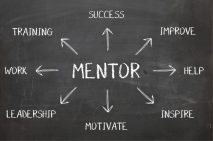
Do you mentor?
Do you mentor?

Few of us are born with an inaccurately low self-esteem, but the potential is there for disordered self-image. I may have inherited my mother’s negative opinion of personal abilities (hers and mine), but the passing of the flaw was socio-cultural, not biological. How I got that way is unimportant. What is important is that while humility may be a good thing, too often people miss much in life because they found their way to the “I’m not good enough, I can’t, I am too scared, or nobody loves me” quagmire.

Jack was my teenage friend, and the first to motivate my turnaround from I cannot, to I can. I’ve met others who helped me see my greater potential to achieve. They always came into my life at the right time. My post on synchronicity tackled the phenomenon. Some are still involved in my life, and some inspirational souls have recently landed in my patch of life.

When I first met Hilton M. Kennedy he was a Master Sergeant in the US Air Force, and he would soon be my boss and direct supervisor. The man I eventually called Ken, but many called Mac, had olive colored skin, lots of jet black hair, was several inches shorter than I, and smoked too many Salem cigarettes. I don’t know if Ken was a hyper-active child, but he was one for the most effervescent men I had met. Ten years my senior, Ken reeked enthusiasm. Other than being married, where we worked, and the Air Force, we had little in common, at first.

Ken’s personality included talking fast, a trait one seldom finds in a Louisiana native. I enjoyed our many chats where he made me believe that he was interested in me, and that I would have a successful future. Many of those discussions were accompanied by measured amounts of fine liquor. Living in Ankara, Turkey, ensured financial advantages for Americans in the late sixties. Of course, fine liquor required equally fine cigars.

Do what?
Do what?

I began to see good changes in myself. I was becoming more confident. My self-opinion and hopes began to unfold from whatever dark recess of my mind they were held captive. I attribute any success and goodness in my life to many people, some from my past and some in my life today, some from almost 50 years ago. Hilton Kennedy was the right guru at the right time in my life.

We became personal friends and our families got close as he kept tabs on my career following the end of my enlistment and his eventual retirement. We went to visit him, and he and his wife visited our home. Eventually, our relationship was more friendship and less his being my mentor and advisor. One of the last times I saw him, my wife and I were guests of he and his wife in Rome, New York. He played the harmonica and I thought all was well. But it was not to be.

To remember a friend

In the late eighties, I learned that my friend and mentor had been diagnosed with Huntington’s Disease, a dreadful genetic illness with no cure. The mental  and physical degradation was disastrous for someone who was such a fast-paced, high-stepper in life.

It was horrible. I didn’t know what to do, what to think, or how to feel. While I felt bad for him and his family, I regretted the worlds loss of one of the good ones. Fortunately, the regressive disease was stopped when Ken died of a heart attack at the age of 55. I faced the loss feeling that any suffering by Ken and his family was aborted.

Ken has been gone for over 25 years. I remember, and I’m grateful for that man being in my life and the difference he made in me simply by believing in me, showing his faith in me, and his eventual friendship.

Look both ways every day.
You may be the long remembered difference is someone’s life.
But, mind the gaps.

It’s Hopeless – That’s Good

hopelessness2

One of my favorite movie lines is, “What if this is as good as it gets?” Watch the movie trailer here.

This scene takes place in a shrink’s office after Melvin Udall’s (Jack Nicholson) doctor tells him that he needs an appointment. The doctor is pleased that Udall maybe taking responsibility and he acknowledges Udall’s difficulty with that. Have you ever asked yourself, is this as good as it gets?

Let’s answer this empowering question with, “It is what it is.” But, it’s more than that, and it applies to life.

Sometimes, feelings of sadness or depression blow through me like gusts of wind through the branches of trees. These visiting emotions last just long enough, and are disturbing enough, to let me know they visited. Then, just as quickly, they’re gone. I feel normal again. I know the feelings aren’t far away and they will return. When they come back, I have no way to expel them. These feelings have their own will; one I don’t control. When they return, I hope they don’t stay long.

I fancy myself a happy person, although I find happiness in my own way. Life is about how we feel. I love life and living – being me. I accept reality, which gets a bad rap for being negative. Life is what it is, which is mostly good for me. I know it’s good from my experience with when it was bad. I don’t like feeling desperate, but I feel hopeless at times. It’s not the same as depressed.

I’m hopeful about many of the things over which I have no control. When I fly, I hope the airplane doesn’t crash. When I drive through the I-90 tunnels toward Seattle, I hope there’s not an earthquake. Fear could prevent me from doing either. Planes crash and earthquakes happen. In The Road Less Traveled, Scott Peck talks about denial keeping us from dying of freight. I’m not sure about that, but it might help me get to Austin. It’s not denial – shit happens.

hopelessness3However, I am willing to work with my feelings of hopelessness. I’m not referring to the charming but hopeless romantic, or being merely incompetent (Bill’s hopeless). And I’m not talking about sadness, fear, or denial. I’m talking about the feeling that can cause despair (being without hope). Back in the day, ‘twas that conclusion I expressed when I’d say OMGIF! (Oh my God, I’m fucked).

Some things are hopeless. While my online dictionary defines hopelessness as causing despair; being desperate, wretched, demoralized, or impossible; I prefer a simpler hopelessness: feeling the loss of hope. And hope is “a longing for a future condition over which you have no agency (control, influence, or power); it means you are essentially powerless.” (Derrick Jensen)

I recall an audio tape where the narrator asked, “What is the best hoped-for outcome of any relationship?” My answer is best expressed in the movie The Notebook. What I like most about that movie is Noah, who never gives up on his love for Allie despite their apparent hopeless situation. Spoiler alert: they don’t live happily ever after (which is my point). But they do have a great life.

Think of the Buddhist issue with desire as the cause of all of our problems. Is a desire not something hoped for? Two related Buddhist sayings are: “Hope and fear chase each other’s tails,” and “When you give up on hope, you turn away from fear.”

Time for some philosophical music….

Is it all dust in the wind? Are we? Metaphorically, perhaps so; in reality, we will be. The song talks about the impermanence of passing time, the endlessness of earth and water, and the certainty of death, whereby our only immortality is by returning to earth and water.

Embracing hopelessness is not the same as giving up. It’s a form of acceptance. It is time for us to do what we can. It is time for our action. It helps us to live more in the present moment. We rely less on tomorrow being a better day. I’ve been accused of being negative when I defended reality. Others may want to live in fantasy, to deny reality to the point of making things worse (i.e., not seeking medical assistance), but that feeds denial and makes things worse. Accepting things as they really are, even when hopeless, gives us a better life.

hopelessness1I read this good article about hopelessness in the Orion Magazine called “Beyond Hope,by Derrick Jensen. He talks about hopelessness as a general topic, but specifically applies environmentalism as an example. Hopelessness does not deprive us of that final act of defiance.

As we accept the reality of hopelessness,
we need to look both ways and mind the gaps.

Recovery from Middle Age

When It Happened

Middle age is in my past. My t-shirt says, “Beware, second childhood in progress.” When people ask, I tell them it’s an old shirt. I’m long past that.

At 27, I knew everything (we all do). I would live forever. By age 40, I thought I might not live that long. Around then, I was sure that other’s opinion of me was paramount. I included everyone, especially any man who could possibly effect my life personally or financially.

Unfortunately, I often said what I thought – more than I would now. Today, I’m unlikely to answer personal questions. I may. But usually I want time to be calm and ponder consequences.

Back in the day, if my boss told me to do something that I felt was against my personal opinion, I would say, “No, sir.” Often, this happened in front of people. I enjoyed two things about it: watching him try to hide his anger (if he did) and some other middle-managers joining my mini-revolt. I wasn’t intentionally a trouble-maker. It just turned out that way.
recovery from middle age3What It Was Like

Looking back to my forties and fifties, a lot happened – both good and bad. But, I recall the difficult times well. In the 90s, I lived away from my family as a weekend commuter for two years. I drank way too much and began to ponder things that I’d never thought about. I was confused about life. I was not happy, and may have been clinically depressed. I was surrounded by others in worse shape than I, thus my problems went unnoticed. I was fine with that. Men do not have such issues, right? No longer did I feel safe. I didn’t understand the rules or what to do. I had morphed into a people pleaser, but I wouldn’t have admitted it.

Add to this, my wife had gone to work and was living as a single parent on weekdays (and nights). She had her issues too. And we had teenagers who’d aged up to their early twenties. Life was not easy for us or them – certainly not emotionally. Denial was my strength and maybe hers. Our dysfunctional family was extended and there were problems in that area over the horizon.

Possible Consequences

recovery from middle age1I’ll spare you details. But during the 1990s all hell broke loose in my life and I thought it had gone into the proverbial toilet.

I recall giving consideration to suicide. I also seriously considered homicide. To be clear, while I never seriously intended either, I considered both as solutions as I never had. But then, I made an important decision. I decided that I would try everything possible to get over it. If my life was not working, it would not be my fault.

If you type middle age American male in Google, you’ll find articles relating to suicide, alcoholism and drug addiction, and the almost inevitable consequence of death. Middle age male suicide is a bigger problem today than 20 years ago. But I can relate to middle aged men today who secretly struggle with something they don’t understand. Looking back over the years, I think I figured out a few things.

What I Did

recovery from middle age2I like to joke that I’m recovering from middle age. But, I am simply living my life. My life is good now, but recovery is an ongoing process. While many of my decisions may have been random, they seemed logical at the time. I was desperate, but knowing that I was not alone mattered.

I read books on self-help, mental health, and recovery – all were about mental and physical well-being. I attended counseling sessions for family members. I became active in a 12-step program. I started to learn about eastern religious thought and philosophy. I took a deep and detailed (analytical) look at myself. I did that twice, six months apart. This was much less about who I am and more about me being me, or me not being me, but being what others thought I should be. This may seem minor; it wasn’t.

My discovery was two-fold: I didn’t know myself, and I wasn’t being true to myself. I couldn’t be. This was important for me to figure out because the solution that followed was not complicated.

My change was from the inside-out, and from the outside-in. I simply was myself. While I could continue to be a good employee, a good friend, a reasonably nice person, and a willing family member; I no longer identified myself by what others thought I should be – what I should think or what I should feel. I was not only ‘okay’ with this. I was delighted. It was not a new me, but just me being me. That is the way I saw it. My motivation was inside and based on how I felt. But as I changed my behavior, that effected more emotional adjustments, which led to being more able to do more with my behavior.
recovery from middle age4

A short while after all this my son told my wife that he didn’t recognize me because of the changes. That was 20 years ago. I’ve hung onto that way of thinking ever since. Being comfortable as me (‘in my own skin’ is the cliché) did not change my life so much as it revealed my life to myself. Now, as a senior American male, I am still as wrong and as programmed as anyone. But when I realize my error, I’ve learned to admit it quickly.

How It Turns Out

As much as I like the phrase, it is what it is; I have my own motto: It is all about how we feel.
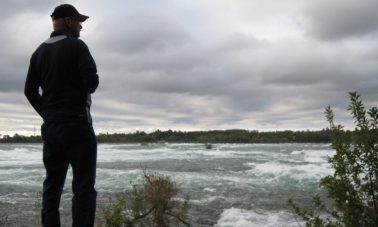
cropped-img_0551-e1469756636276.jpg

Probably my most positive boost has been retirement. No longer subject to the corporate nonsense and politics, I feel “free at last” to keep moving forward with my life on my terms. Virtually all that drama is in the past, and there it shall remain (at least for me).

May you find a path through life that is long and revealing. While giving up is an option, may you never choose it as long as you have any others yet to try. May your days of light be long and may your dark days pass quickly. May you be constantly aware; you are not alone. We are one.
 

Suffering, Love, and Creativity

suffering5

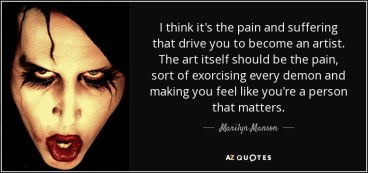
I don’t think I suffer more than average. When I find the enthusiasm to write about myself, I’ll include those painful and dark times from my past, along with the many good ones. I will be unable to link any of it to my creativity because I see no connection.

WebI do believe that to a degree, suffering is optional. I’ve seen people suffer unnecessarily, and I’ve seen those same people get over it.
In my blog tagline, I intend rain as a metaphor for my dark side, but it could also be for pain, suffering, or difficulty in life. The reaching for the sky is either embracing our human dark side or recovering from painful times. Such painful times often come with lessons making them valuable.

Until I read Big Magic, I gave little thought to suffering’s association with creativity, talent, and giftedness. I thought Elizabeth Gilbert’s treatment of the topic was a bit condescending (maybe it’s not). Perhaps it’s me, but telling alcoholics (or drug addicts) to get over it has limited success. On the other hand, many alcoholics told me that the painful consequences handed them by life at the bottom was motivation to recover.

suffering6I think that what Liz bemoans is using suffering as justification to be creative, talented, or gifted, thus making an excuse for hanging on to the bottom. We shouldn’t suffer just because we think it improves our work. I’m concerned because I know people die on the bottom. I’ve experienced great things from living artists, suffering or not – nothing from the dead ones.
I don’t take the relationship between our creativity and suffering too seriously, but I am less apt to dismiss it as some others may do. Conversely, I believe talented people do not need to suffer to be talented or creative. I am a happy guy who loves dark poetry, stories, and the dark side of human nature. Following my review of a memoir recently, I told the author “This is a sad story. Your job is to make me cry.” I’m advocating emotional writing, not suffering, hers or mine.

I avoid pain and consider that normal. Just ask my nurses when I’m having surgery — higher is better. And don’t even talk to me about my dental appointments.

suffering11

While researching this topic, I discovered that I’m not the only person who finds this subject interesting. The available resources on the topic are sufficient for a doctoral dissertation, followed by two books.

I found this link to a blog (here) and a video of a talk (here), both involving Sharon Salzberg. Both are pretty good and not too long (the video excerpt relates to happiness and creativity).

And who does not love this song by Don McLean? It certainly relates to suffering and art.


I also found a site (here) with a collection of information on this and associated topics. It links with other sites and pages for developing creativity and personal growth. Be sure to check it out if you’re interested in any challenges to a creative life.

“Creative artists are fifth in the top 10 professions with high rates of depressive illness. But does depression attract them to the job? Or does the job make them depressed?” “…the reality for the sufferer is that depression is so debilitating it’s impossible to create anything at all.” ~ Helienne Lindvall

suffer6To love what you do, and the love of doing it, even when it is gruelingly difficult (and maybe more so when it is) may be the answer. What I’ve read seems to recommend this. Love your art! Do it for the love of the work, the art, the creativity, the experience. As Stephen King says, do it for the “buzz.”

The concept of a reciprocal relationship with our art was also introduced to me in Big Magic. Doing the art because we love it and love the act of doing it, despite the challenges is one thing. The idea that our art can love us back took me some pondering. Liz Gilbert says “why not?” I’m on board with her. Why not? Maybe not always and forever (although our art will likely outlive us), but at least sometimes.

Gilbert balks at calling our work of art our ‘baby,’ but this seems totally normal to me and many others. We don’t equate art to human babies. But it does vocalize the love we may have for our hard work, often more than nine months worth.

From "Steal Like an Artist" by Austin Kleon
From “Steal Like an Artist” by Austin Kleon

In Steal Like an Artist, Austin Kleon provides two excellent graphic depictions. One describes the challenges and difficult process of creating from an idea. The other depicts that love relationship we have with our creations.

From "Steal Like an Artist" by Austin Kleon
From “Steal Like an Artist” by Austin Kleon

May you be lucky in your love with people and with your work. As Austin says, “Do good work and share it with people.”

Have a wonderful weekend and be happily creative to your heart’s content.

Whatever works for you

The Art of Aging

birthday 70 2

Forty years ago tomorrow, I was the father of two boys: one age five, the other was two (two years later we added a daughter to the pride). Tomorrow would be my 30th birthday.

I was the navigator on a B-52 bomber crew. I recall that as I was taking a shower about fifty yards (roughly 45 meters) from a nuclear armed airplane cocked and ready to go blow the crap of somebody, I was quietly lamenting my age.

B-52D Navigator's Position
B-52D Navigator’s Position

I would no longer be in my twenties. I thought that I was not young and never would be again. I was knocking on the door of middle age, or so I thought. I was feeling down because I was turning the dreaded big three-zero. “Don’t trust anyone over thirty” was the phrase. I still don’t really know what that means. I just knew it was bad.

A Young B-52 Crew Dog

Our society convinced me that I was getting old and that I should be sad about it. In four days, that five-year-old I mentioned turns 45. He and his 42-years young brother really are middle aged, and their baby sister is knocking on that door. I was not old, but I was depressed thinking that I was. Thanks to our shallow, f***ed-up, foolish American culture that values all the wrong stuff in people, my thinking was foolish (and not only about age).

birthday 70 1Is it all that important to be a thin, white, dark-haired, strong, male member of this country? We seem to think so. I hope that continues to change.

We have to pass laws to keep people from discriminating against older people, and the age in the law is 40. WTF? Forty is not old. Again, forty is not old! At most, it’s lower-middle aged.

And if you plan to call this foul-mouthed, hard-drinking, Fightin’ Texas Aggie, Irish-Welshman elderly; you best be certain that you can kick his ass. Because this one is standing straight-up and walking your way (in silence) to demonstrate that old is not elderly!

But, I will indeed become a septuagenarian at midnight tonight. In the game of life, I will be at ‘Level 8.’ I’ve literally been there, done that, and have the scars to prove it (which I wear proudly). I am on a first-name basis with my cardiologists, and if my peripheral vascular surgeon would do a better job, I would be running three miles a day, instead of walking. I ride a Honda Forza motor scooter because my 800-pound, 2007 Yamaha Royal Star Tour Deluxe touring motorcycle got too heavy to pick up (last year). But I still ride on two wheels. I’ve retired from the jobs that pay, but I work every day. I’m a writer and do volunteer work. My only boss is the one I’ve been married to for 50 years.

I like people and I want them to like me. But I also don’t give a flying f**k what anyone else thinks of me or my opinions, politics, religion (or lack thereof), foul language, or beer breath. I do not, and never will, wear socks with sandals. I remain a teenager of the 60s.

birthsday 70 6I am retired. All the shit/crap that I put up with for all those years of school (nuns-groan), yes, sir and no, sir; kissing up to very few idiot bosses (most were great), scrimping and saving and working – it was all worth it. As my wife would say, “Rave on, dog shit!” And so I do. Every day is a weekend and I can do what I want (with her permission—I’m old, not stupid) whenever.
I want to be happy and I am. My last meal will truly be a good pizza (my wife makes the best) and a fine stout brew. When the time comes, I want to walk into Dr. G’s office and say, “Time to shut it down, Doc. It’s been a great ride and I’ve loved it all. Let’s talk about the final git-er-done.” But that day is some ways off. Getting old is not dangerous, driving on our roads is.

Get ready big eight-zero ‘cuz here I come. ~ Me

birthday 70 3

I toast the good health of my birth year (1946) peers: Cher, Barry Gibb, George and Laura Bush, Bill Clinton, Donald Trump, Linda Ronstadt, Sally Field, Ed O’Neill, Reggie Jackson, Daryl Hall, Jimmy Buffett, Dolly Parton, Tommy Lee Jones, Al Green, Loni Anderson, Cheech Marin, and others. We’re still kickin’ the can down the road.

birthday 70 8

May you have love that never ends, much money, and many friends.

Health be yours, whatever you do and may the universe bless you and yours. Rock on, my friends.

I’ll publish my promised blog on creativity this next Friday. I am also tinkering with one on recovering from middle age (men only, I am unqualified for the experiences of the softer, better looking, and smarter sex) because I have been there and done that too.

Spiritual Poetry

I love the spiritual nature of this poem.

rainyday1

      The Rainy Day

The day is cold, and dark, and dreary;
It rains, and the wind is never weary;
The vine still clings to the mouldering wall,
But at every gust the dead leaves fall,
And the day is dark and dreary.

My life is cold, and dark, and dreary;
It rains, and the wind is never weary;
My thoughts still cling to the mouldering Past,
But the hopes of youth fall thick in the blast,
And the days are dark and dreary.

Be still, sad heart! and cease repining;
Behind the clouds is the sun still shining;
Thy fate is the common fate of all,
Into each life some rain must fall,
Some days must be dark and dreary.

       ——-By Henry Wadsworth Longfellow

rainyday3

Longfellow invokes the value of our dark days and the transient nature of life for each of us.

What does his poem say to you?

rainyday2

What do you want?

The first of three questions I think everyone should be able to answer quickly is ‘What do you want?’ I’ve always felt that few of us think about that. We may have short term goals or we may want some things to come our way. But the ultimate answer, while not illusive, is something we seldom ponder. I say this with the opinion that for virtually all of us, the answer is simple, easy, and nearly the same for everyone.

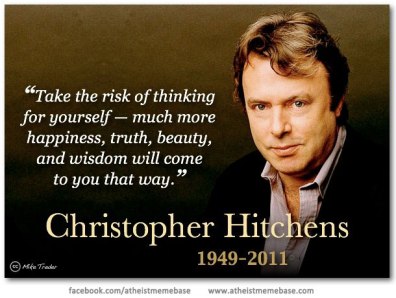
What Do You Want ?As I listened to an interview with Christopher Hitchens, I was surprised by something he said. I’ll get back to that in a minute. Frist, I want to talk about the genesis of the question and my answer.
Beginning about 25 years ago, my life began to take some very significant turns. Much significantly changed for me. My life was on track, then it was not. This life transformation continued for years. Much of it was unpleasant, disruptive, sad, and shocking. The unhappier and more miserable I became, the more I thought about what had happened and what all was going wrong. I’ll save the details for a memoir. Suffice to say, shit happened and stuff changed.

This led to a rather spiritually reflective time for me. I read a lot of spiritual books, studied religions (some more lightly than others), and pondered what I thought were important life questions.

I don’t recall when or how I came across the brochure. It was titled Oh Happy Fault! A Confession of Hidden Sin by Vinny Flynn. In the brochure, Flynn confesses that his sin was being unhappy. Silly as it seems, that resonated with me because I realized that I was unhappy, or depressed, or both. Either way, what had been going on inside me (where no one could see) was the same. This led directly to my reading three books and indirectly, discovering one other.

Fully Human, Fully Alive, by Fr. John Powell, SJ
Siddhartha, by Herman Hesse
Man’s Search for Meaning, by Victor Frankl

About the same time, I also read, The Seven Story Mountain, by Thomas Merton.

Question One7

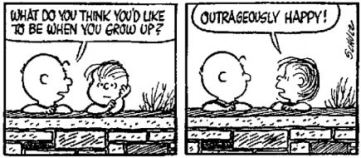
The result of all of this was that I made two decisions. Actually, I made many decisions and continue making them, but early-on I decided that I wanted, or perhaps needed, to be happy. I knew that I was unhappy. So I decided to be happy. More importantly, I decided that my happiness was up to me – that I could do something about it. It took a long time for my happiness to improve, but it did.

Jump ahead about six years. I found myself conducting classes for other very troubled people. They were not exactly unhappy (some were). They didn’t seem to have any focus about anything. In my opinion, they had no world view. One of the questions I would regularly as them was “What do you want?” Their answers sounded like a list of shallow, adolescent ideas about hot cars, money, and hot men or women. The blank stares and silence I got when I asked ‘why’ disguised their answers of ‘who the hell cares?’ With that experience, I have continued asking people the same question for years. “What do you want?”

Question One1

I’ve always thought everyone’s answer should be ‘happiness.’ During the Christopher Hitchens interview, he said that he did not think that he wanted ‘happiness,’ but wanted ‘satisfaction.’ I liked Hitch, but on this answer we would disagree. Maybe he felt that happiness was too much to ask for. Anyway, at least one dictionary indicates the words have synonymous meanings. There is a difference. Even though satisfaction implies having our needs met, happiness involves our state of mind regardless of needs.

Question One5

I’m skeptical of some folks wanting to be happy. Some people seem happy by not being happy, or not wanting anyone to know they’re happy. It’s like if anyone knows, they will set out to ruin my happiness; therefore, I mustn’t appear happy. Maybe they really are just waiting for something bad to happen, or maybe they seriously do not want to be happy. Maybe they think there is a happy tax.

Question One6A satisfaction tax would make a lot more sense. It seems like things may satisfy us, but we decide to be, or not to be happy. How would we measure and estimate a tax on feeling good?
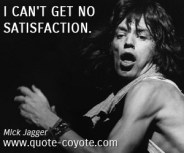
Anyway, I hope you are happy now. I also hope that Hitch is satisfied and Mick Jagger (after all these years) can get some damn satisfaction. I mean, how long does a guy have to wait for that?


Frat Friday (I felt that, Mr. Poe)

When our child was ill, my task was to directly address her illness with an emotionally written letter. I was to tell the illness how I felt, about or toward it, or how it made me feel.

passion15Three days of toil produced words born of emotion, but laying bare only thought and opinion. That challenge to produce expressive discourse full of feeling was riddled with notion and conviction of purpose, while lacking passion. Such analysis had merit and value, but I had so missed the deeper inside of myself that it might have been mere opinion drawn from a detached stranger. Those mindful barnacles of human grief remained anchored to my thoughts, thus hidden except from me.
Why, I wondered, could I not find letters for my aguish? My internal emotional awareness was no less keen than my intellectual understanding of the presence of the illness that was harming our family.

passion16Knowing my feelings was not enabling my telling about them. Had I created a self, unable or unwilling to express feeling? I wondered deeper if I had co-opted with a force to create an emotional Dorian Gray. Were my feelings doomed to be confined in the shadowy attic of my mind? Had I become so adept at emotional deception that I habitually prevented expression of feelings? Had I become factually superficial and emotionally shallow, thus apparently less than a human lacking outward feelings?

 

Consciously or not, my ability to express emotionally was crippled. Historically, I’d been an extremely emotional child, inside and out. Perhaps as an adult, I was the same, but kept my feelings hidden. I had emotional awareness and comfort. But learned how to mask emotion and display a filtered emotional public persona. I was willing to affectively express my feelings, but until attempting to express them in writing, I was unaware of my handicap.

passion7Twenty years hence, my awareness is of two worlds. An external world full of social interactions, judgements by and of others, and basic human needs. This is the world of people wearing masks, hiding feelings, and struggling silently with internal and external burdens. It is a world we need in order to sense the other world – a deep world that is hidden from others and often from our own self-awareness.
 

The other world is not physical. It has no physical activity. But, it has a silence that we hear, a darkness that we see, and a hearing to which we speak. The other world has no touch, but we feel it. It has no eye, but it sees all. It has no physical strength or power, but it controls our external world in every way. We each have this real world, and it is exclusively ours, separated from the independent and silent world of others.passion12

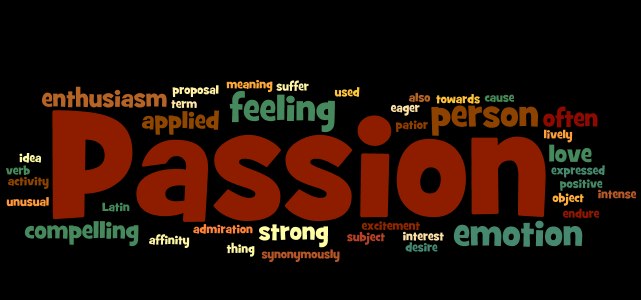
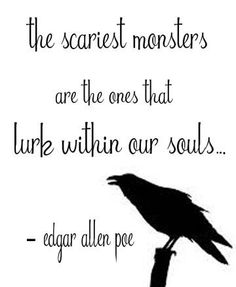
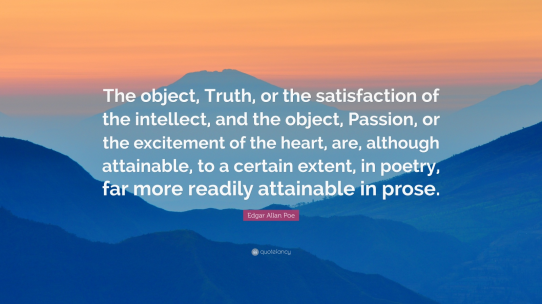
Real physical life is driven by emotion. While I know nothing of death other than its certainty exceeds all other events, if I must lament any loss – it is losing my emotions. Furthermore, the one I will regret most is same emotion that Edgar Allen Poe held so dear when he said…

“With me poetry has been not a purpose, but a passion; and the passions should be held in reverence: they must not – they can not at will be excited, with an eye to the paltry compensations, or the more paltry commendations, of man-kind.” (1845)


passion14


I want passion like that – uncontrolled by logic, analysis, profit, adulation, science, or ego. I want my reason for being and my reason for doing to leap from the shallows of purpose to the depths of passion. Whatever my passions, I want to keep them and to take them with me. I want to feel passionately happy, to be passionate about art and poetry. Maybe I will learn to write passionately about my feelings. Just for now I want to let the world know that I love my passions and lament their loss with life itself. And before I go, I want to write with emotion.