Poetry: Recovery (NaPoWriMo) Day One

The first prompt was to write a poem that provides the reader with instructions on how to do something. I am sick and recovering from a cold, so that’s my poem: how to recover from a cold.

Recovery

Illnesses, colds and flu and some others,
oddly part of a healthy life. It’s normal
for us to suffer. I never get sick.

Until I do, because some germ has taken
to my body as a nice B&B place for a week
or so, and my body begins evicting the visitors

causing displays and loss of sleep and feelings
for which miserable is the visible coughing,
sneezing, and blowing snot. Need more tissue.

Head and body aches and pains and all form
of physical and mental malady, but the torment
and discomforts are symptoms of recovery.

Wash hands often, save others from you, take
meds to dry, less coffee and no beer or wine,
this medication and that – take them all

as directed by a bottle or doctor, but mostly
drink water, juice, tea, and ask doctor Google,
the answer is always the same. Wait.

Like most problems in life, illness will pass,
but another will replace it someday, a cold
or allergy from pollen, or some flu. Make feelings less bad,

medicate and wait, be miserable for days or weeks,
but recover you will. And the tiny viruses in you
will leave you only to return one day to the B&B.

©Bill Reynolds 4/1/2019

Look both ways for avoiding sickness. But mind the gaps of the already ill.

Poetry: Searching for Nothing

wandering the halls, pacing, here,
then there, this way and that – in
corridors between over-decorated
rooms of the hopeless romantic lover
and the stark stripped-bare
reality of a stinking nihilist’s
hopeless shit-house of oblivion,
with its dullness and pointless obscurity

looking for answers in pain
where
too many unreal illusions
are at one end,
and silent nothingness
at the other,
just the bitter taste
of death
following me – chasing me

divining into these closets of insanity,
the brutality of life pounding
and raping each victim as one
reaches for love to taste
no eternal bliss or to miss –
eternal silence, quiet, peace.

©Bill Reynolds 3/28/2019

Look both ways. You need to know what’s coming and going.
Look again to mind the gap.

Essay: Rocks Can Speak

When I was a very young lad, one day as I was walking along a well-worn path, I noticed a stone of interesting size and shape. The stone briefly entered my short span of attention, as did many things lying about my undiscovered world at that age. I don’t recall many other details about my surroundings that day, but they no longer matter.

That was the first time a stone was not just another rock lying among other random bits of littered scree. Certainly, similar discoveries have occurred thousands of times throughout my life while walking, running, hiking, exploring, or just hanging out (thinking or not). This was a simple event that works as my metaphor for many other life events involving discovery, reason, and doing.

The rock was just lying there among others, perhaps for a thousand years or more. I wasn’t yet thinking in geological or historical terms. Stones have served many purposes after they were formed millions, perhaps billions, of years ago. There it was on the ground with others just where my eye located it. It had probably been moved around in one fashion or another over the centuries. I had no way of knowing, nor did I care. Even before approaching it, I was mentally making my I saw it first claim.

Living organic things come and go. Almost all life forms have appeared for a time and then were gone. Over 99 percent of life is extinct. Some rocks may contain fossilized records of past lives, but most are just inorganic minerals. I was not the only child who saw rocks, sticks, or other items as things naturally intended to be thrown about. Getting the right rock and throwing it brings a feeling of success. Skipping rocks on water is a universal rite of passage.

Looking around at the organic things today, I realize that most are less than 100 years old, and less than 50 in current forms. The complexities of the laws of thermodynamics (physics) change things, but we only see the now.

Neither I nor the stone said anything, Rocks don’t talk or hear in the animal sense. But nature can speak to us through both organic living things and through inanimate objects, such as rocks and fossils.

As I moved, the rock played its role as a lifeless stone like billions of similar objects covering the surface of the Earth. Rocks are infinitely expert at going with the flow. River rocks spend so much time tumbling in the roll of water they lose their edge and become rounded. The rock I saw did not sparkle, twinkle, or do anything spectacular. But I saw it. I squatted and half bent over so I could pick it up with my hand. That was many years ago.

More recently, I picked up another rock – my first in years. I carefully examined it, top, bottom, and all sides. One learns that by picking things up, especially rocks, one must carefully examine the item to ensure it is a lone stone, and not one littered with objectionable attachments. It must be just the boy, or now the man, an old man, and the rock with no another surprises.

While I didn’t bother to analyze it, the rock was local Austin limestone, or chalk rock, which is said to have formed in the window of 100 to 200-million years ago. It didn’t matter, and at the time, what I was looking at was just an old rock. Or was it?

Ideas are like stones. Once you pick one up, you must examine it, and only then decide what to do with it. As with stones, I have dropped ideas, put them in my pocket for later pondering, or threw them. When throwing ideas or stones, one must distinguish between discarding, sharing, or targeting. The first is simply throwing it away or back to where it came from. The second is communing by tossing it to someone else. But the third is capturing the idea or stone for our own creative purposes. Like rocks, ideas can speak to us. We just need to listen.

Look both ways for material and ideas. That’s what creativity is all about.
Toss some back to the gods, share some with others, or use them within your own art.
Mind the gaps. Look there for those hidden gems.

Like rocks, ideas may be too big.

Poetry: The Tractor

The tractor rests, over near the barn
she’s not minding the cold, snow, and ice of winters
nor the dry pounding heat of summers,
a little rust, peeling paint, heavy worn tires,
little more than time causes the hulk any harm.

Made to plough and cumber a heavy beam, this ox
of steel and rubber carried men to the work
of sowing seeds with a seeder and a drill,
for tilling of soil with tiller and rotary box.

This mammoth hand of farm and ranch alike
pushes and pulls all kind of cultivator and harrow,
she drags wagons full of fertilizer to make
bull and cow shit fly over ditch and burrow.

Pulling mowers and rakes for the gathering of hay,
with bailers in tow bringing seed in to feed,
with tires made heavy with water in and mud out,
that tough old tractor stands ready for more work.

The Case International, the Massy Ferg’ and the old Ford;
the John Deere and the New Holland or Caterpillar rig.
Germany’s Fendt and Japan’s Kubota.
Canada has a claim with Cockshutt tractors.

Maker of the world’s finest cars will not be omitted,
As Italians lay claim to the craft for the harvest
with a Lamborghini (seriously) trattori pulling that shit.

This old boy was just a wee lad
when he grabbed hold of the wheel
for learning to drive in the only front seat
of a farmer named Dixon and his old Massy Ferguson
we all had great fun in the summer’s hot sun
as the day’s work of the land got done,
for the wheat and the hay (and a little play).

©Bill Reynolds 3/11/2019

Poetry: Peace Be With You


Dark Night Warrior

I love the common, the warm blanket of peace,
the soft whispers of a perfect and quiet day,
the calm of nature, birds, and other people
smiling and loving and happy.

But the Dark Night of thunder and storm,
of lightning and wind and rain excites me.
I feel more alive in a storm than safe
in the banal aspects of a sheltered existence.

My every dream is a warlike challenge
of attacks and kills and fights to a death.
Even mine.
What warrior is content to watch the battle?
Half of me belongs to the night, the dark.

I believe in war, combat, risk, and battle.
Bore me not with stories of contentment.
Challenge me with fear and excitement
before I die from fucking fattened monotony.


Look both ways and ask what kind of existence you want.
The gaps?
Oh yes, there are always the gaps to mind.

Poetry: Unbelief

The greatest sin of unbelief

They tried my soul –
and found it guilty
of the greatest sin,
its unbelief.

There it is
for all to see, the bad is there
all about me, can’t you see?
not rape nor torture or the harm
of murder
none of that is my sin.

I killed no gods or goats
all souls still running free
to come and go,
but my only sin – no god
shall I ever know.

How do I dare
to declare
my mind be free,
and so bare. is it not right there?
show me any god,
then might shall I to care.

Condemn my soul,
if you must. but look at me
and you will I trust
see all I can be,
is humanly free.

The day I die and somewhere lie,
you’ll accuse me as others cry,
not of being bad nor good,
but unlike you,
I just did not believe to be true,
my unbelief in god now flows
through as all my being goes.

©Bill Reynolds   1/28/2019

Look both ways. Mind the gaps.

Song Lyric Sunday – Sadness

The Song Lyric Sunday theme for today is Sadness/Crying. That sounds like the blues to me. I selected B.B. King playing and singing The Thrill is Gone. It’s sad of course, but with double entendre. The song was written by Rick R. Darnell and Roy Hawkins.


The Thrill Is Gone

B.B. King (Manhattan Transfer F/ Ruth Brown, B. B. King)

The thrill is gone
The thrill is gone away
The thrill is gone (baby)
The thrill is gone away
You know you done me wrong baby
And you’ll be sorry some day

The thrill is gone
It’s gone away from me
The thrill is gone baby
The thrill is gone away from me
Although I’ll still live on
But so lonely I’ll be

The thrill is gone
It’s gone away for good
The thrill is gone
It’s gone away for good
Someday I’ll be over it all
Just like a good woman should

Y’know I’m free free now baby
I’m free from your spell
Y’know I’m free free now baby
I’m free from your spell
And now that it’s all over
All I can do is wish you well

Songwriters: Rick R. Darnell / Roy Hawkins
The Thrill Is Gone lyrics © Universal Music – Careers, Universal Music-careers

Look both ways. Mind the gaps.
They can be unbelievably wide.


Click graphic for link to SLS page.


Essay: Romantic or Realist?

Disclosure on me:

I’ve been told that I’m a sensitive man. Given the smiles and nods around the room, it was intended as a compliment. The unstated enigma was that men normally are not.

I was recently told that I am a romantic (noun) because I’ve written romantic (adjective) poetry. The person who said that was laughing at the time because in her view, that is ironic. She claimed the higher ground of a realist (noun) partly because she was on her third (two bad experiences) marriage. This time to a man who was quite ill, adding to the reality of life.

The poem was about the dreamy desire of a (real) woman who was not in a happy, romantic relationship. It was my interpretation of her romantic dream – how she wanted things to be.

I responded that I accept who and what I am, that one can be both romantic and realist (definitions-dependent), and that a romantic realist is a thing in art, if not in people. Realistic art does not necessarily point to a realist artist. A writer of romance literature or romantic poetry need not hold personal romantic views. But, she was partly correct about me (does not know me well).

Most of this is because people attach my writing to my persona (or vice versa), which is okay, but what I write is not always me and certainly not about me. Often, I write about the world and people or things I see. In this case, my poem was about someone I knew who is struggling with life and her circumstance – her dreams and desires, perhaps pushed beyond the limits of practical reality.

Once bitten, twice shy

I believe that we learn best from the most painful lessons of life. We recall shocking or painful times well, if not always accurately. For my age group, it might be when JFK, RFK, or MLK were shot, among others. I suspect that the lady judging me formed her view because of her personal life experiences. That’s fair enough. But given the number of times I have found myself speaking in defense of reality and things as they truly are, a true romantic I am not.

The paradox

I haven’t posted about the paradox of love in a long time. I’m uncertain and struggle with what to say and how to say it. What will people say or think? I worry less about my writing and more about the subject or content. I sometimes wonder if I wrote about crime (I haven’t) if the FBI would show up at my door with a search warrant. But let’s give this a go even if I admit to the romantic leanings of a realist with both feet planted in the real world.

How long is long enough to love someone? In both quantity and time, “I love you now and I will forever (time), to the moon and back (quantity).” Is one day or night all there is? Is 20, 30, or 50 years enough? My mother died about 30 years ago, but I still love her. I’ve been married over 50 years, and my wife and I love each other.

I write about the Paradox of Love, loosely basing some of what I say on a book of the same title by Pascal Bruckner. I add my observations and limited experiences (in the worldly sense mostly, but I love many people, most seem to love me back). There is no shortage of material on this topic, many experts, and hundreds of ways to look at it.

The paradox to me is when love is added to the learning mix of life, painful lessons do not seem to stick. For some, the devastation from damage where love is involved is virtually unrecoverable. Yet, I have seen many times when the paradox of love allows us to move on with life and with love. Once again, “I love you forever…we love each other….” For me, that is the paradox. The human relationship quandary. However, as with the lady who labelled me a romantic, we may move on with less romantic naivety.

The human condition

Yet, love is forever until one of us blinks, looks away, wants more, samples greener pastures, or simply decides it’s over. Then all bets are off. Forever isn’t quite so long as we thought, right? None of that for better or worse shit, it must always be better and continually improving. Bore me and you’re gone. Then there is the ubiquitous found someone else. I admit to being dramatic here, but I’ve seen ugly romantic breakups and divorces. I could add friendships, but I am focusing on romantic love. What makes it work so well for many, yet repeatedly fails for others? Why?

I get it. The human condition is imperfect, and these things happen. People in love can, and do, fall in love with others. How many times do we love before we spend a lifetime with someone? Some people are polyamorous (one is not enough – a blog for next time).

Rarely is it okay with the other person to act on this. And if we do act on it, often all the shit in hell piles into the manure spreader and is sent flying (shit storm). On the bright side, without all the misery involved with love, over half of country music’s best crying in yer beer tunes would have never been sung. That’s also true for much R&R, R&B, and opera. I enjoy romantic comedy, but there’s room for tragedy in my mind. And is pain not the best teacher?

Free love – by the book

In his book, Bruckner describes the 1960s liberation movement (mostly civil rights, anti-war, and feminism) as a time of “free love” (especially within hippy groups but certainly not for all). No commitments, openness and a willingness to share even the most intimate and sexual experiences with others. That still goes on, I suppose, but without all the publicity of post-1950s drama.

Many good things came from the movements of the 60s: improved equality (woman, people of color, others), better human rights, music, long hair, care for the environment, and others. But the oxymoron idea of free love was not one of them – fortunately, according to Bruckner and me.

Free and open sex is just that. And love is also just that, meaning it is neither open nor free (e.g., she/he is mine). While I can’t speak for anyone else, and certain groups (religious, LGBTQ, cultural) may see or experience this differently, the romantic love two people may share could be about the most powerful emotional human force we possess. But, (and my idea of the paradox is) it is also among the most destructive.

All my exes live in Texas

A friend of mine who had been married several times, looked at me one day and informed me that her latest husband told her that he no longer wished to be married. Obviously shaken, she further confided that she had never loved him. I didn’t ask her (or him) if he felt the same way.

After the divorce ball was rolling along, he asked to reconcile (meaning he’d been dumped). She declined, which pissed him off, and it was not a nice, amicable divorce after that. The third thing she told me was that she was sure that she was not good at marriage. A difficult time followed for her, but that was mostly recovering from financial and ego damage. In time, she survived both and eventually remarried a guy after a long partnership (News update. I recently learned they divorced, and she is engaged to a new man).

Which are you?

To love and to be loved are wonderful things. Romantic me. To love often may also be wonderful. To be the couple in my poem is indeed romantic, but is also realistically feasible. Yet, to love comes with great risk and personal vulnerability. Remember, even the realist was on her third marriage. What is this human condition I call the paradox of love?

My original post on the paradox of love was over a year ago. It is more about the book than my thoughts. Read it by clicking here. You can read the poem that started this by clicking here.

Look both ways in romance and reality.
Be especially mindful of gaps in romance and real world relationships.
Live and learn, love and learn. Risk love, always.
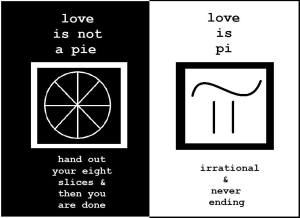
 

Note: paradox synonyms; contradiction, contradiction in terms, self-contradiction, inconsistency, incongruity; oxymoron; conflict, anomaly; enigma, puzzle, mystery, conundrum, dichotomy, and incongruity.

Song Lyric Sunday – Laughing


Jim selected the Song Lyric Sunday theme of laugh.

I almost took a pass today because it’s that kind of day for me. But, I browsed my iPhone playlist and selected Losing My Religion by R.E.M. Fucking perfect!

This is a song about a pissy (as in arrogantly argumentative) mood, which is where I am this Sunday morning. The mood will pass, but this song is a classic rock-whiner. I love it! I might not normally pick alternative rock, but this tune means a lot to me.

I prefer the official (old MTV) video best. Since it has no lyrics displayed, I’ve pasted them below. The hook is in the refrain lyrics:

“I thought that I heard you laughing//I thought that I heard you sing//I think I thought I saw you try”

Losing My Religion
R.E.M.

Oh, life is bigger
It’s bigger
Than you and you are not me
The lengths that I will go to
The distance in your eyes
Oh no, I’ve said too much
I set it up

That’s me in the corner
That’s me in the spotlight
Losing my religion
Trying to keep up with you
And I don’t know if I can do it
Oh no, I’ve said too much
I haven’t said enough

I thought that I heard you laughing
I thought that I heard you sing
I think I thought I saw you try

Every whisper
Of every waking hour
I’m choosing my confessions
Trying to keep an eye on you
Like a hurt lost and blinded fool, fool
Oh no, I’ve said too much
I set it up

Consider this
Consider this
The hint of the century
Consider this
The slip that brought me
To my knees failed
What if all these fantasies
Come flailing around
Now I’ve said too much

I thought that I heard you laughing
I thought that I heard you sing
I think I thought I saw you try

But that was just a dream
That was just a dream

That’s me in the corner
That’s me in the spotlight
Losing my religion
Trying to keep up with you
And I don’t know if I can do it
Oh no, I’ve said too much
I haven’t said enough

I thought that I heard you laughing
I thought that I heard you sing
I think I thought I saw you try

But that was just a dream
Try, cry
Why try?
That was just a dream, just a dream, just a dream
Dream

Songwriters: Bill Berry / Michael Stipe / Mike Mills / Peter Buck
Losing My Religion lyrics © Warner/Chappell Music, Inc, Universal Music Publishing Group

Look both ways and be still my heart at the sound of mandolin and flute.
Mind the gaps, or ‘but that was just a dream, try, cry, why try?
That was just a dream, just a dream’ or maybe
a dream within a dream.

Note: I get it, but it would be cool if there was a flute.

Essay: Shit Happens

  1. My mother said, “What did I ever do to deserve this?”
  2. My wife looked at my adult son and said, “Everything happens for a reason.”
  3. The minister looked into the eyes of the congregation and said, “There is no such thing as a coincidence.”

I forget the exact contexts and situations.

To my mom I would say, “You did nothing to deserve cancer; no one does.” While there may be reasons someone gets cancer, it is not punishment for being not good enough or for being bad. However, it is no joke that a lot of people think like this because of religion.

To my wife I say that most things have a cause and effect. Many things happen due to natural causes, environments, and special situations. Some things are random and have disastrous outcomes. Shit happens.

When someone is fired from (or not selected for) a job, and they later get a much better job, that is good fortune probably assisted by the fact that the person is well qualified for both jobs and it is fortunate that they snagged the better one. The opposite also happens. While such a comforting phrase may bring minor, temporary solace; it is not true that everything happens for a (supernatural) reason. A spiritual being causing a temporary problem to bring about a happier or sadder outcome fails any common-sense test.

To the minister I say that coincidence may not mean exactly what you think it means. According to one (MW) dictionary it relates to coinciding of events that happen at the same time by accident but seem to have a connection. Better words might be random, arbitrary, pointless, haphazard, or desultory.

Whether one believes in a god or not, and regardless of the influence of any god, those words exist because things and happenings can be random, pointless, and desultory.

I recall reading a poem in Stumbling Blocks or Stepping Stones: Spiritual Answers to Psychological Questions by the late Father Benedict Groeschel. The poem of unknown authorship is titled “The Weaving.” The last of three, eight-line stanzas goes,

At last, when life is ended,
With Him I shall abide,
Then I may view the pattern
Upon the upper side;
Then I shall know the reason
Why pain with joy entwined,
Was woven in the fabric
Of life that God designed.

While the poem is beautiful and weaving as a metaphor for a life designed by a god is useful, it also points to the unknown reason for the suffering in life. It implies that we will find no reason until after death, and then only if we are in heaven with the deity who will, presumably, make it all clear. In other words, it makes no sense.

I prefer this outlook from the song “The Sad Café” by the Eagles.

***
Now I look at the years gone by,
And wonder at the powers that be.
I don’t know why fortune smiles on some
And lets the rest go free
***

Shit happens. It’s not our fault. Blame it on whatever imaginary entity you choose. That may be the only reason you ever find.

© Bill Reynolds 1/10/2019

Look both ways for the reasons in life, but don’t accept not knowing—wonder.
Mind the gaps, they are real, but may be overcome with knowledge.