NaPoWriMo: 30 poems in 30 days (day 17)

Day 17 prompt: write a poem that features forgotten technology.


It’s For You

Privacy was not an issue, there simply was none.
I vaguely recall the telephone first being installed,
owned and operated by the telephone company (till the break up),
on a party line shared with neighbors about four houses over.

It sat on a round table in a short hallway near the unlocked front door,
next to our living room, from where all could listen to every word I said.
I could listen back. Wires were straight or twisted, and got in the way,
or we fumbled with them. You only had to spin-dial three or four numbers.

Learning how to dial was like tying your shoes or walking. You just learnt.
Our number was Valley – forty – eight-hundred, and I’ve known that
for as long as I could say my name, maybe longer, like our address.
The farthest room from the phone was my parent’s upstairs front bedroom.

First my friends would call, mostly Jimmy or Jack. Then later, my girlfriends.
Only one at a time so no one had to ask her who was calling. But they did.
We had to turn down the TV so Dad could hear, but that was because
he couldn’t hear. The sound was always too loud. Dad did not like phones.

As I recall, no one called Dad until my half-brother went into the Maine Corps.
Danny called Dad. And when Danny was in a car wreck, Dad was called.
Few call my smart phone. I, too, have trouble hearing. I’m like my Mom.
Socially, I am like Dad, too. When the phone rang, someone answered it.

I remember when the scams and telemarketing started. If you wanted to text,
you needed to put a stamp on it, but it was only a few pennies for a post card.
Mom called family on weekends, and when I moved out, so did I. Sundays.
Long distance cost extra and over three minutes even more. No more.


Look both ways for someone to answer the phone.
Mind the gaps on a party line.

NaPoWriMo: 30 poems in 30 days (day 14)


Day 14 prompt: write a poem that deals with the poems, poets, and other people who inspired me to write poems.


Dad never encouraged me to anything but obedience,
yet he knew funny limericks that made me blush
and he sang like George Burns, not quite as well.

O, the battles he lost.

Sister Mary Something Awful believed in god
and memorizing to exercise my brain like a muscle.
Walt Whitman’s O Captain! My Captain!

O, the battles she lost.

We committed it to memory, like a prayer,
in some later years of elementary school,
something I shall never forget.

O, the battles I lost.

Robin Williams’ emotionally charged role
in Dead Poets Society, the movie and final scene
woke sleeping poets buried deep inside me.

O, the battles we fought.

To my insistent denial, Sue said yes you can
while others saw poetics hidden within my prose,
as I read the confessions of closet poets.

O, the battles turned, still hidden.

When muse passed me a parachute, I jumped
and discovered endless fields of sounds,
words, and beats to claim as my own.

O, joy, the battle done,
when I stopped fighting,
the prize I sought was won.


To look both ways I must turn my head and see.
Mind the gaps for their good intentions.

Sammi’s weekender #152


We wandered aimlessly.

As we toured all the South Pacific islands we could reach,
burning off fuel to be light enough to land.

Some piloted the two-hundred-ton B-52. Like cold war nomads,
we wove through the sky from place to place.

In the air we carved circles around the clouds, talked, ate boxed lunches,
and wondered which of us would write the story and a poem about it.


Look both ways,
unless you’ve been cleared to wander aimlessly.
Mind the gaps,
aviation is inherently dangerous.

NaPoWriMo: 30 poems in 30 days (day 11)

Day 11 prompt: write a poem in which one or more flowers take on specific meanings. I wrote three poems, but only posting two.


That Special Flower

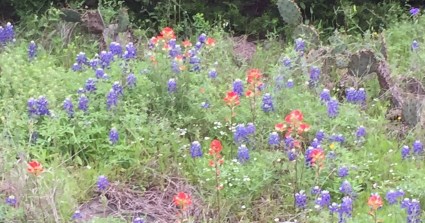
Bluebonnets taking over the crushed granite trail.

March is an alarm clock
if you’re a Texas Bluebonnet,
the official flower of that State
everybody knows.
We have pride of place artfully
set in many homes but few yards
of natives and transplants, alike.

By legislative decree, all species
are official, and abundant,
thanks to Lady Bird who said
plant a tree, a bush, or a shrub.
Our blue pedals and white top
mark spring weather as we make
bisexual moves for next year.

We marvel at our neighbor,
Indian Paintbrushes or Blankets
complimentary red and yellow
color of 200 species or more,
as we compete for turf in arid, sandy,
dry soil. It’s Texas, after all.

Crowding where others fear to grow
we push our blue until we turn purple,
near the end of our time, then struggle
and exit the stage for later bloomers.

True Texans must be pictured with
children and pets and flowers all around.
They hunt bluebonnets with cameras,
and drive miles to wait in line,
to see and capture scenes
in the perfect photo or painting,

and they name everything after us.
What’s not the lone star is called
the bluebonnet whatever it is.
It’s nice to be so loved, but our
magical time is brief, yet meaningful.
Here comes the sun of the Texas
Summer following Spring.


Married to Bluebonnets

Texas Bluebonnets mean Yolonda,
and art on our walls, and spares in boxes,
they mean Lady Bird behind so many
wildflowers, like Indian Paintbrush,
or Blankets, they are what early spring is for.
They tell us it’s that time of change.

Close up of Indian Paintbrush seen on my walk.

In Texas, it’s Spring baseball (but not this year)
and bluebonnets and with their blue and white
caps that turn purple (purple bonnets?);
and the red, orange, yellow tease of
200 varieties of Indian whatever wildflowers
that are the first up, pushing their
primary colors quickly into the world,
making seeds to make more flowers for next year.

They mean the toughness of my adopted State,
the arid sandiness and limestonish mix
to be followed in the last few weeks
of spring with more crazy beautiful
flowering weeds, and the colorful,
awesomeness of prickly pear cactus
flowers that remind me of Silvia Plath,
and her poem about Red Poppies, yet to come.

I smile at the flowers, partly because of beauty,
and partly because of what they mean to me;
another season with a new reason, but mostly
because of who they remind me of.


Look both ways but keep your eyes on the road.
Mind the gaps, each one is there for a seed to make a plant.

The mix of early Spring wildflowers.

NaPoWriMo: 30 poems in 30 days (day 9)

Day 9 prompt: write a concrete poem wherein the lines and words are organized into a shape that reflects the theme of the poem. Old, beat up baseballs, covered in electrical tape, were not always spherical either. This must be viewed on the site. Email will not provide the shape.


***

Sandlot baseball,
stickball, wiffleball, were all
for me, when I was a cantankerous lad
of some age without a uniform or cap, and maybe
a black taped ball in hand, air, or a grounder to bounce
just right to smack my face, but no such fear did I ever show,
even though I had bouncing grounders or fliers catch me taking
a peek to home or second, at the runner, and not a catch would I
make, or when batting rocket arm riley wound up to heave a bean
ball shot at me wearing no sissy hard hat or gloves or pads, just me
in the sun on a warm summer day doing things with balls or games,
like burn-out, whatever cleat-less shoes we had worked and we had
no managers, couches, parents, or girlfriends to bother with us. An
old dog chased our ball, swiping it, tearing the tape, and left us to
scavenge for a new old beat-up ball. The dog would not give
ours back. We could not catch one old dog. I recall many
memories of taped balls and bats and days when we
would just play the day away with whatever we
had. That left us with only memories of balls,
old dogs, and names of many games
we played in those dirty
old sandlots.

***


Look both ways, but do not take your eye off the ball.
Mind the gaps but take the longest lead you can safely manage.

Sammi’s Weekender #151: Keepsake


It says,
“Sambo.Richards, Duck Pond, PA”
(northeast of Scranton)
on a keepsake;
a dog tag probably,
all the d’s are backwards.
It was my mother’s,
and I have others. Some
were my grandfather’s
who was quite the handyman.
I never knew Sambo,
nor my grandfather.
But I knew Mom.


Looking both ways,
keepsakes are memories,
sometimes not our own.
Mind the gaps. History is there.

NaPoWriMo: 30 poems in 30 days (day 2)

Day 2 prompt: Write a poem about a place (i.e., a house, store, school, or office). How ‘bout a bar?


Packy’s

Sorry to say it’s gone now,
Packy Lenahan’s bar.
Packy too. Kids may age,
Patty and Maureen Keating,
lived in the same attached building.
I forget the people’s names
in the apartment above Packy’s.

It was on the corner of Madison street,
where friends Jimmy, June, and nine more lived,
and my grandpop had lived before I was born,
and Butler street where we lived.

Packy’s, some thirty yards west of
my bedroom window,
was where they drank and smoked,
and where they played games and ate food
until well past my bed time.

Inside to the right a huge mahogany bar
had big high mirrors, stacked whisky bottles, and beer taps.
I learned shuffleboard to the left,
and my first dart board was on the back wall,
left of some stairs up to the dining room
with tables and chairs, a kitchen and
toilets were to the right.

Few stools were at the bar, but it had real,
often used, brass spittoons on the dirty,
cigarette-burn stained, wood floor where beer
was often spilled and seldom mopped
under high ceilings with fans on long poles.

The back door was mostly for exiting,
or entering when closed (but not really),
on Sundays after church or after last call,
always unlocked after knocking.

There was a piano,
and a smell of stale beer
and staler smoke, and a juke box
back in the dining room
where I sometimes played,
but bar spittoons always intrigued me,
men spat, often missing, one of the things
they only did at Packy’s.

Many nights I laid in bed and listened to them
talking or singing and being loud, having fun
at Packy’s. Sometimes fighting
after Packy threw them out and I wanted
to go see who got clobbered
with a brass spittoon off the floor.


You can see Packy’s door and window over my Dad’s right shoulder (circa 1948)

Look both ways cuz it’s not always what you think.
Mind the gaps and don’t trip over spittoon.

Click for link to web page


Sammi’s Weekender #144: sculpture


Cowboys look like Cooper, Wayne,
Marvin; or tall, thin Stewart. I seen
movies in the 50’s,
High Noon or Liberty Valance with
great songs.

Not s’posed to look like the sculpture.
The horse is right,
but the cowboy rock sittin’ is short,
round-faced with a big ‘stash and
no gun, holdin’ reins
lest Ol’ Buck runs off spooked.

The wrangler wears chaps and a jacket.
Reality ain’t movies, both’s art though.


Drop your blinders and look both ways.
Mind the gaps for, “The history of mankind is carried on the back of a horse.”


Essay: I Wear Lorry’s Ring

I think my aunt Lorry loved me a lot more than I realized. I remember how each week she’d cut the latest Dennis the Menace gag comic, single-panel cartoon from her newspaper along with a word of the day snippet, and she would mail them to me accompanied by a little note. My behavior reminded her of the cartoon protagonist, or vice versa. While I never saw the connection (the cartoon being more innocently contrived), it was the only mail I recall getting from anyone, particularly from an adult when it was not my birthday or Christmas. Lorry and what she did for me are among many things I failed to adequately appreciate in my childhood. But I do now.

When I graduated from Texas A&M, my mother’s older sister also paid for my class ring. Aggie class rings are a big deal to alumni (aka former students), as they are for grads of many other schools. I still wear the ring today, almost 50 years later.

Her real name was Dolores. My sister and I, along with our cousin, called her Lorry, but I never asked why. For most of my life, Lorry lived and worked in Washington, D.C., about a four-hour drive from Wilks-Barre today with light traffic, but almost twice that by bus in the 1950s. So, I didn’t see her often. She also never married and was considered old fashioned and a very traditional, staunch Catholic, even back in the day. She was not difficult, but would criticize wrongdoing when she saw it, explaining her labored relationship with my father.

I suspect Lorry was quite bright. Had it not been for the negative antifeminist influences of her early 20th Century culture and her family, she would have achieved more, not that she did poorly for one who entered the female workforce early in the Great Depression. But then, I’d not have a famous cartoon character as a childhood alter ego, my vocabulary might be less sufficient, and my word-love less geeky had she been different.

Unlike me and little Jackie Paper, Dennis (the menace) Mitchell is still five-and-a-half years old. The cartoon dates to 1951, and it is still in world-wide syndication. Can you imagine Dennis in his late 60s? (I smiled when I wrote that question.) I can. I imagine him in his early 70s, still with the persona of a five-year-old troublemaker.

For the record, Puff the Magic Dragon and Jackie Paper are in their late fifties. I try not to mentally associate them with AC-47 Spooky gunships through that song, but that’s part of me too. There is a certain sadness to all that 1960s and ‘70s stuff that my Irish nature seems to nostalgically understand, but few others get.

But I wonder. What would the Lorry I knew think of me today? As always, there are some aspects of me with which she would undoubtedly find fault. I’m sure she would explain where I could improve. Fair enough. But would she get my ironic sense of humor? What about my vocabulary? I’d probably get a dictionary or world atlas for my birthday (again). And what of her opinion of my writing? My poems (the clean ones)?

Do you have a troublesome young family member? Do you think he or she will remember you and write about you 40 years after you die? Lorry would not have thought so either. But she’d a been wrong. And she might have corrected my spelling and grammar. And I would change it – for her.

What we see as we look both ways changes with life and times,
but not really who we are.
Mind the gaps, but cherish the memories.

Sammi’s Weekender #142: Looking-glass


i know. you know this privilege
denied many, this gift of age,
being long of life. pleasures
charging dues paid
with guilt, pain, and sorrow.

now i see that it’s
no longer me; old bones
with thin skin,
lost hair
or worthless white wisps.

does this looking-glass lie?
let me be what i was—

young. look, old man. look at me.
i’m your truth.


See truth and reality in the looking glass. Mind the gaps and ignore the bald spots.