Our Struggle with Love

valentine-2

Mom frequently told me that she loved me. I don’t recall Dad saying it. If he told me, it was seldom. They both loved me; and while I loved them back, the feeling that I had was not the same for each. What was that? One word with so many meanings.

We even manage to say love to express approval of inanimate objects, “Oh, I love that pizza.” Or, as my young grandchild copied from his mother, disapproval: “I’m not lovin’ it!” He was too young for such a trendy (now trite) phrase, but he understood it.

If we considered all the meanings we have for the word and lined them up on our continuum of human emotions, the variety would defy any logic we use to keep saying it. Fortunately, context helps us out and we socially understand each other’s intent. We would need to invent too many new words to replace love. Someone once told me, “I love you, but I’m not in-love with you, if you know what I mean.” I understood and welcomed the explanation since the first three words could be concerning, but still not necessarily unwelcome.

valentine-1Regarding romantic love, it is one of the most fantastic feelings we can experience. We can even see that love feeling in friends who have fallen into love, head over heels. More evidence for the wonderfulness of amour is that the love and lust emotions get us in so much hot water, but we seem to dive right in anyway. It’s such a good thing. Would we be human without it? Barring some interfering DSM IV, mental problem diagnosis, we all love someone, and usually many people. And each feeling of love will be different from person to person, but it’s still love.

All love makes this world a better place. We’ll never have too much love in the world, but we seem to have too little of it. We have faced that since the beginning of time – too little caring about each other.

Enjoy The Youngbloods as they sing one of my best-liked, hippy love songs from the 1960s: Get Together. I’ve provided the lyrics below, as well as links to two other love-tunes.

The Youngbloods – Get Together lyrics

Love is but a song to sing//Fear’s the way we die//You can make the mountains ring//Or make the angels cry//Though the bird is on the wing//And you may not know why.

Come on people now//Smile on your brother//Everybody get together//Try to love one another//Right now.

Some may come and some may go//We shall surely pass//When the one that left us here//Returns for us at last//We are but a moment’s sunlight//Fading in the grass.

Refrain//refrain//refrain

If you hear the song I sing//You will understand (listen!)//You hold the key to love and fear//All in your trembling hand//Just one key unlocks them both//It’s there at your command.

Refrain//refrain//refrain

Right now…

Right now….

Also, Haddaway’s is a more erotic and fun video of What is Love (click here); and Dionne Warwick finishes up with What the World Needs Now is Love (click here). None of these songs have many lyrics, but I love them anyway.

valentine-3

Happy Valentine’s Day.
Remember, love is a two-way street.
So, mind the gaps and be sure to look both ways.

Morality, Sin, and I over E (I/E)

Disclosure: I’m of the there are no gods variety of atheist. Consequently, there’s no sin. Since we can’t have one without the other, sin is a word I use only because the majority use the word, even if they’re agnostic. But, there is some general agreement about what is or isn’t moral behavior.


morality-1

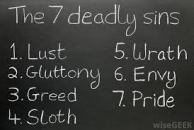
The past few weeks, I’ve posted about the seven deadly, and predominantly Christian, sins of greed, pride, lust, anger, gluttony, envy, and sloth. I also provided a brief contrast with an opposite word. My approach was based on the source of our behavior, our human mind and emotions. Each of the seven begins with an emotion that may later be manifest in behavior – we act based on how we feel.

Writers have a phrase: show me, don’t tell me. In movies, the words and actions of the actors are used to portray thoughts and feelings. In my opinion, we cannot choose each emotion. Happiness is a little different. We can be happy people and still experience dark-side emotions. Furthermore, we can usually choose our behavior. Some comments have implied that we’re in total control over emotions, and then control our actions, as well. While I don’t share that opinion, my behavior is based upon my emotional state has led to more apologies from me than I care to admit – slow learner.

As a society, a nation, or arguably, within a religion, we subjectively decide what’s moral. It changes over time, and we routinely disagree about what’s unacceptable (political-type disagreements). While we don’t always agree, often we do.

In the title equation, I = intellect, and E = emotion. When we experience emotions, we follow that feeling with behavior. To the degree that we can, ideally, we choose the behavior we morally and intellectually we want to display. For example, if someone elicits our anger, jealousy, or some other feeling from our complex emotional spectrum, we then pick our next move. I over E implies that we select our words or actions based on our intellect (good judgment, wisdom), rather than the emotion we feel. It’s not easy to behave contrary to how we feel. Nor is it always necessary. Going with our emotions (following our heart) is very often our best and most sincere option. We love with not only our personal emotions, but often those of others. How others tug at our emotions makes life magical. Life is wondrous, but not simple.

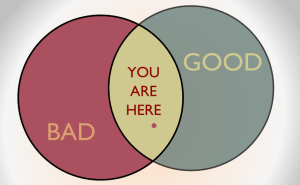
The common thread that I’ve stitched through each of the seven is that emotions are not sins. Feelings are legitimate. Be they good or bad feelings, it’s our behavior that determines anything about moral standards. And it doesn’t make a tinker’s-dam if one believes in a god, gods, or none. Each of the seven have opposite virtues. Every good person has a dark side. Every saint has a past; every sinner a future.

Humans are very much part of nature. We are where we belong. Our greatest need is for each other. Our greatest challenge is in dealing with each other.

Our lives are full of stepping stones to make life better and with stumbling blocks that bring us incredible amounts of pain and suffering – and valuable lessons.

morality-2

Let’s be accepting and understanding of ourselves and others to the degree that we’re able. We are not static beings. We’re who and what we are, but we have opportunities and futures. We come into this world as we are – a combination of physical and mental paradoxes and mysteries. A lot happens between the average birth and death. This includes running the bases of virtuous and bad behavior, and the personal experience of staring into the abyss that is us.

Look both ways, and mind the gap.

Morality Series: Wrath (Anger)

wrath-1

This one’s mine. Other than talking about the illogical wrath of a deity, or when humorously speaking of enduring the anger of someone else, we don’t use this word. We prefer rage, resentment, fierce anger, vengeance, or a few other synonym-like words (pissed off). I will use the word anger because wrath is archaic. We get angry, not wrathful. I also dislike typing the silent “w,” and a rath is something else.

I could easily write a book about my own anger. If I included the whole enchilada of human nature, it would probably expand to three fat volumes, and be boring. Anger is an emotion. One foolishly considered bad or sinful. While it’s neither, it is dangerous. Anger is a legitimate and real emotion that we may each experience differently. Some people seem to be incredibly patient and tolerant, seemingly never experiencing anger. Others seem explosive, and are sent to (drum roll) Anger Management classes to learn how to behave. I like to call it Charm School.

art-memoir-analogy2An old friend of mine had to do that with his work later in life. We grew up together, and as I recall, my friend was exceptionally demonstrative when angry. It didn’t take much before he felt slighted, irritated, or offended. When we were teenagers, I either ignored him or put distance between us until he calmed down. Even later in life, I was still surprised that he could come unglued about things that I considered little more than a trivial nuisance. However, I also had my share of temper tantrums throughout life.
For most of my life, I had a sexist view of anger. I thought men experienced anger more frequently than women, and that acting out our anger was not only what men did, but it was semi-acceptable. I’ve since learned that my view was wrong (read this).

The point of view I had learned was that all other male emotions were unacceptable, and any emotional display was a sign of weakness. What this wrong opinion did for me was to allow me to exhibit angry behaviors regardless of what emotion I may have been feeling. I later learned that I not only had to get in touch with my emotions, I had to start identifying them: fear, shame, sadness, disgust, anxiety, guilt, and many more. I don’t blame society or culture. I take responsibility for my behavior, as should we all.

Another problem with anger is the difficulty of properly identifying it in either ourselves or others. Depression, anxiety, fear, and other emotions may manifest themselves, both inside and out, through behavior that could be considered anger. It’s confusing and figuring this out may take the help of a friend or counselor.

People lash out for a variety of reasons, and it may have little or nothing to do with being angry. I’ll leave it to the experts to follow this rabbit trail, but I suggest we try to pick out the different emotions we feel and deal with them for what they are. I posted about jealousy on Tuesday. Certainly, we feel some anger when we’re jealous. We need to recognize when more than one emotional thing is happening to us at a time. When I was beginning to work on this for myself, I would try to reflect on my feeling and not be pinging off the walls so much.

wrath-3

Then, a close family member accused me of being an “emotionless automoton” who had no feelings and didn’t care about others. I love the memes of a light switch for turning emotions on and off. She was confusing my trying to remain calm with lack of emotion. No such luck.

Politics, religion, sports, and money are four topics that can lead to anger during many seemingly innocuous discussions. If we have not experienced the feelings ourselves, we have certainly seen them acted out by others.

wrath-4We are social (sociable or not) beings walking around in bodies transporting minds packed with emotional potential. We’re not Vulcans, like Mr. Spock (played by Leonard Nimoy) in the Star Trek series. Spock was of a mixed human-Vulcan heritage race that had mostly conquered his emotions and made them subject to his control. We are simply humans.

Ironically, the death of Spock occurs in the movie The Wrath of Khan, and some think that it’s the best scene in the movie. Forgive my digression; I’m a long time Star Trek, Spock, and Leonard Nimoy fan.

This concludes my series on The Seven Deadly Sins, or Morality. I plan a summation for next Tuesday’s post that may explain my take on this from a broader perspective.

Have a wonderful weekend.
Look both ways and mind the gaps – every day.

Morality Series: Envy

envy-3

“Do not overrate what you have received, nor envy others. He who envies others does not achieve peace.” ~ Buddha

Let’s say that you and your close friend try out or compete for the same thing. It could be making the team, getting either a promotion or an award, or winning the lottery. You learn that your friend makes the team, got the promotion, or won the prize. You did not. How do you feel?

First, if you are an adult, you’re happy for your friend. If you’re a teenager (or you need to read The Untethered Soul), you may get out the voodoo doll and some pins, or begin some plot against your former friend.

envy-4We may begin to feel something else. It’s an emotion that we don’t want to feel, but it’s there. It’s a twinge we feel on the inside that is directly related to our disappointment and that other person. We feel envy. We do! It’s normal, and it’s okay as long as we don’t act-out on that negative emotion. I’ve never received recognition or a promotion (that others also wanted) without someone letting me know of their displeasure.

One time, I asked this guy, “Did you want me to turn it down so you can have it? I know you think you deserved or wanted it more than I did. Don’t you feel just a little petty right now?” I have been on the losing end enough times to recognize his emotion. Myself and I have had talks about that. I don’t like feeling envious. It makes me feel worse. Envy is not unusual. I often admit to the feeling.

So, if this is normal, why is it considered another breach of all that is good and holy within us? The reason is simple: this is not a good thing about our human nature. We know that envy is normal, and that it will pass, but it’s also dangerous. Loving friendships have ended. Businesses have suffered. Shame and embarrassment have been coopted by envy because the accompanying behavior make us feel worse. Envy is part of us, a dark corner of who and what we are. We must acknowledge that part of our dark side.

There is a shallow envy that is part of daily life. When I see men of my age with huge locks of thick, beautiful hair (usually gray), I feel mild envy. I admit it. I want what they have. That guy did nothing to deserve to have more than his share of hair follicles so late in life. I did nothing to promote my loss of the same. I’m almost proud of my envy. It’s true. I own up to it. I get it: envy is the desire for others’ traits, status, abilities, or situation.

In Summa Theologiae, Thomas Aquinas said, “Envy, according to the aspect of its object is contrary to charity, whence the soul derives its spiritual life… Charity rejoices in our neighbor’s good, while envy grieves over it.” Why do we do this? Because other people are so much luckier, smarter, more attractive, and better than we are. Lucky bastards.

envy-2But there’s good news. If you go to Hell, your punishment awaits: you’ll be put in freezing water. I looked it up. Think about that. Hell, fire and all that; and you and I are hanging out at the ice bar. Now, it’s their turn to be envious, right?

I don’t know why, but envy is associated with the dog and the color green. Oh, right, the green-eyed monster. Not so fast. I use envy and jealousy as two different words that apply to different kinds of situations.

Envy and jealousy are not the same emotions. Envy, as unpleasant as it can be, usually doesn’t contain a sense of betrayal and outrage. Jealousy needn’t contain a sense of inferiority. The difference is in the numbers.

Envy is a two-person situation, jealousy is a three-person situation. Envy is a reaction to lacking something. Jealousy is a reaction to the threat of losing something or someone. Of course, when we feel jealous, we often feel envious as well.

envy-1

The opposite of envy is supposed to be charity. I think the more accurate word is love. Some experts say kindness. I say love, not because love will prevent envy, but because our love will help us overcome that part of our dark, selfish selves and we’ll find peace and happiness sooner. Love is the primary emotion. Envy and jealousy are both subordinate to fear, which is also primary. Both fall under the heading of wasted time and emotions since neither accomplish anything.

But, as long we are normal humans, we must deal with our feelings and emotions. It’s all about how we feel. The actions we choose to follow our emotions are up to us. Can we at least balance some light with our dark side?

Envy is real and normal. So is jealousy.
We generally see them as bad, weakness of the spirit, and damaging to life and our relationships. Consider both to be among life’s gaps.
Mind those gaps and look both ways. We need to see our own human darkness and weaknesses and deal with them.

Morality Series: Glutony

I seldom eat the whole pizza any more, at least not in the same evening. My wife may have one slice, but not always. Still, why do some religious folks insist that if, per chance, the wife wants none, I’ll go to Hell?

glutony-3

Am I gluttonous? I eat more than that guy, but less than that one, and maybe about the same as the other dude. When does eating and drinking become one of the deadly or capital offenses? Where do we cross the line that assures our trip to the inferno?

I’m not going to argue that overeating is good for us. We all know it’s not. But the reason is biological, not spiritual. Besides, I do it more than I care to admit. I don’t think I am alone in my gastronomic fault. In fact, for an American, I’m probably about average.

glutony-1In the Summa Theologiae, Thomas Aquinas said, “Gluttony denotes, not any desire of eating and drinking, but an inordinate desire… leaving the order of reason, wherein the good of moral virtue consists.” Inordinate? I only know this limit after I am well past it.

Devils, Demons, and Witchcraft says those who commit the sin of gluttony are punished in Hell by being forced to eat rats, toads, and snakes. Are they cooked or raw? Do we get hot sauce? Since these are eaten by people around the world every day, I feel so not threatened.

I posted about Epicurus back in the Spring, so I want to invoke him here. His name and philosophy has been incorrectly associated with glutinous behavior for centuries. I had it a bit wrong. Further, we’ve also bogarted his name to be associated with fine dining.

The word epicure is linked to indulging the appetite, but that is not the teaching of the man to whom we owe the word. That ancient Greek philosopher taught of simple pleasures, friendship, and a secluded life. He believed in the pursuit of pleasure (as do I), but pleasure for him equated with tranquility and freedom from pain (Dude! Try this plant.) – happiness.

Cannabis
Cannabis

Detractors of Epicurus misrepresented his notions of pleasure to material and sensual gratification. When epicure entered the lingo about 500 years ago, his philosophy had been trivialized. Epicure or epicurean became synonymous with “hedonist.” Way back, he showed a lot of wisdom.

“Let no one be slow to seek wisdom when he is young nor weary in the search of it when he has grown old. For no age is too early or too late for the health of the soul. And to say that the season for studying philosophy has not yet come, or that it is past and gone, is like saying that the season for happiness is not yet or that it is now no more. Therefore, both old and young alike ought to seek wisdom, the former in order that, as age comes over him, he may be young in good things because of the grace of what has been, and the latter in order that, while he is young, he may at the same time be old, because he has no fear of the things which are to come. So we must exercise ourselves in the things which bring happiness, since, if that be present, we have everything, and, if that be absent, all our actions are directed towards attaining it.” —Epicurus, Letter to Menoeceus

His philosophy combines a form of materialism with ethics that emphasizes moderation of desires and cultivation of friendships. His world view was optimistic, stressing a philosophy of not fearing death or the supernatural. It can teach us how to find happiness in almost any situation – without moaning after we’ve eaten the whole thing.

glutony-4The opposite of gluttony is abstinence. Once again, from one extreme to the other. Abstaining from food can be a diagnosable eating disorder. We know how much, and of what things we should eat and drink. We must eat, but not too much; we must sleep, but not too much; we must drink. But there’s no such thing as too much fun.

“Moderation in all things, especially moderation.” ~ Ralph Waldo Emerson

Eating is an essential part of life.
Eat well, be happy, and enjoy all that life offers.
If we mind the gaps and look both ways, we’ll be fine.

Morality Series: Pride

Who or what are you proud of? Do you feel proud of yourself? If so, do you consider it immoral or sin?

Lucifer to Satan
Lucifer to Satan

Pride is an insufficient word for the immoral feeling that is an exaggerated sense of self. Hubris works a little better. Pride is often normal and not bad. As with any of these so called sins, when taken to psychological extremes, pride can become a problem that others often are more aware of than we see in ourselves. Behaviors associated with pride can become annoying, but we expect a proud bow from anyone doing well.

So, here I go again; playing devil’s advocate in the defense of normal human feelings and behavior that many religious people accept as sinfulness of the highest order. What’s even harder to understand is that this one is considered the worst of the worst. This is Lucifer’s sin, if you believe that. This self-opinion allegedly paves the way for all badness (or sin, if you prefer) to follow. In the words of  C. S. Lewis and many other religious writers, its primacy is made clear.

pride-4

Are we to believe that humility, the alleged opposite, prevents us from immoral behavior? I can be most humble and immoral simultaneously. I can lust with humility oozing from my pores, or maybe it’s the other way around. Excuse me while I humbly eat the entire pizza and down a six-pack of beer.

Pride is mostly good, unless you’re Irish-Catholic, in which case you’ll hear, as I did in my youth, who the hell do you think you are? This put-down, shut-down, and buzz-kill phrase is more annoying than piles of pride.

Gay pride, black pride, being proud of self, kids and grands, other family and friends, school pride, pride in state or country, religious pride or pride in non-belief, the overcoming of adversity, pride in relationships, athletic team pride, corporate pride, and the list goes on. What’s wrong, bad, or sinful about any of this? Nothing!

pride-1

My entire life I’ve worked on my humility (minding that gap). One friend made a sarcastically funny plaque for me because I often discussed trying to be humbler. I thought that I’d be a better person if I was humble. Of course, I could be proud of my humility, right?


I like this
I like this

I think power often corrupts, and I’m sure that pride plays into that human fault. We should get this pride deal straightened out. Going overboard on my ego is indeed bad for me and for those around me. Fortunately, my family and friends have the chutzpa to point out my faults. I no longer have my dad to ask me, “Who the hell do you think you are?” I can still hear his voice when others remind me that I may be a bit full of myself. It happens, preferably seldom. Maybe pride is not exactly the correct word for me.

What about the other prideful words? Vanity? I pine for my hair and regret the loss of my locks. Conceit? Probably not me. I’ve known none who admit to this, but we easily see it others. Arrogance? I have the tee shirt for this one. I’m guilty. I can be arrogant as hell. Conversely, I admit when I’m wrong. I’ll apologize for any harm done. I don’t apologize for being wrong unless harm was done. I’ve been accused of arrogance for that. To me, I’m being sincere. Otherwise, I’d constantly be apologizing.

How about self-respect, self-esteem, or self-love? What of narcissism? I know that’s not pride, but we agree it’s an abnormal extreme, unless you’re a politician. Dictionary synonyms include pleasure, joy, delight, gratification, fulfillment, and satisfaction. I think I see a pattern here.

Is it possible that Christianity and some other religions are opposed to people finding pleasure in life?

Yours, mine, or theirs – what’s your take on the pride?

Hold your head up and walk tall. Be the person you are – true to yourself.
Be proud when you have reason.
Be happy in life, but look both ways and be mindful of any gaps.

Morality Series: LUST!

You’ve been waiting for this one, right?

lust-4As a noun or verb; it means a very strong sexual desire, or a passionate desire for something. The synonym list is downright erotic: sexual desire, sexual appetite, sexual longing, ardor, desire, passion, libido, sex drive, sexuality, biological urge, lechery, lasciviousness, concupiscence, horniness, the hots, randiness, greed, desire, craving, covetousness, eagerness, avidity, cupidity, longing, yearning, hunger, thirst, appetite, hankering desire, be consumed with desire for, find sexually attractive, crave, covet, ache for, burn for, have the hots for, fancy, have a thing about or for, and drool over. (Whew) The key word in all of that is desire. This is not an act, it is merely a basic human want, or as George Carlin put it, “You gotta wanna.”

lust-5“It’s what’s in your mind that counts. Your intentions. Wanna is a sin all by itself….it was a sin for you to wanna feel up Ellen, it was a sin for you to plan to feel up Ellen, it was a sin for you to figure out a place to feel up Ellen, it was a sin for you to take Ellen to the place for you to feel her up, it was a sin to try to feel her up, and it was a sin to feel her up. There was six sins in one!” George Carlin, Class Clown, 1972.

When I get to be Pope, this lust deal comes off the list. The desire we call lust may cause us innumerable problems, but by itself, it’s no sin. It is not even bad. Our behavior may be bad. The desire may burden us in some way. We may not even admit to its existence. We lust, and we do it well. Were it not for bit of lust taken to the physical level about nine months before our original birthday, none of us would be here.

lust-9I wanna. Before you tar and feather me for being a dirty old man (normal), know that I was raised Irish-Catholic, just like Carlin was. Human sexual desire for other humans is normal, good, healthy, and leads to some of the best moments in our lives, not to mention procreation of the species. A vigorous libido is a good thing to have. But, not everyone agrees with me. Most obviously, many Roman Catholics, and certainly not their leadership. I quote from a piece by Sam Guzman, republished in The Catholic Gentleman.
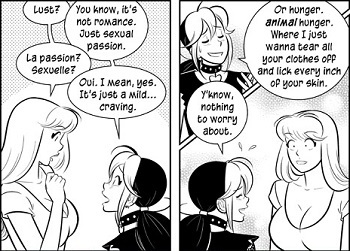
“In my own observation, lust seems the most obvious of the seven deadly sins, and also the one that can overcome the unwary Christian soul like a flash flood.”

I like the flash (flesh?) flood part. But lust isn’t bad – it’s not immoral. It’s normal. Sexual repression, on the other hand, is abnormal. Yet it is supposed be the hallmark of a good Christian life. Accepting the reality that lust is a feeling just like any other, and learning how to deal with it seems much healthier than trying to deny its existence, repressing it, and making millions of young people think they are going to burn for eternity because racing hormones are doing the talking. Think about it. We’ve all been there.

lust-2

One source I found said the opposite of lust is chastity. I disagree. You can do both: be chaste, but still lust. I looked up antonyms of lust, but the list is unsatisfactory. Only apathy (sloth?), and satisfaction (Rolling Stones song) got my attention. I don’t think there is a precise opposite for lust, unless it is not-lust, and that’s dumb. Maybe sloth is a good opposite, but how do we say having no desire, or not thinking? Dead? I wish not to be dead. Lust is a good sign that I’m not. Is un-wanna a real word?

lust-8

When I was challenged to do this series, the proposal was to juxtapose the sin with its opposite. In this case, I can’t point to anything, and it would be pointless anyway. Sorry, I just can’t get no satisfaction.

When we fight against nature, two outcomes are possible. Either nature wins, or our human nature becomes corrupt and disordered.

lust-1

Everything leads to something.
How we follow that path, and where it leads, is how we live.
Passion is good, desire is good, wanna is good! Lust to your heart’s content.
We get one life – live it well and enjoy the parts you can.
Mind any gaps and look both ways.

Series on Morality: Greed

Just another desire?

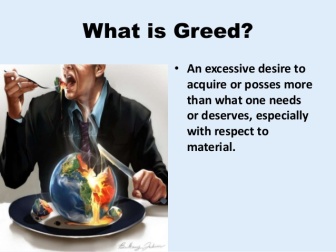
How much is enough? When do our simple desires or wants rise to the level of immoral greed?

Steal to feed your hungry family, and you may go to jail. An investment banker, who makes millions, steals from the public, nearly destroys the economy, and causes financial crises to millions of people; we talk about the banker’s greed and move on – no consequences.

So some of us firmly believe.

Here’s how I see my own greed: my wants become immoral greed when my having too much causes others to go without or suffer. That view is mostly due to culture and my beliefs about human nature. If I lived the aesthetic life of a Trappist, I’d restrict myself so there would be more for others. I want to have enough without taking away from anyone, especially those in need. But not everyone feels that way.

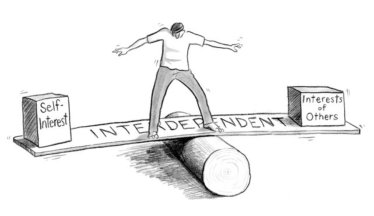
If there are 10 things we both want, and we each take five, that might seem fair. But what if we need only two each, and will never need more? Do we hoard the other six? Collectors spend fortunes adding items to their collections. Is that greed? If so, is it immoral? If they also donate fortunes to philanthropic causes, does that change anything? Am I discussing greed, or is this an issue of caring about others.

Is greediness a normal part of our nature? Is it instinctive to be greedy to survive, but also part of a darker human condition to be immorally greedy? If the answer to both questions is yes, why? From whence does our greedy nature come? Why are some of us incredibly selfish, while others are altruistic to the point of self-denial? If we feel greedy, but don’t act on that feeling, is it ok? If it’s normal, as I contend it is, then we should feel no guilt. If our actions cause unnecessary harm to others, that’s different.

One of life's balancing acts
One of life’s balancing acts

Why do some people think greed is immoral, yet they blindly practice it routinely? Is it really the opposite of liberality, which is defined as the behavior of someone who gives things or money in a generous way? I think these are both normal. We are greedy and generous.

Bill Gates is very wealthy and continues to make a lot of money. He lives a good life that doubtless has some excesses. But, Gates is also very generous and kind. He is both an American capitalist and a kind and generous person. Many wealthy people seem to be. Some are not.

Is greed a form of self-preservation that has gone too far? When humans find themselves in extremely stressful situations, they become not only selfish and greedy, but dangerously so. Starvation changes us. When basic needs are not met, we don’t consider it greed when people take extreme actions to meet those needs.

Behavior in WWII concentration camps and American prisoners in Bataan and other places provide ample evidence to support this. Oddly, there are remarkable altruistic exceptions. Victor Frankl, in his book Man’s Search for Meaning, discusses why one camp prisoner will give away his last morsel of food to another who is dying. Yet, another prisoner will harm others, steal from them, or commit murder or suicide. While this was an observational basis for Frankl’s therapies and personal outlook, these very real human experiences testify to major differences in people.

Can greed be satisfied?

If it has always been that way with people, will it continue? Is greed normal in other animals? Is survival of the fittest a basic instinct of our animal inheritance that now masquerades as greed?

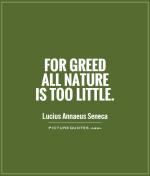
Greed, like quality, is difficult to precisely define. Yet, also like quality, most of us know it when we see it; particularly when we see it in other people. However, we must admit that greed is something we seem to share, want it or not. We need to feel safe and that may mean not trusting that we will manage with enough. More is safer and better.

Our human nature has many facets and sides. Our morality is a big part of our nature, good or bad.
Keep in mind that if we take only what we need, we care for more than ourselves.
May we live our lives in concert with humanity and all of nature.
Let us look both ways and mind the gaps.

Don't even think about it
Don’t even think about it

Series on Morality: Introduction

“…people have inside them something that could bring them to ruin…This basic truth of life has been denied by both believers and unbelievers in every age. Yet anyone who has tried to help others with their problems knows that we all share a common struggle against self-destructive tendencies. Hidden in the human heart are marvelous capacities for good and dreadful possibilities of evil.” ~ Stumbling Blocks or Stepping Stones, Benedict J. Groeschel

7-sins-intro-3Steven stirred the pot when he responded to my previous post on the basic nature of humans with, “One word: Greed.” Reader comments followed with discussions about greed in terms of human nature. Sue V. weighed-in by suggesting that I compose a series of posts on the seven deadly sins alongside their antitheses, the seven virtues. I like that idea. I plan to write a series within the human nature theme reflecting on the human condition, using Sue’s suggestion as a method to breakout specific topics into manageable sized chunks.

I want my posts to be thought-provoking (we think about it), simple (easy to read and understand), and brief (1,000 words or less). If we can read it in five-to-ten minutes, comprehend it, and have an opinion; I’ve achieved those goals. I’m pleased when readers enjoy my dribble. I’m not trying to persuade or educate anyone, but only to explain my take on the topics.

7-sins-intro-4After reading them, maybe you’ll ponder your opinion vis–à–vis either mine or someone’s comment, and share your views. I also want my posts to have a free-thinker flavor; secular, but with an inclusive bent, if that’s possible. I’m not opposed to religious comments. I think secular.

Morality (or immorality) is the series theme. It’s a better word than sin, vice, virtue, or others that I see as rooted in religious belief. Sin is a theist concept; morality seems more secular, at least to the degree that it’s subjective. I’ll borrow from the topics commonly known as sins. Words like vice and virtue are okay, but they add value judgment before discussion.

7-sins-introMoral and immoral may do the same thing, but I see them as opinions that are formed after discussion. Topics are natural, but often seen as immoral under certain conditions. For example, lust seems normal and humans could be extinct without it, but it’s on the list of sins. I’m not sure how or why chastity applies to anything other than medieval devices of questionable utility. How we see our basic nature and religion both affect how we’ll see the seven sins or vices.
I’ll follow Sue’s suggestion to include both sides of the moral coin. Like Pride and Humility (the yin and yang). I’ll begin with Greed on Friday. We can ride that pony until one of us falters. Then, I’ll choose another pair. I plan two posts per week.

I’m open to your suggestions for topics. After I get all boned up on each topic, I’ll post my remarks. Then, I’ll hang them out for your target practice.

The seven sins I found (with their opposites) are: pride (humility), greed (liberality), lust (chastity), envy (kindness), gluttony (abstinence), wrath (patience), and sloth (diligence). The Catholic Catechism lists virtues as prudence, justice, temperance, courage, faith, hope, and charity. The Bushido Code has seven or eight virtues of a Samurai warrior, four of which are generosity, forgiveness, compassion, and altruism.

7-sins-intro-2

While we’re not all the same, we each have our bright and dark sides.
They are difficult to explain in our personal nature,
but they’re there. Mind those gaps and look both ways.

It’s Hopeless – That’s Good

hopelessness2

One of my favorite movie lines is, “What if this is as good as it gets?” Watch the movie trailer here.

This scene takes place in a shrink’s office after Melvin Udall’s (Jack Nicholson) doctor tells him that he needs an appointment. The doctor is pleased that Udall maybe taking responsibility and he acknowledges Udall’s difficulty with that. Have you ever asked yourself, is this as good as it gets?

Let’s answer this empowering question with, “It is what it is.” But, it’s more than that, and it applies to life.

Sometimes, feelings of sadness or depression blow through me like gusts of wind through the branches of trees. These visiting emotions last just long enough, and are disturbing enough, to let me know they visited. Then, just as quickly, they’re gone. I feel normal again. I know the feelings aren’t far away and they will return. When they come back, I have no way to expel them. These feelings have their own will; one I don’t control. When they return, I hope they don’t stay long.

I fancy myself a happy person, although I find happiness in my own way. Life is about how we feel. I love life and living – being me. I accept reality, which gets a bad rap for being negative. Life is what it is, which is mostly good for me. I know it’s good from my experience with when it was bad. I don’t like feeling desperate, but I feel hopeless at times. It’s not the same as depressed.

I’m hopeful about many of the things over which I have no control. When I fly, I hope the airplane doesn’t crash. When I drive through the I-90 tunnels toward Seattle, I hope there’s not an earthquake. Fear could prevent me from doing either. Planes crash and earthquakes happen. In The Road Less Traveled, Scott Peck talks about denial keeping us from dying of freight. I’m not sure about that, but it might help me get to Austin. It’s not denial – shit happens.

hopelessness3However, I am willing to work with my feelings of hopelessness. I’m not referring to the charming but hopeless romantic, or being merely incompetent (Bill’s hopeless). And I’m not talking about sadness, fear, or denial. I’m talking about the feeling that can cause despair (being without hope). Back in the day, ‘twas that conclusion I expressed when I’d say OMGIF! (Oh my God, I’m fucked).

Some things are hopeless. While my online dictionary defines hopelessness as causing despair; being desperate, wretched, demoralized, or impossible; I prefer a simpler hopelessness: feeling the loss of hope. And hope is “a longing for a future condition over which you have no agency (control, influence, or power); it means you are essentially powerless.” (Derrick Jensen)

I recall an audio tape where the narrator asked, “What is the best hoped-for outcome of any relationship?” My answer is best expressed in the movie The Notebook. What I like most about that movie is Noah, who never gives up on his love for Allie despite their apparent hopeless situation. Spoiler alert: they don’t live happily ever after (which is my point). But they do have a great life.

Think of the Buddhist issue with desire as the cause of all of our problems. Is a desire not something hoped for? Two related Buddhist sayings are: “Hope and fear chase each other’s tails,” and “When you give up on hope, you turn away from fear.”

Time for some philosophical music….

Is it all dust in the wind? Are we? Metaphorically, perhaps so; in reality, we will be. The song talks about the impermanence of passing time, the endlessness of earth and water, and the certainty of death, whereby our only immortality is by returning to earth and water.

Embracing hopelessness is not the same as giving up. It’s a form of acceptance. It is time for us to do what we can. It is time for our action. It helps us to live more in the present moment. We rely less on tomorrow being a better day. I’ve been accused of being negative when I defended reality. Others may want to live in fantasy, to deny reality to the point of making things worse (i.e., not seeking medical assistance), but that feeds denial and makes things worse. Accepting things as they really are, even when hopeless, gives us a better life.

hopelessness1I read this good article about hopelessness in the Orion Magazine called “Beyond Hope,by Derrick Jensen. He talks about hopelessness as a general topic, but specifically applies environmentalism as an example. Hopelessness does not deprive us of that final act of defiance.

As we accept the reality of hopelessness,
we need to look both ways and mind the gaps.