This, my first sonnet, was difficult. It was also fun and I learned more about the challenges of writing poetic. I want to work more with meter and rhyme, but now’s not the time.
I attempted to write in the Shakespearean tradition of a sonnet, with 14 lines of 10 syllables each, with a rhyme scheme of abab, cdcd, efef, gg; and the iambic pentameter. Like we all know what that is, right? My humble apologies to the Bard for attempting such a sacred task.
***
Seeking the Truth by Bill Reynolds
In seeking the truth, I require some proof,
My goal to touch some real conclusion.
A quest to discover both reason and truth,
The turning of pages led to confusion.
Noble the search for answers not pallid,
From myth; if I am, then god must be too.
From science we ask, a source that is valid,
From faith of past, must it be now so true?
These are the chains of unfounded mystique.
None of this means any absence of love,
Admit to the truth, there’s no god to seek.
My freedom is not a power above.
I found this truth after seventy years,
Loving all others is more happy cheers.
***
Look both ways and you’ll see them coming.
Minding the gaps will keep your heart running.
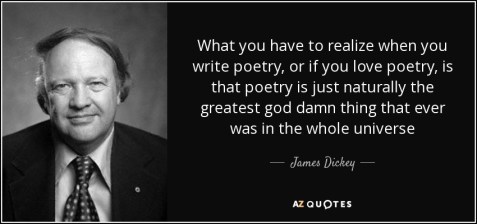
The title of this quatrain poem is taken from a New York Quarterly, ‘Craft Interview’ with James Dickey, as quoted in the Introduction to The Art of Poetry Writing by William Packard. I’m new to poetry writing, but I have always loved it. Thus, I concur with Mr. Dickey’s assessment.
***
The Greatest God Damn Thing by Bill Reynolds
Beating hearts bring words as rhythm flows,
the brick and mortar for posing forms.
They come to me in words of prose.
I wrangle with words to bring the storms.
I feel the beat as I tap my feet,
I catch the bop and I keep the time.
My world finds rhythm to keep the beat.
I seek my Po-voice and find the rhyme.
Mind and spirt bring forth my emotions.
Poetic verse grows as I now can hear it.
Out of me come plans and potions.
The poem I’ve written is part of my spirit.
The pleasure I found in hearing the sound.
My voice is here and my voice is there,
My emotions can show a feeling we share,
My poem’s my gift to everyone around.
**
Read, write, and love poetry silently and in several voices
as you look both ways on the highway of life.
See and hear all the rhythm and rhyme.
But, mind the silence of the gaps.
A limerick consists of five lines. Lines one, two, and five have 3 beats each and rhyme. Lines three and four have 2 beats and rhyme. Referred to as light verse (or vers de société) by Lewis Turco, limericks tend to be light, humorous, and often bawdy or dirty.
***
The first “poem” I recall hearing was a bawdy limerick my father told me. I don’t recall my age. I heard it once and never forgot. It was a shocker, although Dad often used such language around me.
There was a young lady from Freeling
Who had a funny feeling
She laid on her back
And tickled her crack
And pissed all over the ceiling
***
I wrote this one in class about a Creative Writing teacher.
There once was a lady from North Bend
In teaching us to write, she had no end
She had a great thought
We fit and we fought
Until our writing was well penned
Well, the class thought it was funny.
***
Some wee dribble of self-pique from the old flapdoodle.
There was an old-fart named Bill
Who was also a bit of a pill
Until he met her
The rest is a blur
And now he conforms to her will
It’s all about me, ya know.
***
Many of us follow this lass. So, a bit of a gentile and friendly jab. Click on her name to link to her blog.
There once was a blogger named joey
And she loved to tell us her story
She speaks of the mister
Like he is her sister
Instead of her very first quarry
Do ya think I’ll hear about that one?
***
I had to take shot at someone, or male pride, in general.
There once was a man from south Brooklyn
Who thought his self too good lookin’
It happened one day
His thing wouldn’t play
Now he’s no master Al Pushkin
Dirty is funny, right?
***
Mind the gaps on top of it all Look both ways: eye on the ball But watch for the fart That is really a shart And you’ll have no reason to bawl
(Sorry. I couldn’t help myself. I wrote them all, except the first one, and I assume full responsibility for the content of my limericks.)
Kismet (kiz-met) means destiny, or fate; or a power that is believed to control what happens in the future. The word kismet come to us from Turkish, originally from the Arabic word qisma (keese-mah), meaning portion or lot. There is so much poetry about, or related to, kismet that it seems to be its own type within a genre.
Specks: Coincidence meets Kismet By Bill Reynolds
Among the billions traveling through space…
Two specks of dust without direction or purpose,
None aware of another, simple lifeless vectors of eternity
on pointless, unrelated journeys to nowhere.
Each born of events eons past in both time and distance,
mindless entities uncaring, without purpose or reason.
Unguided, random, alone, on endless journeys to
nothingness, absent of all consciousness, awareness, or
desire in the vast universe of both
loving and frightening utter insignificance.
They do not know, do not feel, do not see, do not care.
Mindless and might be as well, not to exist at all.
Set apart in time and distance, spirits within–
Still unfulfilled, unknowing of self, unknowing of others.
Closer they loom but continue to wander,
thru time and thru space with nothing to ponder.
Then a fire starts to burn. There is something.
A light. A spark. A slowing from forever’s pointlessness.
Slowly, one at a time, a special day, each glides to a stop…
With spirit and magic, of others around they’re now more aware.
Spirit knows life and begins to evolve,
with wonders and mysteries yet to resolve.
They notice things now, a rhythm, a beat they can hear;
There’s movement within, fluid awareness begins.
There are noises and smells, they feel things
And notice more, it’s like nothing before.
Now being, now joining,
Each has become, part of life here on earth.
Each morphs into a part of the soul of a child.
Each has one life and each grows to a person…
with love and with needs, and all that should follow.
What was that fire? Where did it start?
Both still in the universe, but no longer apart.
Each gradually feels more awake, more abiding,
Each strives on and on, to be with one who is living.
People and places and sights and sounds.
Emotions and tastes and the hearing of life.
The specks found common goals, one mission in life,
to find something missing, the whole of it all.
Through the eyes of their hosts, each speck meets the other.
Instantly their kismet arrives, as love for all their lives.
Their kismet has sent them to be as they are,
from that moment on, they’re forever together.
Now fully aware of why they are here,
the hosts of the specks become a great couple.
In love and now bonded together as one,
they move through this life, both sharing a fate.
A journey of eons with circumstance shared…
the past has been long, their future’s eternity.
Has coincidence brought two lovers together?
Or was their kismet at work without a conclusion?
The humans may pass, but the specks live forever.
Their love will go on, into ever and ever.
What is our kismet?
Seek your destiny — but look both ways, and mind the gaps.
The universe is important. Click here to learn all you need to know,
in about four minutes. It’s well done and funny.
From the tiniest thing to the vast secrets of the universe, what will humans ever know? Will anyone ever correctly proclaim that all knowledge has been discovered and may be known or available to everyone? I doubt it.
Our galaxy – one of many
Science helps us understand our natural world better. But, science provides information only through descriptions from observations. With science, we may understand better what an earth quake is, or how to grow more soy beans, but ultimately the answers we receive from research are observations.
Microscopes, telescopes, laboratories, and other equipment for tests and measurements are among the tools used to make these observations. Yesterday’s scientific conclusions lead us to today’s information, and then to the changes we will read about tomorrow. It was scientific observation that convinced us the sun, stars, and planets revolved around the earth. It was also science that convinced us that was not the case.
The discoveries of science change. Does truth ever change? When I look around at our natural world, I see is what humans have done. Everything I see, while either part of nature or taken from it, was placed, caused, or permitted by humans—to a point. Other life forms may make their mark, but that will last only if humans permit it. When we don’t allow nature to progress or we interfere, it can be disastrous due to our limited knowledge. It may be science, but we don’t know everything and we can only explain so much.
Sensing and Nature
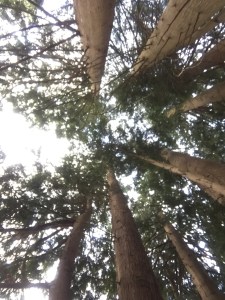
The spectacular trees
While nature is everywhere, my senses respond more strongly outdoors, in unfamiliar surroundings. I notice things less in my usual, everyday world. Change awakens my senses, whereas routine numbs them. Walking along a forest trail during a gentle, but persistent, rain provides stimulation that rejoins my surroundings with my own basic nature. It feels so right.
Seeing the trail, the roots of the magnificent trees, the green vegetation bouncing and dancing with falling raindrops, I feel aware and connected with the essence of life. It’s all here with me: sky, water, rich aromatic soil, and scree giving softness to my footsteps. Nature paints portraits of life and movement. I see how moisture mingles with the soil to send nutrients of life to plants and to quench thirsty animals, of which I am one.
Hearing the rain mesmerizes me as it falls where it will, on the leaves of trees and brush, onto the boulders and earth, and into the growing puddles and flowing streams. This is the sound of natural life – earth as it should be. The rustling sounds of birds and animals is alerting, as life deals in with nature’s wet gifts. And the rain. The glorious rain.
Feeling the soft, spongy earth beneath each step, I look down to see how the lovely wet soil now clings to my touch. I feel the rain pecking at me as it does upon the flowers. Animals respond to the natural bathing as a refreshing cleansing.
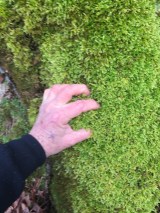
Touching the soft moss on a tree
My touch to the soft moss hugging tightly to the trees is a pleasant reminder of life on life, the natural interdependence within nature’s home. Against my face, and over my entire body, the rain penetrates cloths to caress my skin. I become one with the flora. I am refreshed, another being, pleased with our universe.
I can taste the freshness of the day. While rain on my head and face washes into my eyes, other drops find their way to my mouth, adding salt to the taste – the salt of the earth. I belong here.
A forest petrichor is the most pleasant of scents following rain. As the sounds and sights change with the gradually ceasing rain, and the forest begins to release the magical and glorious aroma of nature at work; life flourishes. If there is a heaven, it’s right here, right now, with me. I feel completely connected to nature. I yearn for this life, as it should be. I know this is life.
Awareness of Belonging
I become aware of the cosmic interconnectedness of everything. I know I have my place, fitting in with everything in the universe. The vastness of the cosmos finds the path and weaves its pattern through space, through time, and through me to the tiniest speck of galactic dust.
While science can provide words, descriptions, and explanations for everything that I sensed during my inspired walk in the forest rain, nothing can explain the deep, soulful feelings I experience when the vastness of nature communes with me. Conscious awareness.
Our senses perceive the environment as we discover nature and life. Our sixth sense is that of belonging to the Universe.
Look both ways, discover the gaps, feel where we fit in.
Reading or writing about events like Bataan, we often focus on man’s inhumanity to man – that dark side of our nature, which we often shun until memoir time. Throughout known history, our capacity for cruelty is well-documented. Genocide (killing to eliminate a group, race, ethnicity, religion, or language) is too common. While respecting victims of atrocities, I want to focus on survival, with one survivor in mind.
Ben enjoying it.
When survivors tell their story, they become windows to history, guiding and motivating our chant of never again. From their dark stories, we learn to prevent future atrocities. On the bright side, survival stories are inspirational. What others endure, survive, and subsequently achieve are symbolic of human resilience: that remarkable human physical and spiritual asset.
I discovered Benjamin Charles Steele long before I met him, as I was feeding my curiosity about Bataan by reading books. I only read five. “Only,” because so many books and articles have been written about the Death March, many by survivors or their families.
One of those books, Tears in the Darkness by Michael and Elizabeth Norman, focuses on Ben’s story. While the Normans included much more within the pages of their ten-year project, they trace Ben’s life experiences, particularly during the war years. I recommend it.
My signed copy
Born in 1917, Ben Steele grew up on his parent’s Montana ranch. The family lost the ranch during the Depression Years, when he was about 15. Ben continued to work as a ranch hand, which interrupted his education several times before he finally graduated from high school in 1939. The following year, Ben joined the Army Air Corps. Eighteen months later he was a prisoner of war (POW) in the Philippines.
Ben may have developed a passing interest in art when had delivered art supplies. But, he had little exposure, and no formal training. Ben received his formal art degrees after the war.
For much of his early POW time, Ben was ill (Beriberi, dysentery, pneumonia, blood poisoning, and malaria). He worried about adding mental illness to the list, as so many others had. So, he began to draw. Risking severe punishment or death to stay sane, Ben started a self-prescribed therapy to fight off life-threatening melancholy. He had seldom drawn anything during his life.
Feeling guilty about my unused art supplies.
Unknowingly, from his sick-bed in the wretched Bilibid Prison, he was launching a seventy-four-year, successful art and teaching career. This late high school graduate, Army enlistee, and future college professor, was barely hanging on to life. While starving and hardly existing in some of the bleakest living conditions imaginable, Ben used charcoal and sticks to do his first primitive drawings.
“I used to sit there day after day. I thought I’d lose my damn mind. I wanted something to do, so I started drawing with anything I could find to draw with. I’d draw on walls. People around me said, ‘Why don’t you draw the guys? You know, there are no photographs taken of this stuff.’ So, I started drawing stuff around the camp and sketches of people and portraits as close as I could. I wasn’t very skillful.” ~ Ben Steele
Eventually, Ben was moved to mainland Japan where he worked as slave labor in coal mines. The only two of his original drawings to survive the war were done there. The original drawings he did in the Philippines were in the possession of a fellow prisoner, catholic priest, and army chaplain, named Father Duffy. When the ship Duffy was on sank, the drawings ended up at the bottom of the Pacific Ocean. A few years later, as he recovered in a Spokane, Washington, hospital, Ben reproduced his lost drawings from memory (part of his therapy).
When the US dropped an atomic bomb on Hiroshima, Japan, Ben worked 75 miles south. He heard the blast. Soon the war ended. Ben and others were on the road home and toward recovery from the three-and-a-half-year ordeal. Ironically, some survivors eventually fell victim to mental and emotional problems resulting in suicide, death from substance abuse, or other such maladies. However, most survived, and I was fortunate enough to meet some of them.
Once a cowboy….always…
When Ben’s art was displayed in a building on White Sands Missile Range in 2011, I was there for my last Death March. By then I’d read Tears in the Darkness, and other books about Bataan. So, I knew Ben’s story.
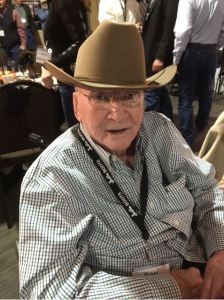
When I went to see the art the day before the March, Ben was there. His daughter was escorting him in his wheel chair – he was 93. We shook hands. He signed my book about his art and we talked, mostly about his life as an artist.
I immediately knew I was talking to a Montana cowboy, who happened to have been a POW, college professor, well known artist, an American hero, and a witness to much about life’s realities.
At his core, this happy man who was pleased with life and was the same cowboy who joined the Army Air Corps 71 years earlier.
“Little things that probably bother a lot of people don’t bother me. I figure I’m probably living on a little borrowed time, and I’d better enjoy it!” ~ Ben Steele
Another WWII veteran I knew, Joe P., said virtually the same thing to me last year. Both men died in 2016, in their late 90s after living full and happy lives. Perhaps their life choices were reflected in the last three words I quoted from Ben, “…better enjoy it!”
Life has its ups and downs; reality in art, literature, history, and personal stories enable us to look both ways, to the dark, or to the light. Enjoy life, but mind the gaps.
Mom frequently told me that she loved me. I don’t recall Dad saying it. If he told me, it was seldom. They both loved me; and while I loved them back, the feeling that I had was not the same for each. What was that? One word with so many meanings.
We even manage to say love to express approval of inanimate objects, “Oh, I love that pizza.” Or, as my young grandchild copied from his mother, disapproval: “I’m not lovin’ it!” He was too young for such a trendy (now trite) phrase, but he understood it.
If we considered all the meanings we have for the word and lined them up on our continuum of human emotions, the variety would defy any logic we use to keep saying it. Fortunately, context helps us out and we socially understand each other’s intent. We would need to invent too many new words to replace love. Someone once told me, “I love you, but I’m not in-love with you, if you know what I mean.” I understood and welcomed the explanation since the first three words could be concerning, but still not necessarily unwelcome.
Regarding romantic love, it is one of the most fantastic feelings we can experience. We can even see that love feeling in friends who have fallen into love, head over heels. More evidence for the wonderfulness of amour is that the love and lust emotions get us in so much hot water, but we seem to dive right in anyway. It’s such a good thing. Would we be human without it? Barring some interfering DSM IV, mental problem diagnosis, we all love someone, and usually many people. And each feeling of love will be different from person to person, but it’s still love.
All love makes this world a better place. We’ll never have too much love in the world, but we seem to have too little of it. We have faced that since the beginning of time – too little caring about each other.
Enjoy The Youngbloods as they sing one of my best-liked, hippy love songs from the 1960s: Get Together. I’ve provided the lyrics below, as well as links to two other love-tunes.
The Youngbloods – Get Together lyrics
Love is but a song to sing//Fear’s the way we die//You can make the mountains ring//Or make the angels cry//Though the bird is on the wing//And you may not know why.
Come on people now//Smile on your brother//Everybody get together//Try to love one another//Right now.
Some may come and some may go//We shall surely pass//When the one that left us here//Returns for us at last//We are but a moment’s sunlight//Fading in the grass.
Refrain//refrain//refrain
If you hear the song I sing//You will understand (listen!)//You hold the key to love and fear//All in your trembling hand//Just one key unlocks them both//It’s there at your command.
Refrain//refrain//refrain
Right now…
Right now….
Also, Haddaway’s is a more erotic and fun video of What is Love (click here); and Dionne Warwick finishes up with What the World Needs Now is Love (click here). None of these songs have many lyrics, but I love them anyway.
Happy Valentine’s Day.
Remember, love is a two-way street.
So, mind the gaps and be sure to look both ways.
Disclosure: I’m of the there are no gods variety of atheist. Consequently, there’s no sin. Since we can’t have one without the other, sin is a word I use only because the majority use the word, even if they’re agnostic. But, there is some general agreement about what is or isn’t moral behavior.
The past few weeks, I’ve posted about the seven deadly, and predominantly Christian, sins of greed, pride, lust, anger, gluttony, envy, and sloth. I also provided a brief contrast with an opposite word. My approach was based on the source of our behavior, our human mind and emotions. Each of the seven begins with an emotion that may later be manifest in behavior – we act based on how we feel.
Writers have a phrase: show me, don’t tell me. In movies, the words and actions of the actors are used to portray thoughts and feelings. In my opinion, we cannot choose each emotion. Happiness is a little different. We can be happy people and still experience dark-side emotions. Furthermore, we can usually choose our behavior. Some comments have implied that we’re in total control over emotions, and then control our actions, as well. While I don’t share that opinion, my behavior is based upon my emotional state has led to more apologies from me than I care to admit – slow learner.
As a society, a nation, or arguably, within a religion, we subjectively decide what’s moral. It changes over time, and we routinely disagree about what’s unacceptable (political-type disagreements). While we don’t always agree, often we do.
In the title equation, I = intellect, and E = emotion. When we experience emotions, we follow that feeling with behavior. To the degree that we can, ideally, we choose the behavior we morally and intellectually we want to display. For example, if someone elicits our anger, jealousy, or some other feeling from our complex emotional spectrum, we then pick our next move. I over E implies that we select our words or actions based on our intellect (good judgment, wisdom), rather than the emotion we feel. It’s not easy to behave contrary to how we feel. Nor is it always necessary. Going with our emotions (following our heart) is very often our best and most sincere option. We love with not only our personal emotions, but often those of others. How others tug at our emotions makes life magical. Life is wondrous, but not simple.
The common thread that I’ve stitched through each of the seven is that emotions are not sins. Feelings are legitimate. Be they good or bad feelings, it’s our behavior that determines anything about moral standards. And it doesn’t make a tinker’s-dam if one believes in a god, gods, or none. Each of the seven have opposite virtues. Every good person has a dark side. Every saint has a past; every sinner a future.
Humans are very much part of nature. We are where we belong. Our greatest need is for each other. Our greatest challenge is in dealing with each other.
Our lives are full of stepping stones to make life better and with stumbling blocks that bring us incredible amounts of pain and suffering – and valuable lessons.
Let’s be accepting and understanding of ourselves and others to the degree that we’re able. We are not static beings. We’re who and what we are, but we have opportunities and futures. We come into this world as we are – a combination of physical and mental paradoxes and mysteries. A lot happens between the average birth and death. This includes running the bases of virtuous and bad behavior, and the personal experience of staring into the abyss that is us.
This one’s mine. Other than talking about the illogical wrath of a deity, or when humorously speaking of enduring the anger of someone else, we don’t use this word. We prefer rage, resentment, fierce anger, vengeance, or a few other synonym-like words (pissed off). I will use the word anger because wrath is archaic. We get angry, not wrathful. I also dislike typing the silent “w,” and a rath is something else.
I could easily write a book about my own anger. If I included the whole enchilada of human nature, it would probably expand to three fat volumes, and be boring. Anger is an emotion. One foolishly considered bad or sinful. While it’s neither, it is dangerous. Anger is a legitimate and real emotion that we may each experience differently. Some people seem to be incredibly patient and tolerant, seemingly never experiencing anger. Others seem explosive, and are sent to (drum roll) Anger Management classes to learn how to behave. I like to call it Charm School.
An old friend of mine had to do that with his work later in life. We grew up together, and as I recall, my friend was exceptionally demonstrative when angry. It didn’t take much before he felt slighted, irritated, or offended. When we were teenagers, I either ignored him or put distance between us until he calmed down. Even later in life, I was still surprised that he could come unglued about things that I considered little more than a trivial nuisance. However, I also had my share of temper tantrums throughout life.
For most of my life, I had a sexist view of anger. I thought men experienced anger more frequently than women, and that acting out our anger was not only what men did, but it was semi-acceptable. I’ve since learned that my view was wrong (read this).
The point of view I had learned was that all other male emotions were unacceptable, and any emotional display was a sign of weakness. What this wrong opinion did for me was to allow me to exhibit angry behaviors regardless of what emotion I may have been feeling. I later learned that I not only had to get in touch with my emotions, I had to start identifying them: fear, shame, sadness, disgust, anxiety, guilt, and many more. I don’t blame society or culture. I take responsibility for my behavior, as should we all.
Another problem with anger is the difficulty of properly identifying it in either ourselves or others. Depression, anxiety, fear, and other emotions may manifest themselves, both inside and out, through behavior that could be considered anger. It’s confusing and figuring this out may take the help of a friend or counselor.
People lash out for a variety of reasons, and it may have little or nothing to do with being angry. I’ll leave it to the experts to follow this rabbit trail, but I suggest we try to pick out the different emotions we feel and deal with them for what they are. I posted about jealousy on Tuesday. Certainly, we feel some anger when we’re jealous. We need to recognize when more than one emotional thing is happening to us at a time. When I was beginning to work on this for myself, I would try to reflect on my feeling and not be pinging off the walls so much.
Then, a close family member accused me of being an “emotionless automoton” who had no feelings and didn’t care about others. I love the memes of a light switch for turning emotions on and off. She was confusing my trying to remain calm with lack of emotion. No such luck.
Politics, religion, sports, and money are four topics that can lead to anger during many seemingly innocuous discussions. If we have not experienced the feelings ourselves, we have certainly seen them acted out by others.
We are social (sociable or not) beings walking around in bodies transporting minds packed with emotional potential. We’re not Vulcans, like Mr. Spock (played by Leonard Nimoy) in the Star Trek series. Spock was of a mixed human-Vulcan heritage race that had mostly conquered his emotions and made them subject to his control. We are simply humans.
Ironically, the death of Spock occurs in the movie The Wrath of Khan, and some think that it’s the best scene in the movie. Forgive my digression; I’m a long time Star Trek, Spock, and Leonard Nimoy fan.
This concludes my series on The Seven Deadly Sins, or Morality. I plan a summation for next Tuesday’s post that may explain my take on this from a broader perspective.
Have a wonderful weekend.
Look both ways and mind the gaps – every day.
I seldom eat the whole pizza any more, at least not in the same evening. My wife may have one slice, but not always. Still, why do some religious folks insist that if, per chance, the wife wants none, I’ll go to Hell?
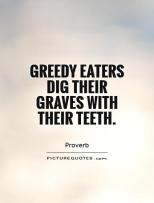
Am I gluttonous? I eat more than that guy, but less than that one, and maybe about the same as the other dude. When does eating and drinking become one of the deadly or capital offenses? Where do we cross the line that assures our trip to the inferno?
I’m not going to argue that overeating is good for us. We all know it’s not. But the reason is biological, not spiritual. Besides, I do it more than I care to admit. I don’t think I am alone in my gastronomic fault. In fact, for an American, I’m probably about average.
In the Summa Theologiae, Thomas Aquinas said, “Gluttony denotes, not any desire of eating and drinking, but an inordinate desire… leaving the order of reason, wherein the good of moral virtue consists.” Inordinate? I only know this limit after I am well past it.
Devils, Demons, and Witchcraft says those who commit the sin of gluttony are punished in Hell by being forced to eat rats, toads, and snakes. Are they cooked or raw? Do we get hot sauce? Since these are eaten by people around the world every day, I feel so not threatened.
I posted about Epicurus back in the Spring, so I want to invoke him here. His name and philosophy has been incorrectly associated with glutinous behavior for centuries. I had it a bit wrong. Further, we’ve also bogarted his name to be associated with fine dining.
The word epicure is linked to indulging the appetite, but that is not the teaching of the man to whom we owe the word. That ancient Greek philosopher taught of simple pleasures, friendship, and a secluded life. He believed in the pursuit of pleasure (as do I), but pleasure for him equated with tranquility and freedom from pain (Dude! Try this plant.) – happiness.
Cannabis
Detractors of Epicurus misrepresented his notions of pleasure to material and sensual gratification. When epicure entered the lingo about 500 years ago, his philosophy had been trivialized. Epicure or epicurean became synonymous with “hedonist.” Way back, he showed a lot of wisdom.
“Let no one be slow to seek wisdom when he is young nor weary in the search of it when he has grown old. For no age is too early or too late for the health of the soul. And to say that the season for studying philosophy has not yet come, or that it is past and gone, is like saying that the season for happiness is not yet or that it is now no more. Therefore, both old and young alike ought to seek wisdom, the former in order that, as age comes over him, he may be young in good things because of the grace of what has been, and the latter in order that, while he is young, he may at the same time be old, because he has no fear of the things which are to come. So we must exercise ourselves in the things which bring happiness, since, if that be present, we have everything, and, if that be absent, all our actions are directed towards attaining it.” —Epicurus, Letter to Menoeceus
His philosophy combines a form of materialism with ethics that emphasizes moderation of desires and cultivation of friendships. His world view was optimistic, stressing a philosophy of not fearing death or the supernatural. It can teach us how to find happiness in almost any situation – without moaning after we’ve eaten the whole thing.
The opposite of gluttony is abstinence. Once again, from one extreme to the other. Abstaining from food can be a diagnosable eating disorder. We know how much, and of what things we should eat and drink. We must eat, but not too much; we must sleep, but not too much; we must drink. But there’s no such thing as too much fun.
“Moderation in all things, especially moderation.” ~ Ralph Waldo Emerson
Eating is an essential part of life.
Eat well, be happy, and enjoy all that life offers.
If we mind the gaps and look both ways, we’ll be fine.

This, my first sonnet, was difficult. It was also fun and I learned more about the challenges of writing poetic. I want to work more with meter and rhyme, but now’s not the time.


 A limerick consists of five lines. Lines one, two, and five have 3 beats each and rhyme. Lines three and four have 2 beats and rhyme. Referred to as light verse (or

 I had to take shot at someone, or male pride, in general.
 A journey of eons with circumstance shared…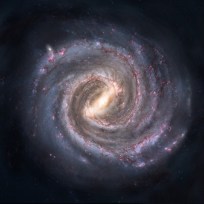




 Regarding romantic love, it is one of the most fantastic feelings we can experience. We can even see that love feeling in friends who have fallen into love, head over heels. More evidence for the wonderfulness of amour is that the love and lust emotions get us in so much hot water, but we seem to dive right in anyway. It’s such a good thing. Would we be human without it? Barring some interfering DSM IV, mental problem diagnosis, we all love someone, and usually many people. And each feeling of love will be different from person to person, but it’s still love.


 An old friend of mine had to do that with his work later in life. We grew up together, and as I recall, my friend was exceptionally demonstrative when angry. It didn’t take much before he felt slighted, irritated, or offended. When we were teenagers, I either ignored him or put distance between us until he calmed down. Even later in life, I was still surprised that he could come unglued about things that I considered little more than a trivial nuisance. However, I also had my share of temper tantrums throughout life.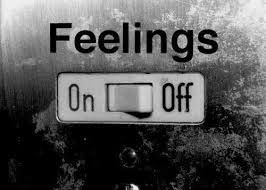
 We are social (sociable or not) beings walking around in bodies transporting minds packed with emotional potential. We’re not Vulcans, like Mr. Spock (
 In the Summa Theologiae, Thomas Aquinas said, “Gluttony denotes, not any desire of eating and drinking, but an inordinate desire… leaving the order of reason, wherein the good of moral virtue consists.” Inordinate? I only know this limit after I am well past it.
 The opposite of gluttony is abstinence. Once again, from one extreme to the other. Abstaining from food can be a diagnosable eating disorder. We know how much, and of what things we should eat and drink. We must eat, but not too much; we must sleep, but not too much; we must drink. But there’s no such thing as too much fun.
 Our Literary Journey