NaPoWriMo: 30 poems in 30 days (day 11)

Day 11 prompt: write a poem in which one or more flowers take on specific meanings. I wrote three poems, but only posting two.


That Special Flower

Bluebonnets taking over the crushed granite trail.

March is an alarm clock
if you’re a Texas Bluebonnet,
the official flower of that State
everybody knows.
We have pride of place artfully
set in many homes but few yards
of natives and transplants, alike.

By legislative decree, all species
are official, and abundant,
thanks to Lady Bird who said
plant a tree, a bush, or a shrub.
Our blue pedals and white top
mark spring weather as we make
bisexual moves for next year.

We marvel at our neighbor,
Indian Paintbrushes or Blankets
complimentary red and yellow
color of 200 species or more,
as we compete for turf in arid, sandy,
dry soil. It’s Texas, after all.

Crowding where others fear to grow
we push our blue until we turn purple,
near the end of our time, then struggle
and exit the stage for later bloomers.

True Texans must be pictured with
children and pets and flowers all around.
They hunt bluebonnets with cameras,
and drive miles to wait in line,
to see and capture scenes
in the perfect photo or painting,

and they name everything after us.
What’s not the lone star is called
the bluebonnet whatever it is.
It’s nice to be so loved, but our
magical time is brief, yet meaningful.
Here comes the sun of the Texas
Summer following Spring.


Married to Bluebonnets

Texas Bluebonnets mean Yolonda,
and art on our walls, and spares in boxes,
they mean Lady Bird behind so many
wildflowers, like Indian Paintbrush,
or Blankets, they are what early spring is for.
They tell us it’s that time of change.

Close up of Indian Paintbrush seen on my walk.

In Texas, it’s Spring baseball (but not this year)
and bluebonnets and with their blue and white
caps that turn purple (purple bonnets?);
and the red, orange, yellow tease of
200 varieties of Indian whatever wildflowers
that are the first up, pushing their
primary colors quickly into the world,
making seeds to make more flowers for next year.

They mean the toughness of my adopted State,
the arid sandiness and limestonish mix
to be followed in the last few weeks
of spring with more crazy beautiful
flowering weeds, and the colorful,
awesomeness of prickly pear cactus
flowers that remind me of Silvia Plath,
and her poem about Red Poppies, yet to come.

I smile at the flowers, partly because of beauty,
and partly because of what they mean to me;
another season with a new reason, but mostly
because of who they remind me of.


Look both ways but keep your eyes on the road.
Mind the gaps, each one is there for a seed to make a plant.
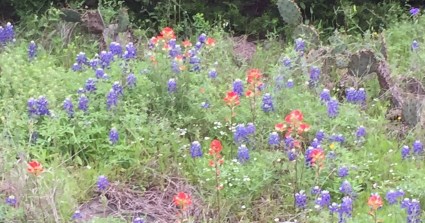
The mix of early Spring wildflowers.

NaPoWriMo: 30 poems in 30 days (day 8)

Day 8 prompt: Use a portion of a poem from a twitter bot as seed (inspiration) to write a poem.


Confession: I dislike the words twitter, tweet, and bot. It’s getting late. I need a poem. I’ve read nearly all of Anne Carson’s “The Glass Essay” searching. I considered her “Where does unbelief begin?” and discovered her phrase, “That was the night that centered Heaven and Hell,” which I may use later. I pondered Richard Siken’s words, “Let’s admit, without apology, what we do to each other” and “This has nothing to do with faith but is still a good question.” I did the perusal work of reviewing several twitter bots. Nothing worked.

Then, as I was re-reading Tim O’Brien’s The Things They Carried (1990), I found it. I try to do “optional” prompts. I hope I semi-followed the elective prompt with a twist.

My poem is based on a scene from O’Brien’s book, specifically from the chapter, “On the Rainy River.” Tim writes of sitting in a small boat 20 yards from Canada while facing his inner dilemma of doing what he thinks is morally right and what his family and most people (at the time) thought he should do: to accept his draft notice and fight in the Viet Nam War.


The Embarrassment of Tears

It was a moral freeze,
part hallucination, he supposed,
as paralysis took his heart,
a tightness he wants me to feel.

He could swim but he saw them,
a blind poet scribbling notes, people,
his past and his future, and mine.

His conscience lost the battle in a war
it could not win. He would do it.

He would go to the war –
he would kill, and maybe die
because he was embarrassed
not to. That was the thing.

And so, he sat in the boat,
and he cried, but he did not die.
Not a happy ending, his war,
his book, our war. He went to the war.

He was a coward, he claims,
because he stuffed it for them,
for their love, which he carried then,
and carries today. I disagree.

He asks me, and you,
would you cry? The scene jerks
my tears, not for Tim, or the war,
but for me. I was not in his boat.


Sit in your boat and look both ways, to Canada or to home.
Mind the gaps, there may a book or a poem in them.

NaPoWriMo: 30 Poems in 30 Days (day 5)


Day 5 Prompt: write one poem using or doing the Twenty Little Poetry Projects of Jim Simmerman. You can google it for other examples.


Torn Knights

He yelled into my face,
“Life’s not a bowl of cherries.”

I wanted to rip him to pieces
then and there, feeling his grip on my neck,
smelling the furious anger of alcohol breath,

I heard the silence of witnesses
sulking away, their fear fed my will to fight,
as his words breathed fire into my eyes,
all could see desperate anger quake the Earth
and shake trees as leaves fell like tears of fear.

Bill and Dan at it again on Butler Street,
brotherly love, kin with no wisdom to share
as each could see the envy of one
less favored dragon slayer.

“You da cool fool, hayna, baby-bro?
Ah tells ya, ‘cuz I luvs ya brudder.’

“Well I’ll swanny over such tots,”
tasting sweat mixed with vile spit.

Waltzing a pugilistic polka
inflamed a poison pit of spite,
played to muffled grunts and groans
Dan became the dragon, thus
Bill drew a slayer’s sword
to end of the fiery brand
brother’s battle forever.
Soft liquid steel shattered
the end, an old beginning.

Fata Morgana
reaching fait accompli,
times past without tears,
Earth swallowed Irish blood
into a hell of hate. Two men swearing,
dancing in the dark
to unending songs of never love.


Look both ways as life is not always as we wish.
Mind the gaps and choose wisely.

Sammi’s Weekender #151: Keepsake


It says,
“Sambo.Richards, Duck Pond, PA”
(northeast of Scranton)
on a keepsake;
a dog tag probably,
all the d’s are backwards.
It was my mother’s,
and I have others. Some
were my grandfather’s
who was quite the handyman.
I never knew Sambo,
nor my grandfather.
But I knew Mom.


Looking both ways,
keepsakes are memories,
sometimes not our own.
Mind the gaps. History is there.

NaPoWriMo: 30 poems in 30 days (day 2)

Day 2 prompt: Write a poem about a place (i.e., a house, store, school, or office). How ‘bout a bar?


Packy’s

Sorry to say it’s gone now,
Packy Lenahan’s bar.
Packy too. Kids may age,
Patty and Maureen Keating,
lived in the same attached building.
I forget the people’s names
in the apartment above Packy’s.

It was on the corner of Madison street,
where friends Jimmy, June, and nine more lived,
and my grandpop had lived before I was born,
and Butler street where we lived.

Packy’s, some thirty yards west of
my bedroom window,
was where they drank and smoked,
and where they played games and ate food
until well past my bed time.

Inside to the right a huge mahogany bar
had big high mirrors, stacked whisky bottles, and beer taps.
I learned shuffleboard to the left,
and my first dart board was on the back wall,
left of some stairs up to the dining room
with tables and chairs, a kitchen and
toilets were to the right.

Few stools were at the bar, but it had real,
often used, brass spittoons on the dirty,
cigarette-burn stained, wood floor where beer
was often spilled and seldom mopped
under high ceilings with fans on long poles.

The back door was mostly for exiting,
or entering when closed (but not really),
on Sundays after church or after last call,
always unlocked after knocking.

There was a piano,
and a smell of stale beer
and staler smoke, and a juke box
back in the dining room
where I sometimes played,
but bar spittoons always intrigued me,
men spat, often missing, one of the things
they only did at Packy’s.

Many nights I laid in bed and listened to them
talking or singing and being loud, having fun
at Packy’s. Sometimes fighting
after Packy threw them out and I wanted
to go see who got clobbered
with a brass spittoon off the floor.


You can see Packy’s door and window over my Dad’s right shoulder (circa 1948)

Look both ways cuz it’s not always what you think.
Mind the gaps and don’t trip over spittoon.

Click for link to web page


Poetry: Back in the Day


House lights were off, back in the day.
A tinted eerie black and white glare,
as the boob-tube illuminated
white nicotine-laced clouds,
cigarette smoke from lit ends of
Camels or Pall Malls, unfiltered butts crowded
many ashtrays, back in the day.

Like ghosts sucked into dying lungs
of people I loved,
alive, back in the day.

The smelly, wispy, floating clouds
rolled and twisted or waved
as we passed through,
back in the day.

Forbidden addictions, I then, not yet
old enough to kill myself,
back in the day.

Second hand was for used,
not smoke.
Sickening smokers,
plus all who breathed in,
nicotine laced habits, back in the day.

Born into our rite of passage.
Now sick and dying, smoking goes on.

Never allow science to invade
personal stupidity.
We’ve always done it this way.
Back in the day.


Look both ways but stay away from back in the day.
Discover progress through science but mind the gaps to fill as we learn.

Sammi’s Weekender – Flash Story: The Little White Lie


The young man stood straight as the teacher’s loud, angry voice bristled. She berated his atrocious spelling and wretched grammar. He held back tears of shame and anger as she publicly humiliated him. She declared his entire family abysmal failures as human beings destined for an eternity in hell.

He found abysmal in the dictionary. When his mother later asked how he had done on the school paper he worked on so diligently, he reported that the teacher said it was very deep and that the entire family was destined for infinite success.


Look both ways. They may forgive, but they’ll not forget.
Mind the gaps. No memory is flawless.

Essay: I Wear Lorry’s Ring

I think my aunt Lorry loved me a lot more than I realized. I remember how each week she’d cut the latest Dennis the Menace gag comic, single-panel cartoon from her newspaper along with a word of the day snippet, and she would mail them to me accompanied by a little note. My behavior reminded her of the cartoon protagonist, or vice versa. While I never saw the connection (the cartoon being more innocently contrived), it was the only mail I recall getting from anyone, particularly from an adult when it was not my birthday or Christmas. Lorry and what she did for me are among many things I failed to adequately appreciate in my childhood. But I do now.

When I graduated from Texas A&M, my mother’s older sister also paid for my class ring. Aggie class rings are a big deal to alumni (aka former students), as they are for grads of many other schools. I still wear the ring today, almost 50 years later.

Her real name was Dolores. My sister and I, along with our cousin, called her Lorry, but I never asked why. For most of my life, Lorry lived and worked in Washington, D.C., about a four-hour drive from Wilks-Barre today with light traffic, but almost twice that by bus in the 1950s. So, I didn’t see her often. She also never married and was considered old fashioned and a very traditional, staunch Catholic, even back in the day. She was not difficult, but would criticize wrongdoing when she saw it, explaining her labored relationship with my father.

I suspect Lorry was quite bright. Had it not been for the negative antifeminist influences of her early 20th Century culture and her family, she would have achieved more, not that she did poorly for one who entered the female workforce early in the Great Depression. But then, I’d not have a famous cartoon character as a childhood alter ego, my vocabulary might be less sufficient, and my word-love less geeky had she been different.

Unlike me and little Jackie Paper, Dennis (the menace) Mitchell is still five-and-a-half years old. The cartoon dates to 1951, and it is still in world-wide syndication. Can you imagine Dennis in his late 60s? (I smiled when I wrote that question.) I can. I imagine him in his early 70s, still with the persona of a five-year-old troublemaker.

For the record, Puff the Magic Dragon and Jackie Paper are in their late fifties. I try not to mentally associate them with AC-47 Spooky gunships through that song, but that’s part of me too. There is a certain sadness to all that 1960s and ‘70s stuff that my Irish nature seems to nostalgically understand, but few others get.

But I wonder. What would the Lorry I knew think of me today? As always, there are some aspects of me with which she would undoubtedly find fault. I’m sure she would explain where I could improve. Fair enough. But would she get my ironic sense of humor? What about my vocabulary? I’d probably get a dictionary or world atlas for my birthday (again). And what of her opinion of my writing? My poems (the clean ones)?

Do you have a troublesome young family member? Do you think he or she will remember you and write about you 40 years after you die? Lorry would not have thought so either. But she’d a been wrong. And she might have corrected my spelling and grammar. And I would change it – for her.

What we see as we look both ways changes with life and times,
but not really who we are.
Mind the gaps, but cherish the memories.

Poetry: Put it on our bill

A Starbucks in a grocery store,
it’s still a place to shop
for food, and in this state,
wine and beer—a super market—
what my mother would call
the Acme (pronounced ack-a-me
in the vernacular of “The Valley”
where I grew up)—

those early places that put
the small Mom and Pop, corner
stores with personal
one-on-one service and where I,
even as a kid, could say,
“put it on our bill,” out of business.

No receipt. No stolen identity fears,
just trust. A time and place where everybody
knew my name and who my
family was, and knew more about all
of us than any one of us did. And
the cash register had a crank handle,

and I could walk there
in five minutes and nobody
had a credit card and Starbucks
and my first child were still
then, 15 years from now.

That Mom and Pop stuff
is all gone now.
But there’s $14.65 left
on my Starbucks gift card.

Look both ways, there is no time limit on gift cards,
and I will think of you every time I use it.
Mind the gaps, they have limits and must be used.

Poetry: Risk & Danger = Life

The mature doctor who would begin residency
for Psychiatry in the morning
after 25 years as a surgeon,
a guy I liked but only saw
one time, turned to look at me
as he was walking out the door,
after I told him about me owning
a motorcycle and he said,
“Well, don’t ride it.”

Too dangerous? This,
after we had discussed
my heart disease with six stents,
and a severely wonky-donkey
heart valve, my high-grade,
lingering dangerous
sarcoma cancer, and my head
to toe clogged arteries holding
three more stents—strokesville?

oh,
and my good old age,
bad high blood pressure,
and the pending possibility of
dangerous surgery and
risky hospital stay.

Risk and danger have been
my companions
since childhood (we have
an understanding). A
motorcycle accident might kill me
faster than a mistake
by a doctor—a surgeon,
maybe.

He was giving up surgery
to be a shrink, so he “could
help people.”

Kind a makes ya wonder,
don’t it?

Look at risk and danger both ways,
but gamble not with the welfare of others.
How well we walk through the fire depends on the width of the gaps.


“Too often the people complain that they have done nothing with their lives and then they wait for somebody to tell them that this isn’t so.” ― Charles Bukowski, What Matters Most is How Well You Walk Through the Fire