NaPoWriMo: 30 poems in 30 days (day 14)


Day 14 prompt: write a poem that deals with the poems, poets, and other people who inspired me to write poems.


Dad never encouraged me to anything but obedience,
yet he knew funny limericks that made me blush
and he sang like George Burns, not quite as well.

O, the battles he lost.

Sister Mary Something Awful believed in god
and memorizing to exercise my brain like a muscle.
Walt Whitman’s O Captain! My Captain!

O, the battles she lost.

We committed it to memory, like a prayer,
in some later years of elementary school,
something I shall never forget.

O, the battles I lost.

Robin Williams’ emotionally charged role
in Dead Poets Society, the movie and final scene
woke sleeping poets buried deep inside me.

O, the battles we fought.

To my insistent denial, Sue said yes you can
while others saw poetics hidden within my prose,
as I read the confessions of closet poets.

O, the battles turned, still hidden.

When muse passed me a parachute, I jumped
and discovered endless fields of sounds,
words, and beats to claim as my own.

O, joy, the battle done,
when I stopped fighting,
the prize I sought was won.


To look both ways I must turn my head and see.
Mind the gaps for their good intentions.

NaPoWriMo: 30 poems in 30 days (day 6)


Day 6 prompt: write a poem from the point of view of one person, animal, or thing from Hieronymous Bosch’s famous, bizarre triptych The Garden of Earthly Delights. After spending too much time searching the five-hundred-year-old hallucination on wood, I decided on one of two snakes from the left panel.


Blame Game

They could have blamed the moon,
or that unicorn, which never existed,
but no. Let’s go low, they said.

Talking creepy crawlers, snakes,
and fruit peddling serpents make
splendid scapegoats. Why not a goat?

We can’t talk, bark, purr, or bleat.
She points to me, he believes her,
and all hell (right panel pun) happens.

Pin it on snakes, they said. Scary,
but defenseless. Look at panel two’s
big party of naked fruit eaters.

We got the rap for all of that. Sinners
should blame monkeys. At least they
look and act like you people.

And what’s with the guy
growing flowers out his arse?
Who does that that? Not us.

So, what do you get? Panel three.
From a diluted old man
with bad acid in his enema.

Time now to get over it.
Past post-medieval art is fine,
slithering snakes are silent.


Look both ways, or with triptychs, three ways.
Mind the gaps, it’s where the story’s told and the pictures fold.

Click for link.

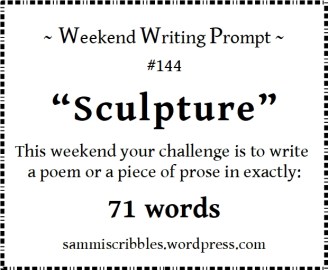
Sammi’s Weekender #144: sculpture


Cowboys look like Cooper, Wayne,
Marvin; or tall, thin Stewart. I seen
movies in the 50’s,
High Noon or Liberty Valance with
great songs.

Not s’posed to look like the sculpture.
The horse is right,
but the cowboy rock sittin’ is short,
round-faced with a big ‘stash and
no gun, holdin’ reins
lest Ol’ Buck runs off spooked.

The wrangler wears chaps and a jacket.
Reality ain’t movies, both’s art though.


Drop your blinders and look both ways.
Mind the gaps for, “The history of mankind is carried on the back of a horse.”


Sammi’s Weekend Prompt

***

A Sip and a Nib

The poet sits and stares,
then doodles and sketches,
wondering where this will lead.

A sip from the cup of wisdom,
a wandering stare looks
through a window, searching
for worldly ineffable words
of brilliant order, expressing
the unspeakable, describing
all indescribable forbidden things.

A pen finds the artist’s hand,
familiar fingers hold its frame
and place the nib upon paper.

It begins: a poet’s search
for perfection and beauty.

***

Look both ways through the window of inspiration.
Mind the gaps for perfect words. 

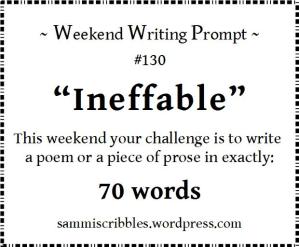
Sammies Weekend Writing Prompt 122 — Museum

Monet at Kimbell

Not a big fan of Claude,
I wanted the experience
of seeing his original later work
at the Kimbell Art Museum
in Fort Worth.

In Cow Town, I ran
marathons and we danced
at Billy Bob’s near the stockyards,
and went to see Elvis, Marty Robbins,
and two of our three were born there.

A shining light of cowboy culture,
the Kimbell is one of many
attempts to not be Dallas.
DF dubya is nearby and
Cowboys play football in Arlington,

where the Rangers play baseball
and Six Flags (over Texas)
amusement park resides.
But what is most important
is not the museum or foot races,
not the water garden or train station,

what matters most to me about Cow Town
are the memories. The comrades, the friends,
the scandals and the hanky-panky,
the music (up against the wall, redneck mother)
Oh Lord, I knew it all so well.

But gunna miss the Monet.

Look both ways between Dallas and Fort Worth (I love you).
Mind the endless gaps in between.

Fandango’s Provacative Question (FPQ) #35

Fandango’s Question: Do you believe public figures (e.g., politicians, celebrities, athletes, authors) — or anyone, actually — should be judged by today’s standards for their words or actions from decades earlier? Why or why not?

In the Summertime was written by Ray Dorset, of the group Mungo Jerry, in 1970. Some of the lyrics can be questioned for time and morals, but also for culture and interpretation. The song also says, Life’s for living yeah, that’s our philosophy, which I like. A few other questionable verses make the song neither sexist nor racist, in my view. Dorset is a Brit, about four months my senior, and an active Freemason thrice married with six kids and some grands. He wrote the song in ten minutes. (For what it’s worth.)

The more I think about this good person/bad person in light of the times topic, the more it gets wrapped in the philosophical tentacles of my own confusing need for a balanced, fair, and just (maybe perfect) world. Do I have any right or business judging anyone? What shall I make of people like Jefferson Davis? He was wrong as hell in my book, but not in his. He remains a hero to many.

I mentioned this kind of issue in a recent blog where I discussed the artist Jonas Gerard. Comments indicated that we can separate people’s behavior from their art, but in Gerard’s case, there is a petition to remove his art from city property. And it’s not decades old.

Can we separate the good from the bad, or does a tarnished reputation make all the good suddenly bad? Do I declare a song such as Dorset’s or Baby It’s Cold Outside to be evil because of someone’s PC interpretation? Do I get to declare someone’s art, writing, or music null and void after I learn of their human condition, religion, or political views? It happens a lot.

Charles Lindbergh fell from grace following a pro-Nazi Germany speech. A sample of many more: Cosby, O.J., Armstrong, Burr, Nixon, Haggard, Dixie Chicks, and (oops) another one bites the dust. Yesterday, I was reading about Philip Larkin and how his past may have tarnished his work. Does it? Should it?

I like the book/story about Dr. Jekyll and Mr. Hyde because it reminds me that we all have a dark side: that Jekyll was a good man, but Hyde was not, yet they were entities of the same person.

The answer to Fandango’s question is yes; but I’m sorry to say, also no. Yes, because by today’s standards (whatever those are culturally, interpretatively, or historically) are what we use to judge people today (not that we should, but we do). However, can we manage to form an opinion within the context of times past or some other mitigating circumstance?

Looking back on my life, I’m grateful that no nearby microphones were switched on when I said stupid shit; that no tapes or cameras were rolling when I did equally dumb stuff. While I don’t care or worry much about being judged, I prefer my lowest and worst moments be seen for what they were—not my standard, whatever that is or was.

I like learning that past heroes had weaknesses; dark sides mixed in with talent, wisdom, and intelligence. I have no time for idealistic nonsense. Right is right and wrong is wrong, but there are hundreds of grayish shades between. I’m not religious, but approve the idiom let he who is without sin cast the first stone. BTW, the song also advocates drinking and driving, or it seems to. It shouldn’t. So what?

Look both ways.
Beware not to place heroes too high on a pillar, nor allow your imperfect self
the hypocritical luxury of being the Judge, Jury, Executioner for others;
as so many fools before us have done.
Closely mind the gaps that contain closeted skeletons and dark secrets.

***

Pingback: https://fivedotoh.com/2019/08/07/fandangos-provocative-question-35/

How I want to write poetry. And how I don’t.

I can’t always do it. I would never be openly showy or make any form of art before an audience. I don’t think I could. Challenges or prompts during writing group meetings and a few online are the most I can do in social settings where people know me. Other than that, my writing is a solitary effort, although I’m not exactly the poster boy of the garret-imprisoned scribe. I do write in coffee shops, libraries, parks, waiting or dining rooms, and even during my morning walks. But usually I write at this desk on this laptop.

Yet, I have times of emotional outburst writing. At least one reader seems to know or recognize exactly when that happens. I love the experience, and I find satisfaction when I read my scribble after the excitement has passed. If I can let go of something within me, an inner editor, judge, or critic, I like what happens. I feel so free. It’s about emotionally letting go of something.

I don’t listen to music when I read or write. I can only tolerate classical type without being distracted. I am not sure how it would work. I may try it sometime.

In order to give you an example for what I have in mind, I did some research on a well-known artist who I am familiar with. Well, I thought I was. Nothing about the art is independent of the artist—not the form, method, appeal, depth, or reputation.

Jonas Gerard of Ashville, TN, puts on an impressive show. The personal emotion he displays in making his art is the poster for explaining how I sometimes want to write, especially poetry. I have been to his studio, I have talked to him and several of his assistants, and I bought some of his work.

The youtube video below is an example of what I mean (he did a number of these). The vision of personal emotion (fake or real) is inspiring. But, artist or not, apparently old Jonas (he’s 78 or so) has had issues with untoward behavior (sexual harassment, maybe assault) in his past. I never put this guy on a pedestal or thought of him as anything more than a cool modern artist. Yet, I’m disappointed, angry, and confused. Because of what I learned, I considered not writing this piece or posting it.

But this is about me and I agree with what he says in the video about fear.

I want to write with emotional vigor displayed by Jonas Gerard when he paints. I want to let go, as he mentions. I love it when I can let go. It’s the temporary feeling and process I enjoy. The product, like all writing, will outlive the writer.

Look both ways. Every saint has a past, every sinner has a future.
Mind the gaps but dismiss excuses.

Poetry: A Place for Weeds

Jim was watering his experiment
for his ag doctorate, Grasses of the Brazos.
The good ol’ country boy let his smile show
when I observed and laughed at him
for making a big deal out of a bunch of weeds.
They were not flowers or cash crop plants.

Jim said, without looking at me,
“a weed is just a plant out of place.”

Over fifty years now. Where did they go?
I remember Jim
and his greenhouse full of weeds at A&M,
we’d go spray water on them weeds daily.
Later Jim would defend his dissertation about
Brazos Valley dirt and river bank weeds.
Doctor Jim was a dirt man, agronomist.
Just a plant out of place.

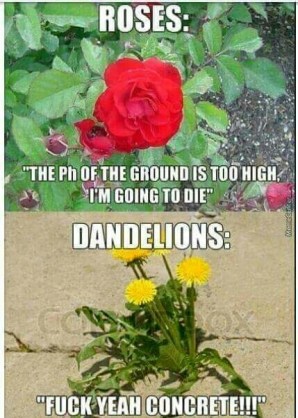
Jim got his Ph and D in dirt.
Then, he moved away to California;
who with his high-pitched, out yonder,
Texas drawl, old Jim
was decreed Doc Jim, the good-old-boy
from Meridian, Texas.
In his own way, he became
a plant out of place.

Many times, I have been a weed,
a person out of place,
or so I felt.
I needed to be in a different place,
to feel unweedly,
wanted by anyone,
or not. Was I where I belonged?
Or, was I just another plant
out of place?

Was I
in the place I was supposed to be?
Bloom where you’re planted,
that’s what they say.
Weeds need to grow everywhere,
but it is nice to find your space.

No longer, am I,
a plant out of place.

©Bill Reynolds, 5/23/2019

Look both ways crossing but look all around for misplaced plants and people.
Mind the gaps, weeds grow there.

Song Lyric Sunday – Listen

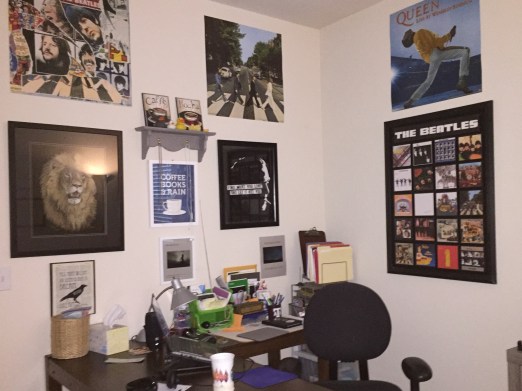
Two posters and a 20 album cover montage (just saying).

I was early to bed last night so I did not see Helen’s Song Lyric Sunday theme until this morning: Listen.

The Beatles classic was in my brain, ears, eyes, and on my tongue as my lips whispered the words, “let me whisper in your ear.”

This bit of boomer nostalgia is less than two minutes.

Lyrics: Do You Want to Know A Secret
You’ll never know how much I really love you
You’ll never know how much I really care
Listen do you want to know a secret
Do you promise not to tell woh woh woh closer
Let me whisper in your ear
Say the words you long to hear
I’m in love with you oo
I’ve known the secret for a week or two
Nobody knows just we two
Listen do you want to know a secret
Do you promise not to tell woh woh woh closer
Let me whisper in your ear
Say the words you long to hear
I’m in love with you ooooo

Songwriters: John Lennon / Paul Mccartney
Do You Want to Know a Secret lyrics © Sony/ATV Music Publishing LLC

Look both ways, but the music of your youth never goes away.
Mind the classical gaps.
Click graphic for link to SLS page.


Poetry: A Strain of Madness

The pathetic bitch just lay before my eyes,
we each blamed the other for her horrible lines.
I had once dreamed of her as a flawless beauty,
but her loveliness was soon all too fleeting.
Everything about her soon disgusted me.

She beamed as I hacked away and mutilated her.
Such beatings were horrible, she no longer was fair,
not lovely as once I’d imagined. She was my obsession,
she had to be better, no – I demanded perfection.
I swore at her, insulted her, I’d not let her rest.

Her excruciating pain was caused by my emasculation,
as I twisted her limbs, she bled and cried out my damnation.
I never shed tears. I was her god, her creator; I owned her.
Angered I was, by what she’d become in my hands.
No longer did she sing her sweet angelic song.

Her nightmare was my blind fury. As her cruel and ruthless master,
I swore obscenities and pointed out her flaws; her heart was shattered.
I pondered her shredding – me killing her. Where could I hide?
Should I kill us both? Maybe that was it; murder-suicide.
Thus ending our miserable suffering, both would just die.

Without me, she would not exist. Mutilation continued;
I hacked off pieces, yet that suffering twaddle endured.
I attached new members, only to rip them away as crap;
I ignored her cries for mercy as I tossed her limbs as scrap,
replacing them with her rip-torn skin; still oozing blood.

Was her beauty hidden or gone? I ripped at her face.
She was mine to mold, to satiate my perverted desires.
Everything, from her disfigured hair flowing down
to her awkward stumbling feet, was to gratify me.
Her suffering would end with my metered pleasure.

I deemed us inhuman. A mere dullard of life, all that she was.
Her reasons for existing were meeting my ruthless demands.
She failed. Each day I emptied myself into her, more beatings.
Her tolerance for my impatience stroked her pleasurable feelings,
her loving and caring endurance infuriated me all the more.

I was disgusted. All that time. All the work. All our suffering.
Yet, lain before me that pathetic little twat blamed me.
Exhausted, I thought this would be the end for us both.
Barely breathing, her heart murmuring along with mine,
our time together had neared its end, soon it was done.

One final scream! And then; calmly I stared, feeling a bit proud.
My anguish gone, I muttered the sounds of her words aloud
just as she set them before me. Slowly, she began to change.
That poisonous little worm became my lovely butterfly.
She smiled at me. Then she pouted, both sensuous and shy.

We reached out to each other one final time.
Soon, she would be with eternity, but somehow still mine.
I wept as my pleasure mixed with regret and my sorrow.
After setting her release for after sunrise, tomorrow,
I abandoned my poor little poem to whatever might follow.

Bill Reynolds, 9/4/2017

Know the gaps and mind them well. Look both ways, or deal with hell

But he who, having no touch of the Muses’ madness in his soul, comes to the door and thinks that he will get into the temple of art – he, I say, and his poetry are not admitted; the sane man disappears and is nowhere when he enters into rivalry with the madman. ~ Plato, Phaedrus

Hence poetry implies either a happy gift of nature or a strain of madness. Aristotle, Poetics

Love the art, poor as it may be, which thou hast learned, and be content with it, making thyself neither the master nor the servant of any man. ~ Marcus Aurelius, Meditations, Book Four