Essay: My FWB Neighbors (2 of 4)

Part 2 of 4: Parents and Children

This is the second of my four-part ‘tattletale’ series about our neighbors in Fort Walton Beach, Florida. I had three kids, and my kids have kids. So, I have some street cred opinions about this.

I never met the man who lived in the house to the right of us before he died. A younger couple with several children and a dog eventually moved in. I forget their names.

Their children were girls and the girls always seemed to have friends around, so I never got a good head count. I think someone in the family had enemies as evidenced by regular TP in the trees and spray paint (much more serious with ugly messages) on the house.

I recall seeing the children routinely jumping off the roof of the house onto the trampoline in the back yard. It looked like fun, albeit dangerous. Yet, I recall no 911 or EMS calls – at least not for that address. Except for our house and that one, all other homes on that cul-de-sac had at least one emergency call during the time that we lived there.

I think the youngest of the daughters was regularly under severe attack from zombies or some other mean and vile creatures, and their dog tried to save her. I could tell this by the blood curdling screams (her talent) and the crazy loud insane barking which provided accompaniment. We lived with it – but she and their dog both had very capable lungs. Her sudden screams were startling and a bit funny.

Then one night the kids were about 20 feet from my bedroom window and playing loudly on the trampoline. It was a weekend night, so being up late was no big deal. However, after midnight I got a flashlight and decided to join the party. I did not turn on the flashlight until I was at the fence, thus eliciting more screams. Yes, I scared the crap out of them. And yes, I intended to.

I advised the girls that I appreciated there was fun was to be had, but I wanted to sleep and my bedroom was nearby. I asked if there was an adult nearby. They said there was not. I got lots of “No sir” and “Yes sir” answers to my questions, so the kids were polite and just having fun. But still. My intervention stopped the noise. I don’t know if parents were ever aware of the situation, my complaint, or were even home.

I suppose my wife and I may have been overbearing parents compared to those folks. They had cute and polite kids, but I never saw the children and the parents in the same place at the same time. I seldom saw evidence of adult supervision, period. All of this was more experience than problem, if that makes sense.

It was only a few more months before we moved. Following one of the loud, panicked, world-ending screams, I looked at my wife and said, “I wonder how much I will miss living here.” Shortly after our relocation to a Seattle area 55+ community, I made the comment, “The silence here is deafening and disconcerting.” It was too quiet. For a while, I missed the little boogers.

Look both ways. Children are everywhere. Mind the gaps, too. They hide there.


Essay: My FWB Neighbors (1 of 4)

We moved from San Antonio, Texas to the Florida Panhandle (aka southern Alabama or the Redneck Riviera) in 2012. It was to be my last assignment before retiring three years later and subsequently relocating to live near Seattle for a few years.

I got the idea to blog about my neighbors from reading one of Joey’s posts. To be brief, I’ll post it in four parts, each with a featured glimpse of one of the real-life characters/neighbors I met whilst living in the Sunshine State.

Part 1 of 4: Wheeler-Dealer Danny Boy

Not the real guy, but almost.

The neighborhood was built in 1964 and was mid-century semi-modern (i.e., small and old). A man who was a native of either the Empire or Garden State named Danny was my neighbor and lived in the house to the left of ours. Several feet separated our long, sloped driveways.

Danny was an interesting character. If I were to write a book titled, Wheeler-Dealer Meets Reality, Danny would be the main character. His first name was the same as my estranged half-brother and I noticed similarities. Danny’s house was in an uncertain stage of foreclosure. For whatever reason (I neither knew or cared) Danny-borrowed using his home as collateral when the housing market value was increasing. He told me that several times he went to the bank for more as the assumed value increased.

After the collapse of the housing market, Danny owed far more than the property was worth. So, he stopped making all payments. He moved out for a while, opening the door for repo, but then (with legal advice) he moved back in so that they could not repo so fast and easy.

Danny went to different doctors for medical care and used two services. VA for free and some other docs covered by his mail carrier’s insurance. The way he explained it to me was, “I kind of play them against each other.” I cannot recall responding to that comment, but I know what I was thinking. Irony is coming.

I am not sure exactly what marriage Danny was on, but it was number three or four. I never asked him if trading in wives for newer models was precipitous to his financial problems. For as long as I knew him, Danny was deep in debt, in default, and living in a house that was going to be taken away “any day now.” But living there virtually for free. He kept the lights on, but was no longer buying his house. Danny was interesting and while I liked him, I was not gunna follow any of his get rich quick plans.

One day a pre-teen boy knocked on my door. He was a pleasant lad between the ages of 10 and 13. He asked me if he and his friends could use my driveway, which was probably the largest hill in Fort Walton Beach, to ride their bikes (and skate boards and whatever else with wheels) down. I was impressed that he asked, so I said yes provided that their parents knew about the deal. I agreed to this in a town where all children’s swings in the parks had been removed for fear of litigation. While there were some minor crashes, no serious injuries resulted, and I have not been sued. The kids had fun almost every day and I liked the idea that I contributed. It was my driveway on my rented property, or so I thought.

I forget how I learned that Danny had told the kids to go away and that they were not allowed to use my driveway for recreation. But, he did exactly that, and I was pissed. Before I could calm down enough to confront him, Danny had a severe heart attack and was hospitalized for bypass surgery. He recovered, and I decided to let it go. The kids would not return, even if I explained the problem. Danny and his wife eventually moved (evicted), and his home was finally repossessed by the lenders or banks, flipped, and then sold. I don’t recall the new neighbor’s name, but they were not as interesting as Danny. Normal neighbors can be boring.

Look both ways to see your neighbors. Mind the gaps and the children.

Poetry: Honor the CAS Brigade

Memorial Day greetings as we acknowledge our remembrance with parades and poems, and we mark the unofficial threshold of Summer with humbled celebration.

I wrote a poem for Memorial Day…

Agree.

Honor the CAS Brigade

Not the six hundred, your life or mine.
My life for yours, in what noble cause?
You, comrade, have set my stage,
presented me with this chance,
and roll life forward to repay.

Has the world truly lost you?
Is it peace we’ve all gained?
Willing you were, but not for the price
to pay for my freedom, this high liberty.
Did you pay all my dues? What is my debt?

You did not die to win over another,
’twas peace you willed not mere death.
Shall I follow your glorious footsteps?
What cost for Liberty the price to pay?
Was the sum too dear for us to say?

Back to you, no debt can now be paid.
Was there glory in your demise?
Hail Liberty! is now your shroud,
I bow my head and we salute your life,
as today we stand to morn your death.

Comrade be known to only so few,
your loves, your bests, your suffering pains.
Dress right in honored memory
and in memorial spirit. Your life for mine –
no greater sacrifice, no higher honor.

Me. Standing before you,
your stone,
your memory.
Your life!
I’m humbled.

Yet honored.
Not that you died,
But that you lived.
And because you lived, you died,
So I may live. That we can live.

To my fallen fellows,
to my comrades of ideal,
may your sacrifice be honored
within our best brigade.
I salute your life.

Bill Reynolds © 27 May 2018

Look both ways in Memorial to our fallen comrades, yours, mine, ours. Allow no gaps.

Poetry: Sonnet – To Magic

My inspiration was from Edgar Allen Poe’s Sonnet — to Science (click to read it). Reading Poe’s poem gave me chills of guilt. While not anti-magic, I’m pro-science. Knowledge makes the universe more interesting. We will never know or understand everything. Magic and scientific exploration will go on. Yet, I do share Poe’s lament.


Sonnet – To Magic

Magic! True father of science thou art!
…Who brightens all things with thy happy cries.
Why say thou to poetic scientific hearts,
…A scolder, who brightens our dullest eyes?
How should we love thee? Or how deem thee wise,
…Who of magic wouldst leave him to his thing?
To see for answers in the quelled skies,
…Albeit he soared with daunted left wing?
Did thou set Diana into her car,
…And give Hamadryad her tree of wood
And seek shelter on some happier star?
…Hast magic not set the Naiad to flood,
The Elfin to green grass, given to me
…Summer dreams beneath the tamarind tree?

(Bill Reynolds © 9 May 2018)

With magic and science, look both ways and be mindful of many gaps.


Love is the biggest magic of all.
**Note: I am not a fan of analyzing poetry, but my editor questioned some lines. This explanation relates back to Poe’s sonnet. “Line nine, Hast thou not dragged Diana from her car? refers to the Roman goddess of hunting and virginity, who rides the moon across the sky at night. With science, people saw that the moon, instead of being a carriage for a goddess, was actually a lifeless rock, so science metaphorically dragged her off the moon. The next two lines talk about the Hamadryad, which is a nymph from Greek and Roman mythology that lives in a tree and dies when the tree dies. Science, however, believes the tree lives without such creatures, and so the idea of the Hamadryad has been driven away.”


A to Z Challenge — E is for Elf

The Elf has evolved into a category of beings, as opposed to a specific creature. As with the word human, to get the picture of an individual elf requires more information. Just as there are all kinds of humans or people (it takes all kinds?), there exists many types of elves and elven mixes. Yesterday, I spoke of the drow, or dark elves, just one sub race.

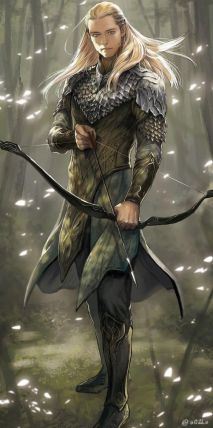
While the original concept of elves was Norse (álfar) or German, modern fantasy literature depicts elves as an almost divine race of beings with human stature and appearance, friendly natures (minus those from the dark side) and pointed ears (a must to my mind). The elves of today are different from traditional elves found in Middle Ages folklore and Victorian era literature.

The long and pointed ears seem to have started with Tolkien noting that the ears of elves were leaf-shaped. The length and shape of their ears depends on the artist, medium, or round-ear in question. I prefer pointed ears, but not the long ones like a donkey might have.

Wood elves are close to nature.

Modern fantasy elves (evolved from D&D or other role-playing media) may be immortal or slow maturing and long living compared to their humanoid cousins. They are also more attractive, smarter, gifted with magical power, and have a sharper sense of reality. Pure-blood elves do not possess facial or body hair. They are seldom portrayed as fat, lazy, or old.

Today, thanks to Tolkien, there are elf languages that have evolved and are often taken seriously and spoken by dedicated role players. Click here to get more information on the Elvish language.

The many types of elves include wood elves, high elves, aquatic elves, light elves, dark elves, sun elves, moon elves, forest elves, and savage elves. Even if you’re not an elf aficionado, you still should get the picture. If you are, you can add to the list.

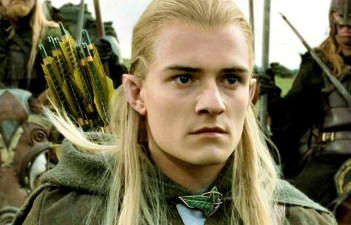
Elf Legolas Greenleaf (Orlando Bloom), in The Lord of the Rings

Elves are more ancient than humans or other races and flourished in a sort of Golden Age forgotten by other races. The mixing of elves with other races is interesting in that it is a mix of the real world, with all its limitations, and fantasy worlds with its unlimited imagination.

If you discard the elf on the shelf and the comedy movie, Elf, staring Will Farrow, the best known modern elf is probably the archer Legolas Greenleaf, portrayed by Orlando Bloom in The Lord of the Rings film trilogy. Arguably Tolkien’s best-known elf. Good clips from the movie with great sound.


Cautiously, look both ways in fantasy and reality.
Mind the gaps if you mix the two.

A to Z Challenge — D is for Drow

The Underworld of Drow

I have never played D&D, but I wish I had. When it was popular, my kids played the game. Since writing about these creatures, my daughter has invited me to play D&D with her, her hubby, and the grandkids. I discovered on-line role playing several years ago. That was when I learned how little I knew about elves, and I met my first elf who was a member of a sub-race of elves known as drow.

Of all fantasy creatures, I find elves to be the most interesting. They’re followed by dragons and leprechauns. That is a lot to write about. If we add reports and stories on other humanoids, such as dwarfs and hobbits, a literary subfield within fantasy emerges. Since elf crossbreeding, particularly with humans creates an exponential growth of character possibilities, contemporary story telling became fascinating for both creator and consumer.

If you’re not a fan of D&D or role play (RP), you may assume things about elves regarding stature, intelligence, and friendliness which are likely incorrect. In each case, I was wrong. They’re not little, stupid, and sweet. Admittedly, Santa’s helpers at the North Pole do little to correct the stereotype, but all is fair in fantasy and myth.

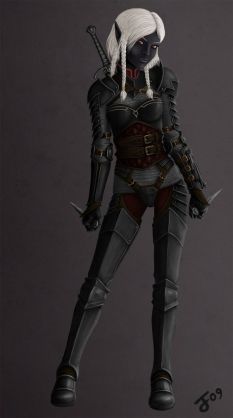
Dark, or black elves are from Norse mythology and thought to be the ancestors of the drow. These elves are usually considered to be evil in the inborn, bad seed sense. Yet there is ample evidence for a human-like nature versus nurture conflict and all drow cannot be depended upon to be as wicked as others.

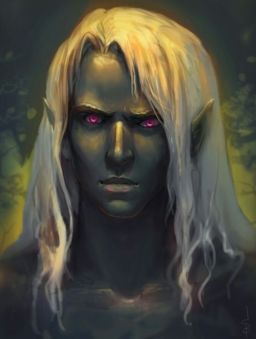
Drow have dark grayish skin. Since they are given to self-decorating, green and even purple colors can also be found. Their hair is naturally white, whitish or yellow, but here again, drow know about hair coloring techniques. Female drow are dominant, being both stronger and slightly larger than males. As with all pure elves, neither sex is capable of beard growth. While eyes are normally red, colors can range. With crossbreeding, even human green or blue eyes are possible. But, if you want to see something spooky; a red eyed, dark-skinned drow can tilt your freak meter.

While drow are unwilling underground creatures, they are most often found by non-drow to be above ground for the obvious reason that subterranean existence for a non-drow creature is as a slave to the drow, if survival is even possible in such a wild, violent place.

Drow fight with anyone, and other drow are never off the hook. That helps to keep their numbers down, since when they do get along well with each other, they are also very prolific producers of offspring.

As with all elves, drow live long lives if they manage to avoid a violent and early death. Again, given all their magic and power, it is their inability to get along that manages to keep the population in check.

Despite what sounds like an evil appearance, drow are attractive elves. This causes surface dwelling races to tolerate drow presence if they behave in a non-drow-like fashion. Surface races of elves and other humanoids have been known to inbreed with drow yielding interesting, yet confusing, results: both good and bad.

Drow are fast, agile, and in their opinion smarter than all other humanoids including other elf groups. The most natural and overwhelming feature of all drow is their phenomenal sense of entitlement. While this can be an annoying and dangerous trait, like so much else regarding drow, it is difficult to tell if it is innate or cultural. Drow culture reinforces all forms of evil within their race beginning at a very young age.

Mind gaps to the world of the drow.
Look both ways as elves are poor drivers.

A to Z Challenge — C is for Chimaera

The Khimaira (Chimera or chimaera) was a three-headed monster. If ya Google it without the mythology tag, most options will be links to ghost fish or sharks. This is no fish story.

Like so many monsters of Greek mythology, The Chimaera was the offspring of couple of monstrous sweethearts named Typhon and Echidna, a pair I envision as sort of an Adam and Eve couple of the Greek Mythological Monster class.

This bizarre, fire-breathing cat had the body and head of a lion (good so far). But peeking over its shoulder was a goat’s head rising out of its back. The beast had udders like a goat (no idea why). Away from the business end, the ubiquitous mythological snake rounded out the creature’s tail, with serpent’s head at the very end.

Since nothing good could possibly spring from the union of Typhon and Echidna, this beast ravaged the countryside of Lykia (Lycia) in Anatolia, which is on the southeastern end of Turkey. Contemporary Turkish history does not jibe well with older Greek myth, but at the time it all fit nicely, if fearsome.

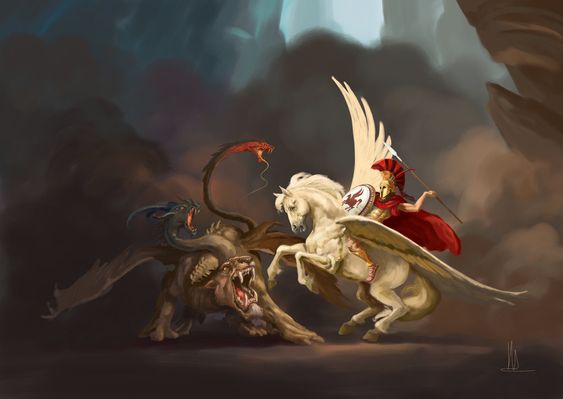
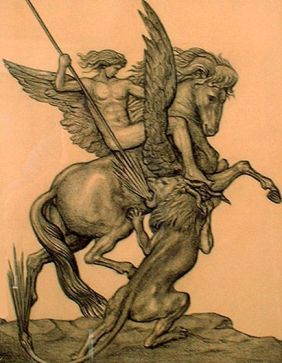
As the story goes, this Chimaera cat was just kickin’ ass all over that part of the world until a hero named Bellerophon came on the scene. He was either asked or commanded, depending on who is doing the telling, by King Iobates to kill the beast.

Bellerophon rode into battle on the back of the winged horse, Pegasus, of course. He sought and found Chimaera and drove a lead-tipped lance into its flaming throat. So, the big cat-goat’s fiery breath melted the lead tip, promptly choking the beast on hot molten metal. Lead poisoning for sure. So, the beast died from sucking on a lead popsicle, Greek Mythology style.


Turkey has never been known for its geological stability. So, later classical writers believed the Chimaera creature was a metaphor for a Lycian volcano, of which there almost certainly were several.

The Chimaera can look both ways at the same time
and the snake can keep its eyes looking backward.
So, mind the gaps.

A to Z Challenge — B for Basilisk

A basilisk is a creature presented as a snake-type or other reptile. Some renditions look related to a rooster, but that would be a cockatrice. You’ve heard, if looks could kill? Well, if it’s basilisk, they do. A direct look from a basilisk and yer a goner.

It’s interesting how the fantasies go on with how dangerous this creepy-crawler is with venom and whatnot, but with looks that kill, who cares? Think Medusa. Ok, so you use a reflection for an indirect look, but unlike Medusa, you’re petrified anyway, meaning you are turned to stone. Think Lott’s wife. I can’t buy the petrified option as being any better than a direct death look. Look away if you see a basilisk coming. Oops, too late.

Basilisk Paining

Some sources (Britannica) list the basilisk as the same creature as the cockatrice, but one is a snake the other a pissed-off rooster that looks related to the village dragon. In mythology there is an odd biological, half-sibling, relationship between the two. This basilisk creature comes into being because a cockerel (rooster) sits on and incubates the egg of a snake or toad. For the cockatrice, the rooster lays the egg (see the problem?) and either the snake or a toad pulls off the incubation challenge.

If a sex is assigned to a basilisk it is often female, yet, due its appearance with a mitre on its head, it is referred to as king of the serpents. The Pope wears a mitre as a kind of crown. It must have been safer to piss off a king, since there were many, than the Pope, of which there were few, if only one legitimate. Since these folks have roosters laying eggs, I suppose that is all fair enough. It’s fantasy, right?

The first writing about a basilisk dates to around 79 AD, about the same time New Testament Gospels were allegedly first written. And if you worried about one of these suckers turning up at the front door, you could simply do pop goes the weasel. Apparently, taking a cue from Asia and the King Cobra’s nemesis, the mongoose, the Europeans made the odor (effluvium) of the weasel be a deadly weakness for the basilisk. That makes sense. With more quafting weasel stink everywhere, there’ll be fewer basilisk, which explains why Europe has such a small problem with basilisks roaming the countryside. Of course, if you did see one, you’d die and be unable to tell us about it.

Cockatrice

Literature is replete with references to the basilisk. In Shakespeare’s Richard III, Anne Neville wishes her eyes (like a basilisk) would kill her husband’s murderer, and in Cymbeline a character refers to a ring as a basilisk.

Samuel Richardson in Clarissa; or the History of a Young Lady, and John Gay in The Beggar’s Opera, have characters who refer to the basilisk in dialogue. Others include Jonathan Swift in a poem, Robert Browning in A Light Woman, and some writings of Alexander Pope.

Shelly refers to “the imperial basilisk” in Ode to Naples; and again in Queen Mab like this:

Those deserts of immeasurable sand,
Whose age-collected fervors scarce allowed
Where the shrill chirp of the green lizard’s love
Broke on the sultry silentness alone,
Now teem with countless rills and shady woods,
Cornfields and pastures and white cottages;
And where the startled wilderness beheld
A savage conqueror stained in kindred blood,
A tigress sating with the flesh of lambs
The unnatural famine of her toothless cubs,
Whilst shouts and howlings through the desert rang,—
Sloping and smooth the daisy-spangled lawn,
Offering sweet incense to the sunrise, smiles
To see a babe before his mother’s door,
Sharing his morning’s meal
with the green and golden basilisk
That comes to lick his feet.
— Part VIII

The basilisk also appears in Harry Potter and the Chamber of Secrets by J. K. Rowling.

Be careful looking both ways.
You want to miss seeing the basilisk, but mind the gaps.


A to Z Challenge — A is for Alecto

One of my grandchildren is named Furie. I was told that her name was based upon Furies of Greek Mythology. That was my inspiration of this blog.

While there were three Furies, I am focusing on one: Alecto (unceasing in anger), mostly because it fits the challenge.

The three furies

In Greek mythology the Furies, were female deities sometimes referred to as “infernal goddesses.” In Roman mythology, they are the Dirae. One Roman writer said they’re called Eumenides in hell, Furiae on earth, and Dirae in heaven. Indeed, these goddesses have significance in the underworld.

In addition to Alecto, her sisters are Tisiphone (avenger of murder), and Megaera (the Jealous one). Each had a role in dealing with the dark side of human nature and behavior.


I am not messing with her.

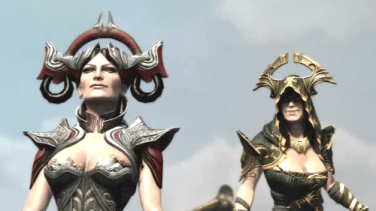
Alecto dealt with people who had problems with others (anger). She was like the goddess, Nemesis, who enacted retribution against those who succumb to arrogance before the gods. However, Alecto was concerned with human to human interpersonal issues, rather than human to god.

The Furies came into being when Cronus, technically their brother and leader of the first generation of Titans, castrated his (and their) father, Uranus. Uranus’ testicles were to be cast into the sea, but blood from them was spilled on Gaia (the Earth) and produced the Gigantes, Meliae, and Erinyes. The Erinyes, or Furies, pursue heinous criminals, punishing them according to their crimes. The imagination of ancient people must have phenomenal regarding their myths.

Furies revenged homicide, unfilial conduct, offenses against the gods, and perjury. A victim seeking justice could call on them for criminal retribution. The most powerful of the curses was of the parent upon the child – for the Furies were born of just such a crime, when the blood of Uranus (or the sky) impregnated Gaia, following Cronos chopping off dad’s nuts, thus Alecto’s unceasing anger.

Their wrath manifested itself in several ways. The most severe was the tormenting madness inflicted upon a patricide or matricide. Murderers might suffer illness or disease; and a nation harboring such a criminal, could suffer dearth, hunger, and disease.

Alecto and Tisiphone

The wrath of the Furies could be placated with purification and some assigned task for atonement. However, Alecto had no sympathy for the wicked.

The goddesses were also servants of Haidas and Persephone in the underworld where they oversaw the torture of criminals consigned to the Dungeons of the Damned. A goddess from Hell who is always angry with everyone and everything should make us behave. As with all such things regarding ancient mythology, the dealings were direct and fierce.

Look both ways for Alecto.
Mind yourself, the gaps go clear to Hell.

Link to A to Z blog Challenge

Signs Yer in Texas

I’m on thin ice here. Texas is different and the natives (Texans) not only insist on it, Texas Pride demands it with few boundaries. It was also 86-cents a 6-pack beer when I was in college. I married a Texas girl, all my kids were born here, and they all read my dribble.

Before traveling, people asked if we or our family lived anywhere near Houston and the flooding from hurricane Harvey. We are about 150 miles west of Houston, so family was on the outer bands of the storm—no damage or flooding, just rain.

Things from my morning walk…

Barbed wire (called “bob-war” in Tex-speak) may be useful for controlling cows, but it’s annoying and dangerous to humans. Putting up such fencing when it’s unnecessary is foolish, but they do it. And they run that miserable prison shit-wire right into the river. WTF is the point of that? There is not a farm, farm animal, ranch, or cow within miles. This is an in-town resort with people and kids. The state motto is “Friendship,” but nuthin’s friendly about that wire. And don’t give me that “good fences-good neighbors” crap. Pointed wire bits that can rip your skin off is not good, neighborly, or friendly.

Texas highways have the best signs. Some are funny. Like up by Moran, a little dry-spot of a town of four or five hundred hardy souls. “Moran next four exits.” It is not on an interstate, there are no exits, and you drive through town. If ya blink, ya miss it. Sarcasm and I love it. Better yet, “Moran Yacht Club Next Right.” There is no yacht club, no water or lake, just cactus and tumbleweed, residents with a sense of humor, and one joker who works for the highway department.

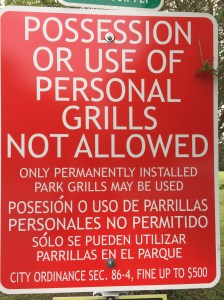
So, as I entered Cypress Bend Park on my walk this morning, I got a chuckle out of the signs at the entrance.

Don’t you dare pop that top until your ass is off our grass. The Guadalupe is kinda green now, but I bet it’s a high yellow color during the summer months.

Know what state you are in. And in this one, fear the sun. And for god’s sake, smile as you fry.

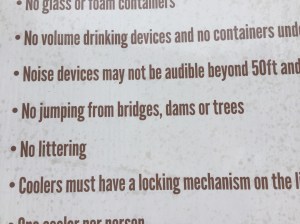
WTF is a “volume drinking device?” Do we need signs to remind us not to jump to our death? Lock yer cooler, the fish are thirsty.

It is not only the heat that is brutal in Texas. The norm for rain is the accompaniment of loud thunder and deadly lightning. Do the peeps here really need signs reminding them to use common sense? Seriously?

If you aren’t concealed (gun) carry licensed in Texas, you must be a namby-pamby liberal Yankee. Thus, if you visit the state capitol, you must pass through the metal detector. That is not required for the 80% who work there and are so-licensed. We know you’re carrying, so just go ahead.

Open carry is also common virtually everywhere in Texas and a gun rack in your pickup is standard, if not required, equipment.

But listen here, Cowboy. Do not open that beer until you’re “feet wet.” And above all, do not dare to open-carry your own bar-b-que grill into this here park. That would be dangerous. Comprehendo, Sundance? (Said the sheriff with a big smile.)

See? Thin ice. I will hear about this.

Look both ways for an easy way through those barb wire fences.
Mind the gaps and don’t jump off the bridges sober.