Elizabeth Gilbert’s book, Big Magic, is about fear. I thought it was supposed to be about creativity, but it is really about fear.
 Fear is normal. We all experience it and depending on the circumstance, it is a prudent thing. Mostly, we seem to fear the unknown. I like many lines in the movie As Good as it Gets, staring Jack Nicholson as Melvin Udall. One of them is Udall to patients in a psychiatrist’s waiting room, “What if this is as good as it gets?” While things may get worse, what if they will not get better. Strange as that may seem, if true, the shrink will soon be out of business. Each patient’s fear may remain in that their problem may get worse, but now they could focus on dealing with life from a different (albeit less hopeful) situation.
In my opinion, what I, and I assume many others, fear most is the unknown lurking in the future. In her book, Gilbert approves of people using entitlement to help overcome fear and any hesitation to create. I would prefer confidence. Maybe I am being a wordsmith about this, but if a person has confidence (faked or not), the likelihood of success increases. I like this baseball analogy.
 A child playing shortstop has a line-drive hit directly at them, they will likely duck and the ball may go into the outfield, thus the batter gets on base. This is true due to a justified fear of being hit with rock-hard baseball suddenly streaking like a rocket toward their head. An experienced shortstop may adjust body position slightly, but will watch the ball and attempt to catch it. The latter is the safest choice in most cases. Experience and confidence payoff successfully in this case. The batter is out!
As I understand it, what Elizabeth Gilbert is trying to say is that we should not allow fear to prevent us from creating something. She also suggests not letting drinking alcohol, feeling depressed, or other illness interfere with our creative adventures. She is right in that folks suffering those issues should seek professional treatment and not assume that such issues are creative muses.
In several places she treats alcoholism as a choice. I have serious doubts that many of us awaken one day, look in the mirror and say, “I need to drink more so that I can be more creative.” Take your pick: drug addiction, depression, suicidal thoughts, or just plain meanness are not choices real people make to enhance their creative juices. They are problems people have and Gilbert tries to explain this, but the whole discussion is too long, convoluted, and contrived.
Fear and worry about what others think of our work are justified, but as Liz says, that fear need not prevent us from doing things with our ideas. We will want feedback, especially if we ask for it (Beta or Arc readers). We want it both ways. An honest opinion and good critique. But what we also want to hear is, “That is so wonderful.” Or the response from the big publishing house that says, “Please send remainder of book immediately. We must publish this book of yours as quickly as possible. Fat advance check enclosed herewith.”

Where I agree most with Liz is that we need to do that work. We need to make the stuff that we want to make. We need to try. I need to write: my novel, my essays, my memoir, short stories, and (in spite of Gilbert says in her self-help book about not writing a self-help) my own self-help book. I want to write a few poems. I want to do the stuff writers do. As far as her suggestion to put my created ‘baby’ out there; that is my decision.
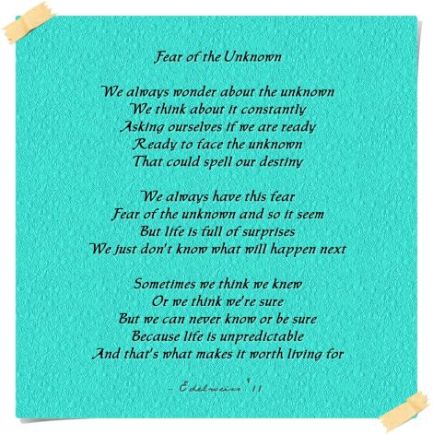 It is indeed true. Fear is there. It can be helpful or harmful. It depends on how we manage and deal with it.
My next blog coming on Friday will focus on another book that actually is about creativity and aligns much better with my point of view.
How do you deal with this topic of fear and creativity?
Does fear prevent you from doing things?
 I’ve been trying to figure out how to review Elizabeth Gilbert’s book. Developing a plan for a contrary opinion of Big Magic is like trying to figure out how to swim upstream against hordes of powerful whales and others going against me. The book has an 89% four/five-star approval on Amazon. The high praise of editorial reviews includes: #1 Globe best seller, the Washington Post, Cosmopolitan, Huffington Post, Daily Beast, Harper’s Bazaar, Christian Science Monitor, New York Times, Associated Press, Yahoo, Seattle Times, USA Today, Vanity Fair, O Magazine, San Antonio Express News, and a few of my friends.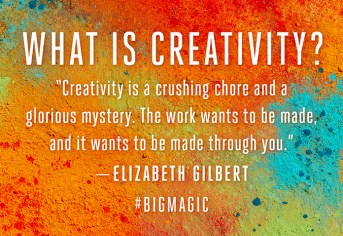
 In trying to figure out how to handle reviewing her book, I’ve decided not to. Instead, I plan to write several blogs on creativity and associated aspects of that human phenomenon, paying special attention to writing, my own issues, and my point of view. I also plan to add other books and input from others to the mix. If you have suggestions or input, please add your comment.
 Two memories from my youth relate to this post. I recall my mother frequently telling me that I was contrary. She would say, “Now Billy, stop being so contrary.” She could have chosen from many words: obstinate, difficult, stubborn, negative, or silly. Actually, that’s not true. She used silly a lot, as in, “Silly-Billy.” I actually liked being called silly and still do. Today, such a fun-loving attitude coupled with silly behavior would prevent a diagnosis of Oppositional Defiance Disorder (ODD).
 As a youngster, I did have more than my share of confrontations with adults, especially those in positions of authority. I admit it. Mom was right (aren’t they all?). I was often contrary and many synonymous terms applied equally well. I confess that I enjoyed being difficult, most of the time. Sometimes, I paid for it. Some say I never outgrew my contrarian attitude.
 The other memory comes from the time of my early to mid-teens. I don’t know where if came from, but we adapted a phrase for a while that was intentionally meaningless, but we said it – a lot. It was kind of an early version of whatever! We would say it to each other and often to adults. We always knew exactly what the adult retort would be. The locution was Yeah, but, or yeahbut. Today, the Urban Dictionary says yeahbut should be followed by f**k, but we seldom used those words in combination.
 However; yet, nevertheless, nonetheless, even so, still, notwithstanding, in spite of that, for all that, and all the same; I do like butts. Some more than others.

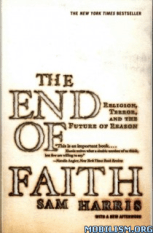 The End of Faith has been reviewed extensively since its first publication, but I need to pipe my opinion. With my gradual understanding and knowledge of Sam Harris, this book came to my attention as an eventuality. I’ve read only one other of his books (Islam and The Future of Tolerance), but I intend to read them all. I like his approach and what is, in my opinion, his open mind regarding universal principles which not everyone (atheist or not) shares. Anyone who thinks that all atheists share the same thoughts, opinions, or principles with each other does not understand them. The thesis of this book is no exception.




 So I snuck like a Ninja, undetected by the dozing, fat, fuzzy feline. Then, my stomach rumbled because I was hungry. Cats have very sensitive hearing. She woke up and chased me. I quickly climbed some drawers to the stove.
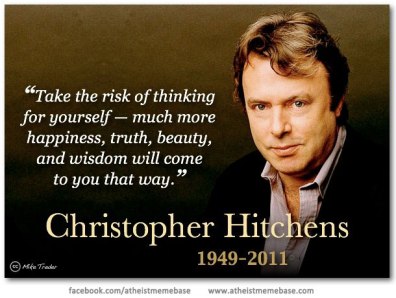
 As I listened to an interview with Christopher Hitchens, I was surprised by something he said. I’ll get back to that in a minute. Frist, I want to talk about the genesis of the question and my answer.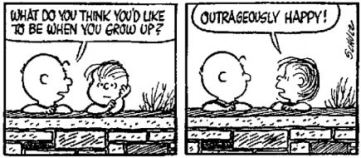
 A satisfaction tax would make a lot more sense. It seems like things may satisfy us, but we decide to be, or not to be happy. How would we measure and estimate a tax on feeling good?
 I do my best not to ‘unintentionally’ hurt somebody’s feelings. However, I’m unopposed to stepping on an emotional toe when I hear the call. As a senior citizen, I sometimes feel a sense of entitlement to do that, but I usually refrain. I once knew one guy who was so Cliff Clavin (from the TV show
  Several years ago, my daughter-in-law said that I was snarky. I appreciated her honesty and courage. I also liked it. She was right; I am snarky. I’m also sarcastic. In fact, being both makes me
 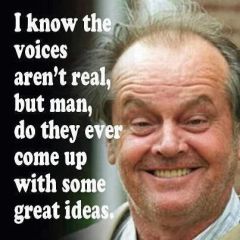 Jack Nicholson in As Good as it Gets (and other movies of his)
 Female Comedians (Yes they are)
 Not everyone has been introduced to my brand of snarkasm. After a while, when most people get to know me, they agree that I can pull it off. Many find it humorous. In fact, that’s the point – humor. I’m not on some kind of anti-PC* crusade here.
 Are you Andy or Barney?
 The internet is loaded with lists. Lists are recommended for writing/blogging because we read them. My wife likes to read lists to me. Neither of us have any idea why. This is my personal short list with explanations for why the item is here. In a way, it’s a gratitude list, but that’s not exactly what this is about. It’s about me, not the list. Please comment with your top five. I’d like to know if you share my opinions.

 Actually, I have no idea which is worse. Together, they conspire to make anything I handwrite virtually useless. Even I can’t read it. Professional, highly trained code breakers would never figure it out. It’s like a disability. Fellow writers often proclaim the great value of writing by hand. One page and my hand hurts. My head hurts from trying to make it legible. And my brain is pissed from focusing on scripting and spelling and not on content.
 Airplanes. I like to fly. Much of my first career was spent flying or teaching others how. My second career was still associated with teaching others to fly. I like aviation museums. I also like books and movies about flying.




 Our Literary Journey