
Life can only be understood backwards, but it must be lived forwards. ~ Soren Kierkegaard
Talking about this is difficult enough, but putting my spiritual story into words has been a challenge. It’s 70 years long. While details are normally important, I cut them out because there are too many. I’ll save the “rest of the story” details for a memoir.
I grew up Roman Catholic–I prefer Irish Catholic. In parochial elementary school (K thru 8th grade), I was taught by nuns (Sisters of Mercy, who had none). That was a lot of church and religion. Then, I attended public high school (9-12).
Around age 13 or 14, I would leave home for church on Sunday mornings. But, I would go play pinball for an hour and then walk back home. Maybe I believed in god as a teenager. Because of the way I lived then, I don’t think I did.
My friend Jack and my girlfriend at the time, both attended the Episcopal church down the street. I started going to that youth group, but my participation there had nothing to do with religion.
Following high school graduation, I joined the Air Force at age 18; I met and married a girl in Texas at age 19; graduated from college and started having children by age 25. Two years later, I was back in the Air Force and flying B-52s.
While I sampled some other Christian denominations during the 70s, I also ventured back to the Catholic Church for a couple of years. We had our marriage made official (sometimes incorrectly called blessed) in the eyes of the Church.
We had three children in the 1970s: boy, boy, girl. While we played on the Pope’s team, the boys were baptized. The girl was born in 1978, but she was not baptized Catholic. So we must have stopped going to the Catholic Church before mid-1978. By that time, my wife and I decided that Catholicism was not working for us as a family. Perhaps the anti-Catholic sentiments in her family contributed to her part in that decision. My wife and I always wanted to have a church home for our family. So, we kept looking.
The 80s decade began with us living on the island of Guam for two years. We seldom went to church there. Then we moved to California where we attended a Methodist church. That went well for a long time, and our daughter was baptized. However, our try at Methodist fell apart after the Methodist leadership decided to write political letters. They had no right to speak for me. Eventually, other distractions overwhelmed us, and we stopped going.
We next moved to San Antonio, Texas, then to Oklahoma. From the mid-1980s through the mid-90s, we participated in no religion. While that time was among the most difficult of my life for purely secular reasons, spiritual help would’ve been welcome.
About 1997, we again tried religion. This time it was the First Christian, or Disciples of Christ, denomination. During that time, I was reading books about, and trying to learn about, eastern philosophy and religious thought (Buddhism, Taoism, etc.). That led to my reading of Thomas Merton’s autobiography, The Seven Story Mountain. I was spiritually moved by that book, by him, and by other mystics. I considered myself a searcher in the spiritual sense. I was looking for something and trying to understand what I was going through.
In 2000, as we prepared to move back to San Antonio, I told my wife that I intended to go back to the Catholic Church again. Her response was, “Good. I think I’ll go with you.” We did, and this time she became a confirmed Roman Catholic, which means she joined the Church through the sacrament of Confirmation.
We did everything to be good, active, participating members of our large Parish: pray, pay, and obey, as one guy called it. If there was anything we could do, we did it. We went to every adult religious education class, and we participated in many other “ministries.” I ended up teaching those adult classes and I added several lessons to the curriculum, including a critical one called, The Problem of Evil.
I read all of the Bible and started adult Bible Study classes. I did all the lesson plans and taught every class for years. I also taught children’s religious education classes.
I applied to be ordained as a Deacon, but later withdrew my application for a variety of reasons. One was time, and becoming a Deacon required a multi-year program. For two years, I was a member of the Parish Council, then I served as its President for two more years. We were in the top five percent of financial donors to the Parish. My oldest son was married in the church. We did it all. My wife was also employed as the Parish Office Manager for more than 10 years. After she retired, I applied for and received a job promotion that required a move to Florida.
Before we moved, I began to realize that my twelve year immersion into the religion and church of my youth had crystalized within me what I was trying to avoid. I was deeper in doubt. Oddly, it was like I knew too much. I began to realize that I didn’t believe any of it. I felt unfit for any religion because no matter what I did over the years, I did not believe what I professed. I couldn’t. I don’t do hypocrisy well.
I was not ignorant. By 2012, short of most clergy and some long-time apologists, I knew as much about the Christian faith and many other religions, as any layman–more than most. For the next two years, I pondered my beliefs and all that I had put myself through. I am a… I’m… what?
I no longer considered myself a Catholic, practicing or otherwise. I was peeling away the nonsense and discovering my personal truth. I knew the answer, but I avoided it.
I watched a documentary about former ministers who are now atheists. Some were still ministers. I was in awe of their courage. I couldn’t imagine doing that. I still can’t. That’s when I knew I was going to come clean. But how? When? As what?
I probably have not believed in god since I was about 12, but I kept trying. I couldn’t bring myself to write or to say words contrary to belief. I didn’t want to tell anyone. For a long time, no one asked. About three years ago, I did volunteer to a coworker, “I don’t believe it—none of it.” He’s an apostate Mormon and told me that his father, a life-long Mormon, eventually said the same thing.
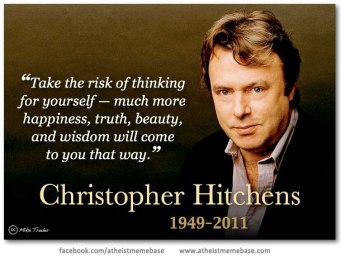 Retiring and moving to the Seattle area provided time for me to consider my beliefs in greater detail. I read more about atheism, and I started to write about it.
Then, a few months ago while meeting with my writer’s group, one lady asked me, “Do you consider yourself an atheist?” I didn’t answer the question right then. After more thinking, I knew that I had to say it. So, days after being asked, my answer was yes–I am an atheist.
I gave up on religion because it never worked. Perhaps it never worked because after I reached the age of reason, I never believed again. I wanted to believe, and I wanted it to work. Now, I know that was impossible. I accept that, and I’m pleased with the outcome.

I have few regrets about any of my life-long spiritual journey. However, I do regret that so many people consider atheism a dark, bad, evil thing. It’s not. Admitting my atheism freed me from the last of my self-imposed, people-pleaser bondages. Now, I need to find a pinball machine for Sunday mornings. Free again, at last.
May your spiritual journey lead to discovery of your personal truth. Let no one place limits on your life, so that you may grow and learn. We need not fear the truth revealed to us, by us.

 I can listen to a song and apply it to any time in my life–past, present, or future. Beautiful songs stir me emotionally. I have thoughts of love and family–those memories we carry with us. As I listen to lyrics, I contrive personal interpretation and meaning.
 Music mines deep into the treasures of our minds, hearts, memories, hopes, and dreams. It changes as we change, while it stays the same. May we enjoy music and the love songs that evoke our emotions. Let’s all find ecstasy in the music that makes us who we are; be we happy or sad, in or out of love, young or old. Let’s all dance to the end of love. And may that end be an eternity away.
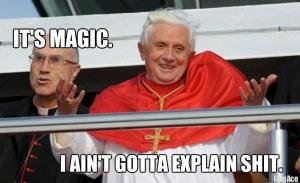 While I may not believe that supernatural beings exist (okay, maybe some duende), I still like to refer to unexplainable, cool happenings as magic. I try not to use the words miracle or miraculous in a serious sense. But magical works for me. If others want to use words like miracle to describe things, I have no issue with that. If the Pope wants to use it’s magic to explain anything, who am I to object?
 The origin of the word, or the concept of magic, seems to be rooted in the religions of ancient times.



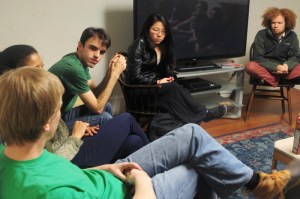 Personally, I don’t see why people shouldn’t discuss religion and atheism (or agnosticism or humanism, or any such subject), if they want. I realize two problems come into play. Human emotion and the need to defend turf, opinions, friends, or in some cases, a god.
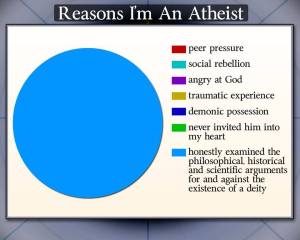
 You have to pass a test to be an Atheist. Did you know that? And the damn test never ends – you take it repeatedly. The questions may be the same, or they may keep changing. Every answer you give will be wrong. You’ll be forced to keep explaining and justifying your wrong answers. You may be criticized by your family and friends for not choosing the correct answers. Knowledge will not help. If you try to use science, you will be told that you know nothing of science. You’ll be given a grade of F for trying to use it to explain your position. If you dare to use logic or philosophy: F. History? F! God forbid that you use religion/scripture/dogma: F-minus.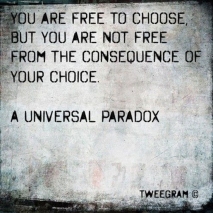

 What It Was Like
 I’ll spare you details. But during the 1990s all hell broke loose in my life and I thought it had gone into the proverbial toilet.
 I like to joke that I’m recovering from middle age. But, I am simply living my life. My life is good now, but recovery is an ongoing process. While many of my decisions may have been random, they seemed logical at the time. I was desperate, but knowing that I was not alone mattered.

 There are too many blocks to mention each one. We all sometimes have blocks.
 Einstein was interested in both creativity and music. He tied the two, even suggesting he would be a musician, were he not a physicist.
 er source your creative ideas flow, may they flow to you in abundance. May you be orgasmic, chilled and thrilled with ideas, concepts, and plans. May you make the best of all your days being creative and doing your thing (art, writing, music, etc.) and enjoying the universal gifts shared by others. May the spirit of duende haunt your heart and mind, thus bringing you to a spiritual bliss as only we humans can experience.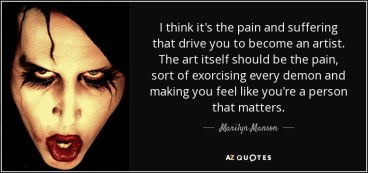
 I do believe that to a degree, suffering is optional. I’ve seen people suffer unnecessarily, and I’ve seen those same people get over it.
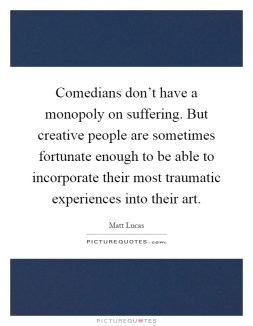 I think that what Liz bemoans is using suffering as justification to be creative, talented, or gifted, thus making an excuse for hanging on to the bottom. We shouldn’t suffer just because we think it improves our work. I’m concerned because I know people die on the bottom. I’ve experienced great things from living artists, suffering or not – nothing from the dead ones.
 To love what you do, and the love of doing it, even when it is gruelingly difficult (and maybe more so when it is) may be the answer. What I’ve read seems to recommend this. Love your art! Do it for the love of the work, the art, the creativity, the experience. As Stephen King says, do it for the “buzz.”



 Is it all that important to be a thin, white, dark-haired, strong, male member of this country? We seem to think so. I hope that continues to change.
 I am retired. All the shit/crap that I put up with for all those years of school (nuns-groan), yes, sir and no, sir; kissing up to very few idiot bosses (most were great), scrimping and saving and working – it was all worth it. As my wife would say, “Rave on, dog shit!” And so I do. Every day is a weekend and I can do what I want (with her permission—I’m old, not stupid) whenever.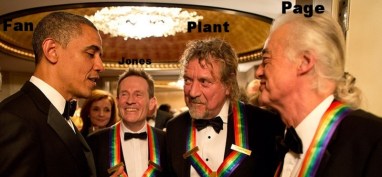





 Our Literary Journey