The day seven poem prompt of the 2018 National Poetry Writing Month challenge was for me to list my different layers of identity (son, father, grand and step-grandparent, retiree, white male, septuagenarian, poet/writer, hippie, etc.) — ways I could be described. Per the prompt, I divided those identities into two lists: what makes me feel powerful; and what makes me feel vulnerable.
I wrote a poem in which one of the identities from the first list (man) contends or talks with an identity from the second list (sensitive man). This poem reflects the doubt seemingly inherent in that conflict.
A Pocket Full of Doubt
Walk tall and proud to be our one man
Carry strong your body, mind, and be of good spirit
Hold on to what’s yours as tight as you can
To be a man, my son, inside you can’t feel it.
It ain’t me. It ain’t me. But a man I must be.
Stand honest and truthful, be a real man
Sense love and sadness and touch with your soul
Let go of yourself, as alone you must stand
Into the soul of men, you must never there go.
Can’t you see? It just ain’t me. Like so, a man I can never be.
So, of two minds you continue to fight?
Two spirits, one soul we continue to see
Where is the truth to set this man right?
Conflicted as such, you’ll never agree.
Let you be the man. The one we can see.
…….A man such as this can never be free.
(Bill Reynolds, 4/7/2018)
Look both ways if you’re of two minds.
In the gaps lie the answers, so mind what you find.
Taken from the epic and ancient poem Beowulf, Grendel, the first and most terrifying monster in English literature, is said to be a direct descendant of Cain, the first biblical murderer. This poetic story of unknown authorship barely survived the atrocious monastic destruction perpetrated by Henry VIII in England. One copy of the poem survived, and it had to be patched up in a few places. But we do have it.
Beowulf may be the oldest example of English (nothing we might recognize) language literature. Dating back to about 700 to 1000 AD, it deals with life and culture around the sixth century. The story is set during a time and in a place when battle, conquest, and death were honored descriptions of what life was like.
The protagonist is Beowulf, a young, strong, and powerful warrior who eventually becomes a king. Unlike the average leader of the time, Beowulf seemed to care about his people and introduced leadership with compassion as opposed to fear and dread. Beowulf must defeat three antagonists: Grendel, Grendel’s mother, and the dragon.
A mead hall
The story tells us that Grendel had been attacking and killing Danes every night for 12 years. Beowulf comes to the aid of the Dane king whose mead hall had been under nightly attack by the monster.
If Beowulf was to fight Grendel to the death on Grendel’s terms, it would be unarmed and (presumably) naked. Since Grendel used no weapons, Beowulf chose the same. Grendel had done a lot of damage and killed many of the king’s mead hall drinkers in his years of harassment. In the poem, Grendel is presented as an evil that must be stopped and Beowulf is the man to do it.
Flash forward a thousand years or so, and in an interesting twist, another side of the story is told in the 1971 book by John Gardner, titled, Grendel. In this frequently banned book, Grendel tells his side of the story. This is a retelling of Beowulf that follows the monster Grendel as he learns about humans and fights the war at the center of the Anglo Saxon classic epic.
I have always felt that there are at least two sides to every story, but one must wonder what the Danes were thinking when they returned to the mead hall every night for 12 years, there to drink and sleep, only to be attacked by the monster. With so many being killed during so many attacks, the Danes must have been close to decimated before Beowulf made his mark.
Open the window and look both ways, the monster approaches.
Mind the gaps as you escape his anger and his vengeance.
The day six prompt of the 2018 National Poetry Writing Month challenge is to “write a poem that stretches your comfort zone with line breaks. That could be a poem with very long lines, or very short lines. Or a poem that blends the two.”
I wrote the poem, but the words? Perhaps you recognize them.
My Affirmation
calmness
serenity
comes to me
the universe I cannot see
change
or control
grant them dignity
to be
as they are
humanity…mine…yours…theirs
face change with
wisdom from experience, peace through acceptance, knowledge of listening
with silent love
and…
it
all
begins with
………………………….me
(Bill Reynolds 4/6/2018)
Alertly relax as you look both ways. Fear not gaps but be mindful.
Two hundred years ago in London, on 1 January 1818, 20-year-old Mary Shelley anonymously published the first edition of her novel, Frankenstein; or, The Modern Prometheus.
Mary was 18 when she wrote the book, the genesis of which goes to the topic of galvanism and other occult ideas that were themes of conversation among Mary and her companions, particularly her lover and future husband, Percy Shelley. Mary, Percy, Lord Byron, and John Polidori competed to see who could write the best horror story. After thinking for days, Mary Shelley dreamt about a scientist who created life and was horrified. Her dream evolved into the novel’s long-famous story.
The problem with this story is that history, Hollywood, and human imagination have been unfair, if not unkind, and inaccurate regarding Victor Frankenstein’s creation. Even Victor was too quick to judge by outside appearance, unpleasant as it undoubtedly was. In Shelley’s book, the outcome of Frankenstein’s experiment is never given a name, although the creature did suggest that he was Victor’s Adam.
At first, the creation is kind and gentle and only wants to be accepted. The creature was eight feet tall and ugly and he knew it. Yet, he sought life and normalcy, but he could not achieve that due to the fearful nature of mankind, and specifically Victor Frankenstein’s fear of what might happen.
I find it interesting that even in the mind of an 18-year-old girl 200 years ago, the innate goodness of a man’s creation can be judged as evil before ever doing anything but kindnesses to others.
One hundred thirty-six years later, the first human body part/organ transplant is completed. Numerous human lives have been extended through science and organ donations and transplants. I would not say we take that for granted, but we’re getting close and for some tissue, there are insufficient donors. One organ not transplanted is the human brain. I have read that it is the one donation where the donor would be the greater beneficiary in the process.
I wonder how Mary, her husband, and their circle of friends would react to the knowledge of today’s reality, scientific knowledge, and literary fantasy if they could suddenly be here and learn about it.
Lord Byron wrote his poemDarkness about the same time as Mary Shelley wrote this book. Given the nature of the book, the poem, and earth during 1816, I do wonder if his poem came to be for similar reasons as her Frankenstein story.
‘tis a dark world after all.
Skeptically, look both ways,
yet apply judgement of others and their creations carefully.
Mind the gaps in your own humanity.
I’m ditching part of the NoPoWriMo, day five, “optional” prompt (assignment?), cuz I dunna get it. It is to write a poem that “reacts both to photography and to words in a language not your own.” I have enough trouble with English.
Instead, I wrote to a photo of a mirror and an essay, both very much my own. You can read the essay by clicking here. I need to credit Yolonda (meh wifey) for this inspiration to write a poem based on that piece which has been judged both the best and the worst thing I have written.
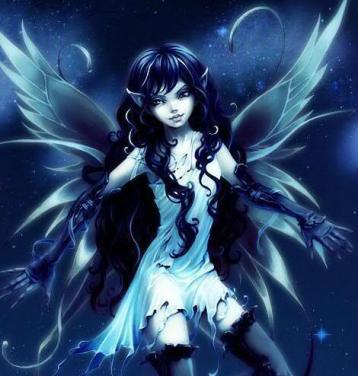
The Elf has evolved into a category of beings, as opposed to a specific creature. As with the word human, to get the picture of an individual elf requires more information. Just as there are all kinds of humans or people (it takes all kinds?), there exists many types of elves and elven mixes. Yesterday, I spoke of the drow, or dark elves, just one sub race.
While the original concept of elves was Norse (álfar) or German, modern fantasy literature depicts elves as an almost divine race of beings with human stature and appearance, friendly natures (minus those from the dark side) and pointed ears (a must to my mind). The elves of today are different from traditional elves found in Middle Ages folklore and Victorian era literature.
The long and pointed ears seem to have started with Tolkien noting that the ears of elves were leaf-shaped. The length and shape of their ears depends on the artist, medium, or round-ear in question. I prefer pointed ears, but not the long ones like a donkey might have.
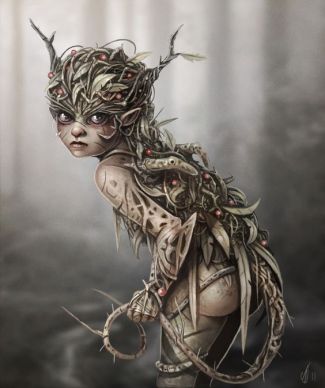
Wood elves are close to nature.
Modern fantasy elves (evolved from D&D or other role-playing media) may be immortal or slow maturing and long living compared to their humanoid cousins. They are also more attractive, smarter, gifted with magical power, and have a sharper sense of reality. Pure-blood elves do not possess facial or body hair. They are seldom portrayed as fat, lazy, or old.
Today, thanks to Tolkien, there are elf languages that have evolved and are often taken seriously and spoken by dedicated role players. Click here to get more information on the Elvish language.
The many types of elves include wood elves, high elves, aquatic elves, light elves, dark elves, sun elves, moon elves, forest elves, and savage elves. Even if you’re not an elf aficionado, you still should get the picture. If you are, you can add to the list.
Elf Legolas Greenleaf (Orlando Bloom), in The Lord of the Rings
Elves are more ancient than humans or other races and flourished in a sort of Golden Age forgotten by other races. The mixing of elves with other races is interesting in that it is a mix of the real world, with all its limitations, and fantasy worlds with its unlimited imagination.
If you discard the elf on the shelf and the comedy movie, Elf, staring Will Farrow, the best known modern elf is probably the archer Legolas Greenleaf, portrayed by Orlando Bloom in The Lord of the Rings film trilogy. Arguably Tolkien’s best-known elf. Good clips from the movie with great sound.
Cautiously, look both ways in fantasy and reality.
Mind the gaps if you mix the two.
The day four prompt of the 2018 National Poetry Writing Month challenge is “to write a poem that is about something abstract – perhaps an ideal like ‘beauty’ or ‘justice,’ but which discusses or describes that abstraction in the form of relentlessly concrete nouns.”
I used an essay I posted in December 2017, as an idea for the abstract noun tranquility. The concretes were the sights, sounds, tastes, and smells that led to the abstraction. You can read the essay if you click here.
Tranquility Remembered: the sounds of silence
My young mind was filled with thought
As I walked, no music or sounds I’d hear
Only deep moans from snow as I crushed it below
A cold white blanket on my pensive dark thoughts
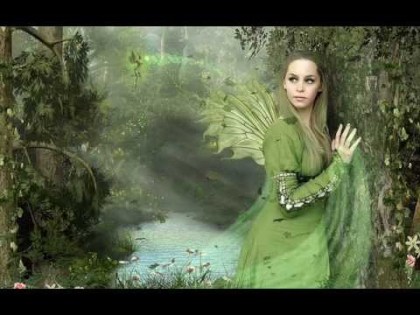
Fairies, charming and peaceful my footsteps they heard
They opened my eyes to tranquil aura yet silent
I saw in the darkness a light with no sound, but
The sweet sounds of silence sent aroma that night
My thoughts melted away into the image of stillness
I heard not a hush of sound cut crisp cold calm air
A silence of power and of peace lifted me up
The flavor of quiet and snow calmed the darkness
Like the artistry of a perfectly painted picture
A vision of nature stillness lived in my brain
That moonlit night not long ago
in halo of street lights and a
reflection of memory of new lying snow
I remember the cold night
I remember the sounds and the silence
I remember the calm peaceful taste of tranquility
I remember I Remember I REMEMBER!
(Bill Reynolds 4/4/2018)
Fill the gaps with memory.
Look for beauty both ways.
I have never played D&D, but I wish I had. When it was popular, my kids played the game. Since writing about these creatures, my daughter has invited me to play D&D with her, her hubby, and the grandkids. I discovered on-line role playing several years ago. That was when I learned how little I knew about elves, and I met my first elf who was a member of a sub-race of elves known as drow.
Of all fantasy creatures, I find elves to be the most interesting. They’re followed by dragons and leprechauns. That is a lot to write about. If we add reports and stories on other humanoids, such as dwarfs and hobbits, a literary subfield within fantasy emerges. Since elf crossbreeding, particularly with humans creates an exponential growth of character possibilities, contemporary story telling became fascinating for both creator and consumer.
If you’re not a fan of D&D or role play (RP), you may assume things about elves regarding stature, intelligence, and friendliness which are likely incorrect. In each case, I was wrong. They’re not little, stupid, and sweet. Admittedly, Santa’s helpers at the North Pole do little to correct the stereotype, but all is fair in fantasy and myth.
Dark, or black elves are from Norse mythology and thought to be the ancestors of the drow. These elves are usually considered to be evil in the inborn, bad seed sense. Yet there is ample evidence for a human-like nature versus nurture conflict and all drow cannot be depended upon to be as wicked as others.
Drow have dark grayish skin. Since they are given to self-decorating, green and even purple colors can also be found. Their hair is naturally white, whitish or yellow, but here again, drow know about hair coloring techniques. Female drow are dominant, being both stronger and slightly larger than males. As with all pure elves, neither sex is capable of beard growth. While eyes are normally red, colors can range. With crossbreeding, even human green or blue eyes are possible. But, if you want to see something spooky; a red eyed, dark-skinned drow can tilt your freak meter.
While drow are unwilling underground creatures, they are most often found by non-drow to be above ground for the obvious reason that subterranean existence for a non-drow creature is as a slave to the drow, if survival is even possible in such a wild, violent place.
Drow fight with anyone, and other drow are never off the hook. That helps to keep their numbers down, since when they do get along well with each other, they are also very prolific producers of offspring.
As with all elves, drow live long lives if they manage to avoid a violent and early death. Again, given all their magic and power, it is their inability to get along that manages to keep the population in check.
Despite what sounds like an evil appearance, drow are attractive elves. This causes surface dwelling races to tolerate drow presence if they behave in a non-drow-like fashion. Surface races of elves and other humanoids have been known to inbreed with drow yielding interesting, yet confusing, results: both good and bad.
Drow are fast, agile, and in their opinion smarter than all other humanoids including other elf groups. The most natural and overwhelming feature of all drow is their phenomenal sense of entitlement. While this can be an annoying and dangerous trait, like so much else regarding drow, it is difficult to tell if it is innate or cultural. Drow culture reinforces all forms of evil within their race beginning at a very young age.
Mind gaps to the world of the drow.
Look both ways as elves are poor drivers.
The third day prompt of the 2018 National Poetry Writing Month: Write a list poem in which all the items are made-up names. This poem is based on a tongue-in-cheek look back at working from the perspective of retirement.
NoMo’ WorkShuns of Retiremeizations
No mo’ traffic commushuns
No mo’ Monday bluesifications
No mo’ burnt coffee offeringtoshuns
No mo’ why I’m late excuzations
No mo’ performance evauliebations
No mo’ worrying about promousayshuns
No mo’ office gossip whosaytions
No mo’ workmate envy whodaypaytions
No mo’ idiot bossbigheadiztions
No mo’ recovery vacatoshortations
No mo’ meeting bordeathpations
No mo’ engineering gobbledygookovations
No mo’ organized rejobmobettatryzations
No mo’ more with lesspraystaions
No mo’ work aggravation peepsalazations
No mo’ monthly disgruntiliations
No mo’ hallucinational goalaberations
No mo’ feckup fairy malfunctioniztions
No mo’ maybenots of probationosensations
(Bill Reynolds 4/3/2018)
Working or retired, look both ways.
Mind those workday gaps.
The Khimaira (Chimera or chimaera) was a three-headed monster. If ya Google it without the mythology tag, most options will be links to ghost fish or sharks. This is no fish story.
Like so many monsters of Greek mythology, The Chimaera was the offspring of couple of monstrous sweethearts named Typhon and Echidna, a pair I envision as sort of an Adam and Eve couple of the Greek Mythological Monster class.
This bizarre, fire-breathing cat had the body and head of a lion (good so far). But peeking over its shoulder was a goat’s head rising out of its back. The beast had udders like a goat (no idea why). Away from the business end, the ubiquitous mythological snake rounded out the creature’s tail, with serpent’s head at the very end.
Since nothing good could possibly spring from the union of Typhon and Echidna, this beast ravaged the countryside of Lykia (Lycia) in Anatolia, which is on the southeastern end of Turkey. Contemporary Turkish history does not jibe well with older Greek myth, but at the time it all fit nicely, if fearsome.
As the story goes, this Chimaera cat was just kickin’ ass all over that part of the world until a hero named Bellerophon came on the scene. He was either asked or commanded, depending on who is doing the telling, by King Iobates to kill the beast.
Bellerophon rode into battle on the back of the winged horse, Pegasus, of course. He sought and found Chimaera and drove a lead-tipped lance into its flaming throat. So, the big cat-goat’s fiery breath melted the lead tip, promptly choking the beast on hot molten metal. Lead poisoning for sure. So, the beast died from sucking on a lead popsicle, Greek Mythology style.
Turkey has never been known for its geological stability. So, later classical writers believed the Chimaera creature was a metaphor for a Lycian volcano, of which there almost certainly were several.
The Chimaera can look both ways at the same time
and the snake can keep its eyes looking backward.
So, mind the gaps.