Song Lyric Sunday – Last

Unfortunately, Helen has had a difficult week. But, bless her heart and soul, she managed to recover enough to give us today’s Song Lyric Sunday theme: Last. I glommed onto Mary Jane’s Last Dance written and sung by Tom Petty (and the Heartbreakers).

The video is a bit weird in my opinion, but it’s all part of the game. Enjoy.

Mary Jane’s Last Dance (Tom Petty)

She grew up in an Indiana town
Had a good lookin’ momma who never was around
But she grew up tall and she grew up right
With them Indiana boys on an Indiana night

Well she moved down here at the age of eighteen
She blew the boys away, it was more than they’d seen
I was introduced and we both started groovin’
She said, “I dig you baby but I got to keep movin’…on, keep movin’ on”

Last dance with Mary Jane
One more time to kill the pain
I feel summer creepin’ in and I’m
Tired of this town again

Well I don’t know what I’ve been told
You never slow down, you never grow old
I’m tired of screwing up, I’m tired of goin’ down
I’m tired of myself, I’m tired of this town
Oh my my, oh hell yes
Honey put on that party dress
Buy me a drink, sing me a song,
Take me as I come ’cause I can’t stay long

Last dance with Mary Jane
One more time to kill the pain
I feel summer creepin’ in and I’m
Tired of this town again

There’s pigeons down in Market Square
She’s standin’ in her underwear
Lookin’ down from a hotel room
Nightfall will be comin’ soon
Oh my my, oh hell yes
You’ve got to put on that party dress
It was too cold to cry when I woke up alone
I hit the last number, I walked to the road

Last dance with Mary Jane
One more time to kill the pain
I feel summer creepin’ in and I’m
Tired of this town again

Songwriter: Tom Petty. Mary Jane’s Last Dance lyrics © Warner/Chappell Music, Inc

Look both ways, first and last.
Mind the gaps – consider the past.

Click graphic for link to SLS page.


Essay: When and What Day is it?

Writers are story tellers and researchers who dig up things after getting lost running down rabbit holes. Mix in some historian, astronomer, anthropologist, math stuff, superstition, and observation of nature and mankind, and we charge into where only rabbits need to go.

My rabbit hole excursion involved time and our (USA/European) calendar. I’ve written about this before – Christmas in August, for example. So, I did some lookin’ stuff up.

Our clock time is based on a 24-hour day, determined by one 360-degree axial rotation of the planet. Calendar time is determined by the full orbit of the earth around the sun which takes 365.256 days. The spinning and orbiting do not come out even, so we have that .256 of a day to deal with. Thus, leap year and February 29th. But there is also the problem of the .006. If you don’t compensate for that, over time, things get off. It has happened.

What gets off? Easter. We had to get a grip on Easter. The solution was a new calendar. Can you imagine?

Computing the exact date of Easter is called computus. Obtaining an accurate calendar was one time when science, or observed reality, served the needs of religion. The Church needed to fix this. So, they did. And with the help of more than one mad scientist.

No shit folks. They feckin’ lost Easta and had to hire a guy to find it!

From first being questioned in 325 AD at Nicaea, it took more than 1,200 years to fix – hundreds more to get the Greeks and Turks on board.

Most of the world now uses the Gregorian calendar named after Pope Gregory VIII. It eventually replaced the Julian calendar due to the timing error. That six thousandths of a day made a big mess. But even with all of that, since Eastern Orthodox and Protestants were suspicious of everything the Roman Catholic Church did, it took hundreds of years for the Gregorian calendar to be adopted. The Pope’s authority was limited.

To bring on the new calendar in 1582, and to get dates properly aligned, 4 October was followed by 15 October, thus jumping 11 days. For approximately 500 years the world had two calendars (really it was more) due to religious mistrust within Christianity.


It took almost 200 years (1752) before England made the leap and adjusted from 2 September to the 14th. Historical rumor claims there were riots in London. The last European countries to officially adopt the ‘new’ calendar were Greece and Turkey in the 1920s.

I counted 34 different calendars in use world-wide this year (2018 or MMXVIII). I learned that horology is the name for the scientific study by horologists of time and the making of time pieces/clocks. I could not find an equivalent for calendar experts.

Time (Earth’s rotation on its axis) and calendar, (Earth’s orbit of the Sun) are closely tied, but the sources of measurement are literally astronomically different. We have time zones and an international date line, but we have no such logical place to start or stop measurement of a year.

Lunar phases come into play and there are lunar calendars. The Church had to deal with them, because of Easter. I know the moon is a big deal (especially when full), but I am writing a one-day blog, not a book. Back to my point.

When does each year begin? Whenever we say it does. Tradition and Greg’s calendar say we begin each year on January first. Why? Who says so? A long-dead Pope?

Another confusion issue with the Gregorian calendar is that it was adopted proleptic, meaning that dates prior to its 1582 inception were extrapolated back in time. For a long time, dual calendar dating was common. Born on 5 October 1254? Not so fast. All that work for a good, accurate calendar.

So, what day it is may depend not only on what religion you are, but also on what sect or denomination of the religion you are, what culture you belong to, and what calendar you are using.

I am thinking of the words in the song by Chicago, with a similar title, “Does anybody really know what time it is…” Do we care what day it is? Yes.

Currently, a new year begins when we are about a week into the northern hemisphere winter. Nothing really ends or begins after 1 January, just some ‘back to’ stuff like school or work, the grind, the salt mines. It’s depressing.

The new year should begin the day after Labor Day, in early September. It just makes more sense. The first Tuesday after the first Monday (Labor Day) would be when the year begins with a four-day weekend. Just move Auld Lang Syne and all the other new year’s traditions back a few months. Football would be just beginning instead of ending. Summer would be almost done, instead of the beginnings of winter.

Fall is already the holiday season. It’s when school begins and life changes. What mo’ betta’ way to bring in the New Year?

Get rid of Columbus Day (or whatever you call it, apparently, he was a dick anyway) and make Halloween a day-off – a real holiday. Pass a law that every normal person must costume up and wear a mask. Instead of trick-or-treating, kids must sing songs for money or candy. Make the day after Halloween even more spooky. Maybe graveyard parties? Bring back Decoration Day but make it Night. Cool!

Vet’s Day is good, but can we move Thanksgiving to something other than a Thursday? If we go with Friday, we can have Black Saturday, Purple Sunday (or Advent day one), and Cyber Monday, as is.

Pass a law that every kid with a birthday in December must have a party (and a good one) in June or July. Require gifts for the first 6 years. Align all the other holidays with Christmas and Yule and make the celebrations 12 days long. Light candles. Or move Christmas to August, as I’ve previously suggested. Think of it. All those f**king Christmas decorations gone by Labor Day (another law).

After New Year’s Day, add Saint Patrick’s Day as a day-off federal holiday and call it Green Day. Require everyone to wear green, drink beer, and eat corned beef and cabbage. Have a similar day for every other immigrant ethnic group there is. If an Indigenous People’s Day is needed. I suggest May first. Wait. What day was Custer’s Last Stand? Make it late June and make Juneteenth a holiday, too.

End the school year on or before June first. Make summer work vacations 20 days long. Require everyone to travel and to spend money with friends and family and to have fun for two weeks. The other six days are for trip prep and recovery. It would be an economic stimulus of the happy kind.

We determine how this goes. We, the people, make the decisions. Pass a law making it illegal for elected government officials not to do what we want. Add a law that jails them if they do not do the things they promised to do while campaigning. Include all presidents. Demand a new government agency to determine and ensure that everyone has life (health), liberty (freedom to choose), and happiness (even if they must go to the dentist sometimes).

But first, let’s fix the damn calendar. Remember, Labor Day is the last day of the year and the following day begins the new year, no matter the date. It would dress up one Tuesday of the year for someone and she’d get all sorts of Happy New Year wishes. A lot could change, until the following Tuesday.

Have a good time. Does anyone know what day or time it is? Does anyone really care?

Look both ways regardless of the days or what culture says.
It is only 2018 if we say it is,
and there have been calendar gaps for as long as
this mote of dust has hung on a sunbeam.

The most inclusive happy holiday song ever. A fun watch, if yer up to it.

Essay: Thanklessness

Gratitude

Some say it’s the least felt of human emotions. That may be. It seems to be the feeling least written about from a mental health professional perspective. And yet, I’ve read that grateful people are happy people. Are they happy because they’re grateful, or vice versa? I should know because I consider myself one of them.

I am uneasy when people thank me for my military service. While there were days I would not want to repeat; some of those memories are among my best. It was my career – my profession. If people were silently grateful, I’d manage. I used to humbly balk at such comments, but I soon learned to say thank you and move on.

I was walking down a street in Crystal City, VA (just outside of Washington, D.C) with a US Marine Corps colonel. We were headed for a meeting. He was in his uniform, but I wore civilian clothes. As we were waiting to cross the street, an attractive young lady walked up and shook his hand as she thanked him for his service.

After she left, he said, “Since being married, I no longer know how to handle situations like that.”

I replied, “Next time, introduce your Air Force friend and I will take it from there.”

The value of gratitude to our overall mental health is well known. I know of no self-help book that suggests being thankless. Everything from gratitude lists to National Holidays inspire us to be reflective of those things and people we feel have improved our lives.

A Memory

My favorite gratitude story involves the son of my wife’s sister. She had six boys, of which Scott was the youngest. Whenever we visited his family, I would find time to play with Scott. Be it baseball, football, basketball, or some other similar endeavor, Scott and I interacted and played – just the two of us. It never occurred to me, as the youngest boy, Scott’s five older brothers had better things to do. And his father, a borderline workaholic, had been worn down by the first five boys.

Eventually, Scott grew up, got married, and graduated from Texas University. He and Sarah had two lovely daughters. I enjoyed my time with him and never gave it another thought after we had both moved on with life.

Scott matured into a handsome, well-liked, and friendly man. Everyone liked him, despite his reputation as a clever prankster.

On a visit with Scott and his family, he asked to speak with me alone. After we retreated to a private area, he said, “I want to thank you for all those times you played ball with me when I was a kid. No one else did that and I have never forgotten. It meant a lot to me. Thank you.”

By being me and playing with some kid, I created memories for him. Now, my memory is of his expression of gratitude. Within a year, Scott had died of a congenital heart problem. When I learned of that, my first thought was of our chat.

‘Thankless’ Employment

I’ve had some experiences with work-type situations some people call “thankless jobs.” While I understand what they mean, I can never get my brain around what a ‘thankless’ job is.

As an additional part of my real job, I once volunteered to be a Facility Manager for a large building where several hundred people worked. I was paid nothing extra.

A few months into the building job (which my wife titled Permanent Latrine Orderly [PLO], from the movie No Time for Sergeants), I realized that all my voice mail messages were either new problems, or comments about on-going issues related to the building, not my real job. I liked the challenges and the idea that my efforts made a better place for people to work for nine hours or more each day.

I also enjoyed the times people expressed their gratitude to me for doing such a ‘thankless’ job. Even with that irony, I also liked when people sent emails to my boss telling him how much they appreciated what I did. He let me know. One day he introduced me to some visiting VIP as his Facility Manager rather than my real job title. Was that a slip-up, or was it because he most appreciated my building caretaker duties? Thankless? I think not!

Thankfully Happy Few

I admit, as Harvey McKay titled a chapter in How to Swim with the Sharks Without Being Eaten Alive, gratitude is (or may be) ‘the least felt of all human emotions.’ But I also know when we think about it, we are usually grateful.

It’s not a perfect world. We have a fair share of ingrates and thankless souls wandering around. But thankless is the other side of what we ought to be, and most of us seem to know it.

I further admit knowing some who fear happiness. They are normal when complaining or worrying. In those cases, we either simply wait for it, or we speed things up by asking, “How are you doing?”

Their answer is, “Well, let me tell you about it….”

There’s nothing wrong with having an attitude of gratitude and it may even lead to a healthier and happier life. Yet, I’ve known some very happy, but cantankerous old farts who relish the chip on their shoulder. Good for them.

The only thankless jobs are the ones we don’t want. People have been treated for long term depression, only to find relief with a job change. It happens.

And the only thankless people are the poor souls who may be struggling with their own sorrows, problems, or demons.

And isn’t happiness what we ultimately want? I think so.

©Bill Reynolds 11/26/2018

Look both ways for health and happiness. Mind the gaps. They may harbor traps.

Song Lyric Sunday – First

Helen’s theme for today’s Song Lyric Sunday is first. It took me a few minutes (ok, over 30) to turn up something from my play list. I selected The First Time Ever I Saw Your Face by Roberta Flack. The video is a cover by George Michael with lyrics. One of the all time most beautiful songs, in my opinion.


The First Time Ever I Saw Your Face

Roberta Flack

Songwriters: Ewan McColl — The First Time Ever I Saw Your Face lyrics © The Royalty Network Inc.


Look both ways and listen to beautiful music.
Mind the gaps and fill them with love.


Click graphic for link to SLS page.

Poetry: What Love is this Love?


And then she kissed him.


Have humans always loved?
Have we always loved as we now do?

Will there always be a forever love? And
is it true – as they say, love conquers all?

What is this love, which we feel but not see?
Or do we see love? How long do we love?

What is the paradox of such love?
Is it that we have only one word
for so many different loves and types of?

©Bill Reynolds

“…I would like to beg you … to have patience with everything unresolved in your heart and to try to love the questions themselves … to live everything. Live the questions now … then, someday … you will gradually … live your way into the answer.” ~ Rainer Maria Rilke, 1903, Letters to a Young Poet.


For all things and every day, but most especially in love, look both ways.
The gaps will always be there — in your mind.
Live into your answers.


I wish for you and yours a wonderful holiday season.

Poetry: The Whole(y) Trinity (Earth+Rain+Sun) +Air

Our Earth is breathtaking, awe-inspiring, magnificent, wonderful, amazing, stunning, staggering, imposing, stirring, and impressive. It’s also formidable, fearsome, mind-blowing, jaw-dropping, marvelous, and wondrous.

I

It is pure coincidence when the sun and I rise together.
Some mornings, I get to see him peeking through smoky cloud,
other times he is in full blast before I notice the lightness
of another day, I might say, he’s looking kind of gray.
We need the sun. Without sun, we are none, no life begun.
But too much sun is less than fun for those of us
who’d a fair-skin mum, with sun’s-red or blonde hair.
Here come the sun, with promises of things not done.

II

‘tis all the same with the rain, hello, this is nature’s sweetest gift.
The water of life, with two hydros and one oh, of it we drink
vapes up to the sky, but not to the sun, to meet
with clouds of wonder before coming to cleanse
and to make things grow, sometimes as ice, or maybe as snow.
To make us a soup the plants may drink and we of the flesh,
must readily use to be mostly moving bags of water —
no rain, no water; no water – no life, but we have for us
the rain and rain and water and life that needs rain.

III

The earth, the dirt and the dullest dust of all things come and gone —
the coat of soil, six inches deep, worn by the planet is key to it all.
Type of soil names go with what it does and may sound human,
like Clay, Loam, Sandy, Peat, Rocky, and Chalky all improved
with organic things of life gone past, soil is often used for art,
but add the seed then wait to see the growth of life and us to be
mixed and matched and combined with time, then add and mix
the sun and rain and plant life comes, and air is there, and life
of animals and we are they. Care for it all if you plan to stay.

IV

Deep sigh for air and sky. Ya know, lads and lasses, it seems
brother air was not always there, but he’s a changeling contrivance
subject to manipulation with a chemical touch and that is, you see,
what all the fuss truly is and what it’s all about. The magic of
the other three working together (with the sea) brought to be
what we now suck into our lungs and over our tongues the air
the plants brought forth by a wonderful trinity of symbiotic
relationships giving life (recently to us) — for a time. How long?

©Bill Reynolds 11/19/2018

Look both ways in matters of life and nature. They’ve been here longer than us.
Mind the gaps with open-minded caution, discovery may one day fill them with knowledge.
All life, all earth is one. Let’s not fuck this up.

Song Lyric Sunday – Listen

Two posters and a 20 album cover montage (just saying).

I was early to bed last night so I did not see Helen’s Song Lyric Sunday theme until this morning: Listen.

The Beatles classic was in my brain, ears, eyes, and on my tongue as my lips whispered the words, “let me whisper in your ear.”

This bit of boomer nostalgia is less than two minutes.

Lyrics: Do You Want to Know A Secret
You’ll never know how much I really love you
You’ll never know how much I really care
Listen do you want to know a secret
Do you promise not to tell woh woh woh closer
Let me whisper in your ear
Say the words you long to hear
I’m in love with you oo
I’ve known the secret for a week or two
Nobody knows just we two
Listen do you want to know a secret
Do you promise not to tell woh woh woh closer
Let me whisper in your ear
Say the words you long to hear
I’m in love with you ooooo

Songwriters: John Lennon / Paul Mccartney
Do You Want to Know a Secret lyrics © Sony/ATV Music Publishing LLC

Look both ways, but the music of your youth never goes away.
Mind the classical gaps.
Click graphic for link to SLS page.


Greetings, My Fellow Humans

Note: Dear beloved English teachers, current and past, I realize every sentence is not a complete sentence. It is intentional. Sorry.

For those of you not of my generation, may you be so lucky as to become old someday, to grow wiser than ever, and to be an able matriarch or patriarch of your tribe. May you be honored for your past, cherished for wisdom today, and be a loss lamented when your time happens.

My wife Facebook shared/posted a (much too) long epistle that numerically listed 21 items of advice for old people (like we effing need it). I don’t agree with most of it. My oldest (adult) son made the sarcastic comment (it’s in his genes), “Dad’s always been on top of the latest fashions.”

I never wear socks with sandals (matured in 60-70-80s), checks or plads with stripes, or color combos that make my wife wince. I wore a uniform for years, then (after a period of high-casual) went as laid back as I could pull off.

I was once asked by a fellow manager how I ran a department where employees (include me) dressed casual Friday, Monday thru Thursday. He told me he asked upper management and got an emphatic ‘NO!” My response was, “I didn’t ask.”

But, Billy has a point.

My below the waist wardrobe: shorts, sweat pants, or jeans (clean underwear). Feet: usually short socks, slide-on shoes of some kind with rubber soles (no crocks), maybe laces, rarely sandals, very temperature dependent. I rotate sneakers but have some for rain and some for mud.

Upper bod gets things with no buttons like an old (maybe new) tee, or pullover long sleeve thingy, or sweatshirt. Formal shirts have collars like golf/polo type. Have some mock turtlenecks for when I feel all cool Pat Conroy, John Updike, or Patterson-ish like.

Dark color, pull-over sweaters for my shady moods and gloomy times of Peter Reading, Poe, Blake, e. e., T.S., A.E., Ezra, or G.G. Lord Byron-ish days. I have them.

I wear baseball (sometimes newsboy/Irish eight-piece/flat) caps.

I have clothes I no longer wear (since retired): Docker-like slacks, dress pants (not sure what still fits), sport coats covered to keep dust off, ‘nice’ long-sleeved button-down shirts (dusty), leather shoes (no wingtips or suede).

One pair of hiking boots I also use for motor scooter rides. I do have variations of workout garb that changes with the weather. A mix of sweat or beach hoodie thingies (how cold is it?) including a red rain jacket. Casual jackets, several of which I cannot recall ever having worn. I have my USAF leather flight jacket that screams ‘you put on a few’ when I wear it.

At home, it’s about how I feel. Out, it depends. I may be professor R.J. at the library, but more Chinasky at the pub. Writing at coffee shops is mood-determined. On my worst low-casual day, I look better than half the peeps in Wally World (maybe more than half), but who cares?

The last time I wore a tie either somebody died, got hitched, or I was being paid to dress like that. I have tossed a ton of ties, but a dusty dozen remain in my closet with all those belts. I wear one belt and only with jeans, but have beaucoup backups.

I try to keep my hair cut short (no old man pony tails for me, thanks), I brush and floss daily, walk about 2mi a day (when motivated), swim a bit more than that in week (shower daily after swim), sit way too much at this computer, go to one or two ‘social’ events a week, read not enough, watch some (too much) TV (The Voice, NCIS [needs me to write for them], Chicago PD, Fire, Med-maybe, an occasional Netflix movie or documentary, Bull a bit, some football [maybe]). If I go to the movie (or other) theater, I will dress medium casual, but at home…eff-it.

I really do care.

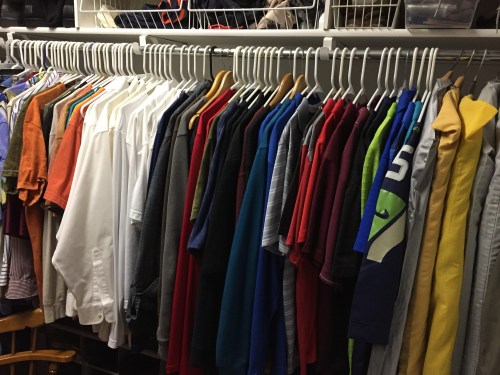
So, what’s up with (in) my closet? An old flight suit that no way would ever fit again, covered sports jacks and an old Class-A, USAF uniform (‘when I wore a younger man’s clothes’), too many shirts of which I wear less than half, pants that if not jeans I never wear, and two baskets for shorts, sweat pants, and miscellaneous whatever.

In drawers I have socks (mostly over-ankle types worn less than one day a week, if it is a socks day), underwear of which some %-age always needs tossed out, more tees, and too many pull over sweaters (all of which I like and do intend to wear, [see mood comments above] but I live in Texas). ‘tis the season, though – twenty-five degrees here this morning, which is why I sit writing this instead of out humpin’ for my 2 miles. Do not hang pullover sweaters on hangers. It gives them (you) shoulder bumps.

Okay. The truth is that I am an old man who basically does WTF he wants and has a dress and grooming code/standard bar set at ‘somewhat’ acceptable, if anyone cares. I do not wear stink (fragrances like cologne or after shave). Me? A fool? I think not; but passionate? Hell, YES! (Just not about my rags.) So, let’s end this with a poem by Yeats.

A prayer for old age by WB Yeats

God guard me from those thoughts men think
In the mind alone;
He that sings a lasting song
Thinks in a marrow-bone;
From all that makes a wise old man
That can be praised of all;
O what am I that I should not seem
For the song’s sake a fool?
I pray—for word is out
And prayer comes round again—
That I may seem, though I die old,
A foolish, passionate man.

Intense?

Look both ways on the closet rack and ask, “why do I have?”
Mind the gaps in the closet, for a tie’s a poor gift to an old man who’d be tickled with a kiss.

An allegory of conclusion

The Man in the Room

I don’t recall exactly when I learned a man was in the room. I’m sure someone told me.

For years, I watched as other people behaved as if they knew he was there. This was serious business. People (called martyrs) died because of this man. As a child, I never doubted what I was told about the man in the room. I not only believed he was there, I also knew a lot about him. He was old with a long gray beard, but handsome. He was quite distinguished and grandfatherly.

The man in the room was more important than anyone, even more than the President or the Pope. The President, and especially the Pope, also believed there was a man in the room. The Pope even had secrets that the man had entrusted to him. The man in the room was even more important than I was, or my parents, or any king.

Everything was about this man.

People wanted me to devote my life to the man in the room. We gave up things and made sacrifices either for him or to him. We did good things, like give money and stuff to the poor and needy because the man in the room wanted us to. The more we showed that we cared about the man, the better we were treated by our teachers, preachers, and parents.

The man in the room made the rules for everybody. He picked special adults and told them what the rules were for all of us. Everyone I knew agreed that there was a man in the room, and he was in charge forever. He was super powerful. He could do anything. He was in total control of everything. He could be invisible and even bring dead people to life.

He had always existed and always would.

Eventually, I learned that the man in the room made everything; even me, and you, and the Pope. I learned that he made me for a reason. I was to love and serve him and to do his will outside of the room. Everyone was. Even people who didn’t know it were supposed to serve him. That was my first world view, my purpose for being, but I didn’t fully realize it.

People would talk to the man in the room. Sometimes, they would ask for something. I was taught how to talk to him. I did this for a long time, but the man never talked back to me. Apparently, he only talked to certain people using his thoughts. That made sense. I sometimes asked the man for things. I was told he was always watching me, so I assumed that was why he never gave me anything I requested.

I knew people went into the room to see the man. One day, I decided to follow some people, hoping to see him. When I opened the door and stepped in, I saw no one, not even the people I had followed. It was an empty room and there was no man or any person to be seen. I wondered why I had seen no one else and why he apparently left the room as I entered. I had been assured that he always remained in the room.

I decided to find out why I had seen no one, especially not the man I was searching for. Since everyone was so positive about the man, I was sure that I had made some mistake.

After leaving the room by the only door, I decided to ask my mother why I had not seen the man. Mom got nervous and seemed upset. She told me to ask my father. I did. That was a mistake. Dad became angry and sent me to my room. He told me that next time he might beat some sense into me.

I decided to try a more neutral person.

I asked one of my teachers who I could trust if there was a reason that I couldn’t see the man. I could see her irritation, but she kindly explained to me that if I could not see the man, it meant that I did not believe strongly enough. I needed to have more faith. If I believed strongly enough, I would see the man.

As I asked others and I talked with friends, I realized that some people did not see the man either. A few of them never went into the room, or they denied any room existed. But they never told me that there was not a man to be seen. Most others told me that they did see the man. I was told that those of us who did not see the man were at fault. The issue was our lack of faith. And my lack of faith was evidenced by the fact that I asked too many questions and talked about it.

I thought the problem was clearly with me. I could see the room, but never saw the man. Others did. I needed more faith. I simply had to try harder.

If others could see him, why not me?

Years passed. I lived my life and almost forgot about the man. However, the man in the room issue never went away. I noticed that people began to assume I could see the man, just as they claimed. I stopped talking about him as though I could not see him. In a way, I lied by pretending.

For a while, I returned to the room often. I decided to ask a ‘man in the room’ expert if there was reason for my failure and if there was anything I could do. Again, the blindness was my doing. If I would believe more, I would see him. That still made sense to me.

I wondered how to have more faith.

Since I was certain that there was a man in the room, that it was my lack of faith that prevented me from seeing him, I decided to take even more drastic action.

I became a man in the room fanatic. I joined organizations. I took all the classes and attended all the learning groups I could find. My expertise allowed me to teach classes to both children and adults regarding the man in the room and the things they should do to be better followers. Eventually, I became a man in the room leader in a large and important relevant group.

I held firmly to the belief that there was a man in that room. Finally, one day I saw the room again. No one could have done more than I to be a true-blue follower, believer, and expert. I had not seen the room in years, but then one day there it was.

That was my moment, my time, my life-long goal of seeing the man was to be that day.

I proudly opened the door and triumphantly marched into the room, and there sitting in the chair in the corner was me as a child.

The child looked up and said, “I have been sitting here your entire life. I wanted nothing more than to meet the man in the room. For over 50 years, I have waited and searched, while you have worked and prayed and believed. But, look around. There is no man in this room and there never has been. I have gone to other rooms with the same discovery.”

I felt broken and deceived. I had wasted so much of my life hoping to see a man who never existed. Again, I walked out through the only door. When I looked back, the room was gone. I thought, and I wondered, and read and studied all the possibilities. I felt myself changing. I began to say negative things to people regarding what may be in the room.

I had lived most of my life with almost constant thought about the man in the room. Over many months I slowly became a person who openly expressed doubts.

Then one day a friend asked if I still believed that there was a man in the room.

I looked at my friend and said, “For more years than you have been on the earth I have searched for the man in the room. I did more than enough. I have decided that I was deceived. After a lifetime of trying to find a man, it is my conclusion that he does not exist and never has. The man is a myth and has always been.” I was relieved to know that I had finally found a truth that escapes so many.

One day, someone asked, “What is the point of you saying that there is no man in the room?”

I responded, “There is no room, only one told in stories. There is no man, invisible or otherwise. Too much life is wasted over nothing. Either there is man, or there isn’t. Faith is irrelevant. Belief does not make it so anymore than failure to believe makes it not so. It is reality based upon evidence.”

Another man overheard that comment. He approached me and said that I may not make such a statement if I have no proof that there is no man in the room. He said that I was asserting a fact that I could not prove. He wanted me to say that I believed that there is no man in the room.

I objected by claiming that I was asked a question (what is the point?) to which I provided my best answer. I postulated nothing. My answer to the question is not an affirmation that there is a man, but a admission that there is no evidence that there ever was a man in the room. Since he was not in the room when I looked, that was all the proof I needed. The fact that others believe there is a man in the room because someone told them has no bearing on reality. It only supports what they already believe.

My conclusion is different than their belief. No one ever told me that there was not a man, only that there was. When I tried to find the man, or to ask why I could not see him, no one said he was not there. They only told me that my inability to find him was my fault. I no longer believe what people told me. But since I did everything I could, and I did what they told me I must do, and I still did not find any evidence of the man, I concluded he does not exist.

One of the things that helped me with my conclusion is the story, and the resulting idiom, of The Emperor Has No Clothes. I should have known from the beginning that there was no man to see because I could not see him. That should have ended it. But I did not want to accept that people were telling me the same lies they had been told.

Almost everyone I knew insisted that I was wrong. When I realized that the Emperor was naked, I knew why I wanted there to be a man in the room. I wanted there to be a man, and I wanted him to be as I was told he was. I wanted to be like most people. I’m not.

Now, I know the truth. I need no proof of what does not exist.

©Bill Reynolds, 11/12/2018

Look both ways. Look again, and again, and ….
Mind the gaps dearly, they may hide truth.


The Emperor Believed.

(pingback: https://grabaspine.wordpress.com/)


Song Lyric Sunday – Veterans Day

Helen’s SLS Theme prompt for today is ‘soul,’ but because it’s Veterans Day (old Armistice Day), I’m going my own way with a poem which has had many beautifully-set musical adaptations.

This famous poem was composed by Pilot Officer (and Poet) John Gillespie Magee, Jr., an American serving with the Royal Canadian Air Force (RCAF). He wrote it during August or September 1941, three months prior to the attack on Pearl Harbor.

Magee wanted to be a poet and he emulated the writing style of Rupert Brooke, for whom Magee wrote The Sonnet to Rupert Brooke. The famous poem, The Soldier, was one of Brooke’s most inspiring World War I poems.

Magee was born in Shanghai, China in 1922, to missionaries. His father was American and his mother was British. He came to the U.S. in 1939 and earned a scholarship to Yale, but in September 1940, he enlisted in the RCAF and was graduated as a pilot. He was sent to England for combat duty in July 1941, where he wrote the poem High Flight. On December 11, 1941, Magee’s Spitfire collided with another plane over England and Magee, only 19 years of age, died in the crash. His remains are buried in the churchyard cemetery at Scopwick, Lincolnshire. (Bio & photo courtesy of USAF)

High Flight, a gift from my wife the day I earned my wings when she was married to a lieutenant almost a third my age, has hung on my office walls for 45+ years. It is a nicely decoupaged (by her) script on a carved wooden plaque.

The High Flight video takes less than one minute and sounds great.

High Flight by John Gillespie Magee, Jr.

“Oh, I have slipped the surly bonds of earth,
And danced the skies on laughter-silvered wings;
Sunward I’ve climbed and joined the tumbling mirth of sun-split clouds –
and done a hundred things You have not dreamed of –
wheeled and soared and swung high in the sunlit silence.
Hovering there I’ve chased the shouting wind along
and flung my eager craft through footless halls of air.

“Up, up the long delirious burning blue
I’ve topped the wind-swept heights with easy grace,
where never lark, or even eagle, flew;
and, while with silent, lifting mind I’ve trod
the high untrespassed sanctity of space,
put out my hand and touched the face of God.”

(This poem is in the public domain.)

Happy Vet’s Day.
Look both ways and check six.
Mind gaps with your head in the clouds.


But, if I had gone with ‘soul,’ it would’ve been Lady Marmalade by (Patti) Labelle – Hey Sister, Soul Sister; click the link to hear the fab song written by songwriters Kenny Nolan and Robert Crewe (Lady Marmalade lyrics © Sony/ATV Music Publishing LLC).


Click graphic for link to SLS page.