And so, today I was challenged to write a poem that describes a detail in a painting. My poem was to begin with a grand, declarative statement.
Who Was She?
It is never just the painting and the world, I know.
Each painting unites with each eye, each mind,
to make the art meaningful. Neither stands without the other.
I recall the overall picture vaguely, but it’s the setting
I remember well. An empty courtroom
except for a little girl standing with her back to me,
and a judge looking down from his bench. Authority!
I cannot see her face, but I know it is the face
of every child confronted with
the reality of the state, power, autocratic justice.
Fear. Helplessness. Hopelessness.
I felt all of that. Overpowering feelings.
A Miami artist opened emotions
hidden so deep that I denied them.
I almost cried. I moved on, hiding the real me.
Look both ways as you play the great pretender who will live forever.
Mind the gaps because somewhere out there,
an artist knows your truth and may tell you.
Disclosure: I do not practice or align myself with any religion. I have in the past, I no longer do. This blog is not about what I do or don’t believe.
I’ve never known when someone would come into my life and make a difference. There have been many, both good and bad. Many have shaped who and what I’ve become. Such influential encounters have happened more times than I can remember. One of those people is the subject of today’s Frat Friday blog.
I’ve never met this man. He was accidently killed in 1968 during my sophomore year in college. At that time, I had never heard of him, and if I had, I would’ve had no interest in him, his life, or his outlook. I discovered Thomas Merton in the late 90s, almost 30 years after his death. I was inspired and intrigued by his autobiography, The Seven Story Mountain, published in 1948. Through his writing, I met the right person at the right time.
AS I PICTURE HIM – REAL
Thomas Merton was one of the most prolific spiritual writers of the 20th Century, a Cistercian Monk, and a mystic. In 1915, he was born in France of a New Zealander father and American Quaker mother, both artists. His mother died in 1921 and he was raised by her family. Merton wrote and published more than 60 books, mostly on spirituality, social justice, and pacifism. He wrote many essays and reviews. Another 30 (or so) of his works were published posthumously and many other of his writings have been released to the public.
What impressed me about this man was his complexity, his courage, and what I see as his wisdom. His life journey and the decisions he made will likely prevent him from ever being canonized a saint by the Catholic Church. Yet those foibles are exactly what attracted me to him twenty years ago, and continue to influence my thinking. The man was a real person – a human being who behaved like one. If they did make him a saint, I think he would be among the most human of that group.
In the early 1940s, Merton went to a Trappist Monastery in Kentucky, knocked on the door, and told whoever answered that he wanted to be one of them. Trappist Monks are strict aesthetics and followers of the Order of Saint Benedict. Merton chose this life and lived it until his death. The Frank Sinatra song, I Did It My Way, comes to mind despite the obedience pledge of Trappists.
Beginning about 1937 during his conversion to Catholicism, Merton was fascinated by what he learned about the eastern religions. From then on, he studied Buddhism, Taoism, Hinduism, Jainism, and Sufism.
THOMAS MERTON WITH THE DALAI LAMA
His primary interest was in Zen, particularly as it applied to Christianity, from his point of view. Within limits, Merton supported interfaith understanding. He pioneered dialogue with the likes of the Dalai Lama, the Japanese writer D.T. Suzuki, the Thai Buddhist monk Buddhadasa, and the Vietnamese monk Thich Nhat Hanh. Many of Merton’s books on Zen Buddhism and Taoism are still in print.
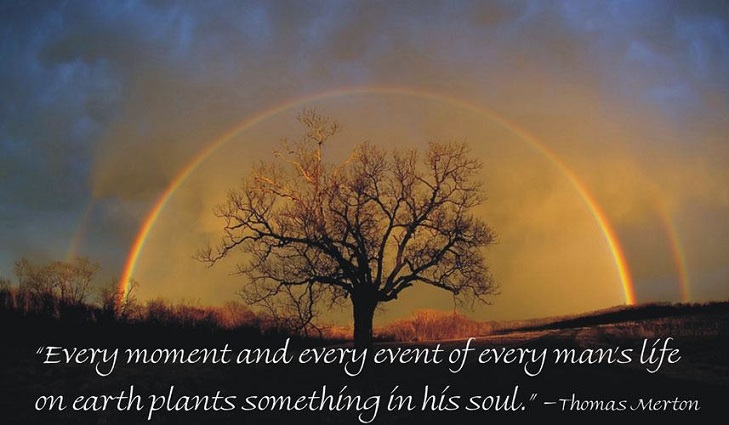
“Art enables us to find ourselves and lose ourselves at the same time.” ~ Thomas Merton, No Man Is an Island
My favorite description of him was by Paul Hendrickson in the Washington Post on December 22, 1998: “Thomas Merton: that bohemian and poet and extreme sensualist, lover of jazz, prolific man, traveler of the new idea. A 20th-century prophet and mystic. Not a theologian so much as a kind of freelance spiritual thinker.”
While I can’t honestly say that Merton makes as much of a difference in my life today, he did at a time when he was the right person with the right thinking. He had prepared for me, fifty years before I needed it. I am not sure exactly what it is that still holds my admiration for and curiosity about him, but I suspect it is how he lived within his human condition.

 What impressed me about this man was his complexity, his courage, and what I see as his wisdom. His life journey and the decisions he made will likely prevent him from ever being canonized a saint by the Catholic Church. Yet those foibles are exactly what attracted me to him twenty years ago, and continue to influence my thinking. The man was a real person – a human being who behaved like one. If they did make him a saint, I think he would be among the most human of that group.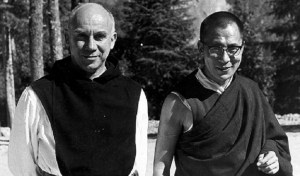
 Our Literary Journey