Memorial Day greetings as we acknowledge our remembrance with parades and poems, and we mark the unofficial threshold of Summer with humbled celebration.
I wrote a poem for Memorial Day…
Agree.
Honor the CAS Brigade
Not the six hundred, your life or mine.
My life for yours, in what noble cause?
You, comrade, have set my stage,
presented me with this chance,
and roll life forward to repay.
Has the world truly lost you?
Is it peace we’ve all gained?
Willing you were, but not for the price
to pay for my freedom, this high liberty.
Did you pay all my dues? What is my debt?
You did not die to win over another,
’twas peace you willed not mere death.
Shall I follow your glorious footsteps?
What cost for Liberty the price to pay?
Was the sum too dear for us to say?
Back to you, no debt can now be paid.
Was there glory in your demise?
Hail Liberty! is now your shroud,
I bow my head and we salute your life,
as today we stand to morn your death.
Comrade be known to only so few,
your loves, your bests, your suffering pains.
Dress right in honored memory
and in memorial spirit. Your life for mine –
no greater sacrifice, no higher honor.
Me. Standing before you,
your stone,
your memory.
Your life!
I’m humbled.
Yet honored.
Not that you died,
But that you lived.
And because you lived, you died,
So I may live. That we can live.
To my fallen fellows,
to my comrades of ideal,
may your sacrifice be honored
within our best brigade.
I salute your life.
I shudda been dead years ago.
Every rock wall or cliff I ever saw
was for climbin’ up or down
got kinda hairy sometimes, ripped pants,
scrapes, scratches, and snakes
got bee stung once.
Every train was our ride, tracks for playing
and high trestles for wide river crossings.
A train’s comin’?
I knew two guys who
killed themselves
jumpin’ off a them bridges.
Every roof was to be jumped from
after a building’s been climbed, got
wrenched, twisted, and sprained —
never broken.
Me and Jimmy swam
butt-naked
in that filthy, dirty, Susquehanna
in our bathing suits, which means naked.
Immunity.
We climbed up shit.
Like towers, bridges, trees, buildings.
Shinnied up rusty poles. If we fell,
we’d die. Motivation!
If a train came, we’d die.
Fucking people jumped
from there
into the river
to kill their selves.
My uncle did – Dad’s brother,
Was his name? James maybe,
Something. Yes it was James. Same as Dad’s dad.
His sons said he was trying to save a dog.
Uncle Jimmy weren’t savin’ no fucking dog,
But glorious if he had.
We poached – fish. Got shot at!
Fuckers missed us – on purpose likely.
When you get shot at,
you hear the bullets buzz past.
Crack, crack,
buzz
buzz.
We left — pronto.
Fish were prolly scared anyway.
It was fun to be
scared. And nothing
scared us more than
death.
But Jimmy and me – we
would live forever.
Then Jimmy died
after heart surgery.
Took him off a machine that
breathed
for him – how fucking
inglorious!
I’ll die too.
Too fucking late for
glorious.
Or is it?
Tom died too. Jumped
off a tower. ‘chute didn’t open.
BASErs say gear malfunction.
Midnight. New Year’s Eve.
BASE jump. Glorious.
Jack died of fucking cancer.
He knew. He called me cuz
he knew. I knew too. When his
wife called to tell me. I
fucking couldn’t talk – I
went totally fucking Dumb.
Give me the Light Brigade.
Fuck pas. Gimme a rifle,
a cause, a revolution, a reason.
Fernando!
Teach me how to
die. All the lessons of
life – not one teaches
me how to die.
Love hard, live fast,
die old. But die for a reason.
If yer gunna die, have a cause.
¡viva la revolución!
Aces’n eights ain’t my hand.
I’m not motherfucking dead yet.
The day 20 poem prompt of the 2018 NaPoWriMo challenges me to write a poem that involves rebellion. For example, defy a rule, or write something either funny or serious. My poem should open a path beyond the standard, hum-drum ruts that every poet sometimes falls into.
Warning, this poem is bleak. It is written to reflect panicked frustration and to respond to the prompt. The dark side of reality interests me. I am not disturbed by it and I accept its existence. Many of you feel the same or Stephen King would be a retired teacher today.
I use the f-word a lot here, cuz I use the spoken f-word a lot, except when I know some prudish soul may be crushed. So, if those two things bother you, please give this driveling twaddle the sack.
One more thing. I am fine. Please try not to think otherwise. Yes, I recently got some bad news, but that has nothing to do with this stream-of-dark-consciousness writing (and if it does, so what?). It’s hard enough to write without folks asking if I’m suicidal.
The poem is rebellion from my POV. If you do read this, and you happen to be, or have been, a Teacher of English grammar, take a deep breath and perhaps a glass or two of wine first. It is one sentence. I know. Many great poems (one of which, this is not) are.
Assimilated Rebel
one must dress like this or that and think thusly and carry this torch to that goal and be always right and feel like shit when not and one must win, always win, a looser dont be, dont say that is not me because bukowski said just do it, just do it, and live and work for the glory of no god or whatever, but to survive and whatnot, and to help them survive, the ones you love and them ya dont and its a beautiful life and we will all just fucking die because thats what we do in the end middle or start, and then go to some nonexistent haven or fucking hell foe-evah cuz ya didnt cross da tee or dit-da-dot on a dam i and smile for a kodak if yer not, then dont fucking try cuz anyway they all die no matter how hard ya try and then dunna fuckin cry, just be stoic, thats a lie but i dno why, just go along to get along and be different and ah independent thinker, just be creative and spell it my way in stripes with plads or circles, and socks wit sandals, and man-buns and feet with pit hair, lay and never lie, its all so jacked up nothin’ fucking matters so fuck it, and fuck it all.
(bill reynolds, 420 day y2k+18; freddie mercury tribute concert day; and a. hitler’s b-day)
Look both ways today to see who’s got the loco weed tea.
Allow no gaps of toke.
The day seven poem prompt of the 2018 National Poetry Writing Month challenge was for me to list my different layers of identity (son, father, grand and step-grandparent, retiree, white male, septuagenarian, poet/writer, hippie, etc.) — ways I could be described. Per the prompt, I divided those identities into two lists: what makes me feel powerful; and what makes me feel vulnerable.
I wrote a poem in which one of the identities from the first list (man) contends or talks with an identity from the second list (sensitive man). This poem reflects the doubt seemingly inherent in that conflict.
A Pocket Full of Doubt
Walk tall and proud to be our one man
Carry strong your body, mind, and be of good spirit
Hold on to what’s yours as tight as you can
To be a man, my son, inside you can’t feel it.
It ain’t me. It ain’t me. But a man I must be.
Stand honest and truthful, be a real man
Sense love and sadness and touch with your soul
Let go of yourself, as alone you must stand
Into the soul of men, you must never there go.
Can’t you see? It just ain’t me. Like so, a man I can never be.
So, of two minds you continue to fight?
Two spirits, one soul we continue to see
Where is the truth to set this man right?
Conflicted as such, you’ll never agree.
Let you be the man. The one we can see.
…….A man such as this can never be free.
(Bill Reynolds, 4/7/2018)
Look both ways if you’re of two minds.
In the gaps lie the answers, so mind what you find.
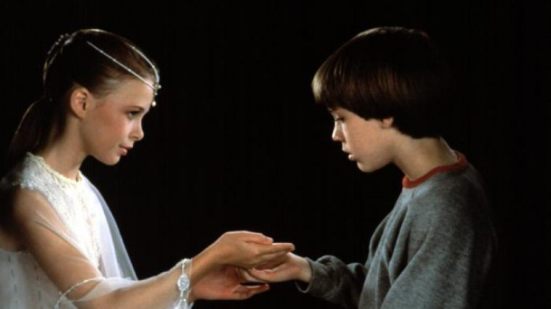
A few weeks ago was the 33rd anniversary of the movie, The NeverEnding Story, being released to theaters. I wrote this little ditty to relate to the moral of the story, as I see it today.
Moonchild
The mantle of truth is a heavy coat of many colors,
it gives warmth and freedom, but not love, friends, or quiet.
I can wear it out for all see, or keep it secretly private,
hidden away from the flak and dissent of others.
During this never-ending search for the best,
I face many challenges, and risk the love of others.
Do I seek such love, or a truth not of any lovers?
Must Falkor guide me on my never-ending quest?
When it’s only a story, is it also a myth?
At the Magic Mirror Gate, what truth have I now?
What is it within me, that this story won’t allow?
Are love and truth the same, or is it the Oracle’s kiss?
I find the impossible hard to defend.
The nothing is within me, but I’ll take my stand
for the dream of truth to my last grain of sand.
No seeker would stop with this as the end.
We deny then accept, it’s hard to compile,
the path is a clear one for all who will stay,
it may not be possible, at least not today.
Make Fantasia all truth, son of Moonchild.
*Bill Reynolds 7/31/2017
On your never-ending story, look both ways. Mind the gaps, they’re not myths.
My favorite lines from the movie (and the youtube clip):
G’mork: Foolish boy. Don’t you know anything about Fantasia? It’s the world of human fantasy. Every part, every creature of it, is a piece of the dreams and hopes of mankind. Therefore, it has no boundaries.
Atreyu: But why is Fantasia dying, then?
G’mork: Because people have begun to lose their hopes and forget their dreams. So the Nothing grows stronger.
Atreyu: What is the Nothing?
G’mork: It’s the emptiness that’s left. It’s like a despair, destroying this world. And I have been trying to help it.
This is my second post in a series about the paradox of love. It is a little different in that it’s about a man I’ve met, and a couple in love. I’ve included two of his poems.
Let’s answer this question: What is the best hoped-for outcome of any relationship?
Even Grimm’s Fairy Tales don’t finish with the “and they lived happily ever after” fantasy. The best we can hope for is, until death do us part. Barring the end of the movie The Notebook, murder-suicide pacts, or certain accidents; someone gets left. And we are often made miserable by our loss, about being left without someone we love, or about how that happened.
I don’t know John Gorow well. We attend the same writer’s group. John’s an old timer in the group; I’m new. He agreed to allow me to publish the story he related to me, and the poems he wrote. It is a remarkable and inspirational story. His poems are wonderful.
Joan and John Gorow met in 1969, when both were recovering from divorce. Prior to their marriage in 1972, Joan told John that she had been diagnosed with Multiple Sclerosis (MS). According to John, Joan’s health setbacks did not begin for about 28 years. Since 2000, her MS was a problem. Then came breast cancer. While treatment led to a full recovery, a Parkinson’s diagnosis soon followed, in addition to her worsening MS.
For approximately 15 years, John was Joan’s constant companion and full-time caregiver. As Joan’s health continued to deteriorate, the burden on John increased. In response to that challenge, John wrote the following beautiful, heart-wrenching poem.
*** CAREGIVER
by John Gorow
Time moves on
Inconvenient impairments become life altering
Legs don’t do what she wants
Hands have difficulty holding things
Normal chores are no longer normal
Cooking becomes dangerous
Washing dishes is impossible
Clothes can’t be carried to the washer while using a walker
The vacuum can’t be pushed
Self-worth begins to fade.
The one who has been cared for must now give care
She has cooked for me
It is my turn to cook for her
She washed our clothes
I will do the washing
She kept our home clean
I will try my best
It is assumed we all can dress ourselves
That is no longer true
Showering on her own can’t be done
No more going to the bathroom by herself
Memory slips – confusion arrives
What day is it?
Where are we?
I need patience
We talk, and then we laugh – I cry on the inside
Kids tell me to get help
I finally do – one day a week
Who is it harder on – her or me?
I get some freedom – she does not.
Caregiving is tough
Better than the alternative
I want her as she was
It will not happen
But then again, I do have her
(October 17, 2013)
***
Seven months ago, on October 22, 2016, John no longer had Joan with him. Since then, John has suffered and struggled with his pain. He wrote the following poem to directly address grief in response to the prompt: what brought you to your knees? In the fifth stanza, he directly addresses the paradox of love, vis-à-vis his grief.
***
GRIEF
by John Gorow
Who are you, grief?
Why do you pester me?
You have dropped me to my knees.
I knew I would have to deal with you,
But is it forever?
You keep lingering in my life.
I think you may be gone,
Then you grab me once again.
My laughs turn into tears.
Others have told me about you,
But you don’t behave the same with all.
I can’t determine when you will rise again.
What a paradox.
I have tried to hate you,
But without love you wouldn’t be here.
I know we will take the rest of my journey together,
So I must accept you.
That acceptance will be slow.
You should know
I will no longer dread the tears you bring me,
You will need to accept that.
You can stay with me,
But I will slowly rise from my knees.
I will move forward, but not forget.
(May 18, 2017)
***
I want to close this post with the same line John ended his email to me. It’s a beautiful one-line poem of five words.
“I miss her very much.”
***
As we look both ways and mind the gaps,
let’s not forget that some of us are suffering.
Let us love and support each other, and at all times, let us cherish those we love –
paradox or not.
This is the first in a series of blog posts about what I see as the paradox of love. This essay is my answer to the prompt, what has brought you to your knees? I’m not sure where I’ll go with this. Maybe you can help. Ask me questions, or prompt me in some direction. Please keep in mind, this is merely my take. Feel free to provide yours.
Nothing begins, nothing ends,
that is not paid for with moan;
for we are born in other’s pain,
and perish in our own. ~ Francis Thompson
Twenty years ago, I started using the phrase it’s all about how we feel. Normally, I’d caveat such a mantra by claiming it only applied to people without mental health issues. In this case, I think the words apply universally. How do you feel?
Love is the highest standard we have for caring about others. In literature, movies, music, religion, and in our daily lives; our obsession with love is obvious. It’s poorly defined, extensively written about, and grammatically misused; but love is everywhere in the English language. We want to love and to be loved. It’s our ultimate pleasure. How sweet love is.
I embrace love, but I fear pain. Pain can take over my body. Excruciating physical pain has brought me to my knees. It’s absurd that such pain may be helpful as it travels my nervous system from its source to my brain. Pain is abnormal. Even though we all experience pain, it’s not supposed to be there unless something is wrong. Pain is a symptom more useful to doctors than to me.
As bad as physical pain is, emotional pain is more devastating. In extreme cases, mental grief often leads to thoughts of suicide. In physical pain I might say, I want to die; but, I never intended that. I only wanted the pain to stop. On the other hand, people in emotional agony can be dangerous.
Our vulnerability to emotional pain is greatest when we love someone. When we love another person, we grant that person more power over us than any god or demon. Still, we choose to love. Not just willingly, but aggressively with passion and desire. Why? It’s like we can’t live without it. If anyone does live without love, we consider that sad and dysfunctional.
Love has brought me to my knees in two ways. First, the wondrous and joyful pleasure of experiencing love has led me to my knees with happiness. Be it romantic love, love of parents, love of children, grandchildren, or friends; the wonderful state of love takes away the dark and gives light.
Second, love has dropped me in pain, in fear, in a depressingly dark, hateful passion. Love betrayed leaves behind lifelong scars too deep to ever completely heal. The end of a romance, the betrayal of a friendship, the dismissal of a parent we love, the suffering or death of a child; each of these may, and perhaps should, put me on my knees. Such pain and agony from the dark side of love makes me question the value of life.
There may be recovery or even pleasure at the end of the tunnel. Time may mend love betrayed. Still, our human nature forces us to look back into that dark tunnel, into that abyss of pain and suffering. We remember. Do we dare to ever again risk pain by making ourselves vulnerable? Do we face the agony of finding ourselves desperately miserable because we loved?
Why do we do it? Would you, could you, live without love?
That’s a paradox of love. We know the risks, the vulnerability, and the potential to suffer. And yet, we still seek out love and take the risk. How do you feel now?
Even when we look both ways and mind each gap, we will experience pain in life.
“The truth is, everyone is going to hurt you.
You just got to find the ones worth suffering for.”
― Bob Marley (20 years after his death, which means he never said it. True, nonetheless.)
The youtube poem below is worth hearing/reading, and I think the Love Hurts song by Nazareth is worth a listen.
This poem is about underground coal miners – people who did, or do, very dangerous work. My father and grandfathers were three. This is also about life in our home when Dad still worked in the mines.
During my early teens, the mining business shut down in northeastern Pennsylvania. This was due to the Knox Mine Disaster in the late 1950s and the easy, cheaper, and cleaner use of oil to heat homes. Today, most coal mined in the USA is exported, but the industry continues to decline. Only 30% of electrical power in America is produced by coal.
Old coal mine entrance. A dark abyss.
Nearer My Hell to Thee By Bill Reynolds
Before leaving the daylight, and going into the pits,
They look deep into the ground, to the soul of the abyss.
The blackest of blacks, the darkest of darks, and danger,
The dank abyss peers back as men descend into nature.
Far below ground, the mine was there lurking, waiting;
That dangerous, disgusting damnation of sound,
For some small wages, they go into that hole far underground.
Deadly it was and deadly it is, they never know when…
Many wives cried at the loss of their men,
Who died in the gut of the deplorable depths.
It was frightening work miners chose, those jobs that killed.
Black hard hats on heads, mining lamps on to cut the dark,
But still never safe. In denial or not, it was dangerous work.
Blackjack and Brass Knuckles same as my father had.
Father was, and so were both grandfathers, miners all.
Walking home through muddy fields and dark alleys,
Dangerous on pay days; all cash in their pockets,
With blackjacks and knuckles, maybe a gun.
He’d push open the gate, then let it slam with a thud.
Dad would stomp up the stairs and in the back door,
It was always the back way after a day’s work.
Covered with coal dust,
The sweat of the labor, and the stink of the mines;
Smoking his Camels, always coughing and coughing.
But he was my Dad, and it was always like this.
I remember Dad much blacker.
Everything filthy, his clothing all rotting,
Black on his skin, and in his gray hair,
He didn’t know about the black in his lungs,
the deadly back dust was glued on hard, but not to his soul.
White at his eyes and over his lips,
he’d set down his lunch pail. No hugs, no kisses,
just “hiya,” and not much of a welcome.
His coat and his cap, and his boots all come off.
Trounced upstairs to the bath, footsteps pounding the way,
Transformation, about to take place.
In cold water each day, he washed coal dirt away,
From his face and his hair, his neck and his chest,
From his waist to his feet, but not from the rest.
Nothing could wash the coal miner away.
Not the water, the union, the beer, or smokes.
Not on the inside, from his throat nor deep in his lungs.
Black dust in his body and in with his blood.
In a coal mine.
It was always the same, until the disaster.
Miners to work, to suffer and die.
Returning to homes, dirty but to homes they came.
Then one day, the depression set in.
The mines all shut down, proud miners, no work.
One day it all ended and everything changed.
Miners laid off, the mines were all closed.
Oil was king, and nobody noticed.
No more abyss, just a new kind of dark.
If you not yet sufficiently depressed, watch this.
What do I want? What do you want? How do you want life to be? What will you do? Equality, fairness, and love should guide us. My friend, Karen, asked me to write a poem about freedom. I did. It has a dark shadow, but the shadow has a crack in it, so the light gets in.
We didn’t start the fire refers to the Billy Joel song, Timothy Frances refers to Leary, the beast is the oppressive government, Tom down is to be subservient. In terms of rhythm and rhyme, this thing is all over the place.
The Freedom Dream is Dead by Bill Reynolds
What do I want to do?
I wanna be happy.
I want you happy, too.
My dream is a happy world.
Imagine that.
How do we want things to be?
Let’s be fair, and hopefully free.
And just, and true, and honest, and imagine…
For all, equality and rights
With love we can see, for all brothers and sisters.
Life is not fair, but are we?
Imagine!
What is this happiness we pursue?
In all fairness, what can we do?
Freedom? Liberty? Is that all?
Equality? Justice, et al?
Can you imagine?
It’s just a damn dream for too many.
And our dream is dying the fastest of any.
One million paper cuts, delivered with slashes,
All hope is lost, the beast burns us to ashes.
As for my dream? It is dead.
We fought all for naught.
Now I feel a dread.
Selfishness won. It owns us now.
I can’t imagine.
Resistance is failing, the world is darkening.
Evil and greed are the name of the game.
Profit and loss the new moral code.
Money is god, ready for more of the same.
The worst from the beast is yet to be told.
Imagine died too.
We didn’t start the fire, we can’t put it out,
Feel the heat from the rich man’s ire
Burning a hole in my hopes and desire.
Timothy Frances, where are you now?
To destroy this beast, please tell us how.
Or do we Tom down, and let it go on?
My dream may be dead, but I will go on!
Resist, resist, resist, fight for rebirth.
Resist until we have new life on Earth.
Imagine a future, resist to the end.
Look both ways and mind the gaps. Life has no guarantees, but we can work for fairness.
An elegy is a mournful poem. I wrote this elegy regarding the loss of my mother, more than 25 years after her death. The elegy is one of the oldest poetic forms. It’s identified by what it says, not how it says it. The Greek word elegeia means song of mourning, and is often included in classical Greek tragedies.
Missing Mom
The day Mom died, I stood there and cried.
To the surface my guilt came out of my eyes,
Beside her deathbed, letting go of our life.
Her suffering had ended, and I was alone.
No person is perfect, no human unsoiled.
Enshrined mother’s love, was sunshine to me,
‘twas the essence of my childhood memory,
My loss just the same, never again she will be.
She’d lived a rough life, through to the end,
But she loved me as only the mother to son,
That unconditional love, will never be done.
Only her death could end our last day.
Alone. Just alone.
Her voice and her scent, ecstasy to me.
So much I still miss them. I can still see.
“Hiya,” she’d say, to even the worst.
As kind as she was, so how she asked me to be.
Mom we still miss you, your face and your smile,
The sound of your voice, the look in your eyes.
Never again, will you be for us to see.
The loss that brings a sadness, one forever I’ll feel.
Mind such gaps, look both ways, and remember love.








 As for my dream? It is dead.
 Timothy Frances, where are you now?
 Our Literary Journey