Essay: Grace Before Rant (and why I care)

So many things about other people are none of my business. It is not the same with everyone because my relationship with each person is different. It begins with me, then my immediate family (in my case), then my friends, professional relationships, then people who want something from me like money or my vote. It may include strangers with whom I share driving on roads, rooms (the sign said ‘employees must wash hands’), grocery stores, air, or transportation systems.

Ambivalence, freedom, and self-preservation

If the man sitting across from me on the bus wants to pray, I don’t care. If he puts down a prayer rug that blocks my exit, I do care. If he jumps up and yells something that sounds like god is great in Arabic, I care a lot about his intention. As the behavior of others moves closer to interfering in my life, the more what is not my business is made to be. Not by me. I begin to care.

Pray, pay, and obey

When I lived at home with my parents, I was the youngest child in an Irish Catholic family. For nine years (1950s), I attended a Catholic elementary school (K-8), as did my older siblings. I was taught all traditional things catholic kids were supposed to learn. I memorized the Catechism. I learned about the religion as it was taught to us, about the saints, and some bible history for eight of those nine years. We had to pray. We had to go to confession and to Mass. We had no choice, but I also recall none of us resisting. We saw it as normal.

Millions of children around the world grew up in similar circumstances (and some have spent a lifetime recovering). It was brain washing, of sorts. We prefer to call it religious education and indoctrination, to be more politically correct.

We prayed to start each school day. We memorized new prayers as part of the curriculum, some in Latin if you were gunna be an altar boy. There were no altar girls then (now both sexes are altar servers), but the Latin has been scrapped in most cases. Before and after recess, we prayed. Before lunch, we prayed Grace Before Meals. When we returned after lunch, we stood next to our desks and prayed the Grace After Meals. Before we left for the day, we prayed. We were expected to pray at home.

When old enough, every Friday, or the day before a Holy Day of Obligation, we went to confession as part of the school day. More prayers; and the assigned penance was to say more prayers (five Hail Mary’s, five Our Father’s, and an Act Of Contrition). Think about that for a minute: prayer as punishment? We did that in anticipation of receiving Holy Communion (the body and blood of Christ) at Mass. You’d have thought we were Trappist monks in training (they pray seven times a day).

Reciprocal respect (do your thing)

I am not going to repeat what I’ve said about prayer (mine or other’s) in past posts. But I want to express a concern (PC for pointed rant). I only know what a few other non-believers do in these circumstances, but I want to briefly whine over how I feel about it.

Maybe I’m being picky or over-simplistic about this, but I strongly believe that no gods exist or ever have. Consequently, communication with something non-existent is pointless, if not weird. I do not include mediation, talking with others (including animals), or talking to self in the same way because in each of those situations, the self or other being exists and meditative relaxation is probably healthy. I have talked to my pets my entire life and in many cases I am sure there was some degree and form of understanding me and what my intention was, even if the language was not understood. They never talked back (at least not in a language like English).

My wife (not atheist) and I occasionally have meals with religious friends (Evangelical Protestant, Lutheran of some kind, Catholic of Roman blend, whatever). In most cases, it goes like this. We meet up, we talk, we sit, read menus, we talk more, order drinks, talk more, order food, they talk even more, and then the food comes. That’s usually when the religious people decide to pray.

Now, if we can pray at religious school before we go home or down stairs for lunch; couldn’t they get the prayer part done a lot sooner? Furthermore, praying, especially while holding hands with convinced atheist, is not a social experience. It is a religious one.

Sometimes, they do pray early. If you go to their home for an outdoor barbeque or buffet style meal, they pray in one of those large group things. Usually, the protestants, and often Catholics, still want to hold hands, bow heads, close eyes, and mumble incoherently. Anyway, I will usually hold hands and watch as someone mumbles a long thanksgiving kind of prayer, often as the food cools. Early prayer is possible.

Truth is, these are my wife’s friends much more than mine (she and they may disagree). If I do not feign cooperation, it could affect her relationship with her friends. I don’t want to do that.

In most of these situations I feel awkward (and maybe a bit hypocritical) because of my beliefs. If they did not pray, or would pray on their own, it would be fine. The problems come with the showing off. That’s when I feel like I am socially being made (as in forced) part of the prayer, prayer group, or blessing process. Maybe I should say something like,

“You go on ahead and pray. I don’t do that. I’ll wait, but if you take too long, I’ll start without you. I’m here to interact with you socially and to eat. Not to pray.”

But I won’t do that.

Is my conclusion equally valid?

While I’m willing to speak openly about my atheism with almost anyone (there are limits), I don’t want to cause problems. I’m often demonstrative when arguing or debating religion (or anything). That’s not good.

Moreover, I don’t want to be the cause of my wife’s friends shunning her or pretending out of sympathy. I don’t care what they think about me. (I’m atheist, I know what many think). But there is irony in that. I do care how the world treats my family, especially when I may be the reason for it. (Your father, grandfather, husband, friend, what-evah).

What do you think?

If you have an opinion or experience with this, I would like to hear it. If you pray, how do you feel about a non-believer excusing themselves or feigning participation? If you are not a believer, how do you handle such situations? Please comment, even if it is that you don’t care either way.

If you watch this show, you know that they seldom hold hands: Catholic.

Bill Reynolds, 5/11/2018

Look both ways when crossing to the other side.
Mind the gap of our differences.

Essay: God do what?

While I say I don’t pray, I kind of do – accidentally. A believer might consider my praying to be blasphemy, but so is embracing atheism or agnosticism. As with so many words, blasphemy is only a thing if god exists (like sin), and it is only bad if you happen to believe in god (Satanists not withstanding).
No god = no blasphemy, no sin, no hell – make sense?

I have a few old habits and knee jerk reactions I’ve tried to shed without success. Two phrases I use too often are God damnit! and God bless you. In both cases, I am apparently invoking the supernatural to my wishes. But since intent matters, in the case of god damning, few of us mean it. In the blessing case, it is an old version of universal well-wishing when people coughed or sneezed. It goes back to the bubonic plague days in Europe. How well did that work?

Since I speak fluent profanity, I don’t blurt out the damning one very often. I’ve always been more of an f- or s-word guy. Yet, if someone near me sneezes, I usually have god blessed them before their next breath or sneeze. I’ve been doing that most of my life. When I don’t say something, I feel like an ass. I need to use gesundheit or one of the other secular phrases from around the world, of which there are many. This sounds like fun.

‘Thank you for covering your mouth and I wish you good health. Live long and prosper.’ (Vulcan Salute)

I used to pray often and for many people, but I didn’t pray for everything. I didn’t pray for rain to start or stop, or for any other change to the weather. I never prayed for bad events, personal wealth, or my own health. I don’t know why, but all that seems in bad taste. Likewise, I would never have prayed for anything bad to happen to any other person, unless you count the god-damning of nouns.

I carried a notebook where I kept notes of who to pray for and why. Seriously. People would ask me to pray for them or for some other person. If I didn’t write it down, I’d forget. Weekly, I would go late at night to a chapel room at our church for what is called perpetual adoration, and there I’d pray in the actual presence of the body and blood of JC (Holy Eucharist). That’s why it was there.

God was literally several feet away in a gold sunburst thingy called a monstrance, behind a tiny piece of glass, in the ‘actual’ form of the body and blood of Christ. He and I were alone most of the time. If what the Church proffered was true, I prayed a lot of folks straight to heaven – big IF. That was then. I still carry a notebook, but not for the same reason.

I’ve often prayed for dead people. That is customary for Catholics. Most Catholic parishes have a Book of the Dead which contains the names of the deceased loved ones we prayed for on All Souls Day (November 1st). It’s called praying for the ‘repose of the soul of’ the people we assumed might be in Purgatory; not in heaven yet. That’s how they say it. The repose part was to get them to heaven. A good thing, right? Just an odd way to say it.

Yep. Praying for other people, especially dead ones, was my favorite. Most of my other praying was reading (often aloud) from prayer books; prayers of adoration, love, or general holy stuff. I had my favorites and I still like what some prayers say. Like this poem by Mary Oliver:

I don’t know exactly what a prayer is.
I do know how to pay attention, how to fall down
into the grass, how to kneel down in the grass,
how to be idle and blessed, how to stroll through the fields,
which is what I have been doing all day.
Tell me, what else should I have done?
Doesn’t everything die at last, and too soon?
Tell me, what is it you plan to do
With your one wild and precious life?

— From “The summer day”;
New and Selected Poems 1992

I am sure that many protestants thought the real presence deal was bull shit. Maybe they were envious. The last time I prayed and was serious about it was about nine years ago.

When people say they will pray for me, I am unsure how to gratefully and gracefully decline the offer. I was diagnosed with cancer. People unaware of my atheism would offer to pray for me. If I requested a pass, they ignored me. So, I just said thank you and moved on.

Some who know of my unbelief would offer to pray, but then would backtrack. I would thank them and explain I understood the intent. I used to pray. I know why people do it.

 Lori Arnold’s (McFarlane) memoir, The Last Petal Falling, talks of her experience regarding prayer. That helped me realize I should be more diligent to replace prayer with action, honest love, or the offer, how can I help?

I usually don’t care what others do. Read a book, contemplate their navel, drink scotch, listen to disco music, meditate, or pray. I think one of those is wasted time, but that’s for others to decide. It’s not my business. Even if others pray for me. It’s okay. If that’s their thing, have at it. However, there is one well-intended prayer I would adamantly decline, if asked.

I hope no one wastes their time praying that god forces me, or any atheist, back to religion. It’s hard to explain, but that’s insulting. It is asking their god to take away my free will. If someone believes in god, I accept that as their belief and I’m ok with that opinion. May they cheerfully return the acceptance.

This kind of ‘praying’ usually involves more famous atheists. For whatever reason and given all the dumb-shit stuff there is wrong in the world to pray for, or all the people who are in need, especially the children; why so many people find it necessary to pray that an atheist will come to the opposite conclusion is mind boggling. I understand why some may wish and hope for change for loved ones. But it is still wrong.

One of the most prayer-group-prayed-for persons in US history was the late Christopher Hitchens. He was a famous writer and atheist of celebrity status who often debated with religious people. These people needed to find something better to do with their time than to pray for atheists (agnostics, free thinkers, skeptics) to stop believing as we do. It is insulting and demeaning. I will personally never recant my atheism. Never. Ok, if god physically shows up, I will. But not due to prayers.

How would a believer feel if atheists prayed for them to apostatize? What if we asked their god to turn them into atheists? How would that sit? Admittedly, a believer would see it as a damning petition. In a way, when people pray for us to recant, it’s the same thing; that we’re damned to hell simply for what we think.

I have a right to believe what I think truth to be. It’s unnecessary for anyone to respect what I believe (or don’t), but at least in quid pro quo fashion, one should give the nod to my right to believe it. Praying to take away that right, or doing so in the practice of one’s religion, is an attempt to take away an inalienable freedom: my right to think.

Some religious folks have the piety to keep their religion to themselves, but too many don’t. In many cases, that would be against their religion. If they must do something, they should follow the many religious who do something useful. If one knocks on my door, I may ask them to read my tract and come over to my way of thinking. Many do.

Look both ways and allow others the dignity to do the same.
Think. It’s free and helpful if you don’t over do.
Mind the gaps.

Essay: Ya’ Know What?

My morning means coffee. As I listen to the Keurig groan to push water through that little plastic cup, I ponder the cosmos. Then, I’m off to my room where, with the help of Lappy the laptop, I investigate the inworld of cyberspace and contemplate the secrets of the vast physical universe. I wouldn’t want to have some cosmic detail wrong.

I sit at my desk and prowl through blogs and respond to comments before flipping to Facebook. After typing a few comments, and some likes or loves, I click to email. And behold: there is the prompt for this week’s essay.

Galileo was put on trial and spent the last years of his life in prison for suggesting that the earth revolved around the sun. We think we have a pretty good idea of how the universe works now, but what if we don’t? What if we’re wrong? What if…??

(Good grief!)

Galileo was on house arrest and ordered to deny the heliocentric heresy, which he did before recanting his denial. The sun-center working of the solar system had been around, but the question for him was whether he agreed with it. This was during the reign of Pope Urban the 8th and when the phrase, don’t piss off the pope became popular. It was bad for Galileo. It was worse for others. In the 400 years since, there has been no Urban the 9th.

The rest of the prompt is figuring out the universe and what if we are (or I am) wrong. The universe is one of my favorite topics and being wrong is something with which I am quite familiar. Just ask my wife or kids. The last part asks, what if?

I like to quote phrases that make me feel smart when they affirm what I have supposed. This phrase is credited to Zen:

‘If you understand, things are just as they are; if you do not understand, things are just as they are.’

Galileo and Pope Urban lived under the same sun and stars within the same solar system. One was right, and one was powerful. But another phrase is might makes right. It did in this case, but not in the long run.

The universe did whatever it did without the help or knowledge of either man. To navigate by celestial means, one assumes that the sun, moon, stars, and planets move across the sky. To the observer, that is what appears to happen, but things are not as they appear.

If we’re wrong, nothing changes. For now, we know what we know, and we look for more answers or corrections.

In time, we’ll correct our errors. Learning is endless, and science has gaps everywhere. Even if we had the cosmos accurately mapped out and understood all the chaos, the potential for more knowledge exceeds the spatial vastness of the universe itself.

And as for the we part; some of ‘we’ think the earth is flat, some of ‘we’ believe some of us are alien creatures; some of ‘we’ deny lunar landings. Too many ‘we’ think Hubble telescope scenes and Voyager photos are fake. Far too many of ‘we’ think science is nonsense, and that it was all created by one supreme deity. Regardless of the signs and clear evidence, some of us will always go the wrong way.

What if is the wrong question. Let’s try what if not? Consider some possibilities.

First, try to imagine this world without science. It is easier to envision a world without humans or any intelligent life. Now, with a twist of the cranium, imagine what John Lennon suggested.

Imagine a world without religion. It’s easier than it was to extract science and learning from history. We’ll always have both, but now we can ask the what if question.

For over 65 years, no one asked me to explain the universe or how it came to be. People were willing to explain it to me in terms of what they thought. Then, a few years ago, about the time I started mumbling the word atheist with personal pronouns, I was suddenly cast into the academic role of Carl Sagan, Bill Nye, and Neil deGrasse Tyson all rolled into one. I was charged with explaining not only how the universe works, but how it came to be. I was also challenged to explain the source of all life on earth, the details of evolution, and to fill-in any scientific gaps. Perhaps the inquisitors thought I would be enlightened.

I not only don’t have all the answers to such questions, I don’t need to have them. Nor do you. None of the seven billion people alive today, nor any of the 100-billion who have ever lived had all the answers or needed to know them.

If the question is what if we are wrong; the answer is of course we are. We do not have all the right answers and that is exactly what all the excitement should be about. Are we willing to learn? It’s why we are here: to always wonder. As Galileo said,

I do not feel obliged to believe that the same God who has endowed us with sense, reason, and intellect has intended us to forgo their use.

***Bill Reynolds***

As you wander, look both ways.
Remember to look up.
Mind the gaps. As you learn, fill in where you can.

Un-shunned, But Out

Several people suggested that my experience with religion may have moved me to embrace atheism. I don’t deny the experience. But, religion was not responsible for my conclusion that no gods exist.

I was born not knowing. Somebody told me there was a god and I trusted they knew what they were talking about. As a child, I ‘believed’ in god because I believed who told me. For shorter periods of time I also believed in Santa Clause and the tooth fairy. I was also convinced monsters existed even though no one told me they did. I never saw a god, Santa, or the tooth fairy. I was sure I saw the monsters, and some lived under my bed.

I was initially told that all these entities existed except for the monsters, but they were the only ones I reacted to and lost sleep over.

I was emphatically told by my parents that there were no monsters and no ghosts. I was agnostic about the ghosts, having seen Casper cartoons. But no monsters? Bull shit! I knew what I saw was real! I began to have doubts about parental honesty.

Eventually, I unwillingly figured out the deal with Santa and the tooth fairy. I also gave up on the monsters, or perhaps they tired of me. Maybe the tooth fairy turned them into dust bunnies.

I figured out the god thingy last, around age fourteen. I was never dumb enough to tell anyone, even friends, that I no longer was buying the eternal life package. My father was the type of Irish-Catholic coal miner who would have attempted to pound belief into me. Besides, the religion thing worked to my social advantage. I often wonder how many of us practice religion for some social advantage or for financial gain, but don’t buy it either.

When my Catholic parish learned that I was an active participant in the protestant Episcopal church down the street, it pissed them off. That pleased me. If I could in some way return the ‘love,’ my parish seemed to have toward me, I was all for that.

Not so much with my parents, who were more upset. Those poor folks had a real shit-head difficult lad to raise, so church was the least of their concerns. Yet, I heard my mother say, “It may not be Catholic, but at least he has a religion.” I did not. But, if she was accepting, I wasn’t going to change it.

The church down the street was a playground of youthful debauchery. I was one of several Catholic teens (boys and girls) who participated in their youth group. My motivation for participation was likely untoward and had nothing to do with religion or god. That was then.

Now, my overall philosophy is a moving target that even I find difficult to corral and define. So, I stole this idea of a three-legged stool from somewhere. One of the legs of the stool is god, which is why the damn thing keeps falling over. Any god or gods get to share one leg and no more. The leg is there, but it’s symbolic. You could call it atheism, but not exactly.

Religion, which I define as the rules regarding humans dealing with gods, is the second leg of the stool. Religion and god relate but are not the same. The religion leg casts an unfavorable shadow upon the god leg. As splintered and twisted as it is, religion exists.

While the non-existence of god is almost a neutral, unemotional, changeable conclusion that came to me from thoughts; my vehement enmity toward all religion, especially the known ‘organized’ faiths, is unwavering and continues to grow as I age and reflect upon what I see and know. If god were to appear before me right now and provide enough proof to roll any skeptic, I would morph to belief in a New York minute, but I would continue to detest religion.

This is where my atheism gets confused with my religious experience. My bitter feelings about religion stem from experience and knowledge. While I am accepting of religious folks and I extend kindness to most believers (and they to me), what they believe I tolerate but don’t respect.

Religious mumbo-jumbo has nothing to do with whether any gods exist. Yet, I remain open to the tiniest of possibilities that something may change my mind. However, throughout history, nothing has ever happened to any human that would convince me otherwise.

What most people seem to believe about god and how to relate or interact with that god is manmade. However, religion has a lot to do with how people act toward each other. Call it morality. Theoretically, that should be good. Historically and practically, it has been otherwise.

The third leg is my spiritual philosophy, which is influenced by the other two legs (no-gods exist, and bad religion). The three legs support the seat, which is my overall philosophy (of life, my world view, reason for…whatever). The analogy isn’t perfect but it works for now.

In a debate Rev Al Sharpton and Christopher Hitchens once struggled to find disagreement because Sharpton kept trying to debate the existence of god (which he admitted he couldn’t prove) while Hitch pointed to problems with scripture, evil, and religion (Hitch admitted he couldn’t prove the non-existence of god). Two separate topics that influence the third philosophical leg of my metaphorical stool.

Atheism is not a religion, a belief system, a philosophy, or anything other than an acceptance of one’s opinion that god might not exist, or probably doesn’t. Atheists have divergent views as do most human groups. Some atheists are nihilist. Most are not. A few atheists go to church. Most do not. Some atheists make room for unscientific things in their opinions and how they live. Others claim that such opinions are not those of true atheists.

It can be confusing. But can’t the same be said of believers? Since I was a child, I was told that TV preachers were nonsense. I still think so. Many believers agree with me. Many believers reject the idea of a virgin birth, others call that heresy. I could go on about divergent religious beliefs, even within a specific religion such as Roman Catholic, Shiite Muslim, or Mahayana Buddhist. Dare I add Southern Baptist or Mormon? But that’s not my point.

While many atheists say that reading scripture will lead to disbelief, I contend that not believing in god is a rational decision not based on religion, dogma, or scripture, even though any of that will support atheism once the no-gods conclusion is reached.

While I claim to be rationally atheist for logical reasons, I think I’m also intrinsically incapable of believing in god without very concrete proof. No religion or religious person; priest, pedophile, or persecutor drove me away from believing in god. I tried to believe. I just couldn’t. Now, I openly don’t. I’m as pleased with that as believers are who foresee their blissful eternity simply because they believe and nothing more. I’m okay with that.

Look both ways in life. Learn from the past. Plan for the future.
Mind the gaps for denial and confusion.

In Defense of Atheists (Part II)

What believers need to know about Atheists

While many people rightfully argue about (or discuss) belief and religion, I’m sure many don’t know what atheists think or believe. However, I encourage people to learn the truth about atheism to understand atheists better. It’s very simple but it may require more unlearning of past prejudices than assimilating new information. That is partly why I decided to become open about my atheism and to write about it.

My take on life’s meaning

I ended Part I with mention of an article that accuses atheists of being nihilists. Indeed, nihilists do not usually follow a god belief. There are multiple forms of nihilism because it is a basic philosophical position that applies to different things differently. So there are many types of nihilists, but that discussion is well beyond my intent here. As with most posts of that nature, it was full of assumptions about atheists that are either wrong or stereotyping. That should be enough, but the article was also replete with reasoning fallacies; a common problem with theistic arguments of virtually any type.

One claim the author made regards life having meaning. Life being meaningless would be a nihilist philosophical premise, but it is not atheist even if some atheists may see life like that. Few atheists are nihilist of any kind, but this is about me. So, this guy claims my life is void of meaning and must be so because it includes no gods. Specifically his. Many people may need a god to give meaning or purpose to their life. Fine – that’s them. I don’t! (And, frankly, neither do they.)

I contend that since this life is all I have (reincarnation notwithstanding), every day of it is filled with purpose and reason. What I will never accept is that life is some sort of test given by a god to determine if I, or my eternal soul, must spend eternity either incredibly bored (or however you see that state) or suffering (aka eternal damnation). I say this life is all we get, and I hope it is wonderful for everyone. If someone thinks it is a blessing from god, I’m ok with that. That’s them. If they follow a religion, I am sure there is more to it.

I think the purpose of each life is simply to live it. My reason for existence is the reason I give it, just as each person gives reason and purpose to their life, with or without the assistance of a deity or the promise of an afterlife. That’s my opinion, and it’s not nihilist. I find people telling me that such thoughts are not what I truly think to be incredibly annoying.

I don’t believe that I was created by a god. It is not the purpose of my life to serve anything or anybody outside of nature – I respect reality and nature. I believe in living my life as implied in parts of much wisdom literature to the fullest (eat, drink, and be merry), to find happiness and pleasure (e.g., The Rubaiyat of Omar Khayyam), to limit my suffering and that of other people and creatures. Certainly, to love.

I am here to be part of nature. And then, as is the highest law all life must follow, to return my borrowed physical essence back to the natural universe, allowing my mind to pass on to whatever respite awaits in death, if anything of the kind follows, which I doubt. That is the natural cycle of life. We cannot change it. I can think of no reason to change it. It seems to be working, provided we don’t fuck things up too badly.

I couldn’t have said it better myself

A Catholic priest once said (I’m paraphrasing), if there is no god, we have all been involved in a horrible deception and charade. I heard those words at a critical time: true, serious, tragic. I consider most people I know to be good, be they atheist or Christian or other religion. I assume that believers who post anti-atheist things are also good people being controlled by religious fear and the dark side of human nature. People can be stubborn. I prefer to say that I’m persistent.

But these folks who write such tripe are just plain wrong about me and other atheists, wrong about the conclusion that is atheism, and are often offensive. I hope that’s because they don’t know that atheists are as good as any believer. But, as Neil Carter implied, the on-line us is often not the best side of the person.

Neil Carter

This youtube video is among the best explanations I’ve seen. It is respectfully well-done by Neil Carter, who blogs as Godless in Dixie. It is an abbreviated version of a longer talk given by Neil. So, while it is about 15 minutes, it’s only part of the talk. The point here is the 11 items and his explanations. This was made in a Christian Church for Christians, so it is worth viewing be you theist, atheist, or anywhere in between.

Look both ways because “a hair divides what is false and true.
And mind the gaps because “
We shall perish along the path of love.”
(quotes by Omar Khayyam)

In Defense of Atheists (Part I)


Most Christians are wrong about Atheists

About me

I’m atheist. I do not identify as humanist or nihilist. I’m expert in neither, but I agree with some views of both philosophies even though they often conflict. That sometimes makes me of two minds, or maybe three. Click this link for my story if you need to know it, but, ya probably don’t.

Why I am writing this

I decided to post this in two parts to keep them of reasonable length. In this part, I talk about things that believers (I say Christians, because that’s what most Americans are) are wrong about regarding atheists. It’s been said a lot, but not enough. Part II will address some things I think people should know (particularly Christians, but anyone) about atheists. Some atheists read my blog and I hope they will correct my errors or clarify my confusion.

I’ve often read long, esoteric, philosophical explanations about why atheists are bad people. I’m a sensitive man, and they hurt what feelings I still have. Since being atheist is simple (we believe in no gods; done.), those rants are virtually always wrong. They are not attempts to convince me to repent or to believe in god. They simply judge atheists, or atheism, as bad.

Believe to be good

Belief in god makes no one better, and vice versa. But, most believers seem to think it does make them better. Otherwise, why bother with religion? That is to be expected. Conversely, they further seem to think that not believing makes me worse. A lot worse, apparently. Since these folks have no specific atheist behavior to point to, they go off on long, broad-brush, baseless philosophical tirades that can only be explained as being essential to their own personal and spiritual well-being. We all know people who put others down to make themselves feel good.

Atheists are bad

I fully understand the morality issue for some folks. But atheists are as moral as anyone. Yet, these rants are not as simple as holier than thou. Each is judging other people they do not know as evil for having a harmless opinion. Conversely, those who do evil things and repent (or maybe not) are judged to be better than those who simply don’t think gods exist. How is that logical?

Bad to the bone

However, leading the pack of obnoxious nonsensical know-it-alls are the clueless people who seem to know exactly what atheism is, what atheists are up to, and why. They claim to know our thoughts. Yet, for all the animus it generates, atheism is simple. But these self-appointed detractors are not atheist and don’t seem to want to get it right. What they seem to want is to preserve something that disbelief threatens simply by being a conclusion in someone’s mind – a conclusion that can change (as in reverse) in a New York minute, but rarely does.

These holy souls swing at the low-hanging-fruit to bash people for what they believe. This is partly because of what they think (not know) about atheists and atheism. Such assaults are unnecessary, insulting, and vulgar. One Orthodox Christian priest has said that embracing atheism is worse than committing murderer. People believe this crap, especially when it’s said from the pulpit by a “man of god.” That annoys me.

I have my limited personal experience, but surveys I’ve read indicated that people trust atheists (I assume ones they don’t know) about the same as convicted rapists and murderers. In some states, it is illegal for an atheist to hold public office, even if democratically elected. While such laws are not enforceable, they remain on the books. Very few outspoken atheists hold elected office – none nationally. So, why the need to pile-on with the endless “they are bad, bad, bad?”

The essay

Recently, I read a post by someone who insisted that all atheists are nihilist. Following several of my objecting comments, he stood firm with his accusation. In the essay he further insinuated that any social justice work done by atheists is a ruse, insincere, and as doomed as a “utopia” (his word). Now, that shit hurts. I can’t imagine how he connected nihilism to utopia (dystopia perhaps?). This, they will say they’re not, but they are argument is worthless. Do all Christians play with snakes or drink poison to prove the strength of their faith? Of course not. Nor do all atheists agree with nihilist philosophies. It’s difficult enough without someone making stuff up.

Look both ways: either there is a god or there are not gods.
Consider all the gaps and mind them well.

Poetry (or is it?)

Is This the Real Thing?

It’s everything what’s bad
You want me to believe
that man is god? Seriously?
Reality is human nature. Dark.
The only safe way to be is against,
against everybody and everything.

‘tis neither fit nor rot.

Is this the reality of real life?
Or is it all just a dream of
A dream within a fantasy?
Open your eyes.
Look to the skies.
Look around and see reality.

Truth is for all to see.

Every form of refuge has its price
Reality is our god. The only god,
The god of universe, birth, death
no tribute or prayer brings change.
We all have dues to pay, the rich,
the poor, the good, the bad.

We deem it reality.

Save the worthless praise. Just be.
Find the truth in this reality
without offer or any sacrifice.
See the light but thank the darkness.
Be the proof of true existence.
Seek out verity in what is.

Truth is Reality!

Bill Reynolds © 7/2/2018

Look both ways to see the light. Mind the darkness of the gaps.

Essay: My FWB Neighbors (3 of 4)


I have always liked the Diamond Rio song, Norma Jean Riley, so it follows this dribble for no other reason than I like it.

Part 3 of 4: Norma Jean (not Riley) and Mac

I met Norma Jean and her hubby, but I recall little about either of them. He was quiet; she was not. I had no judgmental opinion, but my wife seemed to like them. That means they are “fine.” They were longtime residents of the neighborhood and had raised their kids there and all of that. But, we all have our foibles, right? So, I will set this up for you.

We rented the house on the cul-de-sac we lived in for three years. When we announced we planned to move, the owner put it on the market and sold it. The couple who bought the house had children, were of some middle eastern ethnicity or nationality, and of the Islamic faith. I never met them, but I may have seen them when they looked at the house, since it was being shown while we lived in it.

As I understand, after we moved (bless her heart) sweet ol’ Norma Jean, who is of the Southern Baptist tradition, went to meet and welcome her new neighbors. It’s what we do. Being neighborly, right? In classic, southern, Bible Belt fashion, she invited her new neighbors to attend church and especially invited the children to Vacation Bible School.

The father of the children explained to sweet Norma Jean that he and his family were Muslims. He added that while his family would be following their own religious tradition, Norma Jean and her hubby were invited to a sit-down discussion of religion so that they might understand Islam better.

I don’t know what Islamic sect or part of that tradition the family followed. The conversation ended there. I’m sure Norma Jean sweetly declined the invitation. But then, bless her heart, Norma Jean shared the experience and her take on it all with my wife.

Apparently, Norma Jean was quite upset (shocked?) by the invitation for a chit-chat on the topics of Jesus and Mohammed. In righteous indignation she contacted my wife and shared her venomous opinion of such a request. “I have never been so insulted,” is how she felt about it.

I asked my wife how Norma Jean could in good conscience invite a Muslim family to a Southern Baptist church and to Vacation Bible School, but be offended by an offer to compare notes, quid pro quo, especially about two of the three Abrahamic religions of the world.

Some things I will never understand. Most people I will never understand. Southern Baptists and Muslims are two groups that fit both categories. But, that is fine since it is unlikely that they understand me either.

Look both ways in comparing notes with others. Turnabout is fair play but mind the gaps.

A2Z Challenge – Z is for Zeus

Gunna stick with the Greeks, but Romans would be Jupiter.

Zeus is the “Father of Gods and men” who rules the Olympians of Mount Olympus and is the god of sky and thunder in Greek mythology. He is youngest child of Cronus and Rhea and he married Hera although, at the oracle of Dodona, his consort is Dione: according to the Iliad, he is the father of Aphrodite by Dione.

He is known for his erotic escapades, but aren’t they all? That horsing around resulted in Athena, Apollo, Artemis, Hermes, Persephone (by Demeter), Dionysus, Perseus, Heracles, Helen of Troy, Minos, and the Muses (by Mnemosyne). With Hera, he is usually said to have fathered Ares, Hebe, and Hephaestus.

His pappy, Cronus was daddy to several children with Rhea. They were Hestia, Demeter, Hera, Hades, and Poseidon. He swallowed them as soon as they were born because Gaia and Uranus said that he was to be overthrown by his son, just as he had previously overthrown Uranus, his own father. That is family drama for Greek gods. There’s more…

When Zeus was about to be born, Rhea and Gaia came up with a plan to save his ass, but in such a way that Cronus would get his retribution for his acts against Uranus. Rhea gave birth to Zeus in Crete, handing Cronus a rock wrapped in swaddling clothes, which Cronus promptly swallowed.

Zeus and his brothers divvied up the world, Poseidon got the sea, Hades the lower world, and Zeus the heavens and the upper regions. The earth was common to all. Zeus was also the source of all prophetic power, signs, and sounds – good as well as bad.

Why was Zeus the most important god? Because he is the presiding deity of the universe, ruler of the skies and the earth, and was regarded by the Greeks as the god of all-natural phenomena on the sky, the personification of the laws of nature, the ruler of the state, and father of gods and men.

Look both ways and don’t mess with Zeus.
Mind the gaps. Challenge met!

A2Z Challenge: W is for Witches

There are big differences between witches and the other 25 folklore creatures I am writing about. The first is, minus a few mythical ones which may not be, witches are human. The second difference is that I am certain some people who declare themselves witches (including friends of mine) will read this blog. Thus, I may well be brought to correction about what I write. Another difference is, along with elves, I think witches are cool. I like them.

The amount of information available, much of it provided by self-identified living witches, is plethoric. Any library could dedicate and fill an entire section to witch-related topics (I bet some do). All this I say both as an excuse for my brief driveling twaddle, and to encourage the curious toward continued exploratory adventure into the worldly subjects of witches and witchcraft and nature and other witch-related things, such as Wicca.

This link will take you to a list of famous witches from various eras. That page will also provide a link (interesting) to related belief systems (religions). And this link will take you a Wiccan page that will explain 15 different types of witches (I didn’t know).

I have written about witches before (this poem, for example), but only fictionally as I battle my own cognitive dissonance with reality, stereotyping, and fiction.

That said, one category of witchery includes mythology and folklore, which is the category for this blog, according to the A-to-Z Challenge list of categories. To keep between the lines of myth and lore, I present five witches for you from mythology and folklore.

From Homer’s Odyssey, a witch named Circe drugged sailors and then turned them into animals, wolves and lions mostly. For me, that explains a lot. Odysseus worked with Circe on the problem and after a year, he and his sailors were free to go back to Ithaca.

The Witch of Endor used the ghost of Samuel to tell King Saul that he would be defeated and killed by the Philistines in battle. However, he was only wounded in the battle, but then he killed himself anyway. He must have been bewitched. Go figure!

Vampires with toe thing.

The Chedipe is a witch who got pissed at men. She rides a tiger into their homes unnoticed. She then sucks the life out of men through their toes. I have no explanation for her sucking toes to death fetish. The guy dies, and she moves on to the next victim. Have a good night and keep your toes covered. Can a witch also be a vampire? I noticed some talk of prostitution in my research.

The witches from Macbeth remind me of a high school skit I was in. These Sisters of Fate were the agents of destruction for Macbeth and all of Scotland. Bubble, bubble, toil and trouble.
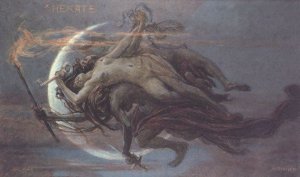
Hecate is the Greek goddess of witchcraft, witches, sorcery, poisonous plants, and other hocus-pocus stuff. She is still worshipped by some groups and is the source for the concept of a jinx.
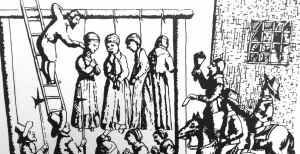


Ignorance then. Now?
I cannot imagine this.

Look both ways for witches from the east and the west, the north and south.
Mind the gaps and the pointed hats.