Taken on my walk this morning. Prickly pears are ripe. Edible, but buy in store and use leather gloves to prepare.
A week of poetry
I listened to the Frank Sinatra Radio station on Pandora during my walk this morning. Good music that makes me appreciate why so many cringed as the rock and roll era dawned. Enjoyed it, but I’ll be back to Thumbprint tomorrow morning.
So, Friday is my birthday. Question: when you become older than older-‘n-dirt, how old are you? I have arteriosclerosis (crummy circulation), heart disease and an effed-up aortic valve, and now I’m looking at “radical” surgery on my left forearm to ensure all the cancer is gone. Oh, and I drink too much wine (beer, coffee). Every day I’m gladder to be alive than I was the day before. Yer only dead once. That can wait. Right?
In ‘honor’ of the year I will spend transitioning into the mid-seventies (proud baby boomer), I plan to post at least one poem each day this week and two on Friday (B-day). These are quick little ditties done in less than 15 minutes each and tweaked very little. Some are exactly as first written. Here’s why…
I’ve read (in On Writing and others) that all first drafts are shit. I agree when it’s prose. I have written good enough poems then tweaked them to death trying to make them better (perfection?) and ended up letting them ride the hard drive for eternity.
Last year I posted a poem about my frustration with my poetry (click here to read it). I never know about my poems, so I often overwork them (not the first time in my life I worked harder than I needed to). I’m currently working on some that I’ve knocked around for over a year. Sometimes it’s cuz my muse got another call and failed to get back to me. Sometimes, I end up with something I like. Sometimes I’m skeptical, but you like it. Go figure?
So, if you read my poems this week, know that they are sunny-side-up or only tweaked to over-easy. They’re a little raw, but thankfully brief. Happy Sunday. The first poem:
Tanka Poem – A Feather
How life passes by
We see, as we feel the breeze
so like the feather
life moves us from here to there
how we love and how we care.
Bill Reynolds – 7/21/2018
Look both ways, wander often, wonder always. Mind the gaps and respect the abyss.
I am atheist. I groan when I read, “as an atheist” before people make a statement. Well, guess what? I owe lots of apologies because….
As an atheist, I have been asked how we handle life when it sucks: sick kids (or grands), lost jobs, death of friends and loved ones, financial trouble, or any disaster. They rightfully ask, “How do you get through those tough times when even heavy-duty doubters pray for relief?” We do manage without god. Not only are there atheists in fox holes, some of us have died there.
I’m dealing with a cancer diagnoses and some of my doctors ask me how I feel about it. “Well, Doc, this is one time I wish you were wrong. Now, let’s do this.” I want action, science, and medicine; not prayers.
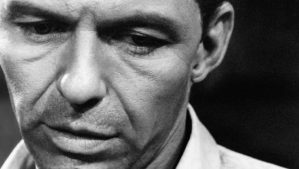
Here’s what I got for ya. Franky, baby! I love the song; both the music and lyrics of That’s Life, by Frank Sinatra. Some say, this too shall pass, but the song puts that theory on another emotional level, and I love it. I hope you do too.
Here are the lyrics. Below them, I also posted a youtube video with music, singing, and the words. Now, let’s get back up, brush ourselves off, and have a wonderful July.
That’s Life
That’s life (that’s life) that’s what people say
You’re riding high in April
Shot down in May
But I know I’m gonna change that tune
When I’m back on top, back on top in June
I said, that’s life (that’s life) and as funny as it may seem
Some people get their kicks
Stompin’ on a dream
But I don’t let it, let it get me down
‘Cause this fine old world it keeps spinnin’ around
I’ve been a puppet, a pauper, a pirate
A poet, a pawn and a king
I’ve been up and down and over and out
And I know one thing
Each time I find myself flat on my face
I pick myself up and get back in the race
That’s life (that’s life) I tell ya, I can’t deny it
I thought of quitting, baby
But my heart just ain’t gonna buy it
And if I didn’t think it was worth one single try
I’d jump right on a big bird and then I’d fly
I’ve been a puppet, a pauper, a pirate
A poet, a pawn and a king
I’ve been up and down and over and out
And I know one thing
Each time I find myself layin’ flat on my face
I just pick myself up and get back in the race
That’s life (that’s life) that’s life
And I can’t deny it
Many times I thought of cuttin’ out but my heart won’t buy it
But if there’s nothing shakin’ come here this July
I’m gonna roll myself up in a big ball and die
Maybe you have heard this: Sets low standards. Achieves same. Or this: Good enough for government work. I find both phrases tediously trite and possibly insulting. But, I’ve cheerfully used both. How about, practice makes perfect? I later heard it as, perfect practice makes perfect.
As that quality assurance guy for government contracts, I was very busy, never bored, and often unloved by contractors. They did not have to be perfect, but they did have agreed to, measurable standards to meet. Nobody likes it when “shit don’t work like it’s supposed to.”
As I write this, I’m sitting in the Tap Room of my local microbrewery sipping an excellent porter. I shall have another. It’s good and reasonably priced, but it’s not perfect. Perfect beer cannot be improved upon.
Perfection, by definition, cannot be made better.
Rarely do I say the word or identify something as perfect. When I do, I’m lying. Perfect works best when it’s said sarcastically and implying the exact opposite: FUBAR (definition below).
My strained relationship with the word perfect started with software – Word Perfect. It was not. Later, the word and the connotation it held annoyed me. Years ago, I decided that perfection was not a realistic or achievable standard. I developed a skeptical dislike for the word. When I heard someone say progress, not perfection, I liked that. Who does not want things to improve?
As part of my prep to write about this, I watched a couple of TED talks that only served to piss me off. With apologies to all her fans, Elizabeth Gilbert has a talent for making me want to bang my head on the nearest wall. Her following is vastly larger than mine, but I still think she’s out there. I like and admire her, but I strongly disagree on many levels with her views on creativity and writing. She makes me feel guilty, and I’m not sure why.
The other TED talk was by a man named Jon Bowers. Jon was (I assume he is) the lead on UPS training. Indeed, he does good work and as a professional trainer myself, I can relate to the challenges his company faces. The title of his talk was, We should aim for perfection – and stop fearing failure.
I interpret that title as, Attempt the impossible and guarantee failure. While Bowers gave many truthful and accurate statistical examples where high standards are critical, he ruined it when he implied that for us to not accept his position equated to accepting lower standards. He is wrong. I agree that excessive fear of failure prevents much good from happening. But, it is also motivation to succeed.
I think we need to set high, achievable standards commensurate with risk. My training background was in aviation. Our stated standard was in the 80 to 85 percentage area. Yet, our trainees (pilots) normally performed in the high 90s, many at the 100% level. Aviation is one of many human, high-risk endeavors labeled inherently dangerous. Fly safe and thank training.
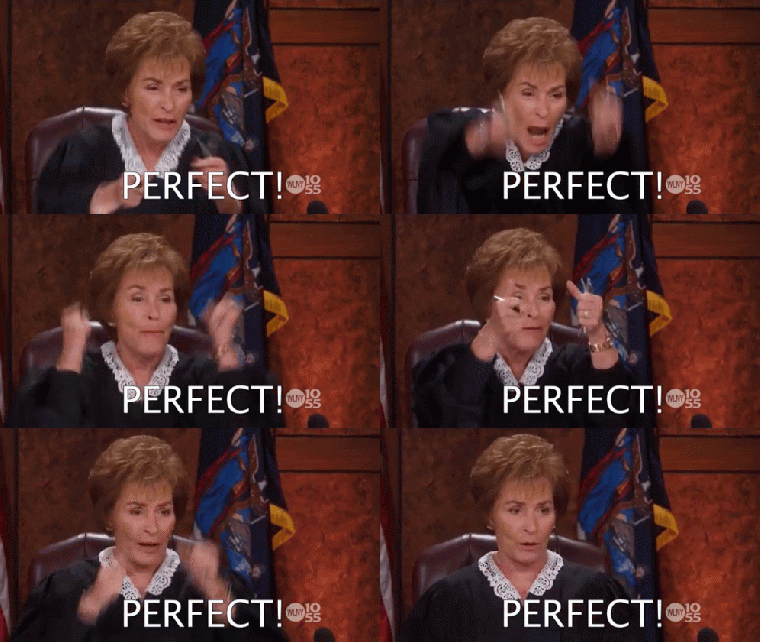
For years the response to many statements (esp. by Brits) was “brilliant.” Another word where sarcasm works better than reality while good or excellent would suffice. But, when I answer a question and the response is “perfect,” I want to ask, “how so?”; or to simply say, “No. It is not perfect. It simply is.” And, thank you, but it’s also not brilliant.
I was on the phone with an otherwise charming and competent millennial when she asked for my address and phone number as part of a business transaction. After I told her my address, she responded with “perfect.” Her reaction to my phone number was again, “perfect.” If my address was One Penny Lane, Liverpool, it would be cool or, in a stretch, excellent. Yet, still not perfect. Same for a phone number of three sixes followed by the digits one through seven. Yet, the young lady declared my responses to every one of her questions perfect.
A friend asked if I was available to meetup next Thursday. When I responded “for lunch at noon” she could have said okay, or see you then, or great. But she said, “perfect.” I assume all times before noon would have been satisfactory and later would have been acceptable. But noon was fucking perfection without peer.
My friend, Jack, once described wine to me as drinkable. If you have ever tasted undrinkable wine, you know exactly what he meant. Jack served mighty fine wine — not perfect, but perfectly drinkable.
When people ask me about something and I answer with good, fine, or (god forbid) okay, it’s common for them to follow by asking me what was wrong or what I didn’t like. Perfect.
Look both ways crossing streets.
The perfectly trained UPS driver may not be having a perfect day.
Mind the gap lest you fall and ruin an otherwise perfect trip.
Note: FUBAR is an acronym for fucked up beyond all reason.
The 30th (and final) Global Poetry Writing Month prompt challenged me to write a poem that engages with a strange and fascinating fact.
I picked the last two sentences from Chapter 24 of Bill Bryson’s book, A Short History of Nearly everything. At the end of page 415, he wrote, “It cannot be said too often: all life is one. That is, and I suspect will forever prove to be, the most profound true statement there is.”
et nos unum sumus
Life
Life is
All life is
All life is one.
Cells.
Just one. Or many.
DNA and all that
One. All one. All life.
Look and see.
Germs to grass to trees,
Animals, birds, fish, and
We’re all one, all related.
Practical profundity,
Quintessential cousintry,
Uncle monkey’s nephew
The lion with the lamb.
All from the same space dust,
Them, you, me; all of us,
Will wonder never cease?
So little difference, you from me.
(Bill Reynolds, 4/30/2018)
Look both ways — know we are not alone.
Mind the gaps, so you can fill them with love.
The 29th (of 30) NaPo prompt challenged me to write a poem based on the Plath Poetry Project’scalendar. I was to pick a poem from the calendar, and then write my own verse that relates to it.
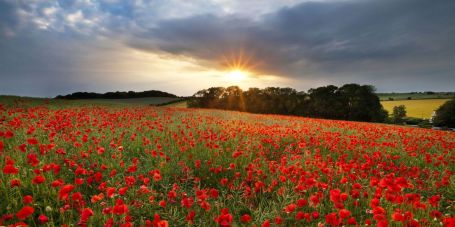
If you don’t know anything about Sylvia Plath, you should. Click on her name to link up. I selected her poem Poppies in July (click for link to analysis) because the city I live in is having a Poppy Festival today. Also, reading the poem and learning about Sylvia’s life was deeply moving.
Poppies In July (by Sylvia Plath)
Little poppies, little hell flames,
Do you do no harm?
You flicker. I cannot touch you.
I put my hands among the flames. Nothing burns
And it exhausts me to watch you
Flickering like that, wrinkly and clear red, like the skin of a mouth.
A mouth just bloodied.
Little bloody skirts!
There are fumes I cannot touch.
Where are your opiates, your nauseous capsules?
If I could bleed, or sleep! –
If my mouth could marry a hurt like that!
Or your liquors seep to me, in this glass capsule,
Dulling and stilling.
The day 20 poem prompt of the 2018 NaPoWriMo challenges me to write a poem that involves rebellion. For example, defy a rule, or write something either funny or serious. My poem should open a path beyond the standard, hum-drum ruts that every poet sometimes falls into.
Warning, this poem is bleak. It is written to reflect panicked frustration and to respond to the prompt. The dark side of reality interests me. I am not disturbed by it and I accept its existence. Many of you feel the same or Stephen King would be a retired teacher today.
I use the f-word a lot here, cuz I use the spoken f-word a lot, except when I know some prudish soul may be crushed. So, if those two things bother you, please give this driveling twaddle the sack.
One more thing. I am fine. Please try not to think otherwise. Yes, I recently got some bad news, but that has nothing to do with this stream-of-dark-consciousness writing (and if it does, so what?). It’s hard enough to write without folks asking if I’m suicidal.
The poem is rebellion from my POV. If you do read this, and you happen to be, or have been, a Teacher of English grammar, take a deep breath and perhaps a glass or two of wine first. It is one sentence. I know. Many great poems (one of which, this is not) are.
Assimilated Rebel
one must dress like this or that and think thusly and carry this torch to that goal and be always right and feel like shit when not and one must win, always win, a looser dont be, dont say that is not me because bukowski said just do it, just do it, and live and work for the glory of no god or whatever, but to survive and whatnot, and to help them survive, the ones you love and them ya dont and its a beautiful life and we will all just fucking die because thats what we do in the end middle or start, and then go to some nonexistent haven or fucking hell foe-evah cuz ya didnt cross da tee or dit-da-dot on a dam i and smile for a kodak if yer not, then dont fucking try cuz anyway they all die no matter how hard ya try and then dunna fuckin cry, just be stoic, thats a lie but i dno why, just go along to get along and be different and ah independent thinker, just be creative and spell it my way in stripes with plads or circles, and socks wit sandals, and man-buns and feet with pit hair, lay and never lie, its all so jacked up nothin’ fucking matters so fuck it, and fuck it all.
(bill reynolds, 420 day y2k+18; freddie mercury tribute concert day; and a. hitler’s b-day)
Look both ways today to see who’s got the loco weed tea.
Allow no gaps of toke.
The day 19 poem prompt of the 2018 National Poetry Writing Month challenges me to write a paragraph that briefly recounts a story, describes the scene outside a window, or even gives directions. I was to erase words from that paragraph to create a poem, or to use the words of the paragraph to build a new poem. Here is my result of that effort, without the paragraph.
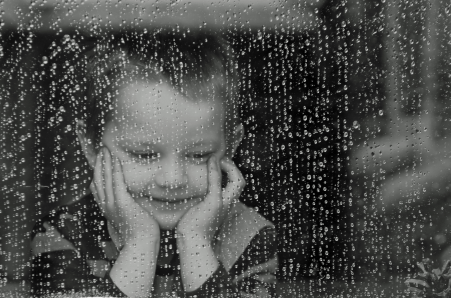
Envy ‘Neath a Window
With Mom I sat
As she was reading
Not to me – getting bored
On a raining summer day.
I’d catch some death of cold
She would say
From being wet with rain,
On that cool summer day.
Something ‘neath the window?
I walked to see a mouse.
I said no words, nor did he,
As I looked out the window.
My first envy feeling was seeing
Friends playing in the rain.
Making themselves damn fools.
I learned, in the adult version
Is as they call it, having a good time.
Damn fool for just sitting here.
“Mom, may I…?”
Envy. I felt it.
(Bill Reynolds, 4/19/2018)
Look both ways and love those rainy days.
Mind the gaps or hydroplane.
I’m opting out of the day 18, 2018 NaPoWriMo prompt. Instead, I wrote this poem.
Fight was His Game
Poor boy whose story we were told,
Danny was his name, fighting was his game.
Young and strong, with dreams of glory in his fists.
He fought to save his life, to be proud and ever bold.
Promised wealth with violence
Would bring so many gifts.
No warning was to move him
from his promised dream.
Boxing and his future, were both all agleam
It was his game, to be his fame, no one interfered.
In the pit of misery, while still just a boy
Trusting words of strangers, and what they had to say.
In the roaring twenties ring
he took the fighter’s stand,
Seeking victory and honor, with his body and his hands
Many marred and broken,
This Danny boy was all aflame.
Stepped into the ring, a fight to be his game.
Still looking for a young man’s fame.
Dan stood strong and determined.
He faced the champ, who gave that boy
quite a beating with a lesson.
Badly beaten, he lost the fight,
And all his pride went with it.
The champ made him a chump
looking too sad and lame.
Still more boy than man, with spirits badly broken,
He searched for work and asked for jobs.
A boy inside, with dreams gone south and broken.
Now the boy was older
In all the world’s wrong ways,
Now laying low without his game,
Still, Danny was his name.
(Bill Reynolds, 4/18/2018)
Look both ways and duck those punches, mind the gaps right cross.
The day 16 poem prompt of the 2018 National Poetry Writing Month challenges me to write a poem that prominently features the idea of play.
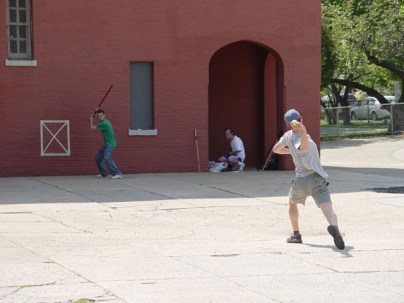
My poem is about my memory of a game we played as children – a game still played today, albeit differently. It has been played for over a hundred years by boys and girls, now also by men and women. Essentially, it is street or vacant lot baseball played with a broomstick for a bat, bases like the manhole cover or the flag pole, and most often a rubber ball.
My gang used all sorts of balls including wiffle balls of various sizes. No one wore gloves or any form of protective gear. Our classic favorite was to use those small plastic practice golf balls with all the holes in them to increase the challenge. They could bounce off any window or person with no damage. No coaches, no adults, highly flexible rules, and we worked out our disagreements without paying lawyers.
My poem is this old fart’s memories of playing the game and living totally for the moment, for the game, to be as good as we could be, and to have fun for the sake of play.
We used handles cut from broom sticks or mops. I do not recall anyone buying a ball, but it would not surprise me to learn that the ones we used were found, or “found” (as in the bottom of dad’s golf bag). The first commercially produced stickball bat came out in the early 1950’s and sold for 89 cents. Today, you can buy a high-tech, Easton T10 Thunderstick stickball bat for $50.00.
One of the problems today is that it has become difficult to find a good wooden broom or mop handle not being used, and games like that have fallen out of favor. However, I have included a photo and video about the game. In both cases, commercial bats are used.
It’s Never Just a Game
I was in the game that day
when it was a hot midsummer afternoon
when we played in the Courtright elementary school yard
when Jimmy Lipinski hit a double off of Joe Mullins’ chest
when time outs were for injury or just to pee.
I was in the game that day
when the fight broke out between Balochi and the new kid
Smitty was new and wanted us to play by New Jersey rules,
Balochi and Smitty became close friends and grew old together
and we learned to play by Jersey rules, East End rules, and league rules,
but mostly we made up the rules based on many things.
I was in the game that day
when Teddy tripped on second base and broke his nose
when the Daniel’s kid at shortstop lit a cigarette in the third
when the school janitor came and ran us all off or he would call the cops,
when we vandalized the school cuz the Janitor was a dick,
when I got my first hit, and when I hit my last.
I was in the game that day
when Lipinski made his behind the back flyball catch
when the worst player on the team hit a grand slam
when cuts and scrapes and twisted ankles were part of growing up,
when it started to rain that day and we played on anyway,
when the game was just the game, and both sides always won.
I left the game that day
when we walked away cuz it was getting dark
when we were thinking of what in life came next
when we thought there were better things to do,
when we walked away one last time
from the game we all so loved.
Let’s go play some stickball.
(Bill Reynolds 4/16/2018)
Look both ways as you play the game.
When at bat, mind you, hit the gaps.
The day 15 poem prompt of the 2018 National Poetry Writing Month challenges me to write a poem in which a villain faces an unfortunate situation and is revealed to be human but still evil.
This reminds me of a discussion I had with other writers regarding antagonists who are both good and bad.
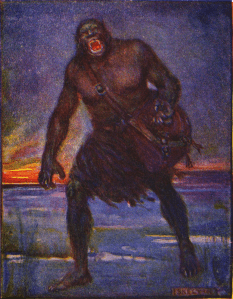
Anyway, I decided to write a poem on one of the villains from Beowulf, Grendel. You can read my April 7th post on Grendel here.
Grendel’s Reflection
Humans.
How nice and kind and all
When they kill,
it’s for the glory
of some crazy god.
Stand and fight,
it is our right,
that is their battle call
They kill each other,
then blame me,
I find it rather odd.
They say old brother Cain
rests within my heart
Not clearly seeing
the happy demon
who owns their very spirit
As they rip and tear
their kind apart.
Why such hate
within them grows,
their god only knows.
In the king’s hall,
it’s all hell they raise
It wakes me from my slumber
Yet when I grant them peace,
‘tis me they blame
for the midnight slaughter.
Little do they know,
that I am not so bad
If they were better neighbors,
it wouldn’t be so sad.
I am, after all,
just being me,
as like them as I can be.
Be your brother’s keeper,
unless he looks like me.
(Bill Reynolds, 4/15/2018)
Look both ways at right and wrong but judge your own-self first.
Tread softly with others being mindful of the gaps.









 Our Literary Journey