The first of three questions I think everyone should be able to answer quickly is ‘What do you want?’ I’ve always felt that few of us think about that. We may have short term goals or we may want some things to come our way. But the ultimate answer, while not illusive, is something we seldom ponder. I say this with the opinion that for virtually all of us, the answer is simple, easy, and nearly the same for everyone.
 As I listened to an interview with Christopher Hitchens, I was surprised by something he said. I’ll get back to that in a minute. Frist, I want to talk about the genesis of the question and my answer.
Beginning about 25 years ago, my life began to take some very significant turns. Much significantly changed for me. My life was on track, then it was not. This life transformation continued for years. Much of it was unpleasant, disruptive, sad, and shocking. The unhappier and more miserable I became, the more I thought about what had happened and what all was going wrong. I’ll save the details for a memoir. Suffice to say, shit happened and stuff changed.
This led to a rather spiritually reflective time for me. I read a lot of spiritual books, studied religions (some more lightly than others), and pondered what I thought were important life questions.
I don’t recall when or how I came across the brochure. It was titled Oh Happy Fault! A Confession of Hidden Sin by Vinny Flynn. In the brochure, Flynn confesses that his sin was being unhappy. Silly as it seems, that resonated with me because I realized that I was unhappy, or depressed, or both. Either way, what had been going on inside me (where no one could see) was the same. This led directly to my reading three books and indirectly, discovering one other.
Fully Human, Fully Alive, by Fr. John Powell, SJ
Siddhartha, by Herman Hesse
Man’s Search for Meaning, by Victor Frankl
About the same time, I also read, The Seven Story Mountain, by Thomas Merton.
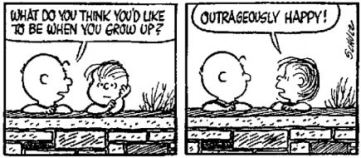
The result of all of this was that I made two decisions. Actually, I made many decisions and continue making them, but early-on I decided that I wanted, or perhaps needed, to be happy. I knew that I was unhappy. So I decided to be happy. More importantly, I decided that my happiness was up to me – that I could do something about it. It took a long time for my happiness to improve, but it did.
Jump ahead about six years. I found myself conducting classes for other very troubled people. They were not exactly unhappy (some were). They didn’t seem to have any focus about anything. In my opinion, they had no world view. One of the questions I would regularly as them was “What do you want?” Their answers sounded like a list of shallow, adolescent ideas about hot cars, money, and hot men or women. The blank stares and silence I got when I asked ‘why’ disguised their answers of ‘who the hell cares?’ With that experience, I have continued asking people the same question for years. “What do you want?”
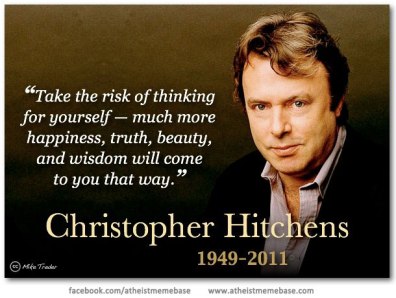
I’ve always thought everyone’s answer should be ‘happiness.’ During the Christopher Hitchens interview, he said that he did not think that he wanted ‘happiness,’ but wanted ‘satisfaction.’ I liked Hitch, but on this answer we would disagree. Maybe he felt that happiness was too much to ask for. Anyway, at least one dictionary indicates the words have synonymous meanings. There is a difference. Even though satisfaction implies having our needs met, happiness involves our state of mind regardless of needs.
I’m skeptical of some folks wanting to be happy. Some people seem happy by not being happy, or not wanting anyone to know they’re happy. It’s like if anyone knows, they will set out to ruin my happiness; therefore, I mustn’t appear happy. Maybe they really are just waiting for something bad to happen, or maybe they seriously do not want to be happy. Maybe they think there is a happy tax.
 A satisfaction tax would make a lot more sense. It seems like things may satisfy us, but we decide to be, or not to be happy. How would we measure and estimate a tax on feeling good?
Anyway, I hope you are happy now. I also hope that Hitch is satisfied and Mick Jagger (after all these years) can get some damn satisfaction. I mean, how long does a guy have to wait for that?

 I do my best not to ‘unintentionally’ hurt somebody’s feelings. However, I’m unopposed to stepping on an emotional toe when I hear the call. As a senior citizen, I sometimes feel a sense of entitlement to do that, but I usually refrain. I once knew one guy who was so Cliff Clavin (from the TV show
  Several years ago, my daughter-in-law said that I was snarky. I appreciated her honesty and courage. I also liked it. She was right; I am snarky. I’m also sarcastic. In fact, being both makes me
 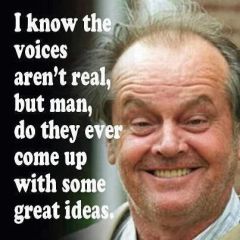 Jack Nicholson in As Good as it Gets (and other movies of his)
 Female Comedians (Yes they are)
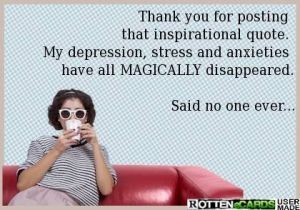 Not everyone has been introduced to my brand of snarkasm. After a while, when most people get to know me, they agree that I can pull it off. Many find it humorous. In fact, that’s the point – humor. I’m not on some kind of anti-PC* crusade here.
 Are you Andy or Barney?
 Some people think that ego is a bad thing. In a way, they are right. In a way, they are wrong. A wooden plaque (given to me by a friend) hangs in my room so that if I (ironically) hold my nose up, just slightly, I can see it. It says, “Humility is not one of my faults, but if I had one, that would be it.” Before you attack my lack of profundity, my friend made and gave the plaque to me as a bit of an ironic joke (I hope).
 I’m making the claim that ego is mostly good for writers. I presume that it is good for artists who work in other forms of artistic expression. I also think that being humble is good and being courageous is good. I also think that each of us should do what works for us. We’re unique individuals who share a passion (if you want to call it that). I admit that an out of control ego is a problem for more than just the narcissist, and egotistical people have their issues. But over-blown personalities write and sell books too.
 We need our ego to launch the work to readers. We need to believe that we can and want to do it. We also need to deal with whatever criticism and rejection we encounter.
 To quote from Poe’s Preface to a republishing of his poems: “These trifles are collected and republished chiefly with a view to their redemption from the many improvements (made by publishers)…I am naturally anxious that what I have written should circulate as I wrote it….” He goes on to say that it is not that his work is that important, but the people who read it are. Ego?
 There are four brothers. They struggle to get along with each other, due to more than a little sibling rivalry. Three of them like to cause trouble. These three are selfish and annoying to humans and gods alike. They like to hide things from the sun, whose name is Sol. The three are very jealous of Sol. They think that they exist purely to keep Sol from comforting the earth and its inhabitants with his warming rays of light. Sol despises the three troublemakers, and openly favors the fourth brother. Sol knows how the earth, plants, animals, insects, and most people respond to his warm presence when the three annoying brothers are resting.
 Boreas is the north wind. While he can be out causing problems at any time of the year, his favorite season is winter. He is cold, icy, and wild. Boreas has a reputation for causing trouble and making a mess. He is a bully known for pushing the other three brothers around, especially Notus.
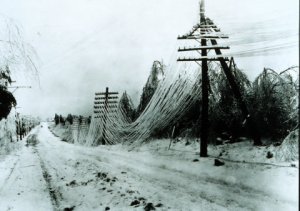 He is sometimes careless. Boreas sneaks under him and freezes his rain, sometimes just as it falls, causing havoc on the earth. At other times the north wind pushes back, causing violent destructive storms. This embarrasses Notus, but Boreas thinks it is funny. To confuse his brothers, especially the irritating Boreas, Notus sometimes spreads fog over the land and sea.
 Eurus, the east wind, is foolish and lazy. He seldom does anything, preferring the amusement of watching the conflicts arise between his brothers. When he is bored, he teams up with Boreas to create problems and confusion. Together they make a north and east wind, known as a Nor’easter. Eurus watches from the comfort of his room and laughs at the chaos he creates with his brother. He is the most evil of the three problem winds.
 Zephyr enjoys seeing humans smile as he touches them, blowing into their faces, caressing their bodies, and messing up their hair. Often, after his brothers make a mess, Zephyr works to clean things up. He sweeps the sky clean of clouds so that Sol can warm the people, melt the frozen ice and snow, and dry the soil. Plants can grow, people can honor the sun, and animals can forage among the plants. Life goes on.

 Ten years ago, I lost one of my best friends from my childhood. Today, I received a phone call telling me that I have now lost the other. A few weeks ago I was tasked with a writing assignment to provide an essay on what I long for. You can see it blogged under “Nostalgia and Longing.” Reading my blog, you can glimpse my view of humanity and the world.
 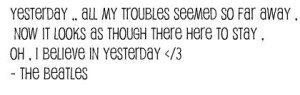 But today, I want to think about the past. Not in a regretful way, but in an “I remember” way that might allow my brain to be the tool of a child’s mind again.
 I know that I cannot go back to that time, and I’m not sure that I would want to. But I want to have those memories until I have no memories. I would like to again feel the freedom, the special bond, and the unquestioned certainty that we would all live forever. I want to think about my future and talk about how much better it will all be. I want free and unlimited amounts of candy and ice cream. We didn’t have that, but when we took over, well, you know, right? I want to know that next year, I will be allowed to stay out after it gets dark, to drive a car (legally), to date girls (with everyone knowing).
 Xanadu may refer to:

 Across the sacred river before the sea
 Where all that move within the light become victims of the night
 Canopies open to view heavens gate as sparkles ignite
 How each of us views utopia is probably similar in the broader sense, but we may differ as we each conceive of the details.
  In the world of politics, the dark side of human nature emerges. Of course, it is always the others or the other side. Real world peace would be required long before we could begin to approach anything like utopia. It requires an egalitarian (equal) society and that is contrary to most politics I’ve ever seen. When I think politics, I see far more potential for dystopia and war.
 Religion? While a great deal of good is done in the name of a deity and the respective religions, that good fades to virtually nothing when balanced against the historical inequality and current turmoil that seems to move more toward dystopia — more war.
 I asked alcoholic and drug-addicted Texas prison parolees the following three questions while teaching secular recovery classes. I came up with these to help them find a world view that went farther than the tips of their fingers. My personal answers are utopian.
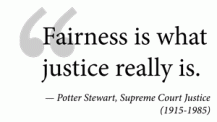 The confusion and struggle so many of us face in answering these questions is an interesting testimony to our nature. But we each have our personal utopia within our answers.
 In a scene from my childhood, I watched through our living room window as kids my age played in a rainstorm. They were laughing and having a wonderful time getting soaked. The streets and gutters were awash. One boy sat down in a flooded gutter as the water pushed against him and splashed hard around his body. I felt envy. Not because they were having fun without me, but because they were playing in the rain. I was home with my mother, and she told me that I couldn’t go out because I would get soaked and catch my “death-of-cold.” I have since learned and admit more about myself, and about colds.
 The word ‘pluvial’ refers to rain or something characterized by abundant rain. The suffix ‘phile’ denotes fondness. Consequently, a pluviophile is one who finds joy and peace of mind on rainy days. I was taught that rainy days were sad, as in the Carpenters song lyric; “Rainy days and Mondays always get me down.” I was to believe nice days were sunny, cloudless, and warm. I’ve never felt that way. Sunny and pleasant days have their place, but few are enough. Later in life, I admitted to liking cloudy, rainy days. I now identify as a pluviophile. These days, I’m often asked why, after more than twenty years in California, Texas, and Florida; I recently moved to the Pacific Northwest. I ask, “Do you know what a pluviophile is?” Like it should be news to me, I’ve repeatedly been told “it rains a lot there.” I reply with a smile, “Yes, it does.”
 My involvement with rain changes with its many forms. Scientific names apply based on how it comes about. But, I am talking about how the rain itself varies from torrential downpour to a gentle drizzle. Duration, wind, thunder, lightning, air temperature, and other factors contribute to our experiencing rain. There are times of rain just falling, and times with thunder and lightning. There is morning rain, afternoon rain, and rain at night. Each is emotionally and physically encountered differently. It can be seen and heard while keeping dry, thus precluding feeling the rain. Only outdoors can we dance in the rain. If I don’t perceive rain with senses—I just get wet. Our world changes when it rains. We need it, just as we do sunshine. To me life smells, feels, looks, and sounds more alive in the rain. In the city, rural areas, and in the forest, everything improves. When I am with the rain, I heal and recover. It’s a spiritual exposure difficult to explain. I’m not especially spiritual, but in rain I sense life — nature.
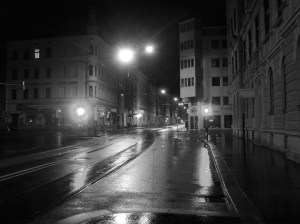 I recently delayed my daily walk when rain was forecast. After waiting for the rain to start, I donned shorts and tee. I was off in good spirits, expecting to be, and was, soaked. After an hour, I was back home. I sat on a dry and covered bench, removed my soaked shoes and socks, slapped water from my dripping baseball cap, and chuckled. I was thinking how others might consider me deranged. But, this is why I’m here.
 tilted forward and cocked right. The front brim bent slightly downward with water flowing off. The sound of falling rain is all around. I hear it splash into puddles and onto sidewalks. With water moving everywhere, I forget the day’s problems and the annoying people. But mystery is afoot. Like it or not, Mike Hammer is involved. And of course, there is a woman. As Hammer, in the writing of Spillane, I mumble, “In the flora and fauna of the Bowery, she was a lot of flora and quite a bit of fauna. She looked like she belonged in a field of Wyoming wildflowers instead of wandering through the human backwash of the avenue.” In the night rain, I can do this. Rain brings magic and drama.
 Let’s take life, rain or shine, one day at a time. It’s about how we feel. We’re not alone in our emotional response to rain. In the Pacific Northwest, we love the outdoors, rain or shine. Too much shine and we miss the rain. After some rain, we’re ready to let a little sunshine in. “In every life a little rain must fall….” Of course, and why not?
 My wife doesn’t like one (or more) of my favorite songs: Night Moves by Bob Seger and the Silver Bullet Band. I thought it was our differing tastes in music (she’s country, I’m rock and roll), but one day our son pointed out why. It’s a ‘guy’ song. I also realized that we each look back in time with different memories. Never mind that she really does not enjoy the raspy-voiced shouting of old Bob. The song, written and recorded by Seger in 1976, is a coming of age tale about adolescent love and an adult memory of it. It strikes memories of my times in the early sixties.
 During the 1970s I graduated from college (many thought impossible), I re-entered the Air Force as an officer, I completed flight training, all my children were born, and I turned thirty (I thought that impossible and I sadly became untrustworthy— relates to the famous “don’t trust anyone over 30” adage of Jack Weinberg, activist of the 1960s, now 76). I usually listen to the music of the 70s. While I enjoy those songs for their own value, the music also often brings with it memories and feelings that can only be called nostalgia. Sometimes, it makes me feel profoundly sad. I’m not sure why, but I suppose it has to do with something that will never be again.
 It was the decade of great music, great movies, and great TV. The politics were interesting. How often do we get to see a president resign? I am working on a historical-fiction novel, set in the 1970s. We had Star Wars, ABBA, and the Beatles break-up. Elvis died. Everything was either brown or orange including the shag pile carpeting (ok, add yucky gold). We had platform shoes, Charlies Angels, Mork and Mindy, metal drinking cups, portable hair dryers, Holly Hobbie, Lava Lamps, and the most outlandish fashions ever for America and England. Who could ask for more? We typed on typewriters, went to Tupperware parties, and air conditioning was a welcome luxury. And who did not have an 8-track?
 She had been in the kitchen helping her slightly-older, barely-teenage sister prepare dinner, but she knew it was nearly that time. She moved to the living room where she could take her usual position. Soon enough, she heard his familiar cough and the sound of his voice as he acknowledged neighbors. As he grew near and she could tell it was him, her excitement would grow as it had for years. She felt delight and love for this stoic Welshman. After work, he was usually more outgoing, partly due to the social and medicinal nature of his homeward-trek diversions. The front door was never locked, so when he opened it, his familiar frame was encased by the doorway. Each time this happened it was the same—she would jump up and run toward him and he would immediately stop her. “Now Bernie, you mustn’t get your dress dirty. Where is Dee?” The sight of her father set in the doorway after returning home would be fixed in her mind for the rest of her life.
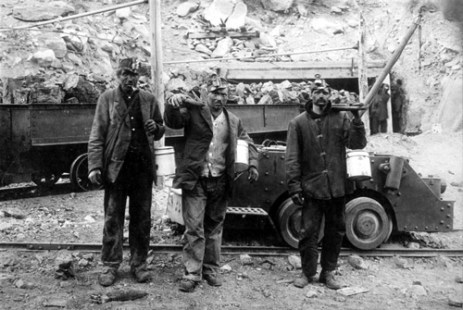 When this man returned home from work, he wore the same drab trappings of men who worked long days underground in a dark, dirty, and dangerous world. He would arrive home from the alley at the back and enter directly into the kitchen. When she looked up, his black silhouette was framed by the kitchen doorway. Her 1920s childhood had been replaced by post-WWII drudgery and insecurity. Their son was born seven months into the marriage. She named him after her father, who died a year earlier. Each day, she was relieved to see her husband return safely home. Funerals and memorial services for coal miners killed in mine disasters were common. Eventually, in the 1950s, the anthracite coal industry would be undermined and replaced by oil.
 She heard footsteps, a familiar cough, and his voice speaking to nurses. She had turned and was looking up just as he stepped on the threshold into her room. She loved the way he looked in his uniform and was delighted to see this man standing there, framed by the hospital-room doorway. She jumped up and ran to him as only a woman in her seventies could. Unlike the days with her stoic father and distant husbands, this man embraced her. They hugged and kissed for a while. She looked up at him and said, “I am so happy to see you.” He smiled and looking down at her asked, “Mom, didn’t you just have surgery?” “I don’t care,” she said. “You are here now.”
