 Many people have found that journaling and being grateful are useful methods to feel better and to enjoy life more. Grateful people seem to be happier. I prefer to be happy, so it follows that I want to be grateful. I will not discuss journaling since I don’t, but I admit that I should. Maybe this blog is kind of like that. I don’t make gratitude lists, but I could easily. I know many happy souls that do.
Last week, I had a medical procedure. It is not new to me. I inherited what I refer to as bad plumbing from my father. He called it poor circulation. Medical folks call it arteriosclerosis. I am not grateful for it. My doctors tell me that I am just ‘one of those people.’ Anyway, I have had this before. They’ve run things up into arteries from my wrists through both arms and into my heart. Years ago, I had stents inserted into my iliac arteries through my groin to help with circulation in my legs. Last week we again had to venture in at my groin. With all of these, I was awake so I could joke with my doctor and tell him how I was doing. As he tried to find my artery and his fingers pressed into the spot between my groin and leg, I let out a moan. He asked me if that was pain, or was I ticklish. I am very ticklish and I was also very stoned thanks to the happy drugs the wonderful nurses slipped into my IV. I already had four stents. These were numbers five and six. It took about two hours and I was off to my hospital room for the night. Not my best night, as it happened.
At that point, I had one order: “Don’t move!” I had to be (lie or lay?) flat on my back until told I could move. From my chest down, I was not to move a muscle, not roll to my side, not lift my knee, not bend my leg, nothing. This is to prevent bleeding. Until blood clotting improves, the doctor left a sheath, or tube, in my artery that the nurses would remove after checking on my clotting factor. Let me help with time.
I got to the hospital about 1:00 PM and was placed on a bed until called to the OR (Cath Lab) at about 5:00 PM. It was supposed to start at 3:00, but there was an emergency. From the time I got there (5:00), I was flat on my back for the next 14 hours. After the procedure, which took two hours, at 7:00 PM, I was in my room. The nursing team transferred this old gnome’s body by sliding me on my back twice. By 11:00 PM I was in miserable pain caused by not moving – as blood just pools with gravity. But there was one more problem. They kept pumping fluids into me, which means that eventually, that bodily function had to….well, function. I had to pee.
The last time I peed from a position flat on my back I was wearing diapers, or should have been. Since pressure was going to be applied to my groin, I had to let it out. But how? I asked the nurse how and suggested rolling on my side. “No, Mr. Bill. You will need to urinate into the container while not moving.” I protested, “That’s impossible. That will never work.” She smiled at me and said, “Let’s just have positive thoughts, shall we?” And then, like I needed extra motivation, she tells me, “If you can’t go, we will just have to insert a catheter. So do your best.” Uh, oh.
Several years ago someone stuck one of those things in me. I’m sure was an old garden hose. Back then, a male nurse (jokingly) informed me that they have a lady whose husband left her for a younger woman put them in. She is angry with all men for what that guy did to her, and she exacts revenge upon those of us who are so equipped. I recalled the pain of that experience and how it was many days later, before I could pee again without pain (Stephen King, are you listening?).
 In less than two minutes I had filled the plastic jug to the brim without moving an inch. I handed to the nurse with a smile and asked her to keep that catheter thingy away from me. She smiled, let out a mildly sinister chuckle. Then she said, “See what positive thoughts can do.”
Finally, at about two in the morning, they managed to remove the tube from my artery with virtually no bleeding. That’s because the nurses maintained pressure on the wound for 25+ minutes. Then the clock started for a minimum of another four hours on my back.
I am grateful for all the nurses, doctors, techs, staff, cleaning crews, medical technology folks who manufacture the stents, the drugs, the plastic jugs, and all that they have done for me. I am grateful for my wife for being there and barking orders when the nurse was off dealing with other snarcastic old farts. I feel wonderful, my heart is doing great, and I am back to normal. Thank you.
 We all have them, to one degree or another. We are born with them and they change over time. They seem to always be there. Admittedly, health issues have a profound effect on our feelings, but that does not diminish the importance of feelings. And feeling can have an equally profound effect on our behavior, and can conversely effect our overall health. I like to say, “It is all about how you feel.” I mean that in life how we feel is critical. People may advise us to cheer up, but how?
 I am not talking about clinical depression, chronic sadness for no reason, or any form of diagnosable mental health problem. I am talking about the normal things in life that may affect us because the emotional weight is so great. Things that make us sad are part of life, but they can, and often do, emotionally stop us right in our tracks. We feel bad. And depending on the degree and how it is handled, it has everything to do with eventually feeling good enough again to get on with it. I will not say get over it, or that we even have to.
 We have heard, “How do you feel about it?” and “How does that make you feel?” We may ask ourselves that question every day. While this is normal, living with a daily problem that makes us feel bad can often be improved. But we have to want to improve and we need to be willing and motivated to do what it takes to feel better.
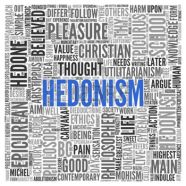 I am an Epicurean. I see nothing wrong with that and even see it as positive. In my house I have food and drink, some of which has minimal or no nutritional value. But I like them and they bring me a certain amount of pleasure. I also have substances that have value in the reduction of pain. Chances are that you do too.
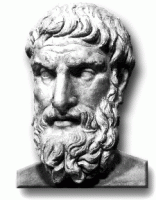 derived from fine food and drink both in a person’s taste and, as it often relates to delight-providing establishments, restaurants. Synonyms for epicureans could include hedonist, sensualist, pleasure-seeker, sybarite, voluptuary, bon vivant, and bon viveur. More related words are epicure, gourmet, gastronome, connoisseur, and gourmand; a generous, life-loving epicurean. Much of how we use the term invites thoughts of fine food and drink. I personally favor the adjective Epicurean to mean leaning more toward an understanding of Epicurus and his ideas.
 This may be the most difficult topic for me, but it’s early in the A-to-Z Challenge. I may find subjects that are greater challenges. Regarding the dark side of human nature, I would simply prefer to accept it and move on. My research of our dark nature has revealed that we humans actually want to deal with it in reality, art, life, drama, poetry, fiction, behavior, and nature. Many of us admit to a duality of human nature, but even more of us reject the dark truths.
 My dark side calls to me. I ask, “What do you want?”
 In addition to Oscar Wilde (The Picture of Dorian Gray), which I’ve read, I shall add the following.

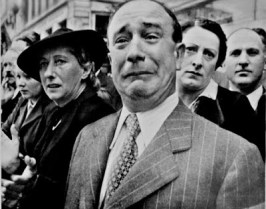 When I ponder c’est la guerre, my thinking goes more toward the conditions or philosophy of war, or the way of life during times of war. As an American, the concept is a little foreign to me (like our wars), since the only ground war we experienced was our war with ourselves: The Civil War. Ironically, it may have been the most destructive of our history in terms of loss of life and property. For at least the past 100 years, we have considered war as something that happens over there. Lucky us.
 While there are many good books regarding the philosophy of war, the classic gold standard is On War by Carl Von Clausewitz – required reading for virtually every military officer. War and Peace by Leo Tolstoy may be the preeminent novel on the subject. And the classic for weaponry and strategy is The Art of War by Sun Tzu; more required reading, if not necessarily the best reading entertainment.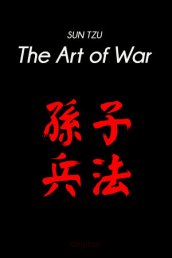
 Blind Man’s Bluff: The Untold Story of American Submarine Espionage (ISBN 0-06-103004-X), published in 1998 by Sherry Sontag, Christopher Drew, and Annette Lawrence Drew, is a non-fiction book about U.S. Navy submarine operations during the Cold War.
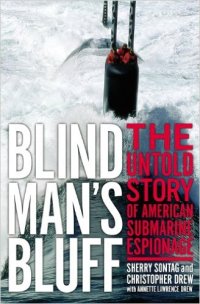 The museum was worth the stop and the tour of the Nautilus was wonderful. If you like that kind of stuff, I recommend it. I usually take time to visit gift shops at such touristy places. That was where I purchased Blind Man’s Bluff: The Untold Story of American Submarine Espionage. I was motivated to read it by what I had seen in the museum and how I felt walking around on the submarine. I’ve had but one friend who was a bubblehead. He was stationed on a boomer (slang for a nuclear-powered ballistic missile submarine; the British say bomber) out of the Navy base at Groton. Those subs are different from the vessels in Blind Man’s Bluff, although boomers represented one leg of the US triad of nuclear defense during the same Cold War (still does).
 More than a year later, I learned a new word that explains my reaction to the painting. It had never happened to me before, and has not since. The word is duende. It is a noun meaning the mysterious power of art to deeply move a person. There is a lot more to and behind this word. You can check it out for yourself by reading the wiki, if you’re curious. Apparently, artists sometimes experience this with their own work. However, if you’re familiar with this, or had a similar event happen, I would love to hear from you.
 Our Literary Journey