Disclosing as atheist is personal. Each person’s circumstance and disclosure story is different. The real question is: why should anyone publicly acknowledge being atheist? For some, it’s best kept private. There are legitimate reasons to hide not accepting the existence of any god. The reason is always the same: believers.
 For many of us, the importance of religion is stressed from a young age–religion must be taught. Logically, we are usually taught that our religion is the correct one and all others are wrong. While atheists have a similar conviction of accuracy, it’s not the same since the basis is no god exists, and consequently no religion is right.

Regardless of the religion or denomination, it seems that most believers don’t understand or accept atheists or atheism without extreme prejudice. Unitarian Universalists are a possible exceptions, as well as a few others such as some pagan groups and Buddhist schools, divisions, or sects.
From my teenage days, I recall my mother telling me that she didn’t care what religion I was, as long as I had one. Mom was raised in a multi-denomination Christian family. I don’t recall Dad saying anything about it. I think he’d approve any religion as long it was “Cat-lick.” I wouldn’t risk telling him anything he might not agree with, certainly not that I didn’t believe in god.
 I haven’t had to deal with negative family or friend issues regarding my public atheist disclosure, which was fairly recent. Other than a hint or two about someone praying for me, it’s been quiet.
After reading my spiritual memoir blog, Free from Religion, my wife said, “I could have written that.” Her experience was like mine, but she remains a theist. While supportive of my decision, she wonders what our religious friends think.
I’m old and can be cantankerous, but I’m usually laid back, quiet, and friendly. I’m retired, and have outlived many of my friends and family. While I want to be liked and loved as much as the next guy, I stopped caring so much about what anyone else thought of me long ago. At least I no longer care in the foolish manner that I once did. By remembering that what others think of me is none of my business, I find that I function much better in life.
For me, accepting my atheism involved learning, personal analysis and self evaluation—all done on my own over many years. Deciding to go public required me to think deeply about it. I wondered, why bother? I’m out, but I still think about it.
 While my disclosure has been inconsequential, I’m concerned for anyone struggling with it. While the decision is personal, I think atheists should disclose (come out) as soon as they’re ready. But, preparation and timing are important, if not critical.
We should not disclose when angry, arguing, or with any motive other than share something about ourselves. Even simply answering a question, as in my case, should be at the right time.
My answers to the question about coming out, posed in the first paragraph are:
- Honesty is the best way to deal with some of the challenges. Experiencing guilt from being deceitful is an unnecessary burden.
- Support. Depending on where one lives, there are groups of other atheists willing to provide advice and support. Being open allows us to take full advantage of such groups. On line groups are plentiful and helpful. The names and contact information for these groups are available through blogs and books.
- Mental health. It feels good. Along with the lifting of a mental burden, many of us feel a new enthusiasm for embracing atheism. My experience is like that.
- Social contribution. It is good for the individual, good for society, and good for atheists and believers alike. The stereotypical view of atheism and atheists is unfair, damaging, and wrong. By allowing others to know we are atheist, it helps them to know the truth. While I’ve been incorrectly labeled an exception, my openness is beneficial to every atheist.
To deal with the idea of disclosure, I recommend the following.
This book: Mom, Dad, I’m an Atheist, by David G. McAfee
Good blog article: 3 Doubts Closet Atheists Should Have Before Coming Out (And 3 Reasons To Do It Anyway)
And another one: Why Come Out As An Atheist?
 A second book that I’ve not read, but looks promising, is Coming Out Atheist by Greta Christina.
Each of us should stand up for our rights. To do that, we need to be out of the closet. Being honest with ourselves and others isn’t easy, but there’s abundant testimony regarding the lifting of a burden that we can only achieve by letting the truth be known.
Making life changing decisions can be difficult.
Look both ways.
 That’s what it says. Not that war is better. It feels better. To put comments like that into context and perspective, you should read the book.


 I despise fighting. I don’t enjoy pain or suffering, especially my own. But when I fight, I don’t want to stop. Something is deep inside me crying for more. Where’s my tribe?
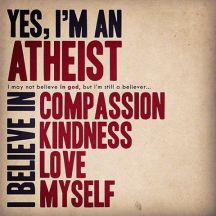 You might ask, “Ok, Bill, I understand what you do not believe. What do you believe?”
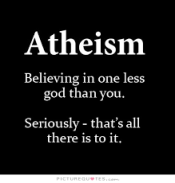 Atheists have no written creed, profession of faith, or official paradigm of beliefs. While some have written non-dogmatic manifestos (public declarations of policies and aims), there’s no agreement or authority to which anyone is bound. You could read dozens of books that provide hints about what some atheists may believe, but many are crap. When you see or hear words like atheists believe or atheists think, false generalizations often follow.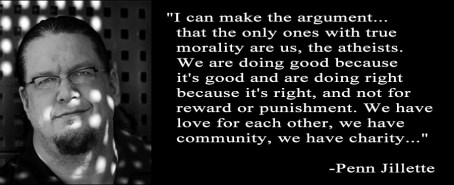

 Some of the best, most memorable English language writings are short. I try to keep my blogs brief, but they often surge over 800 words. I’ll continue to work on that; to chop, murder, and cut.
 The 35 brief chapters are divided into two sections. Section I, How to Write Short, has chapter titles that deliver on the promise to improve short writing. Such as the following famous short writes:
 Some WordPress blogs provide prompts that are helpful practice for developing the craft of writing short. One I like is



 Then, as I was teaching and near the conclusion of that class, one man asked, “Do I need to forgive Madalyn Murray O’Hair?”
 You might say, “Bill, I don’t agree with you. Explain how you decided that.” I may provide my information based upon my experience, reading, some internet or TV source, or maybe I’d inform you about some scientific evidence. If you still disagree with me, you may then counter what I said by presenting similar evidence.
 We may respect each other—people, not necessarily ideas or beliefs. I think we should always be civil, polite, and treat each other well. I don’t mean politically correct. Maybe we like (or love) each other. If we share any common opinions, those should make our relationship better. At some point, we may even find respect (see 1 or 2, above) for each other’s opinions.
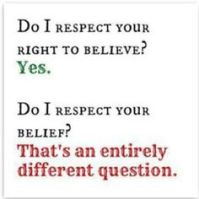 Respect for, or tolerance of, religious belief is an interesting topic in itself, especially to an atheist. All atheists want equal treatment (or respect, if you prefer) and tolerance in return from believers and religious persons—equal to what those folks want from everyone else. Look at the definitions of respect above one more time. Does the believer choose number 1 or 2 regarding someone’s atheism? Stop rolling your eyes and answer the question. Ok, then we shouldn’t talk about it. We need to move on.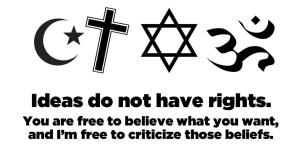
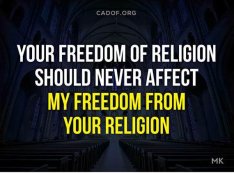 We should certainly not be limited in our actions by any religion, nor are we under any obligation to pay for any religious practice.
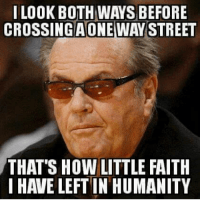 Look both ways can serve as my metaphorical phrase for living life—staying alive and healthy. I can see it as considering all sides of an issue (pro and con), hearing people out who may think different than I, discerning dangers of life, being careful, remembering lessons from our childhood, trying different things and new places. Can you add to my list?


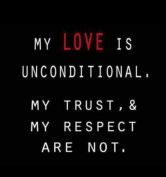 Competence and honesty are two other conditions that effect our trusting others. Our trust may have a few variables and conditions that go with it. I may trust you to suggest a good dentist for me. I will not trust you to be that dentist.
 Trusting seems natural. America’s motto is In God We Trust. Another is E pluribus unum (out of many, one), but in 1956 we wanted to make sure that our country was not confused with the atheistic USSR.
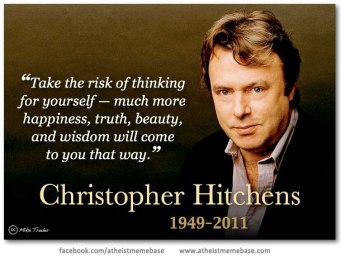 Retiring and moving to the Seattle area provided time for me to consider my beliefs in greater detail. I read more about atheism, and I started to write about it.

