The day 23 NaPoWriMo prompt encourages me to write a poem based in sound. The poem could incorporate a song lyric in some way. Euphonious means pleasing to the ear.
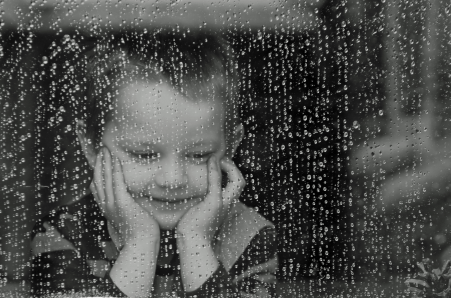
Euphonious Rain
Listen…I Listen with my whole body.
I feel the sounds before I hear them.
They enter my complete being,
I’m mesmerized, tranquilized by sound.
Sounds go deep into my muscles and bones, I feel
enticing beats dive into my groin and pound my chest,
I inhale the rhythm, the beats and the measures.
I feel the music deep within me. As I hear it – I become it.
Listen to the rhythm of the falling rain
as it taps above me. Hear the distant drum of thunder.
I am the rain, the tin roof, I release all thought.
My mindless feeling becomes alluring calm.
Feel the rumble and hear the night dance,
calling me into a sound-filled trance.
Into such a compelling sedative of sound
I let it enter, to hear the rain kiss me and touch me
deep within my being, it becomes my feeling,
my loving soul hears sounds of being alive.
To feel. To love. To be soothed. To hear and
Feel the rhythm of the falling rain calling to me.
Who’ll never stop the wondrous falling rain?
(Bill Reynolds 4/23/2018)
Look both ways on rainy days and mind the gaps and puddles.
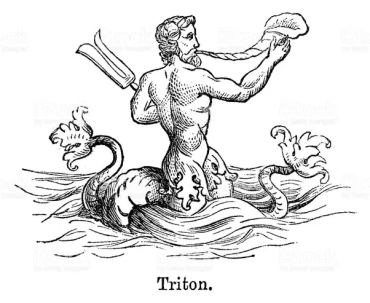
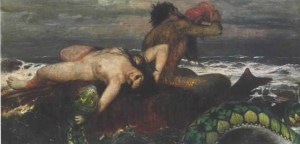
Triton from Greek mythology is a god and the messenger of the sea. He is the son of Poseidon and Amphitrite who are god and goddess of the sea. Triton is often seen as a merman which is a guy mermaid (together known as merfolk or merpeople). Who knew?
Triton carries a trident just like daddy, Poseidon. But Triton’s has a twisted conch shell, which he blows like a trumpet to calm or raise the waves. It sounds so harsh that giants often begin to run away or retreat because they think it’s the roar of a dark wild beast.
An interesting story regarding this god’s pride is that he and other gods were challenged by Misenus, son of Aeolus, to play the conch shell as well as he did. How impertinent, right? Triton drowned his ass for being such a dick, and for making such a foolish challenge. Like I said, these Greek gods are sensitive, so try not to upset them, even if you are one.
Triton was the father of the goddess Pallas, and foster-parent to the goddess Athena. Unfortunately, Pallas was accidentally killed by Athena during a sparring fight between the two goddesses. Good grief! Those goddesses must have had some wild sparring.
At times, Triton has been multiplied into a host of Tritones, satyr-like daimones or spirits of the sea.
The prompt for day 22 of the 2018 NaPoWriMo challenges me to write a poem based on one of six statements asserting something impossible. The poem I write is to have the impossible thing happen. The statement I chose was, A mouse can’t eat an elephant. The elephant and mouse are metaphors for something big (me) and something small: a single cancer cell.
Who Invited You?
Who invited you? This is my party.
You have the wrong cell number,
You were discovered, disguised and in hiding,
Much too small for anyone to see,
And yet, you are a danger to me.
In this dance, docs will lead. I take the next step,
To erase the board and clean the house,
To take out the trash and to purge all the systems,
Flush out the waste and to remove all the danger.
You will be annihilated, to the last little cell.
In the end, you may win, but right here and right now,
the game plays on, and I’m doing the pitching
to cleanse you from my body and soul.
The hurt in me may not be known to you,
But my fear of you continues to grow.
The old man sitting next to me,
Willing to fight what he can see,
It’s you he refuses, cuz he sees only me,
Together we look for the end of the game,
Someday, maybe, not today, not today at all.
(Bill Reynolds, 4/22/2018)
Look both ways and keep your eye on the ball.
Mind the gaps and swing at the strikes.
The day 21 poem prompt of the 2018 NaPoWriMo challenges me to write a poem based on the myth of Narcissus. After reading it, I was to write a poem that plays with the myth in some way.
My poem looks at love from Narcissus’ point of view. Was his beauty a curse? Was his rejection of the love of suitors, male and female, a problem? Should he have loved them all? One of them killed himself and asked the goddess Nemesis to punish or curse the object of his affection. That curse caused Narcissus to love his reflection. That’s what happened, and it is not vanity. How many spurned lovers have placed curses like that?
What is Love?
Bukowski was right
Love is a dog from hell
The passion
The pain
The inevitable pain
Did Shelly love?
Did Browning love?
Who did Dickenson love?
Did Poe, Wilde, Lord B?
Love is a dog from hell
Look at me
Look at you
We echo no love
For the other
cursed self-love
the prayer of A him
the curse of a Nem.
Bukowski was right.
No god can make me
Love you any less
I must die into hell
To love as I must
Be cursed forever
To be loved
By so many
No love to give
In return, forever
To be known as
The beautiful fool
who loved himself.
(Bill Reynolds, 4/21/2018)
Look both way to see love as it is.
Mind relationship gaps.
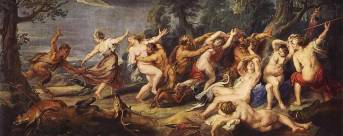
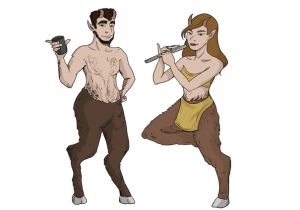
I was gunna tell about being between Scylla and Charybdis, but these satyr characters got my attention. Have you seen the television commercials for women who forget to take their pill but it’s no problem? Well, these satyrs can forget the Viagra. I may even click the little a-to-z box for adult content. I have about decided that the Greeks were into sex much more than I ever knew.
In Greek mythology, satyrs are ithyphallic (click here for hyperlink to definition of phallic) male companions of Dionysus, who was god of the grape harvest, winemaking and wine, of ritual madness, fertility, theatre, and religious ecstasy in ancient Greek religion and myth. He sounds like a god for raising hell, if ya ask me.
Satyrs are human looking but may have ears and tails like a horse. And get this: permanent, exaggerated erections. Got it? Forget calling the doctor after four hours. These guys had gigantic woodies 24/7 and tended to get the local nymphs rightfully excited. They are known to focus on sex and are characterized by a horny desire to have sexual intercourse with as many women (called satyriasis) as possible. Poets, as poets will do, later introduced a female version, called satyresses.
You can find satyrs in Roman myth (faun), as well as other cultural mythology, such as Slavic. Since they are companions of Dionysus (wine god) they spend a lot of time drinking, dancing, and chasing nymphs.
Satyr cavort to the music of pipes (auloi), cymbals, castanets, and bagpipes, and they love to chase maenads or bacchants (with whom they are obsessed). In later art they dance with nymphs and have a special form of dance called sikinnis. They are often represented holding wine cups and appear as decorations on wine cups.
Their chief was Silenus, a minor deity associated with fertility. These characters can be found in the only complete remaining satyr play, Cyclops, by Euripides, and in fragments of others. Plays depicting satyr were short, lighthearted tailpieces performed after each trilogy honoring Dionysus. I wish some of this stuff survived. Can you imagine?
Satyrs, the original wine, woman, and song philanderers.
When you look both ways, try not to be shocked by what you see. Mind your gaps if ya see Satyr loafing about.
The day 20 poem prompt of the 2018 NaPoWriMo challenges me to write a poem that involves rebellion. For example, defy a rule, or write something either funny or serious. My poem should open a path beyond the standard, hum-drum ruts that every poet sometimes falls into.
Warning, this poem is bleak. It is written to reflect panicked frustration and to respond to the prompt. The dark side of reality interests me. I am not disturbed by it and I accept its existence. Many of you feel the same or Stephen King would be a retired teacher today.
I use the f-word a lot here, cuz I use the spoken f-word a lot, except when I know some prudish soul may be crushed. So, if those two things bother you, please give this driveling twaddle the sack.
One more thing. I am fine. Please try not to think otherwise. Yes, I recently got some bad news, but that has nothing to do with this stream-of-dark-consciousness writing (and if it does, so what?). It’s hard enough to write without folks asking if I’m suicidal.
The poem is rebellion from my POV. If you do read this, and you happen to be, or have been, a Teacher of English grammar, take a deep breath and perhaps a glass or two of wine first. It is one sentence. I know. Many great poems (one of which, this is not) are.
Assimilated Rebel
one must dress like this or that and think thusly and carry this torch to that goal and be always right and feel like shit when not and one must win, always win, a looser dont be, dont say that is not me because bukowski said just do it, just do it, and live and work for the glory of no god or whatever, but to survive and whatnot, and to help them survive, the ones you love and them ya dont and its a beautiful life and we will all just fucking die because thats what we do in the end middle or start, and then go to some nonexistent haven or fucking hell foe-evah cuz ya didnt cross da tee or dit-da-dot on a dam i and smile for a kodak if yer not, then dont fucking try cuz anyway they all die no matter how hard ya try and then dunna fuckin cry, just be stoic, thats a lie but i dno why, just go along to get along and be different and ah independent thinker, just be creative and spell it my way in stripes with plads or circles, and socks wit sandals, and man-buns and feet with pit hair, lay and never lie, its all so jacked up nothin’ fucking matters so fuck it, and fuck it all.
(bill reynolds, 420 day y2k+18; freddie mercury tribute concert day; and a. hitler’s b-day)
Look both ways today to see who’s got the loco weed tea.
Allow no gaps of toke.
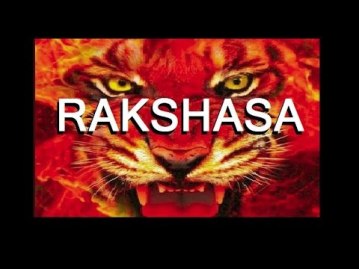
Rakshasa is from Hindu mythology and was later incorporated into Buddhism. Rakshasas are also called maneaters, females are called rakshasi.
Rakshasas were created from the breath of Brahma when he was asleep at the end of the Satya Yuga. As soon as they were created, they were so filled with bloodlust that they started eating Brahma himself. Brahma shouted “Rakshama!”, Sanskrit for “protect me!”. The god Vishnu came to his aid and banished all Rakshasas to Earth. Thanks, Vish, like we needed them.
Rakshasas are ugly, fierce-looking, and big. Most have two fangs protruding from the top of their mouths with claw-like fingernails. They are mean, growling, and cannibals that smell human flesh.
The most ferocious have flaming red eyes and hair, and they drink blood from human skulls. They can fly, disappear, and have other magical powers.
Rakshasas may be either good or evil. As warriors they fought alongside armies of both good and evil. This sounds very human to me. Do we not see each other like this?
In D&D, rakshasa are evil outsiders now native to the Material Plane. They are powerful magic users that, although they disdain physical fighting as ignoble, can be dangerous in close combat against player characters.
Look both ways changing realms.
Be mindful of the many gaps.
The day 19 poem prompt of the 2018 National Poetry Writing Month challenges me to write a paragraph that briefly recounts a story, describes the scene outside a window, or even gives directions. I was to erase words from that paragraph to create a poem, or to use the words of the paragraph to build a new poem. Here is my result of that effort, without the paragraph.
Envy ‘Neath a Window
With Mom I sat
As she was reading
Not to me – getting bored
On a raining summer day.
I’d catch some death of cold
She would say
From being wet with rain,
On that cool summer day.
Something ‘neath the window?
I walked to see a mouse.
I said no words, nor did he,
As I looked out the window.
My first envy feeling was seeing
Friends playing in the rain.
Making themselves damn fools.
I learned, in the adult version
Is as they call it, having a good time.
Damn fool for just sitting here.
“Mom, may I…?”
Envy. I felt it.
(Bill Reynolds, 4/19/2018)
Look both ways and love those rainy days.
Mind the gaps or hydroplane.
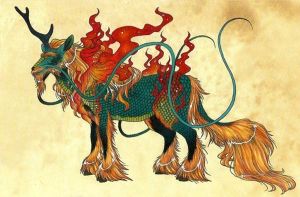
From Chinese mythology we may know about the dragon and the phoenix, but have you heard of the Qilin? As with other mythological animals, the Qilin is composed of different animals. Also, like others, depictions of Qilin have changed over time.
This YouTube video presents it much better than I can. Rather than read my flapdoodle, enjoy the video. It’s only about three and one-half minutes.
Reality or myth, look both ways and mind the gaps.
I’m opting out of the day 18, 2018 NaPoWriMo prompt. Instead, I wrote this poem.
Fight was His Game
Poor boy whose story we were told,
Danny was his name, fighting was his game.
Young and strong, with dreams of glory in his fists.
He fought to save his life, to be proud and ever bold.
Promised wealth with violence
Would bring so many gifts.
No warning was to move him
from his promised dream.
Boxing and his future, were both all agleam
It was his game, to be his fame, no one interfered.
In the pit of misery, while still just a boy
Trusting words of strangers, and what they had to say.
In the roaring twenties ring
he took the fighter’s stand,
Seeking victory and honor, with his body and his hands
Many marred and broken,
This Danny boy was all aflame.
Stepped into the ring, a fight to be his game.
Still looking for a young man’s fame.
Dan stood strong and determined.
He faced the champ, who gave that boy
quite a beating with a lesson.
Badly beaten, he lost the fight,
And all his pride went with it.
The champ made him a chump
looking too sad and lame.
Still more boy than man, with spirits badly broken,
He searched for work and asked for jobs.
A boy inside, with dreams gone south and broken.
Now the boy was older
In all the world’s wrong ways,
Now laying low without his game,
Still, Danny was his name.
(Bill Reynolds, 4/18/2018)
Look both ways and duck those punches, mind the gaps right cross.
The day 23 NaPoWriMo prompt encourages me to write a poem based in sound. The poem could incorporate a song lyric in some way. Euphonious means pleasing to the ear.












 Our Literary Journey