Click on Sammi’s graphic to link up with her page for more 44-word poetry or prose.
Coincidentally, this is the second 44-word poem I have written this week. The other was for the dVerse quadrille challenge. Maybe it’s an omen.
Mom & Me
Mother always pointed out my difficult side;
that contrarian in me, not the exact opposite of good,
more like one who disobeyed, who pushed back,
because I saw life through my own eyes.
Today, I both regret and rejoice my
yin and yang personality.
Look at yourself both ways.
You may not be who you think you are.
Mind the gaps while searching for self.
While I enjoy this musical duet, I am struck by the irony.
This week our magical Mistress Rochelle pulled a mare’s nest from order to muddle my muse and trigger my call to organization.
Texans might say I’ve been feeling puny (ill) for a few days, so I was uninspired until today (Friday – imagine that).
It’s all Rochelle this week as she scattered a photo of her own randomly into the blogosphere. If you think you’d like to push a stormy story of fewer than 101 words, find your way to join the free-for-all by clicking on her photo and seeking order at her purple patterned blog page. Click >here< to read other chaotic stories.
Genre: Therapeutic Fiction
Title: Bollix Minds Word Count: 100
***
Why did you bring me here?
I wanted you to see this metaphor for your mind.
Ridiculous. I’m neat. I hang-up clothes, organize socks, and straighten art. My OCD would organize this fast.
Bill, you were arrested for tampering with a murder investigation. The judge ordered counseling as part of your plea deal.
I simply organized and cleaned up blood. The detectives got upset.
This chaos is how you see the world. Do you understand?
Not true. I do have leads on jobs.
Tell me more.
Stores want me to follow customers around and straighten things up after they pass.
***
Look both ways for all sorts of metaphors.
Mind the gaps and try to understand, things will never be perfect.
This musical bit (If the youtube will not play for you, try this imbedded link.) brought a chuckle to my mind and almost a bit of relating to the song.
I wrote this silly, nonsensical poem for the dVerse Quadrille #162 – “For whom the bell tolls” (a 44-word poem) where any meaning or form of the word bell was to be included. Clickhereto find more awesomely ringing poetry.
More cowbell!
Cowbell fever
removes reaper fear.
Play more cowbell.
Cure your Oyster.
This poem needs more cowbell.
Walken wanders and wonders,
Is there more cowbell out there?
Play the saw or rub your washboard,
a cowbell makes music from hell—
needs more cowbell!
Look both ways when you hear a cowbell because you are not the bull.
Mind the gaps to beat the raps.
Some skits and actors shall live forever.
The cowbell skit from SNL that took a life of its own. Since my previous link did not work outside of the USA, maybe this one will.
The sweet, delightful, and flashy Mistress of Fiction, Rochelle, has prompted my muse with a bit of rain for the second week in a row. Combining strokes from her purple lane, she has splashed the Friday Fictioneer gang with a Roger Bultot picture of a modern, colorful, children’s playground park, seemingly after some precip.
Feel free to dive into our un-juried pool of players with your own fiction of fewer than 101 words. Avoid any litigiousness by giving Roger’s pic a gaveled tap, which will sentence you to review the brief code of conduct behind the purple bars on Rochelle’s blog page. You may want to get setup to be served weekly with a summons write early each Wednesday morning.
Genre: Shakespearean Fiction
Title: Time for Pettifoggers
Word Count: 100
I took my nephew, Dicky, to the playground after the rain had stopped.
He said, “Everything’s all wet, Uncle Billy.”
“Water keeps the insufferable brats and bullies away. Now, go play.”
“There’s lots to climb on. But why no swings or rides?”
“Lawsuits. The lawyers forced the city to take them all away.”
“What are lawyers?”
“People who profit from the misery of others.”
He ran off to play on the wet climbers and such.
“After this,” he yelled, “the first thing we do, let’s kill all the lawyers.”
“A noble goal, Lad. You’re a chap after the old bard.”
Look both ways for the future of the young.
Mind the gaps and dangerous traps, but a life without risk can be dry and vapid.
Note: “Let’s kill all the lawyers” is a line said by Dick the Butcher in William (Bill) Shakespeare’s Henry VI (Part 2, Act IV, Scene 2). It is among Shakespeare’s most famous and most controversial lines.
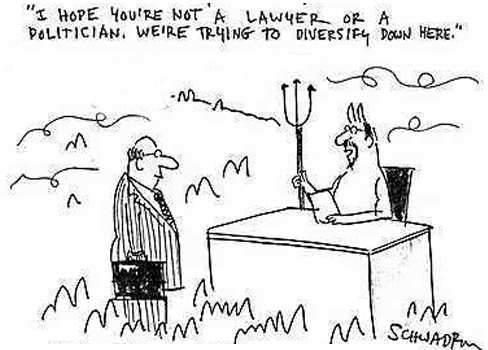
Click on the cartoon to fire up more wonderful flash stories by the fantastic Friday Fictioneers writers.
Click this to open Sammi’s page where you’ll find more fun prose and poems run amok.
Small Battles: Big Wars
We
would rather f-bomb
or recite angry litanies
of forbidden witchery
than speak the word: cancer.
It’s when few of one’s
trillions of cells run amok,
it’s a war fought with
knives, rads, and poisons.
Look both ways to see your own beginning and end.
Mind the gaps, fight the battle, die with dignity.
John Updike, best known, perhaps, as a novelist, was a poet. This short poem of his is one of my favorites regarding life and death. He died of lung cancer in 2009.
For Yom Kippur and the first week of October release, our wonderful server, Mistress Rochelle, and boss lady of Friday Fictioneers has selected a David Stewart dining room photo from her menu and served up a challenge for us to roast some fine micro or flash stories of fewer than 101 words long.
Please read mine below but click on David’s pic to be seated at Rochelle’s perfect purple blog café where you may order up some artful items. We try to abide by and to play nice as we swim in our own creative lanes.
I have nothing at all to sell.
Or to trade.
I walk alone because
we must.
It’s just me
with my own thoughts,
maybe music or a book,
as I deal with some pain.
A good thing,
claim my many doctors.
Not the pain—the dealing with it.
I like the thought of it—alone time,
but it’s not. Not really.
The Universe, also not for sale,
is with me. Always with us.
I call it being alone
because it makes me feel good,
but I know
I am never totally on my own,
without a piece of eternity
talking some quid pro quo.
Look both ways when dealing, feeling, or logrolling.
Mind the gaps between your steps and use the poles lest you fall and break your nose.




 Our Literary Journey