A2Z Challenge – Z is for Zeus

Gunna stick with the Greeks, but Romans would be Jupiter.
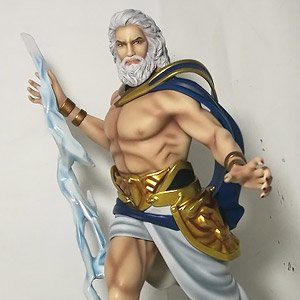
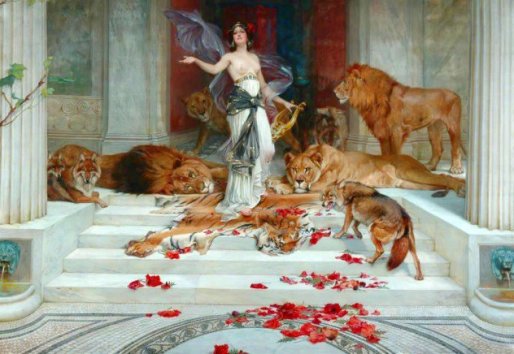
Zeus is the “Father of Gods and men” who rules the Olympians of Mount Olympus and is the god of sky and thunder in Greek mythology. He is youngest child of Cronus and Rhea and he married Hera although, at the oracle of Dodona, his consort is Dione: according to the Iliad, he is the father of Aphrodite by Dione.

He is known for his erotic escapades, but aren’t they all? That horsing around resulted in Athena, Apollo, Artemis, Hermes, Persephone (by Demeter), Dionysus, Perseus, Heracles, Helen of Troy, Minos, and the Muses (by Mnemosyne). With Hera, he is usually said to have fathered Ares, Hebe, and Hephaestus.

His pappy, Cronus was daddy to several children with Rhea. They were Hestia, Demeter, Hera, Hades, and Poseidon. He swallowed them as soon as they were born because Gaia and Uranus said that he was to be overthrown by his son, just as he had previously overthrown Uranus, his own father. That is family drama for Greek gods. There’s more…

When Zeus was about to be born, Rhea and Gaia came up with a plan to save his ass, but in such a way that Cronus would get his retribution for his acts against Uranus. Rhea gave birth to Zeus in Crete, handing Cronus a rock wrapped in swaddling clothes, which Cronus promptly swallowed.

Zeus and his brothers divvied up the world, Poseidon got the sea, Hades the lower world, and Zeus the heavens and the upper regions. The earth was common to all. Zeus was also the source of all prophetic power, signs, and sounds – good as well as bad.

Why was Zeus the most important god? Because he is the presiding deity of the universe, ruler of the skies and the earth, and was regarded by the Greeks as the god of all-natural phenomena on the sky, the personification of the laws of nature, the ruler of the state, and father of gods and men.

Look both ways and don’t mess with Zeus.
Mind the gaps. Challenge met!
A2Z Challenge: Y is for Yeti

Yeti is a company in Austin that angered the NRA. They make coolers and specialized drink cups. Supporters of the gun lobby are taking their Yeti coolers out to the boonies and literally blowing them up (and recording the deed). Turns out it was a misunderstanding, but this is the NRA. Boom! Oops, too late. See it by clicking here. And I am writing about weird behavior by mythological creatures. Oh, well.

Is blowing this up disrespecting the flag?

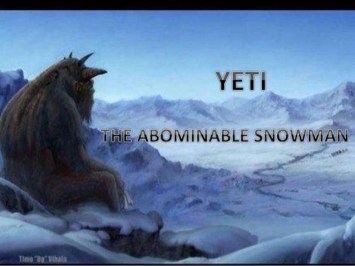
In the folklore of Nepal, the Yeti, AKA the Abominable Snowman, is a tall ape-like creature said to inhabit the Himalayan region of Nepal, Bhutan, and Tibet. This dude could be confused with Big Foot, or Sasquatch, which is a North American (primarily Pacific Northwest, Washington State or BC, Canada). While they’re not the same, there are similarities (big hairy ape-like). In neither case, has anyone ever produced an example or had one over for pizza and some beers.

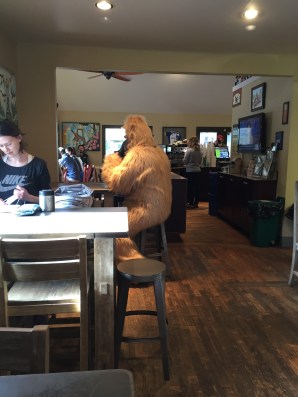
Most folks regard the Yeti as a legend for lack of evidence indicating its existence. As with so many things, existence could be proven, but non-existence cannot. Safe to be Yeti (or Big Foot) agnostic. However, here is proof of Sasquatch: I spotted him at the Issaquah Coffee Shop sipping a latte and meeting his neighbors.

Big Foot having his coffee.

Abominable Snowman was coined as a name in 1921, when Charles Howard-Bury led a British expedition that he chronicled in Mount Everest The Reconnaissance. In the book, Howard-Bury accounts crossing an area at 21,000 feet (6,400 meters) where he found footprints that (according to him) “were probably caused by a large ‘loping’ grey wolf, which in the soft snow formed double tracks rather like a those of a bare-footed man”. He added that Sherpa guides volunteered the tracks must be The Wild Man of the Snows.

Maybe they’re cousins or something.

Look both ways for Yeti or Sasquatch and take a photo so we can prove the affirmative. But mind the gaps, particularly crossing the Himalayas at 21,000 feet without oxygen.


A2Z Challenge: X is for Xochiquetzal

Before I get into this, I want to thank Chris Caldwell for suggesting so many mythological creatures, several of which I have posted so far. He also suggested that look to Aztec mythology for the letter X.

That led me to Xochiquetzal (pronounced Sho.chi.ket.sal), an Aztec goddess associated with fertility, beauty, and female sexual power. She was the protector of young mothers and a patroness of pregnancy, childbirth, and the crafts practiced by women such as weaving and embroidery.

This goddess of sex, crafts, fertility, dance, music, singing, weaving, magic, and love spells holds marigolds as sacred to her.

Xochiquetzal was also the patroness of many other humans; mainly lovers, prostitutes, weavers, and craftspeople. According to some, this was because they could make pleasure or objects that were beautiful to behold.

Xochiquetzal was the goddess who seduced a priest and then turned him into a scorpion as a mark of her power. If you want to make your mark in this world, screw a priest and then turn him into a nasty bug that stings.

She was depicted as incarnated youth, love, and beauty; and was amorously pursued by several Aztec gods. Presumably, they knew about the priest but were unafraid.

Unlike other fertility goddesses, she encouraged love-making for pure pleasure, not reproduction (thus ignoring the Pope). She had the power to forgive human sins that weren’t necessarily of a sexual nature. I am not sure why that matters, but I read it.

She was the wife of the water god, Tlaloc, and consort (girl friend?) to the god, Tezcatlipoca. She lived in the Aztec paradise of Tamoanchan. This goddess-lady was widely worshipped, and many rituals were in her honor, to include incredible acts of sacrifice (of course) and some somber confessions.

Xochiquetzal was a (not the) creator of humans and functioned as an intermediary between them and the other gods. She is frequently referred to as a facet of the female divine goddess, Tonacacíhuatl, from whose womb the first four Aztec gods were born.

Although she was a mother herself, this goddess never grew old and always appeared in the full bloom of youth. However, when one looks at Aztec art and how she was depicted by them, one can see how cultural differences can affect that.

No matter how you see this, look both ways for Aztec gods.
Just don’t try to spell or pronounce their names.
Mind all gaps.


A2Z Challenge: W is for Witches

There are big differences between witches and the other 25 folklore creatures I am writing about. The first is, minus a few mythical ones which may not be, witches are human. The second difference is that I am certain some people who declare themselves witches (including friends of mine) will read this blog. Thus, I may well be brought to correction about what I write. Another difference is, along with elves, I think witches are cool. I like them.

The amount of information available, much of it provided by self-identified living witches, is plethoric. Any library could dedicate and fill an entire section to witch-related topics (I bet some do). All this I say both as an excuse for my brief driveling twaddle, and to encourage the curious toward continued exploratory adventure into the worldly subjects of witches and witchcraft and nature and other witch-related things, such as Wicca.

This link will take you to a list of famous witches from various eras. That page will also provide a link (interesting) to related belief systems (religions). And this link will take you a Wiccan page that will explain 15 different types of witches (I didn’t know).

I have written about witches before (this poem, for example), but only fictionally as I battle my own cognitive dissonance with reality, stereotyping, and fiction.

That said, one category of witchery includes mythology and folklore, which is the category for this blog, according to the A-to-Z Challenge list of categories. To keep between the lines of myth and lore, I present five witches for you from mythology and folklore.

From Homer’s Odyssey, a witch named Circe drugged sailors and then turned them into animals, wolves and lions mostly. For me, that explains a lot. Odysseus worked with Circe on the problem and after a year, he and his sailors were free to go back to Ithaca.

The Witch of Endor used the ghost of Samuel to tell King Saul that he would be defeated and killed by the Philistines in battle. However, he was only wounded in the battle, but then he killed himself anyway. He must have been bewitched. Go figure!

Vampires with toe thing.

The Chedipe is a witch who got pissed at men. She rides a tiger into their homes unnoticed. She then sucks the life out of men through their toes. I have no explanation for her sucking toes to death fetish. The guy dies, and she moves on to the next victim. Have a good night and keep your toes covered. Can a witch also be a vampire? I noticed some talk of prostitution in my research.

The witches from Macbeth remind me of a high school skit I was in. These Sisters of Fate were the agents of destruction for Macbeth and all of Scotland. Bubble, bubble, toil and trouble.
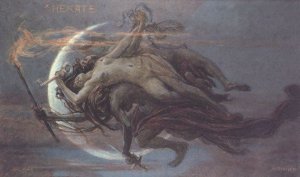
Hecate is the Greek goddess of witchcraft, witches, sorcery, poisonous plants, and other hocus-pocus stuff. She is still worshipped by some groups and is the source for the concept of a jinx.
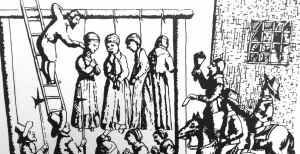
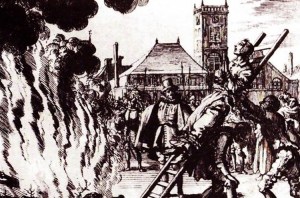
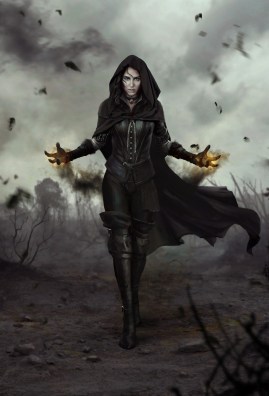
Ignorance then. Now?
I cannot imagine this.

Look both ways for witches from the east and the west, the north and south.
Mind the gaps and the pointed hats.


A2Z Challenge: V is for Venus

I decided on Venus over vampires for this post because some of you know so much about vampires than I. Seriously, I have considered turtle necks on more than one occasion.

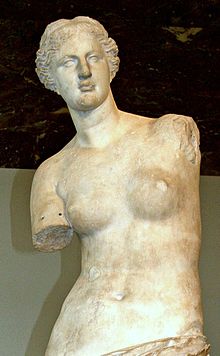
Venus is not just any Roman goddess. She is the. We are talking love, beauty, prosperity, fertility, and victory. And she oversees sex. I could add music, art, and passion. She was so important to Romans that they claimed her as their ancestress. According to mythology, her son Aeneas fled from Troy to Italy. He became the ancestor of Remus and Romulus, who founded Rome. That is a big deal, if you’re a Roman.

So, Venus is mother of Rome, sort of. She has other ties to Greek mythology. The Romans claimed she was the same goddess as Aphrodite, the Greek goddess of love. For Venus the Romans adopted many Aphrodite symbols, like roses and myrtle. Myrtle was so important to this goddess that even statues of her wore myrtle wreaths.

Venus’s festival happens on the first day of April. It was called the Veneralia. Aside from draping Venus in flowers, followers also carefully washed her statue, and promised to fulfill the moral obligations of good Roman wives and husbands. Many men and women also asked her advice on matters of the heart. I am sure they got dependable answers.

Other symbols of Venus included the scallop shell, doves, dolphins, pomegranates, pearls, mirrors, and girdles. Girdles? Some of these were borrowed from Aphrodite. So was her origin story which claims that was born of seafoam.

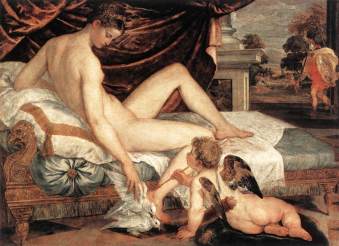
There is a ton of artwork depicting Venus. At one point in history painting Venus was so popular, after the classical era, any unclothed female figure came to be called a Venus.

Venus and Mars

Venus had many titles which further demonstrated her importance. Venus Cloacina was the purifier; Venus Felix was the lucky (she could be prayed to for good fortune); Venus Genetrix, mother; Venus Murcia, representing the importance of myrtle to her; Venus Verticordia, the changer of hearts; Venus Victrix, the goddess of victory.

Venus was married to Vulcan, the god of fire and the forge. Oddly, Vulcan was one of the ugliest of the gods. But he loved her so much that he created a golden carriage to pull her around. The carriage was drawn by doves to match Venus’s own beauty.

Venus was also the mother of Cupid, the Roman god of love.

Despite identification with Aphrodite, Venus was a native Roman goddess. Her name is the same as a Roman word for a particular kind of love. That name can be traced all the way back to the language before Latin, to a word meaning “to desire or love”. It’s clear that Venus was with the Romans for a long time.

The planet is named Venus. It was visible in the ancient night sky and because it was so bright and beautiful, it was named Venus. Although Venus is no longer worshiped by large numbers of people, we still remember her in music and in other in art and science thanks to her widespread influence.

(Requested source reference: https://greekgodsandgoddesses.net/goddesses/venus/  Greek Gods & Goddesses, February 22, 2017)

Two oldie Venus songs…

Look both ways for the goddess of love. Mind the gaps.

A2Z Challenge: U is for Unicorn

Nice Touch – Wings

I am reluctant to attempt to write anything about these beautiful, almost sadly mythological creatures. However, I know some people who read this blog are expecting (perhaps demanding) them for the letter U. They have told me so.

There are two reasons for my insecurity. One reason is that I am pretty sure they do not really exist, but I am uncertain whether most people agree with me. The second reason is that too many people from age five to fifty (and more) know more about unicorns than I do. Fine. But none has stepped forward to write this post.

Unicorns have been described since antiquity as a horse-like creature with a single large, pointed, spiraling horn projecting from its forehead. They were depicted on ancient seals and have been mentioned in many old historical accounts, Greek (not mythology) and otherwise. The re’em, of the Bible is translated to unicorn in some versions.

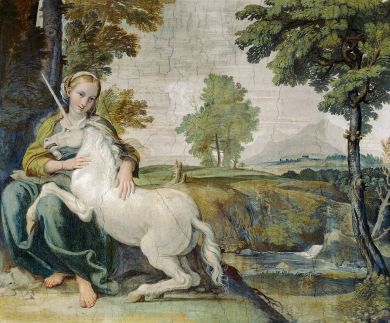
In European folklore, unicorns are described as a white horse-like or goat-like animal with a long horn and cloven hooves. In the Middle Ages they were described as wild woodland creatures, symbols of purity and grace, which could only be captured by a virgin. Some say a unicorn’s horn can purify poisoned water, making it medicinal to heal sickness.

Long ago, Greek writers of natural history were convinced of the reality of unicorns, which they believed lived in India, a distant and fabulous realm for them. Leonardo da Vinci even wrote hunting instructions, which look like a ploy to get your girlfriend to go hunting with you.

The unicorn, through its intemperance and not knowing how to control itself, for the love it bears to fair maidens forgets its ferocity and wildness; and laying aside all fear it will go up to a seated damsel and go to sleep in her lap, and thus the hunters take it.

The unicorn is the symbol of Scotland. It was chosen because it was seen as a proud and haughty creature which would rather die than be captured (liberty or death?), just as Scots would fight to remain sovereign and unconquered.

My proof that unicorns exist can be found in New Braunfels, Texas (USA). The mascot of one of the local high schools is the unicorn. Thus, students are unicorns. So, they do exist in human form. There are a few other schools who have the unicorn as their mascot, but such a mascot is rare.

For the record, I love unicorns. No one should doubt that. I only say or write good things about unicorns, and my disbelief in them is a myth (ignoring my earlier comment).

Now, for a bit of unicorn bathroom humor. This is primarily for certain friends and family (they know who they are), and those among you with such bizarre taste in hilarity.


Look both ways for unicorn.
If you see one, and you are a virgin, try to capture it.
Mind the uni-gaps.

A2Z Challenge: T is for Triton

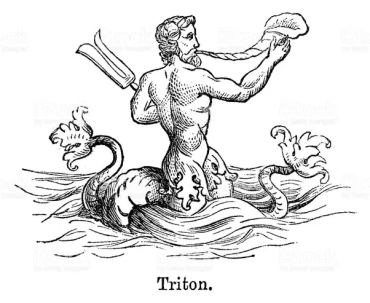
Triton from Greek mythology is a god and the messenger of the sea. He is the son of Poseidon and Amphitrite who are god and goddess of the sea. Triton is often seen as a merman which is a guy mermaid (together known as merfolk or merpeople). Who knew?

Triton carries a trident just like daddy, Poseidon. But Triton’s has a twisted conch shell, which he blows like a trumpet to calm or raise the waves. It sounds so harsh that giants often begin to run away or retreat because they think it’s the roar of a dark wild beast.

An interesting story regarding this god’s pride is that he and other gods were challenged by Misenus, son of Aeolus, to play the conch shell as well as he did. How impertinent, right? Triton drowned his ass for being such a dick, and for making such a foolish challenge. Like I said, these Greek gods are sensitive, so try not to upset them, even if you are one.

Triton was the father of the goddess Pallas, and foster-parent to the goddess Athena. Unfortunately, Pallas was accidentally killed by Athena during a sparring fight between the two goddesses. Good grief! Those goddesses must have had some wild sparring.


At times, Triton has been multiplied into a host of Tritones, satyr-like daimones or spirits of the sea.

In the water, look both ways.
Mind watery gaps.

A2Z Challenge: S is for Satyr

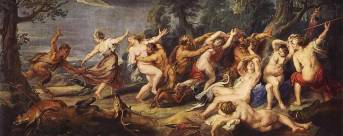
I was gunna tell about being between Scylla and Charybdis, but these satyr characters got my attention. Have you seen the television commercials for women who forget to take their pill but it’s no problem? Well, these satyrs can forget the Viagra. I may even click the little a-to-z box for adult content. I have about decided that the Greeks were into sex much more than I ever knew.

In Greek mythology, satyrs are ithyphallic (click here for hyperlink to definition of phallic) male companions of Dionysus, who was god of the grape harvest, winemaking and wine, of ritual madness, fertility, theatre, and religious ecstasy in ancient Greek religion and myth. He sounds like a god for raising hell, if ya ask me.

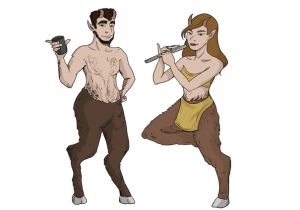
Satyrs are human looking but may have ears and tails like a horse. And get this: permanent, exaggerated erections. Got it? Forget calling the doctor after four hours. These guys had gigantic woodies 24/7 and tended to get the local nymphs rightfully excited. They are known to focus on sex and are characterized by a horny desire to have sexual intercourse with as many women (called satyriasis) as possible. Poets, as poets will do, later introduced a female version, called satyresses.

You can find satyrs in Roman myth (faun), as well as other cultural mythology, such as Slavic. Since they are companions of Dionysus (wine god) they spend a lot of time drinking, dancing, and chasing nymphs.

Satyr cavort to the music of pipes (auloi), cymbals, castanets, and bagpipes, and they love to chase maenads or bacchants (with whom they are obsessed). In later art they dance with nymphs and have a special form of dance called sikinnis. They are often represented holding wine cups and appear as decorations on wine cups.

Their chief was Silenus, a minor deity associated with fertility. These characters can be found in the only complete remaining satyr play, Cyclops, by Euripides, and in fragments of others. Plays depicting satyr were short, lighthearted tailpieces performed after each trilogy honoring Dionysus. I wish some of this stuff survived. Can you imagine?

Satyrs, the original wine, woman, and song philanderers.

When you look both ways, try not to be shocked by what you see.
Mind your gaps if ya see Satyr loafing about.

A2Z Challenge: R is for Rakshasa

Rakshasa is from Hindu mythology and was later incorporated into Buddhism. Rakshasas are also called maneaters, females are called rakshasi.

Rakshasas were created from the breath of Brahma when he was asleep at the end of the Satya Yuga. As soon as they were created, they were so filled with bloodlust that they started eating Brahma himself. Brahma shouted “Rakshama!”, Sanskrit for “protect me!”. The god Vishnu came to his aid and banished all Rakshasas to Earth. Thanks, Vish, like we needed them.

Rakshasas are ugly, fierce-looking, and big. Most have two fangs protruding from the top of their mouths with claw-like fingernails. They are mean, growling, and cannibals that smell human flesh.

The most ferocious have flaming red eyes and hair, and they drink blood from human skulls. They can fly, disappear, and have other magical powers.

Rakshasas may be either good or evil. As warriors they fought alongside armies of both good and evil. This sounds very human to me. Do we not see each other like this?

In D&D, rakshasa are evil outsiders now native to the Material Plane. They are powerful magic users that, although they disdain physical fighting as ignoble, can be dangerous in close combat against player characters.

Look both ways changing realms.
Be mindful of the many gaps.

Click here for A2Z page


A2Z Challenge: Q is for Qilin

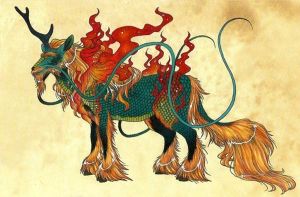
From Chinese mythology we may know about the dragon and the phoenix, but have you heard of the Qilin? As with other mythological animals, the Qilin is composed of different animals. Also, like others, depictions of Qilin have changed over time.

This YouTube video presents it much better than I can. Rather than read my flapdoodle, enjoy the video. It’s only about three and one-half minutes.


Reality or myth, look both ways and mind the gaps.