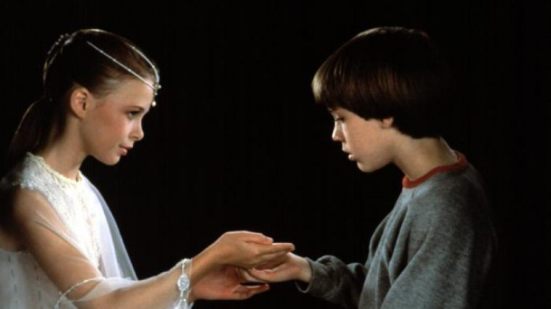
From The NeverEnding Story

A few weeks ago was the 33rd anniversary of the movie, The NeverEnding Story, being released to theaters. I wrote this little ditty to relate to the moral of the story, as I see it today.

Moonchild

The mantle of truth is a heavy coat of many colors,
it gives warmth and freedom, but not love, friends, or quiet.
I can wear it out for all see, or keep it secretly private,
hidden away from the flak and dissent of others.

During this never-ending search for the best,
I face many challenges, and risk the love of others.
Do I seek such love, or a truth not of any lovers?
Must Falkor guide me on my never-ending quest?

When it’s only a story, is it also a myth?
At the Magic Mirror Gate, what truth have I now?
What is it within me, that this story won’t allow?
Are love and truth the same, or is it the Oracle’s kiss?

I find the impossible hard to defend.
The nothing is within me, but I’ll take my stand
for the dream of truth to my last grain of sand.
No seeker would stop with this as the end.

We deny then accept, it’s hard to compile,
the path is a clear one for all who will stay,
it may not be possible, at least not today.
Make Fantasia all truth, son of Moonchild.

*Bill Reynolds 7/31/2017

On your never-ending story, look both ways. Mind the gaps, they’re not myths.

My favorite lines from the movie (and the youtube clip):

G’mork: Foolish boy. Don’t you know anything about Fantasia? It’s the world of human fantasy. Every part, every creature of it, is a piece of the dreams and hopes of mankind. Therefore, it has no boundaries.

Atreyu: But why is Fantasia dying, then?

G’mork: Because people have begun to lose their hopes and forget their dreams. So the Nothing grows stronger.

Atreyu: What is the Nothing?

G’mork: It’s the emptiness that’s left. It’s like a despair, destroying this world. And I have been trying to help it.

A Magical Tempestuous Storm – Poetry

Crazy hair piled up high framing piercing eyes of molten steel,
eyes with a warning smirk of dark trouble and danger
should one touch the shadow of her magic,
thus revealing a turbulent tormented storming soul —
Her wildly pursed red lips inviting living spirits to approach,
still suggesting thoughtful caution of a forbidden mystery,
before approaching near he hears her bittersweet
calling voice echoing deep within his chest,
from the savage throbbing and quivering in delirious frenzy,
he sees dark powers flashing from her black fingertips.

Within her passionate realm a shining moon and stars,
safe from the unrestrained bedlam of magical battles, the sky
enlightens their whirling and spellbound excitement,
dancing into dark night sounds of rapturous laughter;
echoing sighs and resounding venomous frightening cries.
A vehement sorceress casting spells with her thighs,
“Relax, dear man, my sensing pleasure is the rendering
of your haughty spirit into a new submissive being,
tamed forever by your seductive enchantress.”
As she raged, he endured her loving, pounding thunder,
In his toil and trouble, the fire of the witch’s cauldron bubbled,
yet her maddening deadly cries of passion calmed his fears.

Brilliant flashings in darkened skies; fair and foul scents of burning flesh hover;
his body now scorched and red, his mind mixed with passion and mania
as their unrestrained magic erupts into an abyss of souls, nothing but dead.
Yet, willingly he knowingly gives over his being,
his soul, and all he is, was, or ever will be, to her mystical dominance.
Her dark, unconsoled audacious spirit reigns over his battle lost, hers won in the fog of filthy air.
Underground, her biting and pulling him into this night of pain and pleasure,
he is now terminally seduced by this lovingly brash and ruling mistress.
Painfully submitting his pride, his manner, his life and being,
seeking the comfort of her mystical kiss
as he witnesses to her power and takes in his pain,
he kneels before the touch and the torch of his witch, worshipping at her feet.

In his delirium he experiences euphoria –  the ecstasy of pushing aside his anguish and agony,
as she hovers over him and conjures the revoking of his pain at her whim by her will,
she elevates him from the torturous tedium of a miserable existence of sheltered boredom
to a triumphant cloud of comfort and challenge, now subjected to random
spellbinding musings of a mad mistress molding this man into her mate and lover;
expunging his pain with the pleasure and purity of the magical realism produced by fantastic
fantasies as they dance through flames of orgasmic delights devoid of depressing doldrums.

She promised lives of incarnate pleasure and pain;
he as her servient lover, she as his muse and provocateur;
together they sail and they fly through time and space,
he enthralled by her power, she his bellwether to the underworld of a mysterious life,
entrapped by the freedom making two dark souls one bright god and goddess,
master and mistress of all roads and all kingdoms,
their love and mating shall live forever as the forbidden man and his queen of all witches,
never resting or sleeping while forever seeking a peace from their lives of tempest-tossed wonder.
When sounds of the night excite; when the crashing of thunder, lightning, or rain are right;
listen for cries of lovers in pain seeking the pleasures of the witch and her inamorato.

Bill Reynolds 1/24/2017

Night or day, look both ways. The gaps can harm ya, mind them all.

My original idea for this came from the Eagles’ song, ‘Witchy Woman.’ I wanted to “poetic” this idea up further to something about loving witches. Then, ‘Black Magic Woman’ by Santana, while not much for lyrics, bewitched my spirit with his awesome sound. As my imagination drifted, I considered (and used) scenes of the witches from Macbeth. I imagine ‘non-wiccan’ male relationships with a female witch (wicce) to be one of forbidden mystery, good and bad, light and dark, yin and yang. I can’t imagine the witch, no matter how loving, as anything but aggressively dominant, unyielding, yet still caring, nurturing, and protecting. I wanted a struggle. I tried to shed as much of my witch stereotyping as I could, yet keep the drama of the loving, in-control, witch-bitch that captured my thoughts. Is this poetry or prose, fact or fiction, fantasy or reality? Do you want to be either one of the two? Both? Neither?

Some soft witch music would be nice to close.

This Paradox of Love – A book

I’m reading The Paradox of Love by Pascal Bruckner (translated by Steven Rendall). I’m not finished, but I want to post a few quotes from the book. It is interesting, well written, and the translation is solid. I’m reading it as research for writing more about the paradox of love as a topic.

Bruckner’s take on how we got from where our ancestors were to where we are with male-female relationships is informative. I should have known. His commentary on, and experience with, the sexual revolution of the 60s and 70s is interesting (Bruckner is French), but not one I shared.

“Sexual liberation became the most common way of getting in contact with the extraordinary; every morning we reinvented our lives….”

For those of us who may recall some of that time, he asks, “What put an end to this euphoria?” He explains, “We knew only one season in life: eternal youth. Life played a terrible trick on us: we got old.”

He has much more to say; quotes from the book follow.

Regarding the concept of free love, he asks, “How can love, which attaches, be compatible with freedom, which separates?”

Here’s more. These are taken from the introduction:

“Our freedom in love was won in battle at a price that remains to be determined. (Someday the “black book” of the 1960s will have to be written.) Freedom does not release us from responsibilities but instead increases them…It resolves problems less than it multiplies paradoxes…This burden explains in part why contemporary romances are so hard.”

“A paradoxical result: we now ask everything from love; we ask too much of it; we ask that it ravish, ravage, and redeem us…Christianity’s invention of the God of love has made the virtue of love the cardinal value of life…By liberating itself, it reveals itself for what it is, in its flashes of brilliance and in its pettiness: noble and base at the same time.”

Bruckner quotes from Les aventures de Télémaque, by Fénelon, an early 18th Century French novel, “love alone is more to be feared than all shipwrecks.” I like the quote. However, in the world today, it’s blatantly false.

The paradox I promote is that today we would rather suffer the potential pains of love, than to not experience love. And, we seem to keep going back for more. This may seem crazy, but it’s the eventual norm.

I like the chapter title: “Salvation through Orgasm.” I am quoting way out of context here, but along with equating the Aurora Borealis as nothing other than a cosmic orgasm, he says this “…like grace for the Calvinists, the orgasm is the narrow gate to redemption.” You always knew that, right?

Try this: “Depending on whether or not you have an orgasm, the Earth will slip into harmony or into discord: Fourier had already drawn an analogy between human copulation and that of the planets, and saw in the Milky Way an immense deposit of luminous semen. If humans made love more enthusiastically, they would give birth to a multitude of galaxies that would illuminate the planet a giorno [roughly, everywhere] and would solve the lighting problem at small expense.”

I shall never see the night sky in quite the same way again.

A few more like that before moving on: “An erection is an insurrection, the body in emotional turmoil…desire is profoundly moral…Coitus is simultaneously a rebellion against society and the culmination of human nature.”

Ok, enough blushing stuff. Bruckner is right in that it would be an obvious dodge to discuss love between men and woman with no reference to sex. Blame Pascal or the translator, I am only quoting. And cherry-picking.

Here is something that I consider more useful: “…but there comes a time when we have to take the risk of a relationship to the other that will upset our expectations and free us from the dreary conversation with ourselves. Independence is not the last word for people—that is what we are told by the love that has a blind faith in the other: that is why the worst misfortune on earth is the death of the few people who are dear to us and without whom life no longer has meaning or savor.”

And this, “If there is a modern dream (old as the hills but widely shared today), it consists entirely in the twofold aspiration: to enjoy symbiosis with the other while at the same time remaining master of one’s own life.” A dream indeed. Don’t we give up something of ourselves in every relationship?

I agree with, “Love is an experience we don’t want to forego, on the condition that it not deprive us of any other experience.” People in relationships with extremely controlling others might have something to say about this. I would argue that some of us are often willing to be deprived to a degree, perhaps even to submit to a more dominant and demanding love – even a forbidden love.

Regarding the conflict of the old ways of love with new: “Whether we like it or not, to fall in love is to slip back into an ancient, magical humus, to revive childhood fears, excessive hopes, and a mixture of servitude and cruelty. Without this permanence, how could we still read The Princess of Cleves, Liaisons of dangereuses, The Sufferings of Young Werther, Wuthering Heights, Cousin Bette, Madame Bovary, or In Search of Lost Time?

And I like, “Moderns are stupefied to find that love is not always lovable, that it does not coincide with justice or equality, that it is a feudal, antidemocratic passion.”

That much is from only the Introduction and Chapter One. There is much more. I’m over my personal word limit. So, I’ll close with a quote from the beginning of Chapter 4, “The Noble Challenge of Marriage for Love.”

This Bruckner quoted from the website Viedemer-de.fr, 2008:

“Today, I received two text messages from my girlfriend. The first to tell me that it was all over, the second to tell me that she had sent the message to the wrong address.”

***

As you look both ways in life, mind the gaps.
But love! Crash and burn.
Then get up and love again. Feel the paradox.

Am I Too Old?

I see my reality very differently

Am I too old?

How old is old enough?
am I too old to feel young?
am I too old to run and hide?
am I too old to care?

How old is old enough?
am I too old to want to know?
am I too old to love someone?
am I too old to care?

How old is old enough?
am I too old to feel you near?
am I too old to call you babe?
am I too old to care?

How old is old enough?
am I too old to dance with you?
am I too old to share your passion?
am I too old to care?

I am not yet old enough,
so dance me to end of time.
Still I see the fairies dance,
for your love is always mine.

by bill reynolds 7/5/2017

To live long and prosper, look both ways and mind the gaps.

Forever Young!

a prayer

***

O Sweet Zephyr

O sweet pacific Zephyr of pleasure,
overcome and make everything better.
Thru my heart send cleansing measures;
touch my face, unsettle my hair, water my eyes;
refresh all things as you pass.

Bring rain to silence my mournful cries.
Wash my body, brush my thighs,
blow clear my eyes that my mind might see,
this imprisoned heart now set free.

Take away dirt and dinge from the air.
Sweep foul poisons drifting there
left by souls seeming not to care.
Send your sweeping wind of rebirth
into the vile sky polluted by human greed,
now cleaned by your blessing of me in need.

With your breath of god, remove this stillness
that saps life from creatures on earth we crave.
Replace placid with salty moist freshness.

Revive all of me with your ocean scent,
sooth my yearning for pleasures spent,
revive my fondness for life on earth.
Raise my desire for nature’s worth.
Bring to me your refreshing pleasure
into my dead soul, sweet pacific Zephyr.

by Bill Reynolds 6/21/2017

***

Let the sweet breeze of a zephyr touch you. Face the wind, then turn and enjoy life.
Feel the air as you look both ways and mind the gaps.

My Search for Order


Before this life, something of me
spun with the chaos of an endless sea.

No life had I, and yet I did see
how I craved a cosmos of order and peace.

A systematic universe was for me.

Born later with life, a fully formed man,
I searched in a world, both tranquil and bland.
I longed for a love, with balance and peace
and the glory of a calm, with the comfort of ease.

In my life, wanted desires well-nourished.
But then, what is life? Who am I
in this search to be here and why?

As I searched my world for temporal peace.
Two vicious conflicts raged within me:
One as I sleep,
I war with a universe in chaos;
The other awake,
is my war with myself  –  in combat,
I am, with my own human consciousness.

That old inner universe yearns on and on.
Then shall I die. Just then,
no longer alive, but I’m swirling within
part of the universe in chaos again.

My Search for Order by Bill Reynolds 6/12/2017

Look both ways and mind the gaps, but chaos owns the universe.

Thirst for Alone


I went out to be alone.
Away from all people,
I’m called into the night.

I want to be alone.
To ponder, I don’t know what,
To think about my thoughts.

I need time alone.
To gather something in me,
To stand and sit, and to rest.

I need to be alone.
To feel my loneliness,
To look inside me, still and alone.

I want to feel so alone.
To feel something in me,
To feel something leave me.

Into the dark night – alone.
Pointless, aimless, tranquil,
To find nothing important.

I feel the tug. To hear the call
The insignificant calm of night.
Give me my true loneliness.

—La soif by Bill Reynolds 6/3/2017

***

Can’t you see at night?
Don’t look both ways into SoC poems.
Just see stars. Feel. Release. No gaps.

The Paradox of Love – Joan and John

This is my second post in a series about the paradox of love. It is a little different in that it’s about a man I’ve met, and a couple in love. I’ve included two of his poems.

Let’s answer this question: What is the best hoped-for outcome of any relationship?

Even Grimm’s Fairy Tales don’t finish with the “and they lived happily ever after” fantasy. The best we can hope for is, until death do us part. Barring the end of the movie The Notebook, murder-suicide pacts, or certain accidents; someone gets left. And we are often made miserable by our loss, about being left without someone we love, or about how that happened.

I don’t know John Gorow well. We attend the same writer’s group. John’s an old timer in the group; I’m new. He agreed to allow me to publish the story he related to me, and the poems he wrote. It is a remarkable and inspirational story. His poems are wonderful.

Joan and John Gorow met in 1969, when both were recovering from divorce. Prior to their marriage in 1972, Joan told John that she had been diagnosed with Multiple Sclerosis (MS). According to John, Joan’s health setbacks did not begin for about 28 years. Since 2000, her MS was a problem. Then came breast cancer. While treatment led to a full recovery, a Parkinson’s diagnosis soon followed, in addition to her worsening MS.

For approximately 15 years, John was Joan’s constant companion and full-time caregiver. As Joan’s health continued to deteriorate, the burden on John increased. In response to that challenge, John wrote the following beautiful, heart-wrenching poem.

***
CAREGIVER
by John Gorow

Time moves on
Inconvenient impairments become life altering
Legs don’t do what she wants
Hands have difficulty holding things

Normal chores are no longer normal
Cooking becomes dangerous
Washing dishes is impossible
Clothes can’t be carried to the washer while using a walker
The vacuum can’t be pushed
Self-worth begins to fade.

The one who has been cared for must now give care
She has cooked for me
It is my turn to cook for her
She washed our clothes
I will do the washing
She kept our home clean
I will try my best

It is assumed we all can dress ourselves
That is no longer true
Showering on her own can’t be done
No more going to the bathroom by herself

Memory slips – confusion arrives
What day is it?
Where are we?
I need patience
We talk, and then we laugh – I cry on the inside

Kids tell me to get help
I finally do – one day a week
Who is it harder on – her or me?
I get some freedom – she does not.

Caregiving is tough
Better than the alternative
I want her as she was
It will not happen
But then again, I do have her

(October 17, 2013)

***

Seven months ago, on October 22, 2016, John no longer had Joan with him. Since then, John has suffered and struggled with his pain. He wrote the following poem to directly address grief in response to the prompt: what brought you to your knees? In the fifth stanza, he directly addresses the paradox of love, vis-à-vis his grief.

***

GRIEF
by John Gorow

Who are you, grief?
Why do you pester me?
You have dropped me to my knees.

I knew I would have to deal with you,
But is it forever?
You keep lingering in my life.

I think you may be gone,
Then you grab me once again.
My laughs turn into tears.

Others have told me about you,
But you don’t behave the same with all.
I can’t determine when you will rise again.

What a paradox.
I have tried to hate you,
But without love you wouldn’t be here.

I know we will take the rest of my journey together,
So I must accept you.
That acceptance will be slow.

You should know
I will no longer dread the tears you bring me,
You will need to accept that.

You can stay with me,
But I will slowly rise from my knees.
I will move forward, but not forget.

(May 18, 2017)

***

I want to close this post with the same line John ended his email to me. It’s a beautiful one-line poem of five words.

“I miss her very much.”

***

As we look both ways and mind the gaps,
let’s not forget that some of us are suffering.
Let us love and support each other, and at all times, let us cherish those we love –
paradox or not.


From Pleasure, Pain

This is the first in a series of blog posts about what I see as the paradox of love. This essay is my answer to the prompt, what has brought you to your knees? I’m not sure where I’ll go with this. Maybe you can help. Ask me questions, or prompt me in some direction. Please keep in mind, this is merely my take. Feel free to provide yours.

Nothing begins, nothing ends,
that is not paid for with moan;
for we are born in other’s pain,
and perish in our own.
~ Francis Thompson

Twenty years ago, I started using the phrase it’s all about how we feel. Normally, I’d caveat such a mantra by claiming it only applied to people without mental health issues. In this case, I think the words apply universally. How do you feel?

Love is the highest standard we have for caring about others. In literature, movies, music, religion, and in our daily lives; our obsession with love is obvious. It’s poorly defined, extensively written about, and grammatically misused; but love is everywhere in the English language. We want to love and to be loved. It’s our ultimate pleasure. How sweet love is.

I embrace love, but I fear pain. Pain can take over my body. Excruciating physical pain has brought me to my knees. It’s absurd that such pain may be helpful as it travels my nervous system from its source to my brain. Pain is abnormal. Even though we all experience pain, it’s not supposed to be there unless something is wrong. Pain is a symptom more useful to doctors than to me.

As bad as physical pain is, emotional pain is more devastating. In extreme cases, mental grief often leads to thoughts of suicide. In physical pain I might say, I want to die; but, I never intended that. I only wanted the pain to stop. On the other hand, people in emotional agony can be dangerous.

Our vulnerability to emotional pain is greatest when we love someone. When we love another person, we grant that person more power over us than any god or demon. Still, we choose to love. Not just willingly, but aggressively with passion and desire. Why? It’s like we can’t live without it. If anyone does live without love, we consider that sad and dysfunctional.

Love has brought me to my knees in two ways. First, the wondrous and joyful pleasure of experiencing love has led me to my knees with happiness. Be it romantic love, love of parents, love of children, grandchildren, or friends; the wonderful state of love takes away the dark and gives light.

Second, love has dropped me in pain, in fear, in a depressingly dark, hateful passion. Love betrayed leaves behind lifelong scars too deep to ever completely heal. The end of a romance, the betrayal of a friendship, the dismissal of a parent we love, the suffering or death of a child; each of these may, and perhaps should, put me on my knees. Such pain and agony from the dark side of love makes me question the value of life.

There may be recovery or even pleasure at the end of the tunnel. Time may mend love betrayed. Still, our human nature forces us to look back into that dark tunnel, into that abyss of pain and suffering. We remember. Do we dare to ever again risk pain by making ourselves vulnerable? Do we face the agony of finding ourselves desperately miserable because we loved?

Why do we do it? Would you, could you, live without love?

That’s a paradox of love. We know the risks, the vulnerability, and the potential to suffer. And yet, we still seek out love and take the risk. How do you feel now?

Even when we look both ways and mind each gap, we will experience pain in life.

“The truth is, everyone is going to hurt you.
You just got to find the ones worth suffering for.”
― Bob Marley (20 years after his death, which means he never said it. True, nonetheless.)

The youtube poem below is worth hearing/reading, and I think the Love Hurts song by Nazareth is worth a listen.


Mother’s Happiness

I know little of what my parents thought about any deep subject such as a philosophy of life or their world view. I managed no more than hints or rare tidbits. Regarding my father, I remember too much of the bad and little of the good. The opposite is true of my mother.

I remember more in Mom’s case, and most of it good. The few bad memories were usually not her doing. Mom may have had her share of bad days, but I can’t remember one that was her fault.

My clearest memories are the pleasant ones about our overall relationship. We were close. Not in the best of friends sense you may hear some parents brag about. Mom was my parent – not my friend.

As a teenager or young adult, I would have railed against being called a “momma’s boy.” I now look back on our relationship with pride.

My mother protected me, mostly from Dad, but also from a few other things. Oddly, not from bullies. If I developed an early skill in dealing with them, it was avoidance. Later in life, my approach was more direct. Conversely, she liked telling people how she often broke blood vessels in her hands spanking me. I don’t recall any of that.

She and I argued our share. I was a momma’s boy – not a good or obedient boy. There were times when I was disappointed in her for not coming to my aid. Looking back, I now realize how right she was.

When she did help me, she did it her way. She helped me in a manner that permitted me the dignity of learning difficult lessons the hard way – which was apparently my preference. When she felt like I needed to learn a painful lesson, she gave me the space I needed. I now realize how difficult that must have been for her. My mother’s love for me, and mine for her were never in question.

When Dad’s health was declining and she felt like she needed to help him, she postponed action on the lump in her breast. After his death, she moved on to her own health care. Everything she did during the period of that treatment, she did with the occasional assistance of her sister. My sister and I lived too far away to be of much help.

While Mom was a long-term breast cancer survivor, the invasive disease brought on her death only after she decided to end most of the treatment.

But years before that, the spot on her lung had been removed and she was recuperating in the hospital the day my flight from Texas arrived in Pennsylvania. Walking down the hospital hallway, the sounds and smells were unique. I would know where I was had I been awakened blind.

As I walked down the hall following the directions I’d been given, I knew I would take the next right into another hall, then right again into her room. I anticipated walking in and finding her groggy and sore from the surgery. I envisioned her smiling up at me, weak and tired. I turned the corner.

The window at the end of that hall looked down on the hospital’s parking lot. Its sill of hard tile was about a foot deep. My recovering mother could easily sit there and gaze down to the parking lot, watching for me.

When she heard my voice, she turned her head and saw me walking toward her. The day after surgery, my 70-something mother jumped off the sill and started running toward me. Mom drove her five-foot-tall frame hard against me, wrapped her arms firmly around me, and then pulled my face down and kissed me.

After I suggested that she get back into bed, we walked to her room and she slid back onto the sheets and pillow. Mom was excited and chatty. She was always happy to see me. But on that day, her response was overwhelming. The doctors and nurses kept Mom alive. All I had to do was walk down the hall at the right time. I became the star of her show. I will always remember how happy she was to see me that day. I’m glad I could help.

Happy Mother’s Day to moms everywhere.
Look both ways and mind the gaps.