The day 15 poem prompt of the 2018 National Poetry Writing Month challenges me to write a poem in which a villain faces an unfortunate situation and is revealed to be human but still evil.
This reminds me of a discussion I had with other writers regarding antagonists who are both good and bad.
Anyway, I decided to write a poem on one of the villains from Beowulf, Grendel. You can read my April 7th post on Grendel here.
Grendel’s Reflection
Humans.
How nice and kind and all
When they kill,
it’s for the glory
of some crazy god.
Stand and fight,
it is our right,
that is their battle call
They kill each other,
then blame me,
I find it rather odd.
They say old brother Cain
rests within my heart
Not clearly seeing
the happy demon
who owns their very spirit
As they rip and tear
their kind apart.
Why such hate
within them grows,
their god only knows.
In the king’s hall,
it’s all hell they raise
It wakes me from my slumber
Yet when I grant them peace,
‘tis me they blame
for the midnight slaughter.
Little do they know,
that I am not so bad
If they were better neighbors,
it wouldn’t be so sad.
I am, after all,
just being me,
as like them as I can be.
Be your brother’s keeper,
unless he looks like me.
(Bill Reynolds, 4/15/2018)
Look both ways at right and wrong but judge your own-self first.
Tread softly with others being mindful of the gaps.
The day 12 poem prompt of the 2018 National Poetry Writing Month prompt challenges me to write a haibun, which is a prose/poem form that takes in the natural landscape. This one is supposed to be about the place where I live, to bring this area to life through a charming mix-and-match methodology of haibun. Read about haibun hereif you care to.
I am not sure about the charming part. Haibun, and the included haiku or tanka are Japanese poetic forms hundreds of years old. I’m not that old, nor am I Japanese. But, I am an old American boomer-poet, and child of the sixties. It’s poetry. I write ditties. Ditties don’t have rules. What follows is my twist on haibun. (No disrespect to any oriental art from intended.)
Welcome Home…sort of
The rocky trail invites my curiosity as it gives me perspective into the central Texas biota detected by my five senses and absorbed into the lungs of my mind. Stubborn life forms which I admire more for hardiness and attitude than for beauty or comeliness. Bright green immature ears grow from dark-gray, near-dead, needle-covered cactus. Big old oaks mix with scrawny mesquite and scrubs-n-shrubs to shade the rough pathway.
Rain strips pollen
from the air
a deer looks at me
So much nature
look, dunna touch
hearing of voices
Life thrives in this arid environ that permits me, a feral foreign pest, to have a limited experience. Flora here is so much like the native human species; tough, resilient, rebellious. Then there are the wildflowers: the bluebonnets, the Indian paintbrush and blankets. Beautiful. For now.
(Bill Reynolds, 4/12/2018)
Look both ways to see it all. Enjoy the scene but mind the gaps.
Texas longhorn in a field of bluebonnetsClick link to National Poetry Writing Month
The day nine poem prompt of the 2018 National Poetry Writing Month challenge was for me to write a poem in which something big and something small come together.
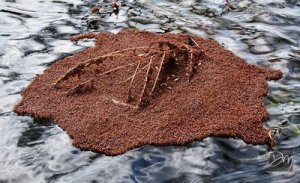
If you’ve experienced fire ants, you know. If you have not, you may want to read this.
I wrote this as a single sentence poem without line breaks so that it can be a fast, angry read. All the king’s power will not eradicate the fecking, misery-causing tiny fire ant.
Henry David Thoreau wrote a famous essay about ants and humans and combat. You can read it here.
Fire ants survived well Hurricane Harvey
Of God’s Little Pests
Thoreau did not know, nor did his essay thus show, the vicious pertinacity of your many tribes to attack and destroy, to sting and cause pain, to kill and devour, to disrupt with the evil of nature’s horror where the fittest survive, but not your power and numbers, that even all Texas resources with added more state and nation agriculture war departments, we burn and we poison, we kill and we murder, we hire mercenary flies to eat away your brain; yet you invade and continue your fight to survive costing billions each year with panic and pain, so that even attacks from Zeus Urei and the rains of Harvey allow you to still survive and produce from one queen astronomical numbers to replace workers each day and the best of science still calls you an exotic invasive species, still you’re a stinging nasty fire ant to me and you always will be, and you win, but I hate you.
(Bill Reynolds, 4/9/2018)
Standing or walking the land in the south USA,
look down and both ways for fire ant mounds.
If you don’t, you’ll soon learn. Mind the gaps.
The day four prompt of the 2018 National Poetry Writing Month challenge is “to write a poem that is about something abstract – perhaps an ideal like ‘beauty’ or ‘justice,’ but which discusses or describes that abstraction in the form of relentlessly concrete nouns.”
I used an essay I posted in December 2017, as an idea for the abstract noun tranquility. The concretes were the sights, sounds, tastes, and smells that led to the abstraction. You can read the essay if you click here.
Tranquility Remembered: the sounds of silence
My young mind was filled with thought
As I walked, no music or sounds I’d hear
Only deep moans from snow as I crushed it below
A cold white blanket on my pensive dark thoughts
Fairies, charming and peaceful my footsteps they heard
They opened my eyes to tranquil aura yet silent
I saw in the darkness a light with no sound, but
The sweet sounds of silence sent aroma that night
My thoughts melted away into the image of stillness
I heard not a hush of sound cut crisp cold calm air
A silence of power and of peace lifted me up
The flavor of quiet and snow calmed the darkness
Like the artistry of a perfectly painted picture
A vision of nature stillness lived in my brain
That moonlit night not long ago
in halo of street lights and a
reflection of memory of new lying snow
I remember the cold night
I remember the sounds and the silence
I remember the calm peaceful taste of tranquility
I remember I Remember I REMEMBER!
(Bill Reynolds 4/4/2018)
Fill the gaps with memory.
Look for beauty both ways.
It was a cold northeastern Pennsylvania night. I don’t recall the day of the week, or even the year, but the season was tucked into that idiom wrongly called, the dead of winter. There’s nothing dead about it.
I was in my teens and still living with my parents. It was late night and snow had covered the ground one day in the early nineteen-sixties. While night, the reflections from the snow allowed me to see everything, although it looked like a blue-tinted black and white photograph.
While all years of my life were important, those teen years are prominent memories. I still recall how I felt then, but now it’s hard to describe. I’ll never feel like that again. The wonderful adjectives of youth applied to me: vital, vigorous, and energetic; yet so did lazy, horny, rebellious, and impulsive. I would not say pensive or thoughtful. Yet, there was that one night.
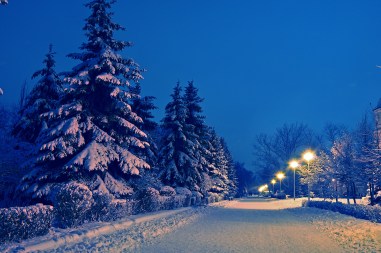
As I walked through deep snow above my ankles, a powdery white mattress was laid out around me in all directions. The white snow was tinted cobalt blue by the moon-lit night sky. None of the snow was marked by footsteps or car tires. The blanket was pristine. The cemetery across the street was a charming and peaceful sight. I loved the sight of the snow, the reflection of street lights with a wintery halo, the contrast of red brick buildings with lines of white where snow landed. Even boarded-up windows seemed fitting to this natural artistic sight. What I saw made me feel good. I was happy, but thoughtful about what I saw.
If anyone saw me, they might assume I was lonely. I was not. Never. While my teen years presented me with daily challenges, feeling lonely wasn’t one of them. Even back then, I treasured my alone time. I have searched for more nights like that one, but I will never discover such a night again. Nature’s art is often so fleeting.
I may have been troubled by any one of the issues I thought life changing. Today, I recall few of those traumatic teeny-bopper problems. But, I can still visualize the night. While I have long since been free of my adolescent burdens, I remember. I didn’t feel cold. I felt both my pending freedom and a connectedness to my surrounding, to the night, and to the silence. And to the darkness, the light, the snow, and a sweet silence only night offers.
I was wearing plain old brown leather oxford shoes and white socks. My pants were a bit too short and much too snug: a style of the times. Adults thought my hair too long. It was a little greasy, and it hung down to cover part of my face. I didn’t wear a hat. My outer layer was a hand-me-down, black, Navy-surplus pea coat – unbuttoned and hanging open. The collar was up.
As I picture that night, I feel my experience. That not-to-be-forgotten night was like a photograph taken with my eyes and ears, sensed with my tongue’s taste buds. I could smell the clean crisp aroma of the night air. It is imprinted in my memory: a serene moment, fifty-some years ago. A semi-normal teenager, I realized that something remarkable was happening around me. I liked it and I wanted to share it with you.
The day’s white powder parted like a soft curtain as my feet gently led me forward. Sidewalks, streets, and any surfaces open to the sky were topped with the blueish flakes. No cars passed. The plows would not be out until early next morning.
Months before this night, trees had lost their leaves. Now, white fluff-covered bare branches stretched skyward like arms reaching to catch descending flakes. Evergreens bore much thicker and fuller sparkling white coats over their needles, a weight they endured with their strong, flexible, down-sloping boughs. I sensed a soft chill as a gentle breeze brushed the powder from trees onto me.
As snow clouds passed, I saw the clear night sky of spiritual proportions. A nearly-full moon illuminated the earth with light reflected upward by snow. Even with the light in the sky, billions of stars floated above me, while below them the sheen of fresh powder glistened. I was so young, yet I intuited the unimaginable enormity of what was around me. I could sense the sheer winter-night beauty of it all. I felt comfort in that notable moment. The night and the silence were etching a memory no artist or photographer could duplicate.
The silence was purposeful and reasoned. A quiet so intense the night air was a sharp penetrating stillness that muted other sounds. All was perfectly still. No movement, not even a hush. It was an absolute quiet: a silence so powerful I imagined intense peacefulness within me.
I stopped. Didn’t move for a long time. I listened for sounds of anything, silent sounds. I heard nothing but silence itself. Very still, breathing shallow, listening intently to what was the most peaceful moment of my life as my personal Sounds of Silence came from nature. I was with my friend Darkness, where I felt destined to be. I experienced sensual pleasure in the absolute beauty of that cold winter night.
I saw silence in the stillness as nothing moved. The world had stopped. I tasted tranquility as the clear, dry night-air slid over my tongue. As the still coolness flowed into my nose with its chilled crisp fragrance, I smelled a fresh aroma only nature could provide to a young mind open to such images. I have aged. But, this memory remains set in the mind of a teenage boy.
Slowly, I started to walk a bit farther. Then stopped again. I knew this was exceptional. Then I walked more, and I stopped again. I do not recall walking away or going home. The memory leaves me standing there, taking it in.
I didn’t know that this memory would be discovered and retrieved by my muse over half a century later. Said she, “Up now, Lad. And write in yer book, before ‘tis lost again in the disorganized gaps of your mind.”
If you have no time for the video now, please come back to watch it. It’s worth it.
Live in the present, but look both ways, to the past for who you were, and to the future for who you’ll be.
Mind the gaps, but fill in where you can.
We think it good, we think it bad,
we think it happy, we think it sad.
Transitions gap our evolving life.
Changes are scary,
transformations are mad.
Everything changes.
Born into kaleidoscope
with passion we creep,
from stumbling blocks
to stepping stones
we eventually leap,
crossing mortared passages
through well-tuned segues
our unplanned journey
continually changes.
First babes, then as children,
we transform into teens,
with hormones and zits
and other strange things.
To walk and to talk,
of this life we wonder,
what it all means
we continue to ponder.
Everything changes.
Back to the womb
we desire to go.
As we learn of the changes
we continue to grow,
but kaleidoscope says
the answer is no.
Thru constant transitions
always more progress.
Life brings us new lessons
and dappled confessions;
how excited we get
as we look for more color.
We twist the scope faster
by leaving the nest,
then we see it in others
that desire for best,
we discover ourselves
as never before, we are
with all the transitions
still frozen by fear
of uncertainty we abhor.
Everything changes.
What is our purpose?
Why are we here?
Why do these changes
bring us such fear?
Back to the past
or into the future;
Where do we go?
What must we know?
Need we keep changing
as we continue to grow?
Everything changes while
the gaudy scope turns.
We fear the next spin
and where it might end.
Continue we must
with this prismatical game,
long into life
and well after birth.
Because everything always changes. It’s never the same.
Bill Reynolds 9/25/2017
Up from the colors, stare into the gaps. Look both ways at life’s many changes.
O sweet pacific Zephyr of pleasure,
overcome and make everything better.
Thru my heart send cleansing measures;
touch my face, unsettle my hair, water my eyes;
refresh all things as you pass.
Bring rain to silence my mournful cries.
Wash my body, brush my thighs,
blow clear my eyes that my mind might see,
this imprisoned heart now set free.
Take away dirt and dinge from the air.
Sweep foul poisons drifting there
left by souls seeming not to care.
Send your sweeping wind of rebirth
into the vile sky polluted by human greed,
now cleaned by your blessing of me in need.
With your breath of god, remove this stillness
that saps life from creatures on earth we crave.
Replace placid with salty moist freshness.
Revive all of me with your ocean scent,
sooth my yearning for pleasures spent,
revive my fondness for life on earth.
Raise my desire for nature’s worth.
Bring to me your refreshing pleasure
into my dead soul, sweet pacific Zephyr.
by Bill Reynolds 6/21/2017
***
Let the sweet breeze of a zephyr touch you. Face the wind, then turn and enjoy life.
Feel the air as you look both ways and mind the gaps.
Click on the graphic to link to the National Poetry Writing Month page.
April was my second time doing the A to Z blog challenge. I combined it with my first attempt at the National Poetry Month (NaPoWriMo) challenge. For 2017, poetry was my theme for A to Z. With four exceptions, my poems were in alphabetical order according to topic or poetic form. I had 30 posts for NaPoWriMo, 26 of which I used for A to Z. The NaPo challenge was to write (post) a poem each day.
My theme developed over time. I wrote poetry every day, but I didn’t finish a poem on each day. Some poems took more than a week, while one or two others were ready in hours. I thought some of my poems were long, but that relates to form, content, and purpose.
NaPoWriMo provides optional daily prompts. I did not use the prompts because my rookie status as a poetry writer and dual use with A to Z were complicated enough. Next year I hope to: participate with the poetry month challenge, write one poem each day (start to finish), and use the prompts provided. I also used poems for my weekly writing class assignments, instead of prose essays. I don’t plan to participate with the A to Z challenge again.
However, I’ve always liked poetry, even though I know so little about it. During April, I discovered my greater love of poetry and an overwhelming fondness for writing poems. I grew increasingly curious about poetic forms, genres, and styles. I read several books about poetry and many poems. My quest to learn continues.
My A to Z reveal was the most popular of related posts. The best-liked of my poems were Specks: Coincidence meets Kismet and Sunday Lions. By far, the most commented on was the Collaboration Poem, Dewey and Dad, with my daughter. Other well-liked poems included my Haiku; Onomatopoeia, Never Again, andRegna, The Poetry of Art. Zumurgy Blessingsfinished off the month well liked.
Surprises that did not do well included my sonnet, the tercet, and the poem on coal miners. Dark poems did not do as well as others. Maybe I should not be surprised. I enjoy dark poems and don’t consider mine as bleak as many. However, since I struggled with those three poems (each for a different reason), it’s more likely they were simply not so good.
Another surprise lesson: I can’t predict what you will like. I can tell from your comments how a poem affected you. I received strong positive comments about twaddle I considered only so-so. Things I thought good, took a long time, or challenged me most, were not always popular. For example, the Sunday Lion verse and Xu (Bang the Gong) I wrote quickly and were liked; whereas, I worked for days on the coal miner poem and the sonnet and they sort of flopped. But, there were some positive comments.
Many readers never click like or comment (maybe can’t). So, I don’t get every reader’s feedback. The bane of a writers craft, “what will readers like?” In some cases, there were more likes on Facebook than on this blog. Another example: when I posted the poem about the deer on the Historical Society’s Facebook page there were more likes, but who knows why? This is no scientific evaluation, despite the best efforts of WordPress to collect data. And no one said anything derogatory.
Bottom line, I learned that, for me, poetry is fun – reading it, hearing it, writing it, or remembering it (we memorized O Captain! My Captain! in grade school). I enjoy relating to love poems, poems about nature or human nature, or the occasional taste of the dark side.
Thank you for reading this. If you will excuse me, I have poems to write, read, and to memorize.
Life is lived forward and understood backward,
but look both ways and mind the gaps.
I sort of got the idea for this from another A to Z blogger, Sandra of What Sandra Thinks, specifically her Bitchfest 2017, where she adds “special touches of sarcasm, darkness and foul language.” Since I find her humor refreshing, I decided to take a similar, but more serious, path.
Vexations create a state of being annoyed or frustrated. I confess that during my life I’ve been guilty of many of the things I find vexing. My greatest frustration may be my own human condition. We have many words devoted to being pissed off. I am not the only one.
***
Vexatious Me by Bill Reynolds
With all the natural evil that be,
I am most troubled by
The moral evils that I see
Placed peeps on peeps. I’m vexed and…
Affronted by unfair stereotyping,
Aggravated by sense of entitlement,
Angered by any amount of animal abuse.
Annoyed by the foolishness of youth,
Bugged by too much welfare abuse,
Bent out of shape by all the bullies,
Disgruntled by job discriminations.
Displeased with wasting time, including mine.
Embittered by lost love.
Enraged by abuse toward women.
Exasperated by flawed governance.
Frustrated by incompetence, especially mine,
Furious over child abuse, anywhere, any time.
Indignant over unjust justice.
Infuriated by big black lies, also
Irked by little white ones.
Irritated by misunderstandings and
Miffed by gossip for fun and pleasure.
Offended by those too sensitive,
Outraged by starving children.
Peeved by human weaknesses, yet
Piqued by those better than I.
Pissed off when treated unfairly, and
Riled by my own pride.
Worried that nothing will change.
***
I failed to mention other drivers (texters, Beemer drivers, and Mercedes too), the wealthy, other people’s kids and dogs, and the folks who work at the driving license places in virtually every state. Also, virtually anyone who disagrees with me about nearly anything at all. And then there are people who are more vexatious than I.
Relax and go with the flow. We’re only human,
but let’s look both ways to enjoy the view.
Mind the gaps my friends, lest you get too twisted.







 Vexatious Me

 Our Literary Journey