The day 17 poem prompt of the 2018 National Poetry Writing Month challenges me to write a poem re-telling a family anecdote. I picked three, all involving stories about one of my sons.
Our middle child, Steven, had three incidents resulting in family anecdotes. I hope he forgives me for blabbing to the blogosphere. I just got his permission to publish this.
Steven in the middle
Anecdotally in the middle
Home before dark meant street lights on, it was time
But in friend’s house with curtains closed
Did not notice when lights came on
So sorry your friend has no clocks at home.
Teacher calls to announce rule was broken
Thou shall not eat departing school cafeteria
Why did you break such a simple rule, my son?
I was not eating. I was chewing. No rule broken.
Where is your new jacket, my son?
I don’t know where it is, dear father.
You lost it already, says I with surprise.
Not lost, says he, just don’t know where it is.
Now, mid-forties, with charges his own
This engineer surely missed his call
A gifted barrister would be so natural
The Prez needing new lawyers and all.
(Bill Reynolds, 4/17/2018)
Same guy with a touch of gray
If you’re in the middle, look both ways.
Mind the gaps.
The day 16 poem prompt of the 2018 National Poetry Writing Month challenges me to write a poem that prominently features the idea of play.
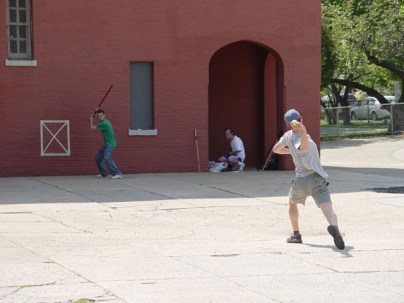
My poem is about my memory of a game we played as children – a game still played today, albeit differently. It has been played for over a hundred years by boys and girls, now also by men and women. Essentially, it is street or vacant lot baseball played with a broomstick for a bat, bases like the manhole cover or the flag pole, and most often a rubber ball.
My gang used all sorts of balls including wiffle balls of various sizes. No one wore gloves or any form of protective gear. Our classic favorite was to use those small plastic practice golf balls with all the holes in them to increase the challenge. They could bounce off any window or person with no damage. No coaches, no adults, highly flexible rules, and we worked out our disagreements without paying lawyers.
My poem is this old fart’s memories of playing the game and living totally for the moment, for the game, to be as good as we could be, and to have fun for the sake of play.
We used handles cut from broom sticks or mops. I do not recall anyone buying a ball, but it would not surprise me to learn that the ones we used were found, or “found” (as in the bottom of dad’s golf bag). The first commercially produced stickball bat came out in the early 1950’s and sold for 89 cents. Today, you can buy a high-tech, Easton T10 Thunderstick stickball bat for $50.00.
One of the problems today is that it has become difficult to find a good wooden broom or mop handle not being used, and games like that have fallen out of favor. However, I have included a photo and video about the game. In both cases, commercial bats are used.
It’s Never Just a Game
I was in the game that day
when it was a hot midsummer afternoon
when we played in the Courtright elementary school yard
when Jimmy Lipinski hit a double off of Joe Mullins’ chest
when time outs were for injury or just to pee.
I was in the game that day
when the fight broke out between Balochi and the new kid
Smitty was new and wanted us to play by New Jersey rules,
Balochi and Smitty became close friends and grew old together
and we learned to play by Jersey rules, East End rules, and league rules,
but mostly we made up the rules based on many things.
I was in the game that day
when Teddy tripped on second base and broke his nose
when the Daniel’s kid at shortstop lit a cigarette in the third
when the school janitor came and ran us all off or he would call the cops,
when we vandalized the school cuz the Janitor was a dick,
when I got my first hit, and when I hit my last.
I was in the game that day
when Lipinski made his behind the back flyball catch
when the worst player on the team hit a grand slam
when cuts and scrapes and twisted ankles were part of growing up,
when it started to rain that day and we played on anyway,
when the game was just the game, and both sides always won.
I left the game that day
when we walked away cuz it was getting dark
when we were thinking of what in life came next
when we thought there were better things to do,
when we walked away one last time
from the game we all so loved.
Let’s go play some stickball.
(Bill Reynolds 4/16/2018)
Look both ways as you play the game.
When at bat, mind you, hit the gaps.
The day 15 poem prompt of the 2018 National Poetry Writing Month challenges me to write a poem in which a villain faces an unfortunate situation and is revealed to be human but still evil.
This reminds me of a discussion I had with other writers regarding antagonists who are both good and bad.
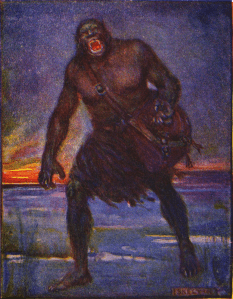
Anyway, I decided to write a poem on one of the villains from Beowulf, Grendel. You can read my April 7th post on Grendel here.
Grendel’s Reflection
Humans.
How nice and kind and all
When they kill,
it’s for the glory
of some crazy god.
Stand and fight,
it is our right,
that is their battle call
They kill each other,
then blame me,
I find it rather odd.
They say old brother Cain
rests within my heart
Not clearly seeing
the happy demon
who owns their very spirit
As they rip and tear
their kind apart.
Why such hate
within them grows,
their god only knows.
In the king’s hall,
it’s all hell they raise
It wakes me from my slumber
Yet when I grant them peace,
‘tis me they blame
for the midnight slaughter.
Little do they know,
that I am not so bad
If they were better neighbors,
it wouldn’t be so sad.
I am, after all,
just being me,
as like them as I can be.
Be your brother’s keeper,
unless he looks like me.
(Bill Reynolds, 4/15/2018)
Look both ways at right and wrong but judge your own-self first.
Tread softly with others being mindful of the gaps.
The day 14 poem prompt of the 2018 National Poetry Writing Month challenges me to write entries for an imaginary dream dictionary. I was to pick one or more of the following words and write about what it means to dream of these things: Teacup, Hammer, Seagull, Ballet, slipper, Shark, Wobbly table, Dentist, Rowboat.
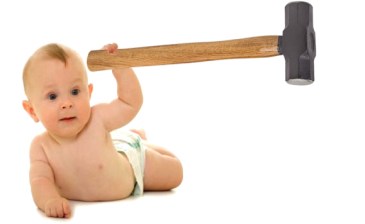
I really don’t get today’s assignment, but my goal is to write to the prompts. I decided to write what a hammer means in my dream, and then a little poetic ditty using hammer metaphorically within the dream. I’ve written too much about dreams lately not to at least attempt this.
When I had the hammer
The hammer is control in my dream
My dreams are always challenges
Problems to be solved, difficulties
My hammer is my courage and power to manage.
In my dream, I walked through four rooms.
In the childhood room, I could not lift my hammer
It was too big and too heavy and too confusing
All adults in the room had hammers, no child did
Some people had several. Someone carried my hammer.
In the young adult room, I struggled to move my hammer
Some days I could drag it, on other days I needed someone to help me
I tried to lift my hammer and to carry it as others seemed to
Several others were burdened as they carried many hammers.
In the middle age room, I carried my hammer with pride
I had a bag full of hammers because I carried hammers of others
…this I did with shameful pride,
…never admitting to the fear and burden of so many hammers
Confused, I wanted to give others their hammers to carry,
…yet, I wanted to continue to carry them.
In the room of seniors, I understood the hammers
I carried mine, yet asked for help when my hammer was too heavy
Some days I helped others carry theirs, some days I carried none
But with each passing day, my hammer got heavier,
…and I knew that soon
…I would have to give my hammer away.
(Bill Reynolds, 4/14/2018)
Look both ways to find your hammer.
Use it carefully as you mind the gaps.
The day 13 poem prompt of the 2018 National Poetry Writing Month challenges me to write a poem in which the words or meaning of a familiar phrase are up-ended.
I chose the phrase whatever doesn’t kill me makes me stronger. My upending is in the poem’s title. Besides the prompt, my inspiration for this poem stems from reading Christopher Hitchens’ Vanity Fair article regarding the maxim, and the entire series he wrote during his tribulation with cancer.
Indeed, successful resistance often strengthens. That is the principle of inoculations against disease, doing regular exercise, preserving through addictions, or recovery from mental setbacks such as depression. The problem arises from the universal application of the maxim, no matter who first said it.
First, it may kill you (and someday something indeed will). Secondly, things (like whatever) can and do leave you weaker, not always stronger. In my opinion, despite having taken the shot against shingles, I contracted the illness because I had been ill repeatedly over months and my immune system had been severely weakened. And there is the age thing (it’s not just a number). Being ill did not kill me, but it did make me weaker, more vulnerable, and not a bit stronger. Shingles does not make you any stronger either.
Here is a good article about Hitch’s Vanity Fair piece. And the poem…
First Weakened Then Dead
I am my body and my mind
‘tis me nature to be friendly and kind.
Then you entered me, quite uninvited
You’re a vile corruption of cells divided.
You took my strength, my pride, my hair
Weakened what I am, if you ever care.
We both suffer, but it’s you we must kill
In my losing battle to save my will.
Die I must, that’s what they say
But I hope to find some other way.
(Bill Reynolds, 4/13/2018)
I’m a Kelly Clarkson fan, especially since watching her coach on the TV show, The Voice. I’ve included her 2012 hit in the interest of leaving you, literally, on a positive note.
From birth to death, look both ways. Mind the gaps and the cleaver maxims.
Even mine.
The day 12 poem prompt of the 2018 National Poetry Writing Month prompt challenges me to write a haibun, which is a prose/poem form that takes in the natural landscape. This one is supposed to be about the place where I live, to bring this area to life through a charming mix-and-match methodology of haibun. Read about haibun hereif you care to.
I am not sure about the charming part. Haibun, and the included haiku or tanka are Japanese poetic forms hundreds of years old. I’m not that old, nor am I Japanese. But, I am an old American boomer-poet, and child of the sixties. It’s poetry. I write ditties. Ditties don’t have rules. What follows is my twist on haibun. (No disrespect to any oriental art from intended.)
Welcome Home…sort of
The rocky trail invites my curiosity as it gives me perspective into the central Texas biota detected by my five senses and absorbed into the lungs of my mind. Stubborn life forms which I admire more for hardiness and attitude than for beauty or comeliness. Bright green immature ears grow from dark-gray, near-dead, needle-covered cactus. Big old oaks mix with scrawny mesquite and scrubs-n-shrubs to shade the rough pathway.
Rain strips pollen
from the air
a deer looks at me
So much nature
look, dunna touch
hearing of voices
Life thrives in this arid environ that permits me, a feral foreign pest, to have a limited experience. Flora here is so much like the native human species; tough, resilient, rebellious. Then there are the wildflowers: the bluebonnets, the Indian paintbrush and blankets. Beautiful. For now.
(Bill Reynolds, 4/12/2018)
Look both ways to see it all. Enjoy the scene but mind the gaps.
Texas longhorn in a field of bluebonnetsClick link to National Poetry Writing Month
The day 11 poem prompt of the 2018 National Poetry Writing Month challenge was for me to write a poem that addresses the future. I was to answer these the questions: “What does y(our) future provide? What is your future state of mind? If you are a citizen of the “union” that is your body, what is your future “state of the union” address?”
I came up with a slightly sarcastic inventory, or catalogue, poem that gives this a septuagenarian’s take on future thinking. I strive to be (and some say I am) a very right here, right now person. My take on this is also male, but women may find commonality with or without small word changes.
When THAT Happens…
When it takes all day to do whatever it was.
When you see wrinkles that have always been there
When all your futures are in your past.
When no one tells you not to run when you are running.
When the future is like the playoffs and you hope to be at least be a wildcard.
When you always take the elevator.
When a young lady offers you her seat, and you take it.
When you allow extra time for everything and end up late.
When you google childhood friends and end up reading the obits page.
When a day off means no doctor appointments.
When young ladies think you’re harmless, and they’re right.
When a middle-age lady says you remind her of her father, or worse, grandpa.
When they stop asking what you do for a living.
When living is what you do for a living.
When even a bad memory is good sign.
When your future state of mind may be homeless.
When your body is like the movie, As Good As It Gets.
When a pain means you moved something.
When those old people turn out to be younger than you.
When sex makes you think of words like dysfunction and prostheses.
When a new tattoo is major surgery, and an old one is a Rorschach Test.
When you been there, done that, got scars to prove it
…but you can’t remember what the hell you were talking about.
When young poets talk about the future and you write a memoir.
When your memories are all in black and white.
When all your friends say, “I remember when…” and you don’t.
(Bill Reynolds. 4/11/2018)
Some of us have more past than future, but we look both ways.
Mind the gaps, ignore the aches.
The day nine poem prompt of the 2018 National Poetry Writing Month challenge was for me to write a poem in which something big and something small come together.
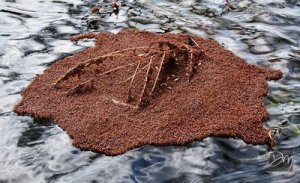
If you’ve experienced fire ants, you know. If you have not, you may want to read this.
I wrote this as a single sentence poem without line breaks so that it can be a fast, angry read. All the king’s power will not eradicate the fecking, misery-causing tiny fire ant.
Henry David Thoreau wrote a famous essay about ants and humans and combat. You can read it here.
Fire ants survived well Hurricane Harvey
Of God’s Little Pests
Thoreau did not know, nor did his essay thus show, the vicious pertinacity of your many tribes to attack and destroy, to sting and cause pain, to kill and devour, to disrupt with the evil of nature’s horror where the fittest survive, but not your power and numbers, that even all Texas resources with added more state and nation agriculture war departments, we burn and we poison, we kill and we murder, we hire mercenary flies to eat away your brain; yet you invade and continue your fight to survive costing billions each year with panic and pain, so that even attacks from Zeus Urei and the rains of Harvey allow you to still survive and produce from one queen astronomical numbers to replace workers each day and the best of science still calls you an exotic invasive species, still you’re a stinging nasty fire ant to me and you always will be, and you win, but I hate you.
(Bill Reynolds, 4/9/2018)
Standing or walking the land in the south USA,
look down and both ways for fire ant mounds.
If you don’t, you’ll soon learn. Mind the gaps.
The day eight poem prompt of the 2018 National Poetry Writing Month challenge was for me to write a poem in which mysterious and magical things occur. Last year, I wrote a long poetic story with a slightly different, yet similar twist. You can read it here.
Night Witch
For years I negotiated my labyrinth of life.
Then one day the path all went dark,
It filled me with alarm and I shook with a fright.
Burning deep within me watchful eyes I felt,
My temptation was rising to the oldest of times,
fear continued to grip me, from within and without.
She was the blackest of darks, that witch of the nights.
Her gaze was upon me when I opened my eyes,
I was blinded by flashes, visions of the enchantress.
I saw in her wonders worlds of exquisite pleasures.
She came from the magic of the eternal hereafter.
Without moving her lips, she spoke directly to me,
“Return with your love, to the darkness and danger,
back to my universe we can travel with ease.
Give over your being to my mystical kisses,
my promise of love will grant all your wishes.”
As she reached out and touched me,
I felt pain and wondrous pleasure,
Yet, drawn to her I nodded my answer.
She took my hand, and with a rapturous laughter,
I saw in the distance her dragons and castles.
She marked our arrival with thunder and lightning.
I saw in her army both imps and her glories
All served at her pleasure.
Now was I there, her newest found treasure.
To me she said, “Through pain and with suffering,
you’ve found a new realm.
Transition, dear man, as best that you can.
Give over your being to the queen of this land.
And she shall make you our king,
if the pleasures don’t kill you.
Together we’ll dance, for our love and our glory.
Let’s begin to write this wonderful story.”
(Bill Reynolds 4/8/2018)
In the labyrinth of life, look both ways for witches of the night.
Mind the gaps.
The day seven poem prompt of the 2018 National Poetry Writing Month challenge was for me to list my different layers of identity (son, father, grand and step-grandparent, retiree, white male, septuagenarian, poet/writer, hippie, etc.) — ways I could be described. Per the prompt, I divided those identities into two lists: what makes me feel powerful; and what makes me feel vulnerable.
I wrote a poem in which one of the identities from the first list (man) contends or talks with an identity from the second list (sensitive man). This poem reflects the doubt seemingly inherent in that conflict.
A Pocket Full of Doubt
Walk tall and proud to be our one man
Carry strong your body, mind, and be of good spirit
Hold on to what’s yours as tight as you can
To be a man, my son, inside you can’t feel it.
It ain’t me. It ain’t me. But a man I must be.
Stand honest and truthful, be a real man
Sense love and sadness and touch with your soul
Let go of yourself, as alone you must stand
Into the soul of men, you must never there go.
Can’t you see? It just ain’t me. Like so, a man I can never be.
So, of two minds you continue to fight?
Two spirits, one soul we continue to see
Where is the truth to set this man right?
Conflicted as such, you’ll never agree.
Let you be the man. The one we can see.
…….A man such as this can never be free.
(Bill Reynolds, 4/7/2018)
Look both ways if you’re of two minds.
In the gaps lie the answers, so mind what you find.





 Our Literary Journey