I love this memoir or autobiography thingy. Like so much of writing, it’s a pain in the ass and a fantastic experience. This has been a busy week for me, as in doing other things besides writing. Of course, bless their hearts, nothing is harder than dealing with the idiots and morons. But dang! We had an election that shook me to my core – more than politics or other elections have in my lifetime.
 On Wednesday, I went to a meeting that took too long and annoyed me – don’t they all?
I’ve managed to stay on pace to meet my Nano word count goal, but this week was not as productive as last week. I’m finding that I need to do a lot of research, too much thinking, and much trying to remember details of events I stopped caring about long ago.
Friday morning, I attended a write-in with the SnoValley group. After getting only four sentences written in the first hour, I gave up on a productive morning. Despite repeated comments from Alex that he would not talk politics, I returned from a break to a hot and heavy discussion relating to the political events of the week. Since I’ve been trying to contain my anger, it was not long before I was in rant mode. More wasted time venting, and less productive time writing.
I had one other event on that day, thus Friday was my lowest word count day since Nano launched. I was told that the Friday group wrote more during Nano. ‘twas not so on Veteran’s Day.
Another adventure this week was attending a session on memoir sponsored by the Pacific Northwest Writers Association (PNWA) It was facilitated by Theo Pauline Nestor, a memoirist and author of Writing is My Drink. The class was a productive learning experience for me and I wanted more. It was too short, even though it went a little overtime. From what I learned in that class, I decided to write an Intro to my memoir. Here’s part of it.
Introduction to Passionate Disbelief (Partial)

To believe, or not to believe? Is that the question? Is it better to suffer with my beliefs as I am told? What good does any of it do? Do I stand behind my beliefs, unpopular or not? Would I be a martyr to my causes and die for my beliefs? Is it possible for me to decide for myself what to believe? If I am to believe anything, do I have the right to demand evidence or proof first?
What do I believe? How did I come to my beliefs? Do we have a complete free will to decide what we believe, or are we programmed? Do genetics play a role? How much does my culture and past life determine what I believe today?
I dislike being asked why. It makes me think and I’m too lazy for thinking.
And yet.
Why? is the best question there is. As children, we ask why repeatedly. As parents, we provide answers to our children, eventually saying, “Cuz I’m (Mom, Dad, your boss), that’s why.” Sometimes we answer why with whatever, just because, it is what it is, why not, the bible tells me so, and my personal favorites, who cares, and I don’t know.
When I was that quality assurance guy, I liked using five whys to determine root causes to problems. It is simply asking why repeatedly for five times, as any three-year old might.
Can I have both an open mind and firm convictions? Is it possible for me tell you why I believe (or don’t) something without trying to convince you that I’m right and you’re wrong? We can both be wrong, but can we both be right?
So many questions. So few answers. Terry Tempest Williams has agreed that her writing is in response to questions (cited in an interview with Scott London on The Politics of Place). She went on to mention Rainer Maria Rilke, who described how questions move us.
“Be patient toward all that is unsolved in your heart and try to love the questions themselves, like locked rooms and like books that are now written in a very foreign tongue. Do not now seek the answers, which cannot be given you because you would not be able to live them. And the point is, to live everything. Live the questions now. Perhaps you will then gradually, without noticing it, live along some distant day into the answer.” (From Letters to a Young Poet, 1929)
Exploring my spiritual past is like reverse engineering, or tracing the specific coding that, to some degree, contributed to my conclusions years later. For many questions, I may have followed Rilke and lived into the answer.
 Wonder why? Carefully look both ways and mind the gap.
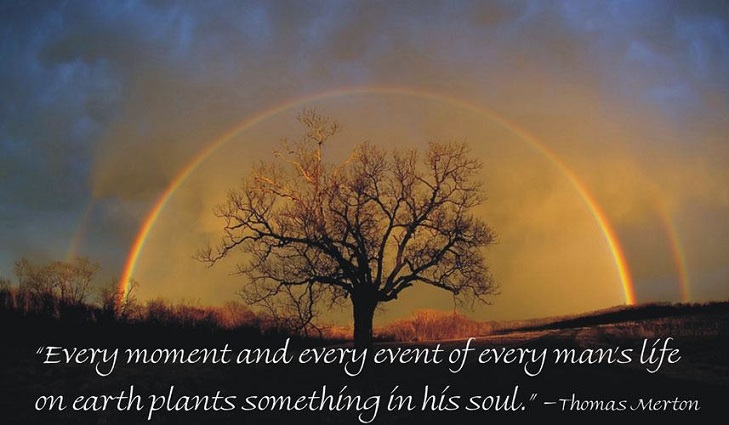

 What impressed me about this man was his complexity, his courage, and what I see as his wisdom. His life journey and the decisions he made will likely prevent him from ever being canonized a saint by the Catholic Church. Yet those foibles are exactly what attracted me to him twenty years ago, and continue to influence my thinking. The man was a real person – a human being who behaved like one. If they did make him a saint, I think he would be among the most human of that group.