A2Z Challenge — H is for Hamadryads

If you’re a tree hugger, all is well. If you’re an arborist, even better. But if yer a tree chopper, you might want to be sure these little darlin’s don’t really exist. If you kill the tree, you kill the Hamadryad of that tree. That pisses off the gods and you know what that means, right?

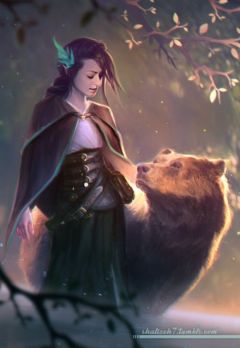
Hamadryads live in the trees, more precisely in an individual tree. They are a specific type of dryad, which are a type of nymph. A nymph is a minor female nature deity usually associated with a specific location or landform.

They are different from other goddesses in that they are divine spirits who animate nature. They are beautiful young maidens who love to dance and sing. Their amorous freedom makes them very different from wives and daughters of the Greek polis. Now we know why those guys were hugging those trees.

Nymphs are beloved and can be found in forests by lakes and streams, and in or on trees.
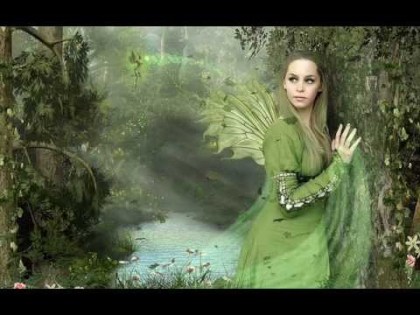
Hamadryads are born bonded to a certain tree. If the tree dies, the hamadryad associated with it dies as well. For that reason, dryads and the gods punished any mortals who harmed trees.

I feel a twinge when I read Poe’s sonnet to science. To a degree, the poet is scolding science and, in a way, me.

He pines well for the wonderfulness of fantasy and nature’s unknown wonders. He is right.

Sonnet—To Science (By Edgar Allan Poe)

Science! true daughter of Old Time thou art!
Who alterest all things with thy peering eyes.
Why preyest thou thus upon the poet’s heart,
Vulture, whose wings are dull realities?
How should he love thee? or how deem thee wise,
Who wouldst not leave him in his wandering
To seek for treasure in the jewelled skies,
Albeit he soared with an undaunted wing?
Hast thou not dragged Diana from her car,
And driven the Hamadryad from the wood
To seek a shelter in some happier star?
Hast thou not torn the Naiad from her flood,
The Elfin from the green grass, and from me
The summer dream beneath the tamarind tree?

Source: The Complete Poems and Stories of Edgar Allan Poe (Pub: Alfred A Knopf, 1946)

Look both ways as you walk the woods
and recall within each tree lives a Hamadryad to protect.
Mind the gaps and morn the loss of so many trees.

 

A to Z Challenge — G is for Grendel

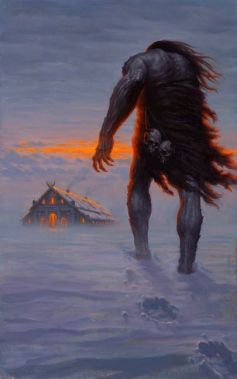
Taken from the epic and ancient poem Beowulf, Grendel, the first and most terrifying monster in English literature, is said to be a direct descendant of Cain, the first biblical murderer. This poetic story of unknown authorship barely survived the atrocious monastic destruction perpetrated by Henry VIII in England. One copy of the poem survived, and it had to be patched up in a few places. But we do have it.


Beowulf may be the oldest example of English (nothing we might recognize) language literature. Dating back to about 700 to 1000 AD, it deals with life and culture around the sixth century. The story is set during a time and in a place when battle, conquest, and death were honored descriptions of what life was like.

The protagonist is Beowulf, a young, strong, and powerful warrior who eventually becomes a king. Unlike the average leader of the time, Beowulf seemed to care about his people and introduced leadership with compassion as opposed to fear and dread. Beowulf must defeat three antagonists: Grendel, Grendel’s mother, and the dragon.

A mead hall

The story tells us that Grendel had been attacking and killing Danes every night for 12 years. Beowulf comes to the aid of the Dane king whose mead hall had been under nightly attack by the monster.

If Beowulf was to fight Grendel to the death on Grendel’s terms, it would be unarmed and (presumably) naked. Since Grendel used no weapons, Beowulf chose the same. Grendel had done a lot of damage and killed many of the king’s mead hall drinkers in his years of harassment. In the poem, Grendel is presented as an evil that must be stopped and Beowulf is the man to do it.

Flash forward a thousand years or so, and in an interesting twist, another side of the story is told in the 1971 book by John Gardner, titled, Grendel. In this frequently banned book, Grendel tells his side of the story. This is a retelling of Beowulf that follows the monster Grendel as he learns about humans and fights the war at the center of the Anglo Saxon classic epic.

I have always felt that there are at least two sides to every story, but one must wonder what the Danes were thinking when they returned to the mead hall every night for 12 years, there to drink and sleep, only to be attacked by the monster. With so many being killed during so many attacks, the Danes must have been close to decimated before Beowulf made his mark.

Open the window and look both ways, the monster approaches.
Mind the gaps as you escape his anger and his vengeance.

A to Z Challenge — F is for Frankenstein’s Monster

One book published many times.

Two hundred years ago in London, on 1 January 1818, 20-year-old Mary Shelley anonymously published the first edition of her novel, Frankenstein; or, The Modern Prometheus.

Mary was 18 when she wrote the book, the genesis of which goes to the topic of galvanism and other occult ideas that were themes of conversation among Mary and her companions, particularly her lover and future husband, Percy Shelley. Mary, Percy, Lord Byron, and John Polidori competed to see who could write the best horror story. After thinking for days, Mary Shelley dreamt about a scientist who created life and was horrified. Her dream evolved into the novel’s long-famous story.

The problem with this story is that history, Hollywood, and human imagination have been unfair, if not unkind, and inaccurate regarding Victor Frankenstein’s creation. Even Victor was too quick to judge by outside appearance, unpleasant as it undoubtedly was. In Shelley’s book, the outcome of Frankenstein’s experiment is never given a name, although the creature did suggest that he was Victor’s Adam.

At first, the creation is kind and gentle and only wants to be accepted. The creature was eight feet tall and ugly and he knew it. Yet, he sought life and normalcy, but he could not achieve that due to the fearful nature of mankind, and specifically Victor Frankenstein’s fear of what might happen.

I find it interesting that even in the mind of an 18-year-old girl 200 years ago, the innate goodness of a man’s creation can be judged as evil before ever doing anything but kindnesses to others.

One hundred thirty-six years later, the first human body part/organ transplant is completed. Numerous human lives have been extended through science and organ donations and transplants. I would not say we take that for granted, but we’re getting close and for some tissue, there are insufficient donors. One organ not transplanted is the human brain. I have read that it is the one donation where the donor would be the greater beneficiary in the process.

I wonder how Mary, her husband, and their circle of friends would react to the knowledge of today’s reality, scientific knowledge, and literary fantasy if they could suddenly be here and learn about it.

Lord Byron wrote his poem Darkness about the same time as Mary Shelley wrote this book. Given the nature of the book, the poem, and earth during 1816, I do wonder if his poem came to be for similar reasons as her Frankenstein story.

‘tis a dark world after all.
Skeptically, look both ways,
yet apply judgement of others and their creations carefully.
Mind the gaps in your own humanity.

A to Z Challenge — E is for Elf

The Elf has evolved into a category of beings, as opposed to a specific creature. As with the word human, to get the picture of an individual elf requires more information. Just as there are all kinds of humans or people (it takes all kinds?), there exists many types of elves and elven mixes. Yesterday, I spoke of the drow, or dark elves, just one sub race.

While the original concept of elves was Norse (álfar) or German, modern fantasy literature depicts elves as an almost divine race of beings with human stature and appearance, friendly natures (minus those from the dark side) and pointed ears (a must to my mind). The elves of today are different from traditional elves found in Middle Ages folklore and Victorian era literature.

The long and pointed ears seem to have started with Tolkien noting that the ears of elves were leaf-shaped. The length and shape of their ears depends on the artist, medium, or round-ear in question. I prefer pointed ears, but not the long ones like a donkey might have.

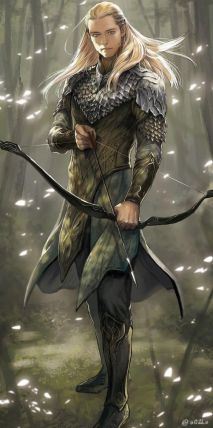
Wood elves are close to nature.

Modern fantasy elves (evolved from D&D or other role-playing media) may be immortal or slow maturing and long living compared to their humanoid cousins. They are also more attractive, smarter, gifted with magical power, and have a sharper sense of reality. Pure-blood elves do not possess facial or body hair. They are seldom portrayed as fat, lazy, or old.

Today, thanks to Tolkien, there are elf languages that have evolved and are often taken seriously and spoken by dedicated role players. Click here to get more information on the Elvish language.

The many types of elves include wood elves, high elves, aquatic elves, light elves, dark elves, sun elves, moon elves, forest elves, and savage elves. Even if you’re not an elf aficionado, you still should get the picture. If you are, you can add to the list.

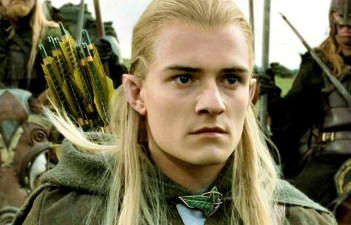
Elf Legolas Greenleaf (Orlando Bloom), in The Lord of the Rings

Elves are more ancient than humans or other races and flourished in a sort of Golden Age forgotten by other races. The mixing of elves with other races is interesting in that it is a mix of the real world, with all its limitations, and fantasy worlds with its unlimited imagination.

If you discard the elf on the shelf and the comedy movie, Elf, staring Will Farrow, the best known modern elf is probably the archer Legolas Greenleaf, portrayed by Orlando Bloom in The Lord of the Rings film trilogy. Arguably Tolkien’s best-known elf. Good clips from the movie with great sound.


Cautiously, look both ways in fantasy and reality.
Mind the gaps if you mix the two.

A to Z Challenge — D is for Drow

The Underworld of Drow

I have never played D&D, but I wish I had. When it was popular, my kids played the game. Since writing about these creatures, my daughter has invited me to play D&D with her, her hubby, and the grandkids. I discovered on-line role playing several years ago. That was when I learned how little I knew about elves, and I met my first elf who was a member of a sub-race of elves known as drow.

Of all fantasy creatures, I find elves to be the most interesting. They’re followed by dragons and leprechauns. That is a lot to write about. If we add reports and stories on other humanoids, such as dwarfs and hobbits, a literary subfield within fantasy emerges. Since elf crossbreeding, particularly with humans creates an exponential growth of character possibilities, contemporary story telling became fascinating for both creator and consumer.

If you’re not a fan of D&D or role play (RP), you may assume things about elves regarding stature, intelligence, and friendliness which are likely incorrect. In each case, I was wrong. They’re not little, stupid, and sweet. Admittedly, Santa’s helpers at the North Pole do little to correct the stereotype, but all is fair in fantasy and myth.

Dark, or black elves are from Norse mythology and thought to be the ancestors of the drow. These elves are usually considered to be evil in the inborn, bad seed sense. Yet there is ample evidence for a human-like nature versus nurture conflict and all drow cannot be depended upon to be as wicked as others.

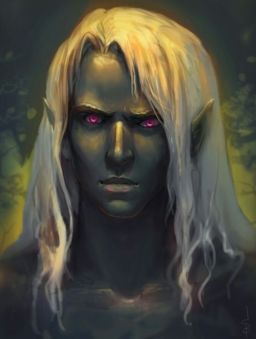
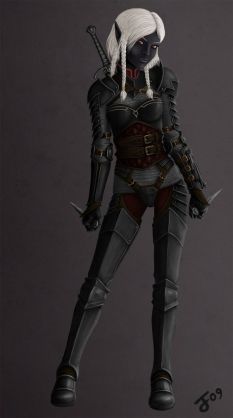
Drow have dark grayish skin. Since they are given to self-decorating, green and even purple colors can also be found. Their hair is naturally white, whitish or yellow, but here again, drow know about hair coloring techniques. Female drow are dominant, being both stronger and slightly larger than males. As with all pure elves, neither sex is capable of beard growth. While eyes are normally red, colors can range. With crossbreeding, even human green or blue eyes are possible. But, if you want to see something spooky; a red eyed, dark-skinned drow can tilt your freak meter.

While drow are unwilling underground creatures, they are most often found by non-drow to be above ground for the obvious reason that subterranean existence for a non-drow creature is as a slave to the drow, if survival is even possible in such a wild, violent place.

Drow fight with anyone, and other drow are never off the hook. That helps to keep their numbers down, since when they do get along well with each other, they are also very prolific producers of offspring.

As with all elves, drow live long lives if they manage to avoid a violent and early death. Again, given all their magic and power, it is their inability to get along that manages to keep the population in check.

Despite what sounds like an evil appearance, drow are attractive elves. This causes surface dwelling races to tolerate drow presence if they behave in a non-drow-like fashion. Surface races of elves and other humanoids have been known to inbreed with drow yielding interesting, yet confusing, results: both good and bad.

Drow are fast, agile, and in their opinion smarter than all other humanoids including other elf groups. The most natural and overwhelming feature of all drow is their phenomenal sense of entitlement. While this can be an annoying and dangerous trait, like so much else regarding drow, it is difficult to tell if it is innate or cultural. Drow culture reinforces all forms of evil within their race beginning at a very young age.

Mind gaps to the world of the drow.
Look both ways as elves are poor drivers.

A to Z Challenge — C is for Chimaera

The Khimaira (Chimera or chimaera) was a three-headed monster. If ya Google it without the mythology tag, most options will be links to ghost fish or sharks. This is no fish story.

Like so many monsters of Greek mythology, The Chimaera was the offspring of couple of monstrous sweethearts named Typhon and Echidna, a pair I envision as sort of an Adam and Eve couple of the Greek Mythological Monster class.

This bizarre, fire-breathing cat had the body and head of a lion (good so far). But peeking over its shoulder was a goat’s head rising out of its back. The beast had udders like a goat (no idea why). Away from the business end, the ubiquitous mythological snake rounded out the creature’s tail, with serpent’s head at the very end.

Since nothing good could possibly spring from the union of Typhon and Echidna, this beast ravaged the countryside of Lykia (Lycia) in Anatolia, which is on the southeastern end of Turkey. Contemporary Turkish history does not jibe well with older Greek myth, but at the time it all fit nicely, if fearsome.

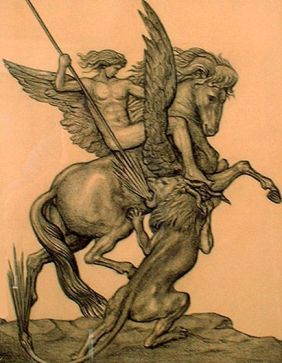
As the story goes, this Chimaera cat was just kickin’ ass all over that part of the world until a hero named Bellerophon came on the scene. He was either asked or commanded, depending on who is doing the telling, by King Iobates to kill the beast.

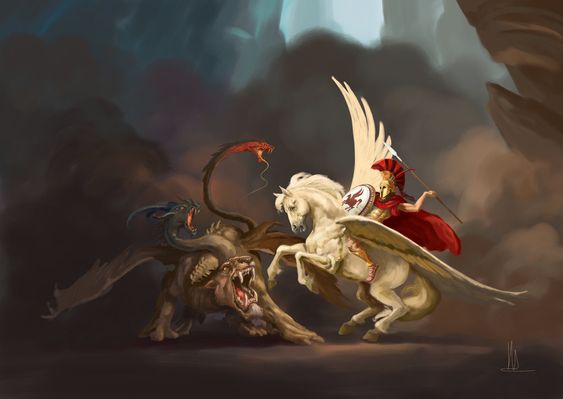
Bellerophon rode into battle on the back of the winged horse, Pegasus, of course. He sought and found Chimaera and drove a lead-tipped lance into its flaming throat. So, the big cat-goat’s fiery breath melted the lead tip, promptly choking the beast on hot molten metal. Lead poisoning for sure. So, the beast died from sucking on a lead popsicle, Greek Mythology style.


Turkey has never been known for its geological stability. So, later classical writers believed the Chimaera creature was a metaphor for a Lycian volcano, of which there almost certainly were several.

The Chimaera can look both ways at the same time
and the snake can keep its eyes looking backward.
So, mind the gaps.

A to Z Challenge — B for Basilisk

A basilisk is a creature presented as a snake-type or other reptile. Some renditions look related to a rooster, but that would be a cockatrice. You’ve heard, if looks could kill? Well, if it’s basilisk, they do. A direct look from a basilisk and yer a goner.

It’s interesting how the fantasies go on with how dangerous this creepy-crawler is with venom and whatnot, but with looks that kill, who cares? Think Medusa. Ok, so you use a reflection for an indirect look, but unlike Medusa, you’re petrified anyway, meaning you are turned to stone. Think Lott’s wife. I can’t buy the petrified option as being any better than a direct death look. Look away if you see a basilisk coming. Oops, too late.

Basilisk Paining

Some sources (Britannica) list the basilisk as the same creature as the cockatrice, but one is a snake the other a pissed-off rooster that looks related to the village dragon. In mythology there is an odd biological, half-sibling, relationship between the two. This basilisk creature comes into being because a cockerel (rooster) sits on and incubates the egg of a snake or toad. For the cockatrice, the rooster lays the egg (see the problem?) and either the snake or a toad pulls off the incubation challenge.

If a sex is assigned to a basilisk it is often female, yet, due its appearance with a mitre on its head, it is referred to as king of the serpents. The Pope wears a mitre as a kind of crown. It must have been safer to piss off a king, since there were many, than the Pope, of which there were few, if only one legitimate. Since these folks have roosters laying eggs, I suppose that is all fair enough. It’s fantasy, right?

The first writing about a basilisk dates to around 79 AD, about the same time New Testament Gospels were allegedly first written. And if you worried about one of these suckers turning up at the front door, you could simply do pop goes the weasel. Apparently, taking a cue from Asia and the King Cobra’s nemesis, the mongoose, the Europeans made the odor (effluvium) of the weasel be a deadly weakness for the basilisk. That makes sense. With more quafting weasel stink everywhere, there’ll be fewer basilisk, which explains why Europe has such a small problem with basilisks roaming the countryside. Of course, if you did see one, you’d die and be unable to tell us about it.

Cockatrice

Literature is replete with references to the basilisk. In Shakespeare’s Richard III, Anne Neville wishes her eyes (like a basilisk) would kill her husband’s murderer, and in Cymbeline a character refers to a ring as a basilisk.

Samuel Richardson in Clarissa; or the History of a Young Lady, and John Gay in The Beggar’s Opera, have characters who refer to the basilisk in dialogue. Others include Jonathan Swift in a poem, Robert Browning in A Light Woman, and some writings of Alexander Pope.

Shelly refers to “the imperial basilisk” in Ode to Naples; and again in Queen Mab like this:

Those deserts of immeasurable sand,
Whose age-collected fervors scarce allowed
Where the shrill chirp of the green lizard’s love
Broke on the sultry silentness alone,
Now teem with countless rills and shady woods,
Cornfields and pastures and white cottages;
And where the startled wilderness beheld
A savage conqueror stained in kindred blood,
A tigress sating with the flesh of lambs
The unnatural famine of her toothless cubs,
Whilst shouts and howlings through the desert rang,—
Sloping and smooth the daisy-spangled lawn,
Offering sweet incense to the sunrise, smiles
To see a babe before his mother’s door,
Sharing his morning’s meal
with the green and golden basilisk
That comes to lick his feet.
— Part VIII

The basilisk also appears in Harry Potter and the Chamber of Secrets by J. K. Rowling.

Be careful looking both ways.
You want to miss seeing the basilisk, but mind the gaps.


A to Z Challenge — A is for Alecto

One of my grandchildren is named Furie. I was told that her name was based upon Furies of Greek Mythology. That was my inspiration of this blog.

While there were three Furies, I am focusing on one: Alecto (unceasing in anger), mostly because it fits the challenge.

The three furies

In Greek mythology the Furies, were female deities sometimes referred to as “infernal goddesses.” In Roman mythology, they are the Dirae. One Roman writer said they’re called Eumenides in hell, Furiae on earth, and Dirae in heaven. Indeed, these goddesses have significance in the underworld.

In addition to Alecto, her sisters are Tisiphone (avenger of murder), and Megaera (the Jealous one). Each had a role in dealing with the dark side of human nature and behavior.


I am not messing with her.

Alecto dealt with people who had problems with others (anger). She was like the goddess, Nemesis, who enacted retribution against those who succumb to arrogance before the gods. However, Alecto was concerned with human to human interpersonal issues, rather than human to god.

The Furies came into being when Cronus, technically their brother and leader of the first generation of Titans, castrated his (and their) father, Uranus. Uranus’ testicles were to be cast into the sea, but blood from them was spilled on Gaia (the Earth) and produced the Gigantes, Meliae, and Erinyes. The Erinyes, or Furies, pursue heinous criminals, punishing them according to their crimes. The imagination of ancient people must have phenomenal regarding their myths.

Furies revenged homicide, unfilial conduct, offenses against the gods, and perjury. A victim seeking justice could call on them for criminal retribution. The most powerful of the curses was of the parent upon the child – for the Furies were born of just such a crime, when the blood of Uranus (or the sky) impregnated Gaia, following Cronos chopping off dad’s nuts, thus Alecto’s unceasing anger.

Their wrath manifested itself in several ways. The most severe was the tormenting madness inflicted upon a patricide or matricide. Murderers might suffer illness or disease; and a nation harboring such a criminal, could suffer dearth, hunger, and disease.

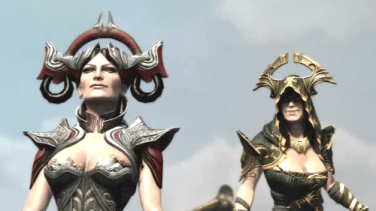
Alecto and Tisiphone

The wrath of the Furies could be placated with purification and some assigned task for atonement. However, Alecto had no sympathy for the wicked.

The goddesses were also servants of Haidas and Persephone in the underworld where they oversaw the torture of criminals consigned to the Dungeons of the Damned. A goddess from Hell who is always angry with everyone and everything should make us behave. As with all such things regarding ancient mythology, the dealings were direct and fierce.

Look both ways for Alecto.
Mind yourself, the gaps go clear to Hell.

Link to A to Z blog Challenge

A to Z Blog Challenge Theme Reveal (2018)

Let’s roll out monsters, goblins, ghouls, and all the fantastic creatures that existed in the minds of men and women from before anyone could write until the present day. Fantasy is not fake when we believe it; and we have for over 100,000 years of human imagination from which to draw. Unfortunately, writing is only about five or six thousand years old. But going way back in time, our innate human ability to imagine is phenomenal. That is my reveal: fantasy creatures displayed front and center.

From angels to zombies, I will select fantastic creatures from legend, fairy tales, fables, and myth. From poems, books, and stories, and from cultures around the world; I will package up those delectably stunning and enchanting fantasy life forms and bring them to you in words and forms.

During April we all do a lot of reading and writing. If you count taxes, arithmetic too. It is a busy, but fun-filled month. I shall attempt brevity and will only present one or two creatures per day beginning with “A” on Sunday, the first day of April, for the 2018 A to Z Blog Challenge.

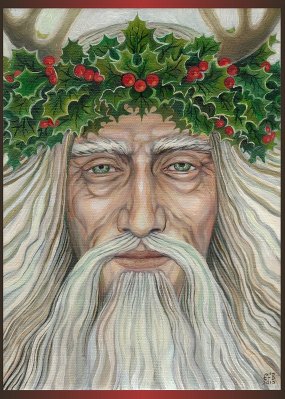
As my trailer here, I present two Celtic kings: The Forest King, better known as the Oak King or sometimes as Green Man, along with his nemesis, The Holly King, often depicted as a woodsy version of Santa Clause.

The Forest or Oak King
The Holly King

Semiannually, these two battle and fight to the death for supremacy. One time per year, each defeats the other. Depending on the culture and beliefs, a final battle is on summer and winter solstices, or, and more logically, at the time of the Fall or Spring equinoxes. During summer, the Oak King reigns. The Holly King kills the Oak King and reigns in the winter. It is the classic holly vs. ivy symbolic battle called out in King Henry VIII’s, Green Groweth The Holly.

The Oak and Holly Kings Battle

The battle is also echoed many times in other myth and folklore such as the fights between Sir Gawain and the Green Knight, or Lugh and Balor in Celtic legend. In all cases, one must die for the other to triumph.

Regarding such battles and the killing of one king, god, or man, George Frazer wrote,”But we have seen that the very value attached to the life of the man-god necessitates his violent death as the only means of preserving it from the inevitable decay of age.” They are two essential parts of the whole (seasonal reality) that battle all year long. Despite being enemies, without one, the other would no longer exist. Sort of reminds one of yin and yang, doesn’t it?

Look both ways in all seasons of life. Mind well the gaps.

Note: I will be participating in the National Poetry Writing Month challenge separately. Those poems will be identified as NaPoWriMo. This means that during April “Our Literary Journey” will have two posts each day, and one on Sundays after the first.

A to Z Blog Challenge and National Poetry Writing Month (NaPoWriMo) Review and Recap


Click on the graphic to link to the National Poetry Writing Month page.

April was my second time doing the A to Z blog challenge. I combined it with my first attempt at the National Poetry Month (NaPoWriMo) challenge. For 2017, poetry was my theme for A to Z. With four exceptions, my poems were in alphabetical order according to topic or poetic form. I had 30 posts for NaPoWriMo, 26 of which I used for A to Z. The NaPo challenge was to write (post) a poem each day.

My theme developed over time. I wrote poetry every day, but I didn’t finish a poem on each day. Some poems took more than a week, while one or two others were ready in hours. I thought some of my poems were long, but that relates to form, content, and purpose.

NaPoWriMo provides optional daily prompts. I did not use the prompts because my rookie status as a poetry writer and dual use with A to Z were complicated enough. Next year I hope to: participate with the poetry month challenge, write one poem each day (start to finish), and use the prompts provided. I also used poems for my weekly writing class assignments, instead of prose essays. I don’t plan to participate with the A to Z challenge again.

However, I’ve always liked poetry, even though I know so little about it. During April, I discovered my greater love of poetry and an overwhelming fondness for writing poems. I grew increasingly curious about poetic forms, genres, and styles. I read several books about poetry and many poems. My quest to learn continues.

My A to Z reveal was the most popular of related posts. The best-liked of my poems were Specks: Coincidence meets Kismet and Sunday Lions. By far, the most commented on was the Collaboration Poem, Dewey and Dad, with my daughter. Other well-liked poems included my Haiku; Onomatopoeia, Never Again, and Regna, The Poetry of Art. Zumurgy Blessings finished off the month well liked.

Surprises that did not do well included my sonnet, the tercet, and the poem on coal miners. Dark poems did not do as well as others. Maybe I should not be surprised. I enjoy dark poems and don’t consider mine as bleak as many. However, since I struggled with those three poems (each for a different reason), it’s more likely they were simply not so good.

Another surprise lesson: I can’t predict what you will like. I can tell from your comments how a poem affected you. I received strong positive comments about twaddle I considered only so-so. Things I thought good, took a long time, or challenged me most, were not always popular. For example, the Sunday Lion verse and Xu (Bang the Gong) I wrote quickly and were liked; whereas, I worked for days on the coal miner poem and the sonnet and they sort of flopped. But, there were some positive comments.

Many readers never click like or comment (maybe can’t). So, I don’t get every reader’s feedback. The bane of a writers craft, “what will readers like?” In some cases, there were more likes on Facebook than on this blog. Another example: when I posted the poem about the deer on the Historical Society’s Facebook page there were more likes, but who knows why? This is no scientific evaluation, despite the best efforts of WordPress to collect data. And no one said anything derogatory.

Bottom line, I learned that, for me, poetry is fun – reading it, hearing it, writing it, or remembering it (we memorized O Captain! My Captain! in grade school). I enjoy relating to love poems, poems about nature or human nature, or the occasional taste of the dark side.

Thank you for reading this. If you will excuse me, I have poems to write, read, and to memorize.

Life is lived forward and understood backward,
but look both ways and mind the gaps.