A2Z Challenge: N is for Nyx

I have done some writing and reading about darkness and night. So, I picked this goddess to review. I am also a fan of another Nicks, the lady called Stevie. It made sense to me.
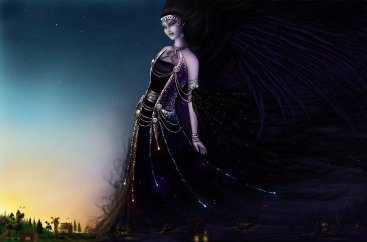
 

Nyx is the Greek goddess of the night. By some accounts, Nyx is the offspring of Chaos; by others, she precedes him. Varying accounts have Nyx, in mating with her brother Erebus (Darkness and Shadows), as the mother of many deities. All this Greek deity myth stuff is very confusing and conflicting. Kind of makes me wonder why someone didn’t just decide on one omnipotent god and leave it at that. Anyway, Nyx had a bunch of kiddoes as well as other brothers and sisters.

Other sibling of Nyx, children of Chaos include Gaea (Earth), Tartarus (Underworld), and Eros (Love).

Disregarding paternity (we don’t care who the daddy was), Nyx was the mother of Hypnos (Sleep), Thanatos (Death), Aether, (Brightness), Hemera (Day), Moirai (the Fates), Geras (Old Age), Moros (Doom), Keres (Destruction), Oneiroi (Dreams), Monus (Blame), Oizys (Pain), Hesperides (Daughters of the evening), Nemesis (Retribution), Apate (Deceit), Philotes (Friendship), and Eris (Strife).

I find it interesting that Eros, god of love or sexual desire (think an adultish Cupid), is a direct offspring of Chaos. Yet, unlike other primordial siblings, he is not a physical world deity, but a god for the condition of procreation. Thus, while accounts may vary, ancient Greek mythology elevated the god of love to a primary level. I like that. I have heard love and sex referred to as primordial desires. Now I know why. I plan to use this information when I get back to writing about the paradox of love.

Nyx appearances are sparse in mythology, but they grant the goddess of night such exceptional power and beauty that she was feared even by Zeus. The story goes that Hypnos (her mischievous son and god of sleep) put Zeus to sleep, allowing Heracles to have a very bad day. Can you imagine, the god Zeus sleeping on the job?

Zeus was pissed and would have tossed Hypnos into the sea. But the sleep-god ran to his mama, Nyx, for protection. Even gods did that. Zeus did not want trouble with Nyx, so he chilled and let Hypnos off easy. Tenuous relationships followed.

The vision of Nyx’s power in the cosmos is further enhanced in poems by Orpheus. In one, the entire universe dances to the tune of Nyx singing or chanting. Now that goddess has a voice better than any angel. Right?

Each night Nyx emerges with Erebus. They block the light emitted from Aether, bringing night and darkness to the world. The next morning Hemera emerges to sweep away the darkness of night. Nyx briefly returns to her abode. Mother Nyx and daughter Hemera are never in the same place at the same time. Things may have changed in later Greek mythology, but Nyx is never subjugated.

Look both ways, especially at night.
Find the gaps and mind them well.
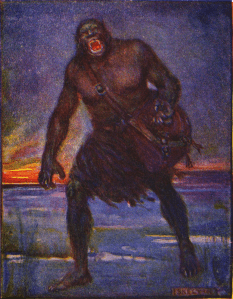
Poem — NaPoWriMo: Grendel’s Reflection

The day 15 poem prompt of the 2018 National Poetry Writing Month challenges me to write a poem in which a villain faces an unfortunate situation and is revealed to be human but still evil.

This reminds me of a discussion I had with other writers regarding antagonists who are both good and bad.

Anyway, I decided to write a poem on one of the villains from Beowulf, Grendel. You can read my April 7th post on Grendel here.


Grendel’s Reflection

Humans.
How nice and kind and all
When they kill,
it’s for the glory
of some crazy god.
Stand and fight,
it is our right,
that is their battle call
They kill each other,
then blame me,
I find it rather odd.

They say old brother Cain
rests within my heart
Not clearly seeing
the happy demon
who owns their very spirit
As they rip and tear
their kind apart.
Why such hate
within them grows,
their god only knows.

In the king’s hall,
it’s all hell they raise
It wakes me from my slumber
Yet when I grant them peace,
‘tis me they blame
for the midnight slaughter.

Little do they know,
that I am not so bad
If they were better neighbors,
it wouldn’t be so sad.
I am, after all,
just being me,
as like them as I can be.
Be your brother’s keeper,
unless he looks like me.

(Bill Reynolds, 4/15/2018)

Look both ways at right and wrong but judge your own-self first.
Tread softly with others being mindful of the gaps.

Click link to National Poetry Writing Month

Poem — NaPoWriMo: When I had the hammer

The day 14 poem prompt of the 2018 National Poetry Writing Month challenges me to write entries for an imaginary dream dictionary. I was to pick one or more of the following words and write about what it means to dream of these things: Teacup, Hammer, Seagull, Ballet, slipper, Shark, Wobbly table, Dentist, Rowboat.

I really don’t get today’s assignment, but my goal is to write to the prompts. I decided to write what a hammer means in my dream, and then a little poetic ditty using hammer metaphorically within the dream. I’ve written too much about dreams lately not to at least attempt this.

When I had the hammer

The hammer is control in my dream
My dreams are always challenges
Problems to be solved, difficulties
My hammer is my courage and power to manage.

In my dream, I walked through four rooms.

In the childhood room, I could not lift my hammer
It was too big and too heavy and too confusing
All adults in the room had hammers, no child did
Some people had several. Someone carried my hammer.

In the young adult room, I struggled to move my hammer
Some days I could drag it, on other days I needed someone to help me
I tried to lift my hammer and to carry it as others seemed to
Several others were burdened as they carried many hammers.

In the middle age room, I carried my hammer with pride
I had a bag full of hammers because I carried hammers of others
…this I did with shameful pride,
…never admitting to the fear and burden of so many hammers
Confused, I wanted to give others their hammers to carry,
…yet, I wanted to continue to carry them.

In the room of seniors, I understood the hammers
I carried mine, yet asked for help when my hammer was too heavy
Some days I helped others carry theirs, some days I carried none
But with each passing day, my hammer got heavier,
…and I knew that soon
…I would have to give my hammer away.

(Bill Reynolds, 4/14/2018)

Look both ways to find your hammer.
Use it carefully as you mind the gaps.


Click link to National Poetry Writing Month

A2Z Challenge — M is for Minotaur

It is not always the impressive awesomeness of the fantasy creature that gets me. Sometimes it’s the story of how it came to be that I find most interesting. I was gunna go with something different today, but when I read about this one, I simply had to tell you about the Minotaur from Greek Mythology. Seriously, who came up this stuff?

With all the family drama, jealousy, hanky-panky, and bestiality, here is how it all went down. Minos, king of Crete, fought his brothers for rule. So, Minos asked the god Poseidon to send him a snow-white bull. Seeing this, his brothers would back off. The god sent the bull and it worked. But then Minos was supposed to kill the bull to honor Poseidon. Minos had a better idea, and that’s when the trouble started.

King Minos decided to keep the bull cuz he thought it was cool. So, King Dum-dum kills another bull thinking this sea-god will not notice or care. Greek gods can be so persnickety. Not just any dead bull would do. It had to be the pretty white one. Poseidon was pissed.

To get revenge, the god does a thing so that Pasiphaë, Minos’s wife, gets the beasty hots for the white bull. You with me? The king’s queen falls all lusty-love for this freakin’ horny bull. Today, this shite would be all over youtube.

No bull, white or not, is gunna do the dirty deed with the queen, lusty-love or not. So, Queen Pasiphaë had a very skilled crafty guy name of Daedalus make a hollow wooden cow. Can you see where this is going?

It must have been one fine piece of work to fool the bull into climbing on board and hammering away. Anyway, the queen climbed inside it and for the rest of the story, I suppose you had to be there. All I can say is Poseidon had an insane sense of humor, if Greek gods did funny things.

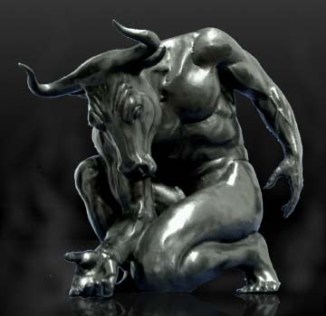
The child born was the monstrous Minotaur. The baby was not so cute with the dad’s head and a mostly human body. Pasiphaë nursed him (don’t get sick on me), but he grew and became a ferocious vile creature, being an unnatural (to say the least) offspring of a woman and a bull.

Minotaur devoured humans (preferably children every few years) for sustenance. Minos, after getting advice from the oracle at Delphi, had Daedalus (builder of the wooden cow) construct a gigantic labyrinth to hold the Minotaur and that is where he lived until he was killed by Theseus.

Look both ways.
If there is a bull in the field, do not climb the fence.
Mind the gaps as you cautiously walk around.
And do not piss off any Greek gods.

Poem – NaPoWriMo: Frist Weakened Then Dead

The day 13 poem prompt of the 2018 National Poetry Writing Month challenges me to write a poem in which the words or meaning of a familiar phrase are up-ended.

I chose the phrase whatever doesn’t kill me makes me stronger. My upending is in the poem’s title. Besides the prompt, my inspiration for this poem stems from reading Christopher Hitchens’ Vanity Fair article regarding the maxim, and the entire series he wrote during his tribulation with cancer.

Indeed, successful resistance often strengthens. That is the principle of inoculations against disease, doing regular exercise, preserving through addictions, or recovery from mental setbacks such as depression. The problem arises from the universal application of the maxim, no matter who first said it.

First, it may kill you (and someday something indeed will). Secondly, things (like whatever) can and do leave you weaker, not always stronger. In my opinion, despite having taken the shot against shingles, I contracted the illness because I had been ill repeatedly over months and my immune system had been severely weakened. And there is the age thing (it’s not just a number). Being ill did not kill me, but it did make me weaker, more vulnerable, and not a bit stronger. Shingles does not make you any stronger either.

Here is a good article about Hitch’s Vanity Fair piece. And the poem…


First Weakened Then Dead

I am my body and my mind
‘tis me nature to be friendly and kind.

Then you entered me, quite uninvited
You’re a vile corruption of cells divided.

You took my strength, my pride, my hair
Weakened what I am, if you ever care.

We both suffer, but it’s you we must kill
In my losing battle to save my will.

Die I must, that’s what they say
But I hope to find some other way.

(Bill Reynolds, 4/13/2018)

I’m a Kelly Clarkson fan, especially since watching her coach on the TV show, The Voice. I’ve included her 2012 hit in the interest of leaving you, literally, on a positive note.


From birth to death, look both ways.
Mind the gaps and the cleaver maxims.
Even mine.

Click link to National Poetry Writing Month

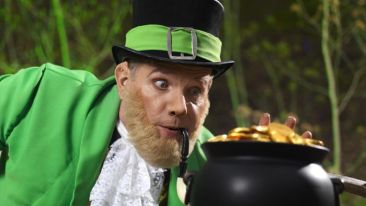
A2Z Challenge — L is for Leprechaun

As I look back, growing up in an Irish Catholic home, superstition and myth were taken as part of life and often mixed with religion. The wee people were never mixed with religion but being Irish certainly was.

It seems like leprechauns were taken for granted. While no one believed they existed, few of us would have been shocked if one was to suddenly appear. Maybe I could say we were more like leprechaun agnostics than non-believers.

In this case, I developed a mental image of leprechauns regarding appearance and spirit, or morality, and I hold to that even today. I did not know the history, but I understood that they could be blamed for everything – good and bad, mostly mischievous. I continue to see leprechauns as childish pranksters. They’re sort of like gremlins on airplanes or motorcycles. (Ever see a motorcycle with a small bell tied to it? It’s there to annoy the gremlins who delight in causing mechanical malfunctions on bikes).

Leprechauns have a folklore family tree. That enchanted race of mythical fairies and leprechauns of Irish folklore are descended from the ancient divine race called the Tuatha Dè Danaan, or “peoples of the Mother Goddess Danu.” The Tuatha Dè were a race of gods that inhabited Ireland before they were defeated by the Celts/Gaels, the ancestors of the present-day Irish and those of Irish descent around the world.

I have no idea how leprechauns procreate since they all seem to be males. But given the family ties with fairies of other natures, I suspect that can be worked out.

Often referred to as The Folk, The Good Neighbors, The Fair Folk, or the Wee People, they can be appeased with offerings. Never anger or insult them. They are often thought of as stunningly beautiful, though they can also be terrible and hideous.

The movie, Leprechaun, relies on some of this myth. Here is the trailer for your review. It’s not too scary, but a wee bit.

Look both ways as you travel to the pot of gold at the end of rainbow.
Be mindful of the wee people and the gaps.

Poem – NaPoWriMo: Welcome Home…sort of

The day 12 poem prompt of the 2018 National Poetry Writing Month prompt challenges me to write a haibun, which is a prose/poem form that takes in the natural landscape. This one is supposed to be about the place where I live, to bring this area to life through a charming mix-and-match methodology of haibun. Read about haibun here if you care to.

I am not sure about the charming part. Haibun, and the included haiku or tanka are Japanese poetic forms hundreds of years old. I’m not that old, nor am I Japanese. But, I am an old American boomer-poet, and child of the sixties. It’s poetry. I write ditties. Ditties don’t have rules. What follows is my twist on haibun. (No disrespect to any oriental art from intended.)

Welcome Home…sort of

The rocky trail invites my curiosity as it gives me perspective into the central Texas biota detected by my five senses and absorbed into the lungs of my mind. Stubborn life forms which I admire more for hardiness and attitude than for beauty or comeliness. Bright green immature ears grow from dark-gray, near-dead, needle-covered cactus. Big old oaks mix with scrawny mesquite and scrubs-n-shrubs to shade the rough pathway.

Rain strips pollen
from the air
a deer looks at me

So much nature
look, dunna touch
hearing of voices

Life thrives in this arid environ that permits me, a feral foreign pest, to have a limited experience. Flora here is so much like the native human species; tough, resilient, rebellious. Then there are the wildflowers: the bluebonnets, the Indian paintbrush and blankets. Beautiful. For now.

(Bill Reynolds, 4/12/2018)

Look both ways to see it all. Enjoy the scene but mind the gaps.

Texas longhorn in a field of bluebonnets
Click link to National Poetry Writing Month


A2Z Challenge — K is for Kelpies

E’m sure y’erd aboot eh Loch Ness Monster, but di’ye know o’ the Loch Ness Kelpie?

Kelpie in horse form

Or is it water kelpie? Whatever, the Scots name given to a shape-shifting water spirit inhabiting the lochs and pools of Scotland is kelpie (not to be confused with the Aussie dog). It’s usually described as a horse able to adopt human form.

Some say the kelpies retain their hooves when appearing human, but that’s nonsense. The arrival of Christianity in Scotland resulted in an association of kelpie with the devil.

Your ride

Robert Burns casts a humorous kelpie net in his 1786 poem Address to the Deil. Disclosure: I love the accent, when I understand it.

When thowes dissolve the snawy hoord
An’ float the jinglin icy boord

Then, water-kelpies haunt the foord
By your direction
An’ nighted trav’llers are allur’d
To their destruction.
O THOU! whatever title suit thee—
Auld Hornie, Satan, Nick, or Clootie,
Wha in yon cavern grim an’ sootie,
Clos’d under hatches,
Spairges about the brunstane cootie,
To scaud poor wretches!

Hear me, auld Hangie, for a wee,
An’ let poor damned bodies be;
I’m sure sma’ pleasure it can gie,
Ev’n to a deil,
To skelp an’ scaud poor dogs like me,
An’ hear us squeel!

–Taken from “Address to the Deil” by Robert Burns (1785) Read full poem here.

Virtually every sizeable body of water in Scotland has an associated kelpie, but the most extensively reported is the Loch Ness kelpie.

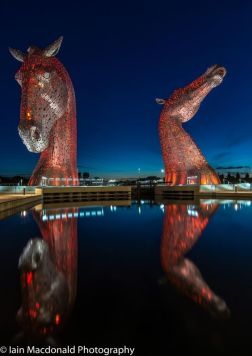
Kelpies have been portrayed in various forms in art and literature. Two 98-foot-high steel sculptures in the community of Falkirk, The Kelpies, was completed in October 2013.

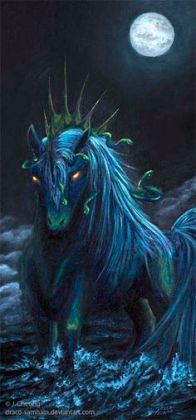
Myth or not, these are supposed to be Kelpie

Other similar creatures of Scotland include the shoopiltee and nuggle of Shetland, and the tangie of Orkney. The Welsh have ceffyl dŵr and the Manx cabbyl-ushtey (I can’t pronounce it either).

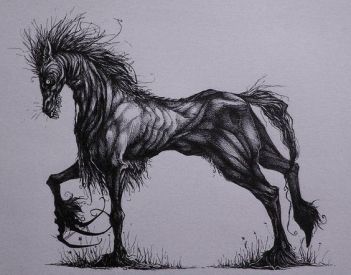
Kelpie are usually described as powerful and beautiful black horses inhabiting the deep pools of rivers and streams of Scotland, preying on humans. If you’re not sure, look at the hooves. Kelpie hooves are reversed from a normal horse, a trait shared by the nykur of Iceland. Another variation has mane of snakes. The resident spirit of the River Spey is white and can entice victims onto its back by singing.

Some folklore says kelpie can be useful, hurtful, or may be seeking human companionship. Others say kelpies take their victims into the water, devour them, and throw the entrails to the water’s edge. It gets creepier.

Another story is the one of several children clambering onto the creature’s back while one remains on the shore. Usually a little boy, he then pets the horse but his hand sticks to its neck. In some variations the lad cuts off his fingers or hand to free himself. He survives but the other children are carried off and drowned, with only some of their entrails being found later. Who makes this shit up? No wonder Scots eat haggis.

Your kelpie awaits

Kelpies can transform into humans, but they may betray themselves by the presence of water weeds in their hair. As humans, kelpies are almost invariably male, but in my opinion, the best art has them la femme.

Even near the water look both ways.
Mind the gaps, lest the kelpie get ya.


Poem – NaPoWriMo: When THAT Happens…

The day 11 poem prompt of the 2018 National Poetry Writing Month challenge was for me to write a poem that addresses the future. I was to answer these the questions: “What does y(our) future provide? What is your future state of mind? If you are a citizen of the “union” that is your body, what is your future “state of the union” address?”

I came up with a slightly sarcastic inventory, or catalogue, poem that gives this a septuagenarian’s take on future thinking. I strive to be (and some say I am) a very right here, right now person. My take on this is also male, but women may find commonality with or without small word changes.

When THAT Happens…

When it takes all day to do whatever it was.
When you see wrinkles that have always been there
When all your futures are in your past.
When no one tells you not to run when you are running.
When the future is like the playoffs and you hope to be at least be a wildcard.
When you always take the elevator.
When a young lady offers you her seat, and you take it.
When you allow extra time for everything and end up late.
When you google childhood friends and end up reading the obits page.
When a day off means no doctor appointments.
When young ladies think you’re harmless, and they’re right.
When a middle-age lady says you remind her of her father, or worse, grandpa.
When they stop asking what you do for a living.
When living is what you do for a living.
When even a bad memory is good sign.
When your future state of mind may be homeless.
When your body is like the movie, As Good As It Gets.
When a pain means you moved something.
When those old people turn out to be younger than you.
When sex makes you think of words like dysfunction and prostheses.
When a new tattoo is major surgery, and an old one is a Rorschach Test.
When you been there, done that, got scars to prove it
…but you can’t remember what the hell you were talking about.
When young poets talk about the future and you write a memoir.
When your memories are all in black and white.
When all your friends say, “I remember when…” and you don’t.

(Bill Reynolds. 4/11/2018)

Some of us have more past than future, but we look both ways.
Mind the gaps, ignore the aches.

Click link to National Poetry Writing Month

A2Z Challenge — J is for Jinn

Jinni (plural Jinn) is romanticized and anglicized as Genie. In Arabic mythology Jinn are supernatural spirits below the level of angels and devils. Types of Jinn include shape shifters, evil spirits, and treacherous spirits of variable form. There are several types in Arabic. Jinn are beings of flame or air who can assume human or animal form and are said to dwell in all conceivable inanimate objects—stones, trees, ruins—underneath the earth, in the air, and in fire. I left out bottles and lamps, but those too.


Jinn have the same bodily needs of humans and can be killed, but they’re otherwise free of physical restraint. Jinn delight in punishing humans for any harm done them, intentionally or unintentionally, and are said to be responsible for many diseases and all kinds of accidents; however, those human beings who know the proper magical procedure can exploit Jinn to their advantage.


Belief in Jinn was common in early Arabia, where they were thought to inspire poets and soothsayers. Even Muhammad originally feared that his revelations might be the work of a Jinni. Their existence is acknowledged in Islam; thus, as with humans, they must face either salvation or damnation. Jinn, especially through their association with magic, are popular in North African, Egyptian, Syrian, Persian, and Turkish folklore and are hot topics in much of our popular literature and entertainment.

Important point to make: people believe in these, even today.

So, look both ways as you rub the lamp or uncork the bottle.
Do not piss off the genie and mind the gaps.