A2Z Challenge: U is for Unicorn

Nice Touch – Wings

I am reluctant to attempt to write anything about these beautiful, almost sadly mythological creatures. However, I know some people who read this blog are expecting (perhaps demanding) them for the letter U. They have told me so.

There are two reasons for my insecurity. One reason is that I am pretty sure they do not really exist, but I am uncertain whether most people agree with me. The second reason is that too many people from age five to fifty (and more) know more about unicorns than I do. Fine. But none has stepped forward to write this post.

Unicorns have been described since antiquity as a horse-like creature with a single large, pointed, spiraling horn projecting from its forehead. They were depicted on ancient seals and have been mentioned in many old historical accounts, Greek (not mythology) and otherwise. The re’em, of the Bible is translated to unicorn in some versions.

In European folklore, unicorns are described as a white horse-like or goat-like animal with a long horn and cloven hooves. In the Middle Ages they were described as wild woodland creatures, symbols of purity and grace, which could only be captured by a virgin. Some say a unicorn’s horn can purify poisoned water, making it medicinal to heal sickness.

Long ago, Greek writers of natural history were convinced of the reality of unicorns, which they believed lived in India, a distant and fabulous realm for them. Leonardo da Vinci even wrote hunting instructions, which look like a ploy to get your girlfriend to go hunting with you.
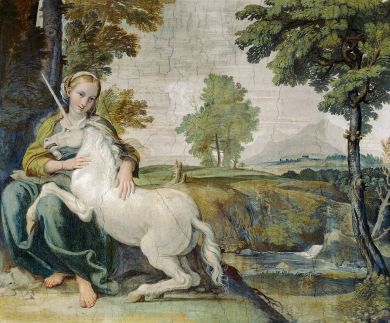
The unicorn, through its intemperance and not knowing how to control itself, for the love it bears to fair maidens forgets its ferocity and wildness; and laying aside all fear it will go up to a seated damsel and go to sleep in her lap, and thus the hunters take it.

The unicorn is the symbol of Scotland. It was chosen because it was seen as a proud and haughty creature which would rather die than be captured (liberty or death?), just as Scots would fight to remain sovereign and unconquered.

My proof that unicorns exist can be found in New Braunfels, Texas (USA). The mascot of one of the local high schools is the unicorn. Thus, students are unicorns. So, they do exist in human form. There are a few other schools who have the unicorn as their mascot, but such a mascot is rare.

For the record, I love unicorns. No one should doubt that. I only say or write good things about unicorns, and my disbelief in them is a myth (ignoring my earlier comment).

Now, for a bit of unicorn bathroom humor. This is primarily for certain friends and family (they know who they are), and those among you with such bizarre taste in hilarity.


Look both ways for unicorn.
If you see one, and you are a virgin, try to capture it.
Mind the uni-gaps.
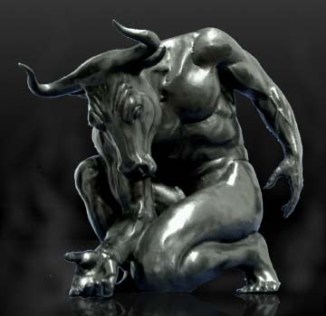
A2Z Challenge — M is for Minotaur

It is not always the impressive awesomeness of the fantasy creature that gets me. Sometimes it’s the story of how it came to be that I find most interesting. I was gunna go with something different today, but when I read about this one, I simply had to tell you about the Minotaur from Greek Mythology. Seriously, who came up this stuff?

With all the family drama, jealousy, hanky-panky, and bestiality, here is how it all went down. Minos, king of Crete, fought his brothers for rule. So, Minos asked the god Poseidon to send him a snow-white bull. Seeing this, his brothers would back off. The god sent the bull and it worked. But then Minos was supposed to kill the bull to honor Poseidon. Minos had a better idea, and that’s when the trouble started.

King Minos decided to keep the bull cuz he thought it was cool. So, King Dum-dum kills another bull thinking this sea-god will not notice or care. Greek gods can be so persnickety. Not just any dead bull would do. It had to be the pretty white one. Poseidon was pissed.

To get revenge, the god does a thing so that Pasiphaë, Minos’s wife, gets the beasty hots for the white bull. You with me? The king’s queen falls all lusty-love for this freakin’ horny bull. Today, this shite would be all over youtube.

No bull, white or not, is gunna do the dirty deed with the queen, lusty-love or not. So, Queen Pasiphaë had a very skilled crafty guy name of Daedalus make a hollow wooden cow. Can you see where this is going?

It must have been one fine piece of work to fool the bull into climbing on board and hammering away. Anyway, the queen climbed inside it and for the rest of the story, I suppose you had to be there. All I can say is Poseidon had an insane sense of humor, if Greek gods did funny things.

The child born was the monstrous Minotaur. The baby was not so cute with the dad’s head and a mostly human body. Pasiphaë nursed him (don’t get sick on me), but he grew and became a ferocious vile creature, being an unnatural (to say the least) offspring of a woman and a bull.

Minotaur devoured humans (preferably children every few years) for sustenance. Minos, after getting advice from the oracle at Delphi, had Daedalus (builder of the wooden cow) construct a gigantic labyrinth to hold the Minotaur and that is where he lived until he was killed by Theseus.

Look both ways.
If there is a bull in the field, do not climb the fence.
Mind the gaps as you cautiously walk around.
And do not piss off any Greek gods.

A to Z Challenge — D is for Drow

The Underworld of Drow

I have never played D&D, but I wish I had. When it was popular, my kids played the game. Since writing about these creatures, my daughter has invited me to play D&D with her, her hubby, and the grandkids. I discovered on-line role playing several years ago. That was when I learned how little I knew about elves, and I met my first elf who was a member of a sub-race of elves known as drow.

Of all fantasy creatures, I find elves to be the most interesting. They’re followed by dragons and leprechauns. That is a lot to write about. If we add reports and stories on other humanoids, such as dwarfs and hobbits, a literary subfield within fantasy emerges. Since elf crossbreeding, particularly with humans creates an exponential growth of character possibilities, contemporary story telling became fascinating for both creator and consumer.

If you’re not a fan of D&D or role play (RP), you may assume things about elves regarding stature, intelligence, and friendliness which are likely incorrect. In each case, I was wrong. They’re not little, stupid, and sweet. Admittedly, Santa’s helpers at the North Pole do little to correct the stereotype, but all is fair in fantasy and myth.

Dark, or black elves are from Norse mythology and thought to be the ancestors of the drow. These elves are usually considered to be evil in the inborn, bad seed sense. Yet there is ample evidence for a human-like nature versus nurture conflict and all drow cannot be depended upon to be as wicked as others.

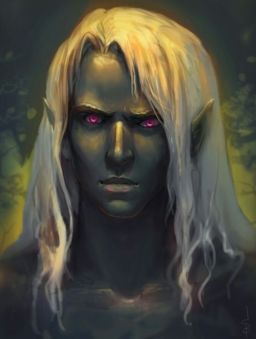
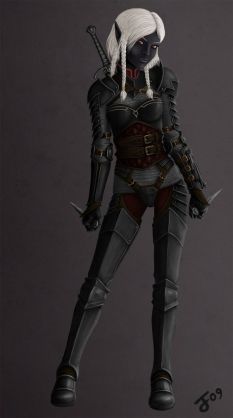
Drow have dark grayish skin. Since they are given to self-decorating, green and even purple colors can also be found. Their hair is naturally white, whitish or yellow, but here again, drow know about hair coloring techniques. Female drow are dominant, being both stronger and slightly larger than males. As with all pure elves, neither sex is capable of beard growth. While eyes are normally red, colors can range. With crossbreeding, even human green or blue eyes are possible. But, if you want to see something spooky; a red eyed, dark-skinned drow can tilt your freak meter.

While drow are unwilling underground creatures, they are most often found by non-drow to be above ground for the obvious reason that subterranean existence for a non-drow creature is as a slave to the drow, if survival is even possible in such a wild, violent place.

Drow fight with anyone, and other drow are never off the hook. That helps to keep their numbers down, since when they do get along well with each other, they are also very prolific producers of offspring.

As with all elves, drow live long lives if they manage to avoid a violent and early death. Again, given all their magic and power, it is their inability to get along that manages to keep the population in check.

Despite what sounds like an evil appearance, drow are attractive elves. This causes surface dwelling races to tolerate drow presence if they behave in a non-drow-like fashion. Surface races of elves and other humanoids have been known to inbreed with drow yielding interesting, yet confusing, results: both good and bad.

Drow are fast, agile, and in their opinion smarter than all other humanoids including other elf groups. The most natural and overwhelming feature of all drow is their phenomenal sense of entitlement. While this can be an annoying and dangerous trait, like so much else regarding drow, it is difficult to tell if it is innate or cultural. Drow culture reinforces all forms of evil within their race beginning at a very young age.

Mind gaps to the world of the drow.
Look both ways as elves are poor drivers.

A to Z Challenge — C is for Chimaera

The Khimaira (Chimera or chimaera) was a three-headed monster. If ya Google it without the mythology tag, most options will be links to ghost fish or sharks. This is no fish story.

Like so many monsters of Greek mythology, The Chimaera was the offspring of couple of monstrous sweethearts named Typhon and Echidna, a pair I envision as sort of an Adam and Eve couple of the Greek Mythological Monster class.

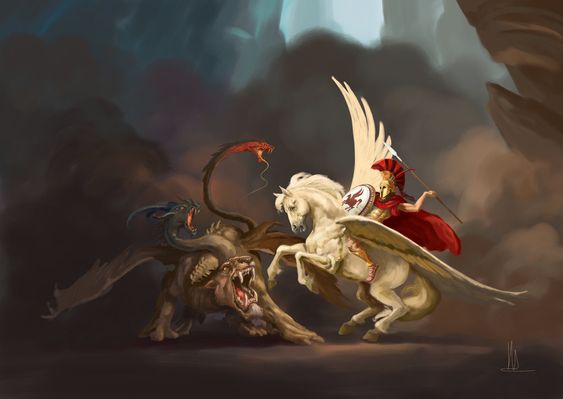
This bizarre, fire-breathing cat had the body and head of a lion (good so far). But peeking over its shoulder was a goat’s head rising out of its back. The beast had udders like a goat (no idea why). Away from the business end, the ubiquitous mythological snake rounded out the creature’s tail, with serpent’s head at the very end.

Since nothing good could possibly spring from the union of Typhon and Echidna, this beast ravaged the countryside of Lykia (Lycia) in Anatolia, which is on the southeastern end of Turkey. Contemporary Turkish history does not jibe well with older Greek myth, but at the time it all fit nicely, if fearsome.

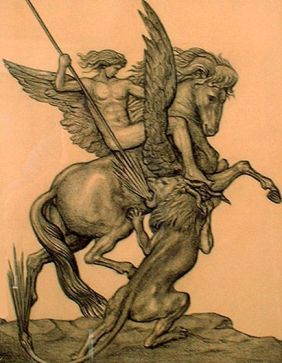
As the story goes, this Chimaera cat was just kickin’ ass all over that part of the world until a hero named Bellerophon came on the scene. He was either asked or commanded, depending on who is doing the telling, by King Iobates to kill the beast.

Bellerophon rode into battle on the back of the winged horse, Pegasus, of course. He sought and found Chimaera and drove a lead-tipped lance into its flaming throat. So, the big cat-goat’s fiery breath melted the lead tip, promptly choking the beast on hot molten metal. Lead poisoning for sure. So, the beast died from sucking on a lead popsicle, Greek Mythology style.


Turkey has never been known for its geological stability. So, later classical writers believed the Chimaera creature was a metaphor for a Lycian volcano, of which there almost certainly were several.

The Chimaera can look both ways at the same time
and the snake can keep its eyes looking backward.
So, mind the gaps.

A to Z Challenge — B for Basilisk

A basilisk is a creature presented as a snake-type or other reptile. Some renditions look related to a rooster, but that would be a cockatrice. You’ve heard, if looks could kill? Well, if it’s basilisk, they do. A direct look from a basilisk and yer a goner.

It’s interesting how the fantasies go on with how dangerous this creepy-crawler is with venom and whatnot, but with looks that kill, who cares? Think Medusa. Ok, so you use a reflection for an indirect look, but unlike Medusa, you’re petrified anyway, meaning you are turned to stone. Think Lott’s wife. I can’t buy the petrified option as being any better than a direct death look. Look away if you see a basilisk coming. Oops, too late.

Basilisk Paining

Some sources (Britannica) list the basilisk as the same creature as the cockatrice, but one is a snake the other a pissed-off rooster that looks related to the village dragon. In mythology there is an odd biological, half-sibling, relationship between the two. This basilisk creature comes into being because a cockerel (rooster) sits on and incubates the egg of a snake or toad. For the cockatrice, the rooster lays the egg (see the problem?) and either the snake or a toad pulls off the incubation challenge.

If a sex is assigned to a basilisk it is often female, yet, due its appearance with a mitre on its head, it is referred to as king of the serpents. The Pope wears a mitre as a kind of crown. It must have been safer to piss off a king, since there were many, than the Pope, of which there were few, if only one legitimate. Since these folks have roosters laying eggs, I suppose that is all fair enough. It’s fantasy, right?

The first writing about a basilisk dates to around 79 AD, about the same time New Testament Gospels were allegedly first written. And if you worried about one of these suckers turning up at the front door, you could simply do pop goes the weasel. Apparently, taking a cue from Asia and the King Cobra’s nemesis, the mongoose, the Europeans made the odor (effluvium) of the weasel be a deadly weakness for the basilisk. That makes sense. With more quafting weasel stink everywhere, there’ll be fewer basilisk, which explains why Europe has such a small problem with basilisks roaming the countryside. Of course, if you did see one, you’d die and be unable to tell us about it.

Cockatrice

Literature is replete with references to the basilisk. In Shakespeare’s Richard III, Anne Neville wishes her eyes (like a basilisk) would kill her husband’s murderer, and in Cymbeline a character refers to a ring as a basilisk.

Samuel Richardson in Clarissa; or the History of a Young Lady, and John Gay in The Beggar’s Opera, have characters who refer to the basilisk in dialogue. Others include Jonathan Swift in a poem, Robert Browning in A Light Woman, and some writings of Alexander Pope.

Shelly refers to “the imperial basilisk” in Ode to Naples; and again in Queen Mab like this:

Those deserts of immeasurable sand,
Whose age-collected fervors scarce allowed
Where the shrill chirp of the green lizard’s love
Broke on the sultry silentness alone,
Now teem with countless rills and shady woods,
Cornfields and pastures and white cottages;
And where the startled wilderness beheld
A savage conqueror stained in kindred blood,
A tigress sating with the flesh of lambs
The unnatural famine of her toothless cubs,
Whilst shouts and howlings through the desert rang,—
Sloping and smooth the daisy-spangled lawn,
Offering sweet incense to the sunrise, smiles
To see a babe before his mother’s door,
Sharing his morning’s meal
with the green and golden basilisk
That comes to lick his feet.
— Part VIII

The basilisk also appears in Harry Potter and the Chamber of Secrets by J. K. Rowling.

Be careful looking both ways.
You want to miss seeing the basilisk, but mind the gaps.


A to Z Challenge — A is for Alecto

One of my grandchildren is named Furie. I was told that her name was based upon Furies of Greek Mythology. That was my inspiration of this blog.

While there were three Furies, I am focusing on one: Alecto (unceasing in anger), mostly because it fits the challenge.

The three furies

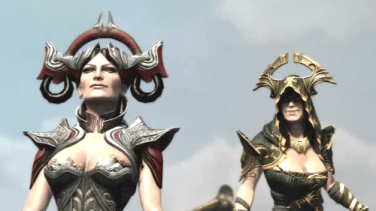
In Greek mythology the Furies, were female deities sometimes referred to as “infernal goddesses.” In Roman mythology, they are the Dirae. One Roman writer said they’re called Eumenides in hell, Furiae on earth, and Dirae in heaven. Indeed, these goddesses have significance in the underworld.

In addition to Alecto, her sisters are Tisiphone (avenger of murder), and Megaera (the Jealous one). Each had a role in dealing with the dark side of human nature and behavior.


I am not messing with her.

Alecto dealt with people who had problems with others (anger). She was like the goddess, Nemesis, who enacted retribution against those who succumb to arrogance before the gods. However, Alecto was concerned with human to human interpersonal issues, rather than human to god.

The Furies came into being when Cronus, technically their brother and leader of the first generation of Titans, castrated his (and their) father, Uranus. Uranus’ testicles were to be cast into the sea, but blood from them was spilled on Gaia (the Earth) and produced the Gigantes, Meliae, and Erinyes. The Erinyes, or Furies, pursue heinous criminals, punishing them according to their crimes. The imagination of ancient people must have phenomenal regarding their myths.

Furies revenged homicide, unfilial conduct, offenses against the gods, and perjury. A victim seeking justice could call on them for criminal retribution. The most powerful of the curses was of the parent upon the child – for the Furies were born of just such a crime, when the blood of Uranus (or the sky) impregnated Gaia, following Cronos chopping off dad’s nuts, thus Alecto’s unceasing anger.

Their wrath manifested itself in several ways. The most severe was the tormenting madness inflicted upon a patricide or matricide. Murderers might suffer illness or disease; and a nation harboring such a criminal, could suffer dearth, hunger, and disease.

Alecto and Tisiphone

The wrath of the Furies could be placated with purification and some assigned task for atonement. However, Alecto had no sympathy for the wicked.

The goddesses were also servants of Haidas and Persephone in the underworld where they oversaw the torture of criminals consigned to the Dungeons of the Damned. A goddess from Hell who is always angry with everyone and everything should make us behave. As with all such things regarding ancient mythology, the dealings were direct and fierce.

Look both ways for Alecto.
Mind yourself, the gaps go clear to Hell.

Link to A to Z blog Challenge

A to Z Blog Challenge Theme Reveal (2018)

Let’s roll out monsters, goblins, ghouls, and all the fantastic creatures that existed in the minds of men and women from before anyone could write until the present day. Fantasy is not fake when we believe it; and we have for over 100,000 years of human imagination from which to draw. Unfortunately, writing is only about five or six thousand years old. But going way back in time, our innate human ability to imagine is phenomenal. That is my reveal: fantasy creatures displayed front and center.

From angels to zombies, I will select fantastic creatures from legend, fairy tales, fables, and myth. From poems, books, and stories, and from cultures around the world; I will package up those delectably stunning and enchanting fantasy life forms and bring them to you in words and forms.

During April we all do a lot of reading and writing. If you count taxes, arithmetic too. It is a busy, but fun-filled month. I shall attempt brevity and will only present one or two creatures per day beginning with “A” on Sunday, the first day of April, for the 2018 A to Z Blog Challenge.

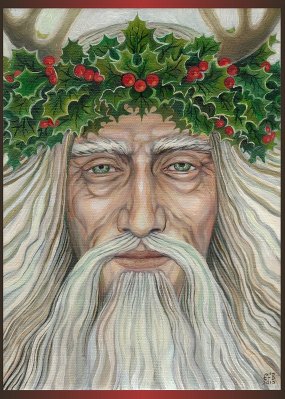
As my trailer here, I present two Celtic kings: The Forest King, better known as the Oak King or sometimes as Green Man, along with his nemesis, The Holly King, often depicted as a woodsy version of Santa Clause.

The Forest or Oak King
The Holly King

Semiannually, these two battle and fight to the death for supremacy. One time per year, each defeats the other. Depending on the culture and beliefs, a final battle is on summer and winter solstices, or, and more logically, at the time of the Fall or Spring equinoxes. During summer, the Oak King reigns. The Holly King kills the Oak King and reigns in the winter. It is the classic holly vs. ivy symbolic battle called out in King Henry VIII’s, Green Groweth The Holly.

The Oak and Holly Kings Battle

The battle is also echoed many times in other myth and folklore such as the fights between Sir Gawain and the Green Knight, or Lugh and Balor in Celtic legend. In all cases, one must die for the other to triumph.

Regarding such battles and the killing of one king, god, or man, George Frazer wrote,”But we have seen that the very value attached to the life of the man-god necessitates his violent death as the only means of preserving it from the inevitable decay of age.” They are two essential parts of the whole (seasonal reality) that battle all year long. Despite being enemies, without one, the other would no longer exist. Sort of reminds one of yin and yang, doesn’t it?

Look both ways in all seasons of life. Mind well the gaps.

Note: I will be participating in the National Poetry Writing Month challenge separately. Those poems will be identified as NaPoWriMo. This means that during April “Our Literary Journey” will have two posts each day, and one on Sundays after the first.