RRWG and NaPo Day 6

While I again wrote two poems to separate prompts, they overlap. David from Round Rock Writers pitched a picture of a sunrise through trees and Maureen from NaPo coached a style. These are in the order I wrote them. You’ll see what happened.
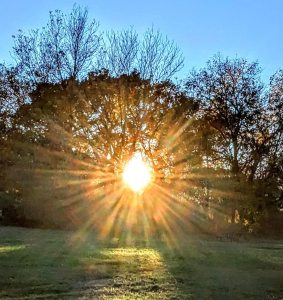
A new day is a symbol of hope
in a hopeless world.
One where deep sadness
is hidden but tasted by many.

While all life itself
is a hopeless endeavor,
always temporary,
phenomenally rare,

I sense, while I can,
that surviving
the darkest night
brings me morning light.

And that light injects
me with desire
fueled by another day
of precious life.


Day 6: In my NaPo poem today, I was to try writing with a breezy, conversational tone, while including at least one thing that could only happen in a dream.

***

Hey, I’m gunna go stand in the yard.
Wanna come with?
I like things better when you’re there with me.
You don’t need to dress. Footwear’s optional.
I know you hate shoes.
We dunna need ta talk. You’ll hear the birds.
Fookin’ loud buggers on Spring mornings.

Just gunna watch the sun rise with ya—
if you want. With me. No obligation, Love.
It’s just that with you there beside me
everything feels different. Safer. Better, an means more.
It’ll only be a minute. So? Ya wanna go?

I’ll show ya this thing we can do.
If you hold up your hands, if ya can,
and close your eyes, you can literally
feel the Sun wrap its arms around ya.
And it’ll kiss ya. We can try it.
Are ya commin’?

Look east then west in the mornings.
Be barefoot so you can feel the morning dew on the grass with your feet.
NaPo & RRWG Day 5

I do not normally (not that I am normal) combine one piece or poem to meet more than one prompt. But I’m still on track to write sixty poems this month.

When I read the NaPoWriMo assignment and then the two Round Rock Writers Guild ideas, I decided to write one poem that might leap the bar of each suggestion. None of the proposals suggested a serious poem.

The challenge from the napowrimo.net page was to “write a poem in which you talk about disliking (hate) something – particularly something utterly innocuous, like clover. Be over the top! Be a bit silly and overdramatic.” The two goads for odes from the Round Rock guild were “Ode to a Comma” and “Ode to the Double Space.”

An ode is normally a formal, ceremonious lyric poem that praises or celebrates something. Yet, an ode in poetry can be sarcastic or hateful, particularly in modern or contemporary literature, where it might be used to express intense emotion. Writers often use “anti-odes” to ironically and bitingly criticize, mock, or express hatred towards a subject. (AI guidance)

Space Comma Commando

Highschool memories in black and white,
my mean ol’ gray haired typing teacher and her cane,
“Stop looking at the unmarked keys! You oaf.
Two spaces, you fool, after a complete sentence period.
Don’t dare ask why. Just do it!” Grade F.

Now some wit-wads refuse to spacebar one-time,
like some kind of grammarly crime. And like a religion of punctuation,
a belief they cannot renounce, they proudly pronounce and declare
allegiance to wasting time one needless space at a time, tap, tap.
And like a dance of purity, they bow, stage left.
(Don’t get me started on poets who space after enjambed lines.)

And I turn the page to English class taught by
the wife of the Merchant of Venice for whom
I tried so hard to please, Portia. She was not hot.
But I wanted to try (ms word removed a comma)
to please her. I made sacrifices. I wrote papers—did homework.
But my commas displeased her majesty. The in-ones needed
cast out, while others from the infinite comma supply closet
of the Universe were to ride in and by God I tried!

Look, Lady.   Three spaces and I did not look at my keys.
and then, a, comer, comma, and semi;colon, buthole bitch.
Fifty years hence with hatred in my heart, reading your obit,
I felt sad that I never could please you.

I hate two spaces after my periods and who,
needs or neglects commas anyway.
No question, Mark! Grade F.

Look both ways because many excellent writers hated English class. And many English majors and teachers broke the rules of grammar in best sellers or Pulitzer winners. Mind the gaps and spaces for reason and logic.